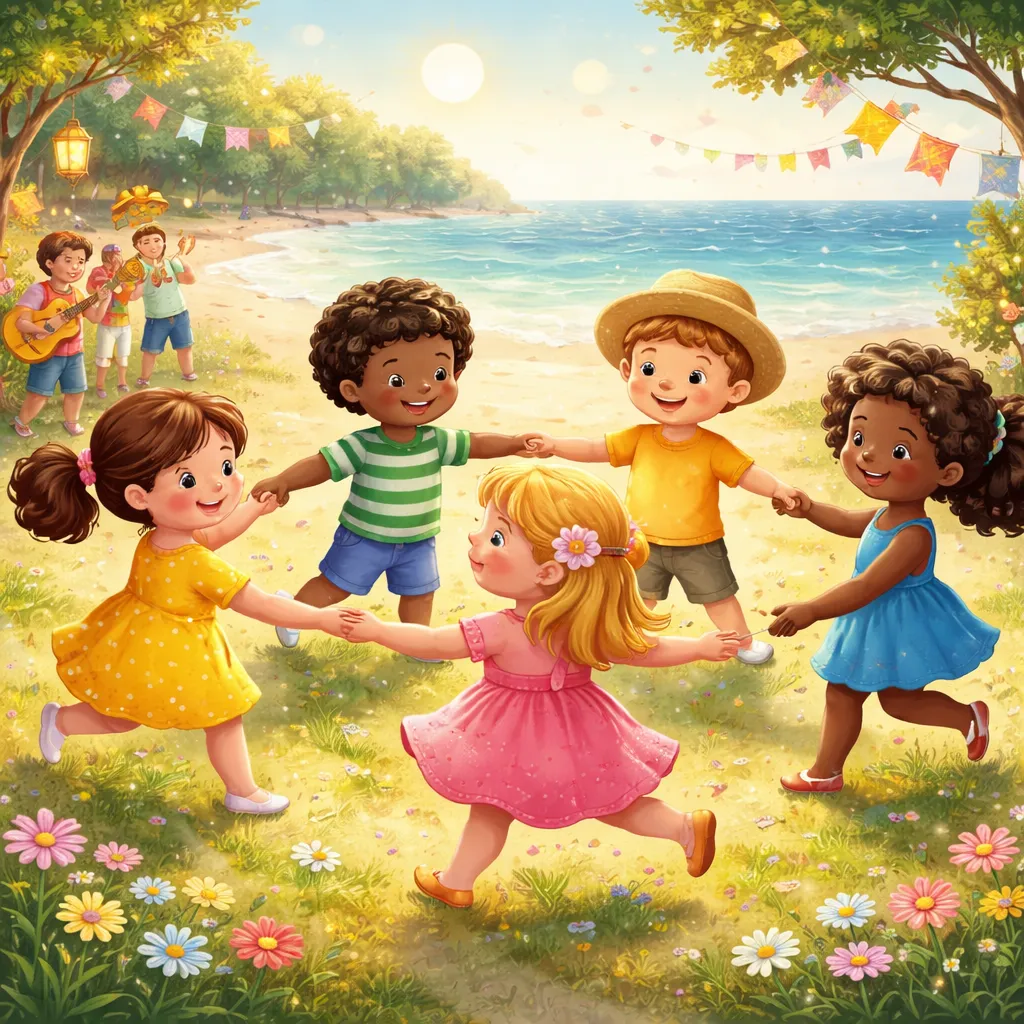

Have you ever held hands with friends and danced in a big circle? Have you played a game where everyone moves together, singing and laughing? In Brazil, there is a very famous and joyful song for exactly that. It is a song about joining hands, moving together, and the magic of a shared circle. Let’s all join hands and learn the classic, unifying song and game “Ciranda, Cirandinha.”
About the Song
Here are the inviting, rhythmic lyrics of the beloved traditional Brazilian circle game song. This is the classic call to play:
Ciranda, cirandinha,
Vamos todos cirandar.
Vamos dar a meia-volta,
Volta e meia vamos dar.
O anel que tu me destes
Era vidro e se quebrou.
O amor que tu me tinhas
Era pouco e se acabou.
Por isso, Dona Chica,
Entre dentro desta roda.
Diga um verso bem bonito,
Diga adeus e vá-se embora.
English Translation:
Ciranda, little ciranda,
Let’s all cirandar.
Let’s give a half-turn,
Turn and half we will give.
The ring that you gave me
Was glass and it broke.
The love that you had for me
Was little and it ended.
So therefore, Lady Chica,
Come inside this circle.
Say a very pretty verse,
Say goodbye and go away.
This is a foundational Portuguese-language children’s circle game song from Brazil, known and sung by generations. The word “Ciranda” refers to the traditional circle dance itself, and “Cirandinha” is the affectionate, smaller version, like saying “little ciranda.” The song is an invitation. The singer calls everyone to join the “cirandar,” which means to do the ciranda dance. The song gives a simple instruction: “Vamos dar a meia-volta” (Let’s give a half-turn), setting the circle in motion. The following verses tell a tiny, poetic story about a broken glass ring and faded love, ending with an invitation for “Dona Chica” to enter the circle, say a verse, and then leave. This structure turns the song into a game where one person is in the center.
What the Song is About
The song is the heartbeat of a communal game. Imagine standing in a big circle with friends, all holding hands. The song begins, “Ciranda, little ciranda, let’s all cirandar.” This is the call to start. Everyone begins to walk or skip sideways in the circle, holding hands. The leader sings, “Let’s give a half-turn, turn and half we will give.” The circle might change direction or the dancers might turn under their own raised arms.
Then, the song tells a little story: “The ring that you gave me was glass and it broke. The love that you had for me was little and it ended.” This part adds a playful, dramatic feeling. Finally, the song invites someone into the center: “So therefore, Lady Chica, come inside this circle. Say a very pretty verse, say goodbye and go away.” In the game, one child (Dona Chica) goes to the center, does a little dance or says a rhyme, and then leaves or chooses the next person. The song is not just about singing; it is about moving together, taking turns, and being part of a shared, rhythmic community.
Who Made It & Its Story
“Ciranda, Cirandinha” is a traditional Brazilian folk song and game with roots deep in Portuguese and possibly older European circle dance traditions, which were adapted and embraced across Brazil. It has no single author, belonging to the collective culture of Brazilian childhood. The “Ciranda” is more than a song; it is a social activity, often seen in schoolyards, parks, and community gatherings. It reflects a core Brazilian cultural value of “coletividade” (collectivity)—the joy found in being part of a group. The simple, repetitive structure makes it easy for everyone to join, ensuring no one is left out. The “Dona Chica” verse adds a playful, theatrical element, allowing for individual expression within the group.
This iconic song is loved for three powerful reasons. First, it is the perfect engine for a inclusive, non-competitive group game that requires cooperation, rhythm, and listening. Second, its simple, repetitive, and chant-like melody is instantly memorable, making it easy for even the youngest children to sing and follow. Third, it beautifully blends music, movement, and social play, teaching turn-taking (“Dona Chica” in the center) and group coordination (moving the circle together) in a joyful, natural way.
When to Sing It
This song is perfect for any group gathering. You can sing and play it during a birthday party in the backyard, forming a big circle with all your friends. You can chant it in the park with your family, holding hands and skipping in a ring. You can also use it in a classroom or playgroup to build teamwork and burn energy, taking turns being “Dona Chica” in the center.
What Children Can Learn
This active, social song is a wonderful teacher about community, movement, and Portuguese language.
Vocabulary
The song teaches us words for games, actions, and storytelling in Portuguese. “Ciranda” is the circle dance game itself. The “-inha” in “Cirandinha” makes it sound small and cute. “Let’s all” (Vamos todos) is an invitation for the whole group. “Let’s give” (Vamos dar) suggests a shared action. “A half-turn” (a meia-volta) is a half circle turn. “The ring” (O anel) is like a jewelry ring. “You gave me” (que tu me destes). “Was glass” (Era vidro). “And it broke” (e se quebrou). “The love” (O amor). “You had for me” (que tu me tinhas). “Was little” (Era pouco). “And it ended” (e se acabou). “Therefore” (Por isso). “Lady” (Dona) is a polite title. “Come inside” (Entre dentro). “This circle” (desta roda). “Say a verse” (Diga um verso). “Go away” (vá-se embora).
Let’s use these words! You can say, “Vamos todos brincar!” (Let’s all play!). Or, “O copo era vidro e se quebrou.” (The cup was glass and it broke.) New word: Cooperation. This means working together to do something, just like everyone in the “ciranda” must hold hands and move together.
Language Skills
This song is a fantastic lesson in using verbs to give friendly commands or invitations, especially the “Vamos + [verb]” form, and in using connecting words like “e” (and) and “que” (that/which).
Concept Definition: An invitation or suggestion is a way to ask a group to do something together. In Portuguese, we often use “Vamos” (Let’s) plus another verb. A connector is a small word that links ideas together. “E” (and) adds more information. “Que” (that/which) connects a thing to a description.
Features and Types: Look at the invitations and connectors in the song. The main invitations are: “Vamos todos cirandar” (Let’s all do the ciranda) and “Vamos dar a meia-volta” (Let’s give a half-turn). “Vamos” is the key word for “let’s.” The song uses “e” (and) to link events: “Era vidro e se quebrou” (Was glass and it broke). It uses “que” to connect descriptions: “O anel que tu me destes” (The ring that you gave me); “O amor que tu me tinhas” (The love that you had for me).
How to Spot Them: Here is a simple “group action detective” trick. Listen for the word “Vamos” at the start of a sentence. It almost always means the singer is inviting everyone to do something together. To find connectors, look for small words linking two ideas. “E” (and) adds something. “Que” (that) usually follows a person or thing and introduces more information about them.
How to Use Them: A great way to start a group activity is the “let’s do it together recipe”. The pattern is: “Vamos + [Action Verb].”
Example from the song: “Vamos todos cirandar.” (Let’s all do the ciranda.)
Example you can make: “Vamos cantar.” (Let’s sing.) or “Vamos pular.” (Let’s jump.)
Sounds & Rhythm Fun
Listen to the steady, marching rhythm of the melody. The song has a strong, clear, and walking-pace beat that is perfect for moving in a circle. The repetition of the “Ciranda, cirandinha” chant acts like a musical anchor, easy for everyone to remember and shout out together. The melody for the story verses (“O anel que tu me destes…”) is slightly different, telling its own little tale, before returning to the instructional or concluding part. The rhythm is not too fast, allowing even little legs to keep up as the circle moves. The words “volta” and “dar” rhyme, and “quebrou” and “acabou” rhyme, giving the song a poetic, memorable quality.
This strong, regular rhythm is what makes the group movement possible—everyone can step in time with the beat. The repetitive, call-and-response nature (one person might lead the “Ciranda” call, everyone responds) makes it easy to learn and builds a sense of unity. This musical pattern is perfect for creating new circle game chants. You can write your own “Vamos todos” song! Use the same tune. Try: “Amigos, amiguinhos, vamos todos brincar. Vamos dar um pulo alto, alto vamos pular…” (Friends, little friends, let’s all play. Let’s give a high jump, high we will jump…)
Culture & Big Ideas
“Ciranda, Cirandinha” is a cornerstone of Brazilian children’s culture and represents the “brincadeira de roda” (circle play or ring game) tradition. These circle games are a fundamental social activity in Brazilian schools, neighborhoods, and festivals. They require no equipment, just a group of people willing to hold hands and cooperate. The “Ciranda” teaches social rules, rhythm, and shared joy from a very young age. It is commonly seen during celebrations like “Festas Juninas” (June Festivals) and in everyday play, embodying the community spirit so important in Brazilian life.
The song conveys three foundational ideas. First, it is all about cooperation and collective action—the game only works if everyone holds hands, moves together, and follows the same rhythm. Second, it teaches social inclusion and turn-taking through the “Dona Chica” segment, where an individual gets a moment in the spotlight before rejoining (or leaving) the group. Third, it connects music, physical movement, and social storytelling into one seamless activity, showing how these elements can combine to create joy and strengthen group bonds.
Values & Imagination
Imagine you are part of the “Ciranda.” You are holding the warm hand of a friend on your left and your sister’s hand on your right. The circle is big, and everyone is smiling. You start to move sideways, your feet stepping in time to the song: “Ciranda, cirandinha…” The circle sways like a big, happy wheel. You feel the pull and push of the group moving as one. Then, the song changes, and your friend Maria is chosen as “Dona Chica.” She lets go and jumps into the center. Everyone claps and sings for her as she does a silly dance. She takes a bow, says “Adeus!” (Goodbye!), and runs back to her spot in the circle. The wheel of movement and song continues. How does it feel to be part of the circle? How does it feel to be in the center? Draw the ciranda. Draw a big circle of stick-figure people holding hands. Color their clothes brightly. Draw one person in the center, maybe with music notes around them. This shows the song’s structure of group and individual.
The song encourages teamwork, friendship, and the joy of shared play. It shows that games are more fun when everyone participates and follows the same rhythm. A wonderful activity is to create your own family or friend “ciranda.” Hold hands in a circle. Walk sideways, singing “Ciranda, cirandinha, vamos todos cirandar.” On “Vamos dar a meia-volta,” everyone turns to face the other way and keeps walking. Take turns having someone be “Dona Chica” in the middle to do a funny move. This turns the song into real, active play.
So, from the first call to “cirandar” to the farewell to Dona Chica, this song weaves a circle of friendship, rhythm, and play. It is a vocabulary lesson in games, actions, and group words. It is a language lesson in giving invitations with “Vamos” and connecting ideas. It is a music lesson in a strong, unifying beat. “Ciranda, Cirandinha” teaches us that together we are stronger, that sharing the spotlight is fun, and that the simplest games—holding hands and moving as one—can create the biggest joy.
Your Core Takeaways
You are now an expert on the song “Ciranda, Cirandinha.” You know it is a traditional Brazilian circle game song that invites everyone to hold hands, move together, and take turns in the center. You’ve learned Portuguese words like “ciranda,” “vamos,” “dar,” “volta,” and “Dona Chica,” and you’ve practiced using “Vamos” to make invitations and “e” (and) to connect ideas. You’ve felt its strong, marching rhythm and created your own circle game chant. You’ve also discovered the song’s message about cooperation, inclusive play, and the joy of combining music, movement, and community.
Your Practice Missions
First, form a “Cooperation Circle.” Gather at least three people—family or friends. Stand in a circle and hold hands. Practice moving together: take four steps to the right, then four steps to the left. Once you can move as one group, add the song! Sing “Ciranda, cirandinha, vamos todos cirandar” as you step. This mission helps you experience the core cooperative action of the song.
Second, host a “Dona Chica Spotlight.” Play the circle game. When you sing the verse for “Dona Chica,” choose one person to go to the center. But instead of the old verse, the person in the center must say a new, nice line in Portuguese. It could be “Vamos pular!” (Let’s jump!) or “Obrigado, amigos!” (Thank you, friends!). Then everyone does that action or repeats the line. This mission practices the “turn-taking” part and lets you use new Portuguese phrases.