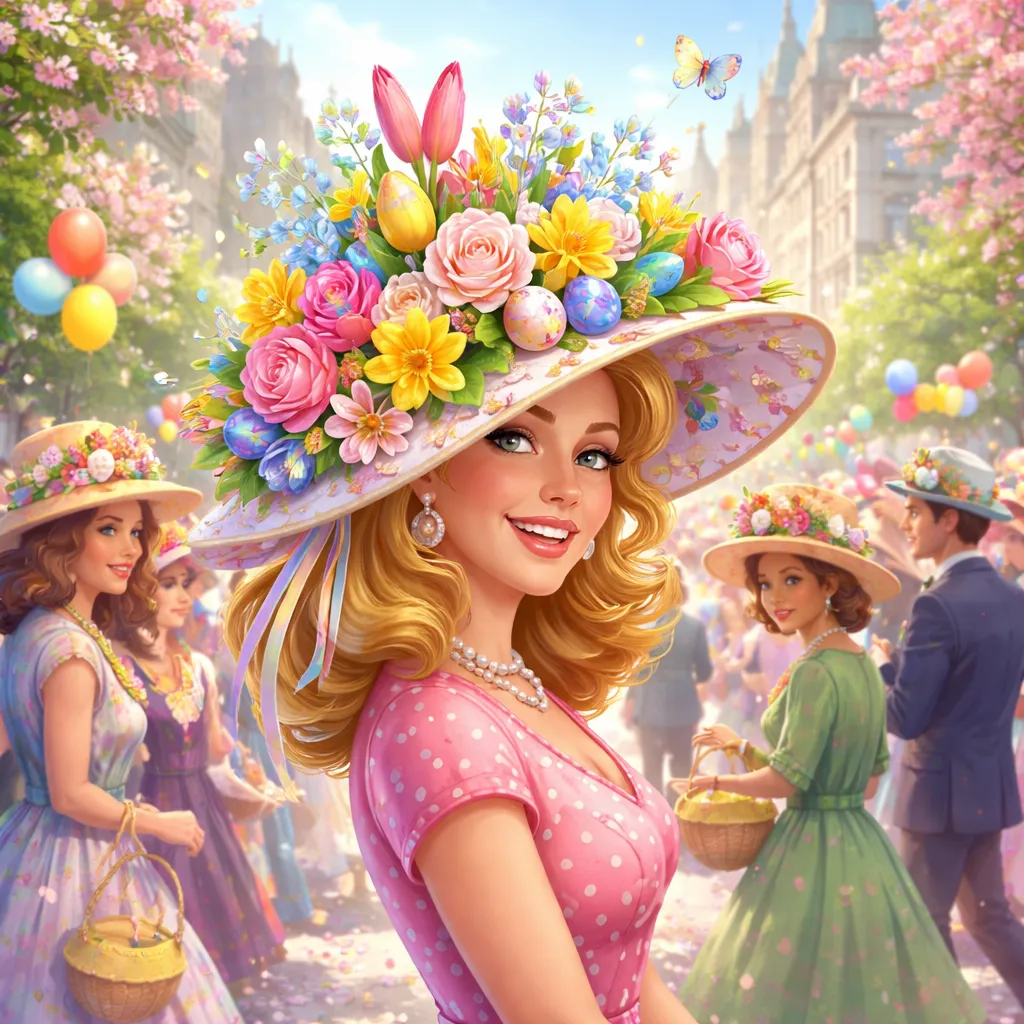

Imagine a sunny spring day. The air is fresh, flowers are blooming, and everyone is wearing their newest, most colorful clothes. They are walking down a wide city street, smiling and laughing. This happy tradition is the subject of a famous, joyful song. Let’s discover the elegant and cheerful tune “Easter Parade.”
About the Song
Here are the lovely, classic lyrics of this popular song.
In your Easter bonnet, with all the frills upon it,
You’ll be the grandest lady in the Easter parade.
I’ll be all in clover and when they look you over,
I’ll be the proudest fellow in the Easter parade.
On the avenue, Fifth Avenue, the photographers will snap us,
And you’ll find that you’re in the rotogravure.
Oh, I could write a sonnet about your Easter bonnet,
And of the girl I’m taking to the Easter parade.
This song is a classic American popular song. It is a romantic and joyful waltz that pictures a couple enjoying the traditional Easter parade. The song was written by the famous composer Irving Berlin for the 1933 Broadway musical As Thousands Cheer. It became even more popular when it was used as the title song for the 1948 movie Easter Parade, starring Judy Garland and Fred Astaire. The song captures the excitement and pride of getting dressed up in new spring clothes, especially a fancy hat, and joining the crowd on Fifth Avenue in New York City for the Easter Sunday stroll.
What the Song is About
The song paints a bright, sunny, and proud picture. A man is speaking to the woman he is with. He admires her beautiful Easter bonnet, a special hat decorated with lots of frills. He tells her that with that hat, she will be the most grand, impressive, and beautiful lady in the whole Easter parade.
The man is so happy that he feels “all in clover,” which means he feels very lucky and content. He knows that when other people look at her, he will feel like the proudest man in the parade. He then imagines the scene on Fifth Avenue, the famous street in New York. He says photographers will take their picture. He jokes that her picture will end up in the “rotogravure,” which is an old-fashioned name for the photo section of a newspaper. He is so impressed by her hat that he says he could write a “sonnet,” a special type of love poem, about it. The whole song is about the happiness of sharing a special day and feeling proud of your companion.
Who Made It & Its Story
The song “Easter Parade” was written by the legendary American songwriter Irving Berlin. He wrote hundreds of famous songs, including “White Christmas.” He wrote this song for a Broadway musical in 1933. The song was inspired by the real-life tradition of the Easter parade on Fifth Avenue in New York City. In the late 1800s and early 1900s, after attending Easter church services, people would walk along Fifth Avenue to show off their new spring outfits and hats. It was a major social event. The song perfectly captured the spirit of that tradition. Its popularity soared with the 1948 film named after it, making it a timeless standard for the Easter holiday.
This song has remained a favorite for three elegant reasons. First, its melody is a beautiful, flowing waltz that feels both graceful and happy, perfect for a spring stroll. Second, its lyrics are charming and specific, painting a vivid picture of fashion, pride, and romance that feels both nostalgic and universal. Third, it connects to a real and fascinating historical tradition, giving us a musical window into a past social custom that celebrated new beginnings and community joy.
When to Sing It
This song is perfect for festive, springtime moments. You can sing it softly while getting dressed up for an Easter or spring family gathering, pretending you are preparing for your own parade. You can sing it on a pleasant walk through a park or your neighborhood, imagining the trees and flowers are your audience. You can also hum it while doing a quiet craft, like drawing or coloring pictures of fancy hats and parades.
What Children Can Learn
This graceful, joyful song is a treasure chest of wonderful lessons. Let’s open it up and explore.
Vocabulary
The song teaches us some wonderful, descriptive words. An “Easter bonnet” is a fancy hat traditionally worn by women and girls at Easter. “Frills” are strips of cloth with many folds, used as decoration. “Grandest” means the most impressive and splendid. A “parade” is a public procession, often for celebration. “Clover” is a small plant with three leaves; to be “in clover” means to be living a carefree life of ease and happiness. An “avenue” is a wide city street, often with trees. “Photographers” are people who take photographs. The “rotogravure” was a special section of a newspaper that used high-quality photo printing. A “sonnet” is a 14-line poem with a fixed rhyme scheme.
Let’s use these words! You can say, “My dress has pretty frills on the sleeves.” Or, “We walked down the main avenue of town.” New word: Tradition. A tradition is a custom or belief passed down over time. The Easter parade is a lovely spring tradition.
Language Skills
This song is a beautiful example of using the future tense to make predictions and promises. The future tense is used to talk about things that have not happened yet. We form it with “will” or its contraction “’ll.”
Look at the promises and predictions in the song: “You’ll be the grandest lady…” “I’ll be all in clover…” “I’ll be the proudest fellow…” “the photographers will snap us…” “you’ll find that you’re…” Using the future tense this way creates excitement and anticipation. It tells us what the singer believes is going to happen. The song also uses the modal verb “could” to express possibility: “I could write a sonnet.” This means it is possible for him to do it, showing how impressed he is.
Sounds & Rhythm Fun
Listen to the flowing, waltzing rhythm of the song. A waltz has a pattern of three beats: ONE-two-three, ONE-two-three. The lyrics have a gentle, perfect rhyme scheme: “upon it” and “bonnet,” “parade” and “parade” (repeated), “snap us” and “rotogravure” (a near-rhyme), and “sonnet” and “bonnet.”
The rhythm is the classic 3/4 time of a waltz. It feels like swaying or dancing slowly. Try swaying side to side: IN your EASTer BONnet, WITH all the FRILLS uPON it. The melody rises and falls gracefully, like a gentle wave. This smooth, dancing rhythm makes the song feel elegant and easy to remember because of its strong, repetitive waltz pattern. You can write your own parade song! Use the same waltzing rhythm. Try: “In your soccer jersey, the one that’s bright and new, you’ll be the fastest player on the field in view. I’ll be cheering loudly from the stands above, so full of hope and so much love!”
Culture & Big Ideas
“Easter Parade” is a direct link to a specific American cultural tradition from New York City in the late 19th and early 20th centuries. The Easter parade on Fifth Avenue was a non-organized event where people from all walks of life would stroll, see, and be seen. It celebrated the end of winter, the arrival of spring, and the themes of renewal and new life associated with Easter. The song reflects the joy of community, fashion, and public celebration.
The song shares three beautiful ideas. First, it’s about pride and admiration. The singer feels immense pride in his companion and admires her appearance, showing that it feels good to appreciate and be appreciated by others. Second, it celebrates shared joy and companionship. The happiness comes from experiencing the parade together, not alone. Third, it connects to the cycle of seasons and renewal. The parade is a spring ritual, marking a fresh start with new clothes, echoing nature’s own renewal.
Values & Imagination
Imagine you are walking down Fifth Avenue on that sunny Easter morning long ago. What do you see? Ladies in long dresses with enormous, beautiful hats? Men in sharp suits? Children in their best clothes? Can you hear the clip-clop of horse hooves? The chatter of the crowd? The occasional click of a camera? What does your own Easter bonnet look like? Is it covered in flowers, ribbons, or even toy birds? Imagine the feeling of the soft spring breeze and the warm sun. Draw a picture of the parade from above, showing a river of colorful hats and happy people filling the wide avenue.
The song inspires us to find joy in simple traditions and to take pride in presenting ourselves well. A lovely idea is to have a “Family Spring Stroll.” On a nice day, have everyone in your family put on something they feel good in—a favorite hat, a bright scarf, a nice shirt. Take a walk around your block or to a local park. As you walk, hum “Easter Parade.” You are creating your own small, modern parade, celebrating spring, family, and the joy of being outside together.
So, as we come to the end of our stroll with this song, think about the elegance it carries. It is a vocabulary lesson in fashion and poetry. It is a grammar lesson in future promises. It is a music lesson in waltz rhythm. From the first description of the frilly bonnet to the final line about the parade, it wraps a sense of occasion, pride, and shared happiness in a graceful, three-beat melody. “Easter Parade” teaches us that traditions connect us to the past, that there is beauty in dressing up and stepping out, and that the simplest joys are often those we share with someone else, arm in arm, on a sunny spring avenue.
Your Core Takeaways
You are now an expert on the song “Easter Parade.” You know it was written by Irving Berlin in 1933 and celebrates the tradition of the Fifth Avenue Easter parade. You’ve learned words like “bonnet,” “frills,” “rotogravure,” and “sonnet,” and you’ve practiced using the future tense (“will” and “’ll”) to talk about what is to come. You’ve felt its graceful waltz rhythm and created your own version. You’ve also discovered the song’s connection to a historical spring tradition and its messages about admiration, shared joy, and seasonal renewal.
Your Practice Missions
First, design your “Easter Bonnet of the Future.” The song is all about a special hat. Using paper plates, construction paper, ribbons, stickers, or any craft materials, create your own fantastical bonnet or hat. It doesn’t have to be for Easter—it can be for any celebration! Describe your hat using at least three words from the song, like: “My bonnet has frills, it is grand, and I feel in clover when I wear it!”
Second, host a “Mini Spring Parade.” Gather your family, friends, or stuffed animals. Put on some nice clothes or fun accessories. Play the song “Easter Parade” or sing it. Then, lead your parade around your living room or backyard. Walk with pride, just like in the song. If you can, take a “rotogravure” photo of your parade with a camera or phone. This brings the song’s scene to life in your own home.