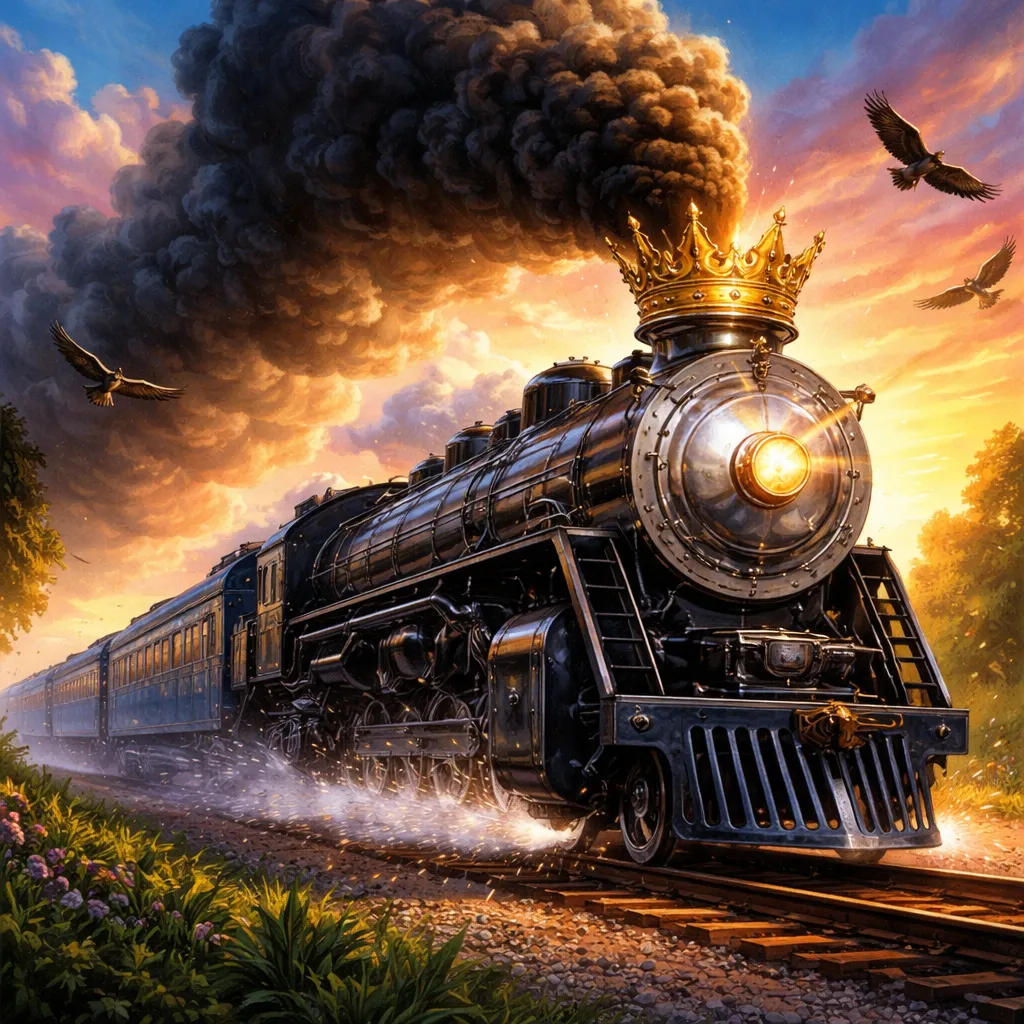

Have you ever heard a story that was so amazing, so grand, that it couldn’t possibly be true? A story about something so fantastic that it becomes a legend. In America, there is a famous song about a train that is exactly that—a magnificent, fictional train that is bigger, faster, and more wonderful than any real one. Let’s climb aboard the legend of the “Wabash Cannonball.”
About the Song
Let’s read the grand, boasting words of this famous tall tale in song.
From the great Atlantic Ocean to the wide Pacific shore,
From the queen of flowing mountains to the south belt by the shore,
She’s mighty tall and handsome, and known quite well by all,
She’s the regular combination, the Wabash Cannonball.
Listen to the jingle, the rumble and the roar,
As she glides along the woodlands, through hills and by the shore.
Hear the mighty rush of the engine, hear those lonesome hoboes squall,
While traveling through the jungle on the Wabash Cannonball.
Now here’s to Daddy Claxton, may his name forever stand,
And always be remembered in the courts of Alabam’.
His earthly race is over, and the curtains round him fall,
We’ll carry him home to victory on the Wabash Cannonball.
This song is a classic American folk ballad and tall tale. It is a lively, rhythmic song that celebrates a fictional, super-powered train called the Wabash Cannonball. The song describes the train traveling across the entire United States, from the Atlantic to the Pacific Ocean. It is personified as “mighty tall and handsome,” the “regular combination” (meaning the best of everything). The song was popularized in the early 20th century, with the most famous version attributed to William Kindt and later recorded by country and folk stars like Roy Acuff and the Carter Family. The real Wabash Railroad operated a train called the Cannon Ball, but the song’s train is a glorious, exaggerated myth that represents the power, romance, and national unity brought by the railroads.
What the Song is About
The song paints the most magnificent picture of a train you can imagine. The singer announces the train’s incredible route, stretching from one side of America to the other. The train isn’t just a machine; it’s described like a royal person: “mighty tall and handsome,” known and loved by everyone.
The singer asks us to listen to the train’s exciting sounds: the jingle, rumble, and roar as it passes through all kinds of landscapes. We even hear the “lonesome hoboes” (travelers) calling out. The final verse is a tribute to a man named Daddy Claxton, suggesting the train will carry his spirit home in a glorious way. The song isn’t about a real trip with a beginning and end. It’s a rolling celebration of the train itself—its sound, its size, its speed, and its place in the heart of the nation. It’s a song that makes you feel the power and excitement of travel and machinery.
Who Made It & Its Story
The origins of “The Wabash Cannonball” are murky, as with many folk songs. It is believed to have evolved from earlier train ballads in the late 19th century. The version we know today was heavily shaped by William Kindt in the 1900s and then made massively famous by Roy Acuff in the 1930s and 1940s. The song is a prime example of a “train wreck ballad” that turned into a celebration. Early versions told of a disaster, but as the song spread, singers turned it into a positive, boastful tall tale. The song became an anthem for the Wabash Railroad and a symbol of American railroading. Its catchy tune and grandiose imagery made it a standard for country, folk, and bluegrass musicians, ensuring its place as one of the most famous American train songs.
This song became a giant hit for three fantastic reasons. First, its melody is incredibly catchy, upbeat, and perfectly mimics the rhythm of a speeding train, making it impossible not to tap your feet. Second, it is a masterpiece of exaggeration and personification, turning a train into a superhero, which is very fun for the imagination. Third, it captures the American spirit of size, mobility, and optimism from the age of railroad expansion, making people feel proud and connected to a vast country.
When to Sing It
This song is perfect for high-energy, imaginative moments. You can sing it at the top of your lungs on a family road trip, pretending your car is the mighty Cannonball. You can chant it while building a train track with toys, making the “jingle, rumble, and roar” sounds. You can also march around the room to its beat, pretending to be the train speeding from one coast to the other.
What Children Can Learn
This larger-than-life song is a funhouse of learning. Let’s board and see what discoveries we make.
Vocabulary
The song teaches us grand, descriptive, and geographical words. The “Atlantic Ocean” is the ocean on the east coast of America. The “Pacific shore” is the west coast. “Mighty” means very strong and powerful. “Handsome” here means impressively good-looking. A “combination” is a mix of different good things. A “jingle” is a light, ringing sound. A “rumble” is a deep, rolling sound. A “roar” is a loud, deep noise. “Hoboes” are old-fashioned words for traveling workers or homeless people. A “jungle” here means a wild, overgrown area.
Let’s use these words! You can say, “The mighty waterfall roared in the distance.” Or, “The car made a rumble as it drove over the bridge.” New word: Personification. This is when you give human qualities to something that isn’t human. The song uses personification to make the train seem like a tall, handsome king or queen.
Language Skills
This song is a great lesson in using the present simple tense to state grand facts and imperative verbs to invite the listener. The song states facts about the train in the present: “She is mighty tall… She is the regular combination.” This makes the legend feel timeless and always true.
The song uses the imperative to draw us in: “Listen to the jingle… Hear the mighty rush of the engine!” This pulls the listener into the scene. The song also uses geographical prepositions to map the journey: “From the Atlantic… to the Pacific shore… through the woodlands… by the shore.”
Sounds & Rhythm Fun
Listen to the driving, chugging, speeding rhythm of the melody. The song is in a fast 4/4 time that perfectly captures a train picking up speed. The lyrics are full of wonderful onomatopoeia (sound words): “jingle, rumble, and roar.” These words sound like what they describe! The song has a strong, rolling rhyme scheme: “shore” and “roar,” “all” and “Cannonball,” “squall” and “Cannonball.”
The rhythm is energetic and relentless. Try slapping your knees like train wheels: From the GREAT At-LAN-tic O-cean TO the WIDE Pa-CIF-ic SHORE. The melody is based on a simple, repeating pattern that is easy to learn and sing with gusto. This fast, repetitive, and noisy musical pattern is what makes the song so exciting and fun. You can write your own tall tale about a vehicle! Use the same speeding rhythm. Try: “From the northern frozen tundra to the deserts down so dry, this super snowmobile goes roaring through the sky. It’s the fastest and the coolest, and it answers every call, it’s the fantastic, fabulous Arctic Snowball!”
Culture & Big Ideas
“The Wabash Cannonball” is a cornerstone of American folk and country music culture. It comes from the era when railroads tied the nation together, symbolizing progress, freedom, and the shrinking of a vast continent. The song is a “tall tale,” a form of storytelling where exaggeration is the point, celebrating the American love for bigness and achievement. The song connects to the shared experience of train travel, which was once the primary way people crossed the country. It is a musical monument to a technology that transformed a nation’s identity.
The song conveys three big ideas. First, it’s about the power of technology and human achievement. The train is a man-made object celebrated like a natural wonder, showing pride in what people can build. Second, it expresses national unity and identity. The train connects the two coasts, making a huge country feel like one connected community. Third, it’s a celebration of movement, sound, and sheer excitement. The song isn’t about a quiet, gentle journey; it’s about the thrilling noise, speed, and power of motion, which is a feeling everyone loves.
Values & Imagination
Imagine the Wabash Cannonball. How long is it? A mile? What color is it? Shiny silver? Does it have a special whistle? Now, imagine the sounds. Can you hear the “jingle” of the bells? The deep “rumble” of the wheels? The “roar” of the steam? What do you see from the window? Mountains? Cities? Draw a picture of the Wabash Cannonball. Don’t draw a normal train. Exaggerate! Make it enormous, with extra wheels, a shining chrome nose, and smoke that forms shapes in the sky. Show it crossing a map of the entire United States in one picture.
The song inspires a sense of wonder, national pride, and the joy of loud, fast movement. A lovely idea is to have a “Tall Tale Show and Tell.” With your family, everyone chooses an ordinary object (a toaster, a bicycle) and invents a tall tale about it, just like the song does for the train. Describe its amazing powers and where it can go. This celebrates creative exaggeration.
So, as the last roar of the Cannonball fades in the distance, think about the power of this tall tale in song. It is a vocabulary lesson in grandeur and sound. It is a grammar lesson in stating legendary facts and using exciting commands. It is a music lesson in a driving, chugging rhythm. From the first coast-to-coast claim to the final tribute, it wraps lessons in technological pride, national unity, and pure excitement in a tune that makes you want to move. “The Wabash Cannonball” teaches us that stories can be bigger than life, that things we build can become legends, and that the journey can be just as glorious as the destination.
Your Core Takeaways
You are now an expert on the song “The Wabash Cannonball.” You know it is an American folk tall tale that celebrates a fictional, super-powered train crossing the country. You’ve learned words like “mighty,” “rumble,” and “combination,” and you’ve practiced the present simple for legends and imperative verbs. You’ve felt its fast, chugging rhythm and created your own tall tale verse. You’ve also discovered the song as a symbol of railroad-era America and its messages about human achievement, national unity, and the thrilling joy of movement.
Your Practice Missions
First, stage a “Cannonball Concert.” Gather noisemakers—pots for drums, shakers for the “jingle,” and your voice for the “roar.” Perform the song as a family band, making the sounds of the train as you sing. The louder and more energetic, the better! This immerses you in the song’s wonderful noise.
Second, map the “Cannonball’s Route.” With a grown-up’s help, look at a map of the United States. Draw the route you think the Wabash Cannonball would take from the Atlantic to the Pacific. What famous places would it pass? The Grand Canyon? The Great Lakes? Draw or list them along your route. This connects the song’s grand geography to real places.