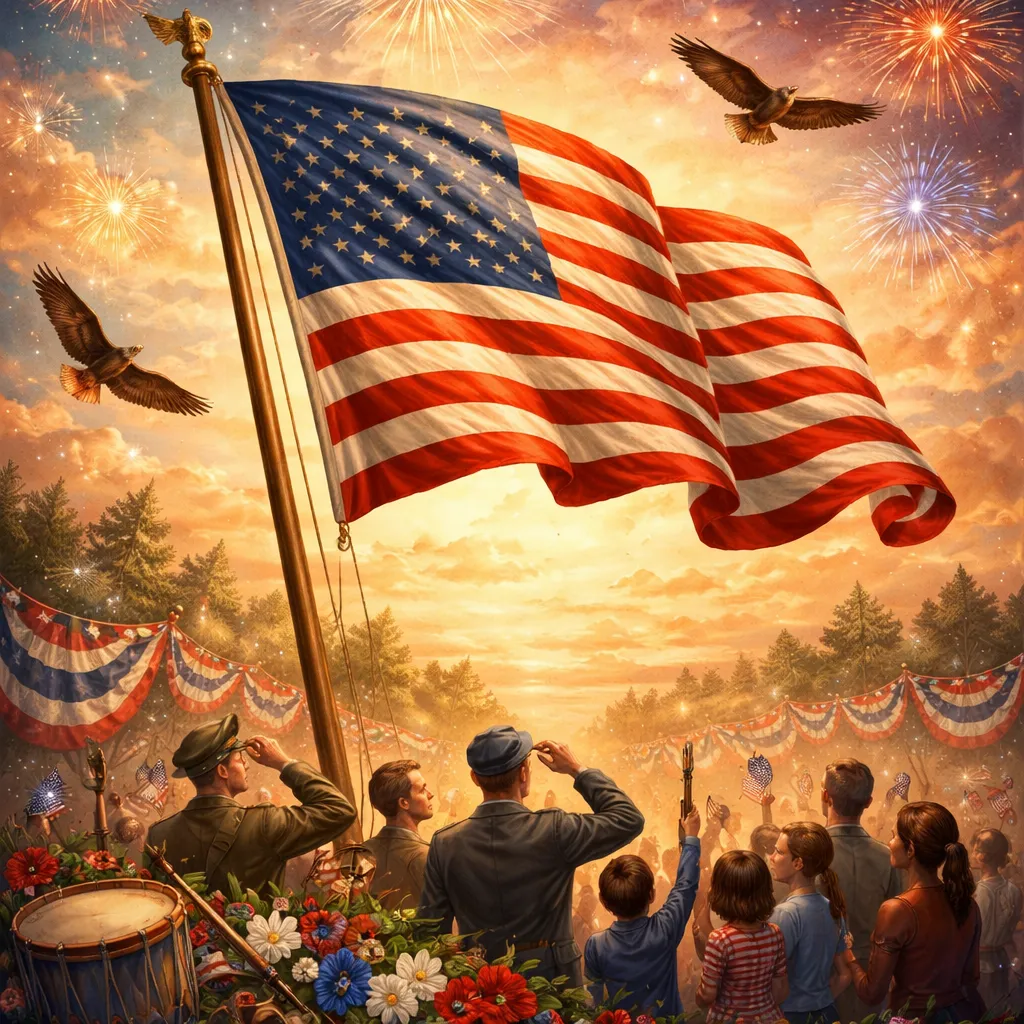

Have you ever seen a flag waving in the wind and felt a little burst of pride? Flags are more than just colored cloth; they are symbols that tell a story. In America, one flag has a very famous, bouncy song that praises it as both ancient and wonderful. Let’s learn about the marching tune “You’re a Grand Old Flag.”
About the Song
Let’s read the proud, cheerful words of this classic march.
You’re a grand old flag,
You’re a high-flying flag,
And forever in peace may you wave.
You’re the emblem of the land I love,
The home of the free and the brave.
Every heart beats true under red, white, and blue,
Where there’s never a boast or brag.
But should auld acquaintance be forgot,
Keep your eye on the grand old flag.
This song is a classic American patriotic march. It is a lively, energetic song that speaks directly to the American flag, praising it as a symbol of freedom, bravery, and national unity. The song was written by the famous American entertainer George M. Cohan for his 1906 Broadway musical George Washington, Jr. Cohan was inspired by a conversation with a Civil War veteran who fought for the Union and called the battle-worn flag a “grand old rag.” Cohan liked the phrase but changed “rag” to “flag” for the song. The tune became an instant hit and remains one of the most beloved patriotic songs in the United States.
What the Song is About
The song paints a picture of a flag flying proudly against a bright sky. The singer is talking to the flag as if it were a person. They call it “grand,” meaning magnificent and impressive, and “old,” recognizing its long history. They call it “high-flying,” meaning it waves up high for everyone to see.
The singer makes a wish: that this flag will wave forever in times of peace. They explain that the flag is an “emblem,” or a symbol, of the country they love—a country that is the “home of the free and the brave.” The song says that every American heart is loyal and true to the red, white, and blue colors of the flag. It says the country is not about bragging, but about quiet strength. The song even borrows a line from another old song (“should auld acquaintance be forgot”) to remind us to always remember and keep our eyes on this important symbol of our shared history and values.
Who Made It & Its Story
The creator of “You’re a Grand Old Flag” is the legendary American songwriter, actor, and producer George M. Cohan. Known as “the man who owned Broadway,” Cohan wrote the song for his 1906 stage musical. The story goes that he met a Civil War veteran who had fought in the Battle of Gettysburg. The veteran, showing Cohan a tattered American flag, referred to it fondly as a “grand old rag.” Cohan loved the sentiment and used it as the basis for the song, though he changed the word to “flag” to be more respectful. The song was the first from a musical to sell over a million copies of sheet music. It cemented Cohan’s reputation as a master of patriotic tunes.
This song became an American classic for three rousing reasons. First, its melody is an incredibly catchy, upbeat march that makes you want to stand up straight and walk with pride. Second, its lyrics are simple, direct, and overflowing with positive, unifying feelings about the country. Third, it arrived at a time when America was becoming a world power, and it gave people a joyful, easy-to-sing anthem that made them feel connected to their nation and to each other.
When to Sing It
This song is perfect for patriotic celebrations. You can sing it loudly at a Fourth of July parade, marching in time with the music. You can sing it at a school assembly for Flag Day or Veterans Day, showing respect for the flag. You can also sing it during a family gathering on a national holiday, while you look at your own flag waving outside.
What Children Can Learn
This proud, marching song is full of interesting lessons. Let’s salute and discover them all.
Vocabulary
The song teaches us strong, descriptive words about symbols and feelings. “Grand” means large, impressive, and magnificent. “Old” means having existed for a long time. A “flag” is a piece of cloth with a special design, used as a symbol of a country or group. “High-flying” means flying or waving at a great height. An “emblem” is a symbol that represents an idea or a group. The “free” are people who are not controlled by others. The “brave” are people who show courage. A “boast” is a statement talking too proudly about yourself. A “brag” is similar to a boast.
Let’s use these words! You can say, “We saw a grand fireworks display.” Or, “The eagle is an emblem of strength.” New word: Patriotic. This means having or expressing love and support for one’s country. The song is a patriotic anthem.
Language Skills
This song is a wonderful lesson in using the contraction “you’re” and the modal verb “may” for wishes. The contraction “you’re” is short for “you are.” The entire song uses this to speak directly to the flag: “You’re a grand old flag.” This is called apostrophe in poetry—talking to something that isn’t a person.
The song also uses the modal verb “may” to express a hopeful wish: “may you wave.” This is a formal way to say, “I hope you wave.” We use “may” for blessings and good wishes, like “May you be happy.” The song also uses the simple present tense (“Every heart beats true”) to state a general, always-true fact about the people’s love for their country.
Sounds & Rhythm Fun
Listen to the strong, marching, two-beat rhythm of the song. It has a “left, right, left, right” feel. The lyrics use clear, bold rhymes: “flag” and “brag,” “wave” and “brave,” “love” and “above” (in other verses). The line “Every heart beats true under red, white, and blue” has a wonderful internal rhythm.
The rhythm is a steady, marching 2/4 time. It’s perfect for strutting. Try marching in place: You’RE a GRAND old FLAG, you’RE a HIGH-fly-ing FLAG. The melody is simple, repetitive, and easy to belt out, with a few jumps that make it exciting. This strong, uncomplicated rhythm is what makes the song so easy to remember and so powerful when sung by a crowd. You can write your own symbol song! Use the same marching rhythm. Try: “You’re a great school mascot, you’re a roaring lion, and forever may you show our pride. You’re the symbol of our school we love, where we all learn and play side by side.”
Culture & Big Ideas
“You’re a Grand Old Flag” is a product of early 20th-century American optimism and nationalism. It comes from the era of Broadway and vaudeville, when popular songs helped shape national identity. The song reflects the American values of liberty, courage, and unity. It also subtly acknowledges the nation’s past struggles (the “old” flag, the Civil War reference) while looking forward to a peaceful future (“forever in peace may you wave”).
The song communicates three key ideas. First, it’s about national pride and identity. The flag is a focal point for love of country and the values it represents. Second, it emphasizes humility and sincerity. The line “where there’s never a boast or brag” suggests that true patriotism is quiet and steadfast, not loud and arrogant. Third, it’s about continuity and memory. The flag connects the present to the past (“auld acquaintance”) and reminds us to remember our history and the people who fought for the ideals the flag represents.
Values & Imagination
Imagine you are the flag in the song. What have you seen in your long history? Battles? Peace treaties? Parades? Immigrants arriving hopeful? What does it feel like to snap in the wind? Can you hear the cheers? Imagine the people whose hearts “beat true” for you. Who are they? Soldiers, teachers, scientists, children? Draw a timeline for the “grand old flag.” At one end, draw the first American flag. In the middle, draw a scene from history, like the Civil War. At the other end, draw the flag today, waving over a modern city or a school. This shows the flag’s journey through time.
The song inspires respect for national symbols and the ideas they stand for. A simple idea is to have a “Symbols of Us” discussion with your family. The flag is an emblem. What is an emblem for your family? It could be a special recipe, a saying, a photo, or a tradition. Talk about what it symbolizes (like love, heritage, or fun). This helps you think about how symbols work in your own life, not just for countries.
So, as the last note of this grand old march fades, think about the unity it calls for. It is a vocabulary lesson in pride and symbolism. It is a grammar lesson in speaking to objects and making wishes. It is a music lesson in sturdy, patriotic rhythm. From the first direct address “You’re a grand old flag” to the final reminder to “keep your eye” on it, the song wraps feelings of loyalty, history, and hope in a tune that begs to be sung with a straight back and a smiling heart. “You’re a Grand Old Flag” teaches us that symbols carry meaning, that love of country can be joyful, and that some of the oldest ideas—like freedom and bravery—are always worth singing about.
Your Core Takeaways
You are now an expert on the song “You’re a Grand Old Flag.” You know it was written by George M. Cohan in 1906, inspired by a Civil War veteran. You’ve learned words like “grand,” “emblem,” and “brave,” and you’ve practiced using the contraction “you’re” and the wish “may you.” You’ve felt its strong, marching rhythm and created your own symbol song. You’ve also discovered the song’s role in American culture, its messages about sincere patriotism, humility, and the importance of remembering history.
Your Practice Missions
First, stage a “Grand Old Parade.” Gather your family or toys. Make simple flags from paper and sticks. Play the song and have your own parade around your home or yard. March in time, wave your flags high, and sing along. This active play connects you to the song’s marching spirit.
Second, interview a “Flag Expert.” Ask a parent, grandparent, or teacher about the American flag. What do the colors red, white, and blue mean to them? What does the flag symbolize in their life? Write down or draw their answers. Then, share one thing you learned with someone else. This helps you understand the personal meaning behind the symbol the song celebrates.