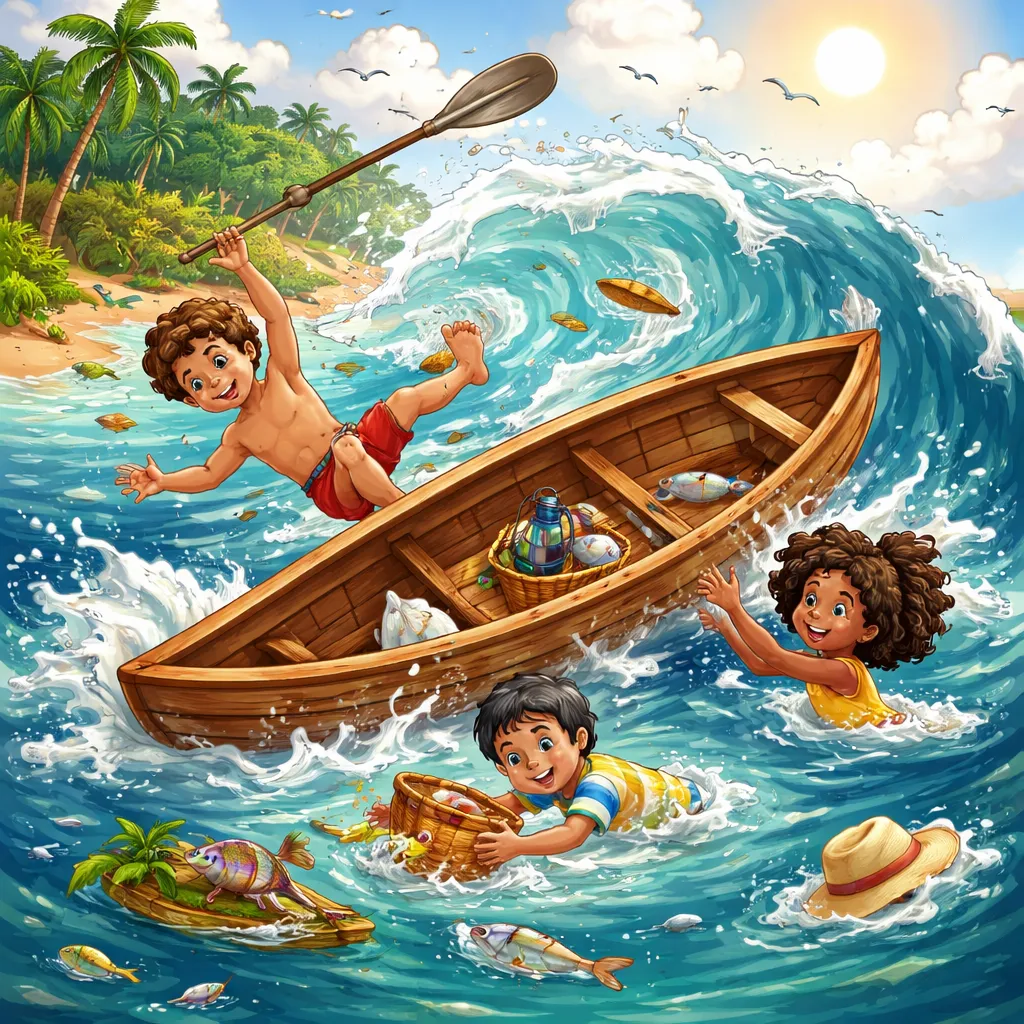

Have you ever been in a small boat or floated in a pool? What happens if it wobbles too much? In Brazil, there is a very famous, playful song about a little canoe that has a big problem. It is a song about a simple action, a funny consequence, and a surprising guest! Let’s see what happened and learn the catchy, storytelling song “The Little Canoe Turned Over (A Canoa Virou).”
About the Song
Here are the classic, fun lyrics of the traditional Brazilian children’s song. This is the most common and beloved version:
A canoa virou
Porque a Maria não soube remar
Se eu soubesse remar
A canoa não viraria.
Foi por isso, foi por isso
Foi por isso que a canoa virou.
Foi porque a Maria
Deixou o jacaré nadar.
English Translation:
The little canoe turned over
Because Maria didn’t know how to row.
If I knew how to row,
The canoe wouldn't have turned over.
That was why, that was why,
That was why the canoe turned over.
It was because Maria
Let the alligator swim.
This is a classic Portuguese-language children’s song and game from Brazil. The song tells a funny, slightly silly story with a surprise ending. The word “canoa” means a small, narrow boat, often moved with paddles. The song starts with a clear problem: the canoe turned over (“virou”). It gives a reason: because Maria didn’t know how to row. Then, it wonders what would have happened if someone else knew how. Finally, it reveals the real, funny reason: it was because Maria let an alligator (“jacaré”) swim! The song is often sung in a circle game where players pretend to row and then “fall” out of the boat. The melody is bouncy, repetitive, and perfect for singing and playing along.
What the Song is About
The song tells a quick, funny story with a twist. Imagine a peaceful scene: a little canoe is floating on a river. A person named Maria is in it, trying to row. The song starts with the big event: “The little canoe turned over!” The canoe flipped upside down, and maybe everyone fell into the water. Why? The song first says, “Because Maria didn’t know how to row.” You can picture Maria trying to use the paddles but splashing and going in circles.
Then, the singer imagines a different story: “If I knew how to row, the canoe wouldn’t have turned over.” The singer thinks they could have done a better job. But wait! The real reason comes next. The song repeats, “That was why, that was why, that was why the canoe turned over.” It builds suspense. Then comes the silly, surprising answer: “It was because Maria let the alligator swim.” So, maybe the canoe turned over not just because of bad rowing, but because a big alligator was swimming by and bumped into it or scared Maria! The song is about cause and effect, making excuses, and a funny, unexpected animal causing trouble.
Who Made It & Its Story
“A Canoa Virou” is a traditional Brazilian children’s folk song and circle game, deeply rooted in the country’s oral tradition and playful culture. Like many folk songs, its specific origin is unknown, passed down through generations of children playing and singing. Brazil has many rivers and a rich culture of stories about the “jacaré” (a type of alligator or caiman common in South America), making this song a fun mix of everyday life and playful imagination. The song is almost always sung as part of a physical game where children sit in a circle, rock back and forth pretending to row, and fall to the side when the canoe “turns over,” laughing all the while.
This energetic song is loved for three playful reasons. First, it tells a complete, mini-story with a clear problem, a guess, and a surprise punchline, which is very satisfying and fun for children. Second, it uses clear cause-and-effect language (“porque”/because, “se”/if, “foi por isso”/that’s why) in a very natural and memorable way, teaching logic through humor. Third, it is an incredibly interactive game song that gets everyone moving, acting, and laughing together, making it a staple at parties, playgrounds, and music classes in Brazil and beyond.
When to Sing It
This song is perfect for active, group playtimes. You can sing it during a pool party or at the beach, splashing in the water when the canoe “turns over.” You can chant it while playing a circle game on the floor, all rocking together and falling sideways at the right moment. You can also sing it on a car trip, making rowing motions with your arms and saying the punchline loudly.
What Children Can Learn
This story-song is a wonderful teacher about action, consequence, and Portuguese language.
Vocabulary
The song teaches us words for objects, actions, and animals in Portuguese. The “little canoe” (canoa) is a small boat. “Turned over” (virou) means it flipped upside down. “Because” (porque) gives a reason. “Didn’t know how to” (não soube) means she did not have the skill. “To row” (remar) is to move a boat with oars. “If” (se) talks about a possibility. “I knew” (eu soubesse) is imagining if I had the skill. “Wouldn’t have turned over” (não viraria) imagines a different result. “That was why” (Foi por isso) explains the cause. “Let” (deixou) means allowed or permitted. The “alligator” or “caiman” (jacaré) is a large reptile that lives in the water. “To swim” (nadar) is to move in the water.
Let’s use these words! You can say, “My cup turned over and the water spilled.” Or, “I let my friend play with my toy.” New word: Consequence. This is what happens because of an action. The canoe turning over is the consequence of Maria letting the alligator swim.
Language Skills
This song is a fantastic lesson in using past tense verbs to tell a story about what already happened and the word “because” (“porque”) to explain why something happened.
Concept Definition: Past tense verbs are words that tell us about actions that are finished; they already happened. The song is a little story, so it uses the past tense. The word “because” (“porque”) is a magic link word. It connects an action (the canoe turned over) to its reason (Maria didn’t know how to row / she let the alligator swim). It answers the question “Why?”
Features and Types: Look at the past tense verbs in the song. The main action is “virou” (turned over). This is a simple past tense verb, telling us the main event. Then we have “não soube” (didn’t know) and “deixou” (let/ allowed). These are also in the past tense, telling us what Maria did or didn’t do. The word “porque” appears right before the reasons: “Porque a Maria não soube remar” and “Foi porque a Maria deixou…” It directly links the flipped canoe to Maria’s actions.
How to Spot Them: Here is a simple “story detective” trick. Ask: “Is the singer telling me about something that already happened?” The words that describe those finished actions are often past tense verbs. To find the reason, listen for the word “porque” (because). It is a big clue that an explanation is coming next. You can also ask “Why?” after hearing about an action, and the part of the sentence that has “porque” will usually give you the answer.
How to Use Them: A great way to tell a short story is the “what happened and why recipe”. The pattern is: [What Happened] + [porque] + [The Reason].
Example from the song: “A canoa virou porque a Maria não soube remar.” (The canoe turned over because Maria didn’t know how to row.)
Example you can make: “O bolo sumiu porque meu irmão comeu.” (The cake disappeared because my brother ate it.)
Sounds & Rhythm Fun
Listen to the bouncy, storytelling rhythm of the melody. The song has a strong, steady beat that feels like the motion of rowing. The repetition of the first line “A canoa virou” sets the scene immediately. The repetition of “Foi por isso, foi por isso, foi por isso que…” builds wonderful suspense and emphasis before the funny punchline. The words have a nice, open sound, with vowels like the “a” in “canoa” and “virou” and the “o” in “porque” and “jacaré.” The name “Maria” and the word “jacaré” are fun to say and are key parts of the story’s rhythm.
The rhythm is energetic and perfect for moving to. The repetitive, call-and-response-like structure (stating a fact, giving a reason) makes the story very easy to remember and retell. This musical structure is perfect for creating new, funny stories. You can write your own “turned over” song! Use the same tune. Try: “A cadeira caiu… porque o gato pulou… Se o gato não pulasse… a cadeira não cairia… Foi por isso, foi por isso… foi porque o gato brincou!” (The chair fell… because the cat jumped… If the cat hadn’t jumped… the chair wouldn’t have fallen… That was why, that was why… it was because the cat played!)
Culture & Big Ideas
“A Canoa Virou” connects deeply to Brazil’s relationship with its vast rivers, like the Amazon, and its rich wildlife. The “jacaré” is a common animal in Brazilian rivers and wetlands, often appearing in folk tales and songs. The song reflects a playful, outdoorsy culture where stories about adventures (and misadventures) on the water are part of life. It is also a great example of a “brincadeira cantada” (sung game), a huge part of Brazilian childhood, where singing, clapping, and coordinated movements are combined for fun and social bonding.
The song conveys three important ideas. First, it’s a playful lesson in cause and effect and taking responsibility (or not!). Every action (letting the alligator swim) has a consequence (the canoe turns over). Second, it embraces humor and imagination in problem-solving. The first reason (not knowing how to row) seems logical, but the second, sillier reason (the alligator) is more fun and surprising. Third, it is all about shared, physical play and storytelling. The song is meant to be sung in a group, with everyone participating in the story through the game, building community and laughter.
Values & Imagination
Imagine you are in the little canoe with Maria. The sun is shining, and the water is calm. You are helping her row, but the paddles are heavy. Suddenly, you see a dark shape in the water near the canoe. It’s a “jacaré”! Its bumpy back is just above the water. Do you feel scared or curious? Maria says, “Let it swim!” and then—SPLASH! The canoe wobbles, flips, and you both fall into the cool water! What does the water feel like? Do you see the alligator swim quickly away? Now, imagine you are the alligator. You were just swimming along, looking for fish. You bump into a strange floating thing. The people shout and fall in! You swim away, thinking, “What was that?” Draw the exciting moment. Draw the canoe upside down in the water. Draw two people splashing. Draw the alligator with a friendly or surprised face, swimming away. This shows the song’s funny story.
The song encourages thinking about actions and consequences in a lighthearted way and sparks imagination about animals and water. A wonderful activity is the “Canoa Game.” Sit in a circle with friends or family. Everyone pretends to be in a big canoe. Sing the song and rock side to side as if rowing. When you sing “A canoa V I R O U!” (The canoe turned O V E R!), everyone leans or falls gently to one side, making a big splash sound. Then, sit back up and laugh! This turns the song into a shared physical game about the story.
So, from the first splash of the flipped canoe to the final funny reason, this song takes you on a short, wet, and hilarious adventure. It is a vocabulary lesson in boats, animals, and actions. It is a language lesson in telling a past story and using “because” to explain it. It is a music lesson in a bouncy, storytelling rhythm. “The Little Canoe Turned Over (A Canoa Virou)” teaches us to see the funny side of accidents, to tell stories with a twist, and to share laughter and play with friends.
Your Core Takeaways
You are now an expert on the song “The Little Canoe Turned Over (A Canoa Virou).” You know it is a traditional Brazilian game song that tells a funny story about a canoe flipping over because of an alligator. You’ve learned Portuguese words like “canoa,” “virou,” “porque,” and “jacaré,” and you’ve practiced using past tense verbs and the word “because” to tell a short story. You’ve felt its bouncy, repetitive rhythm and created your own “turned over” verse. You’ve also discovered the song’s message about cause and effect, playful imagination, and the joy of shared games.
Your Practice Missions
First, play the “Because Detective.” Think of something silly that happened today, like a cup of water spilling or a toy falling. Now, tell the story in the song’s style. Say what happened first: “The water spilled.” Then give a reason with “because”: “because the cat walked by.” Try to make the reason a little funny or surprising, just like the alligator in the song. This mission helps you practice the song’s “what happened and why” pattern.
Second, create a “Jacaré Friend.” The alligator in the song might have just been swimming by! Draw or make your own friendly “jacaré” from paper or clay. Give it a name. As you play with it, you can sing the part: “Foi porque a Maria deixou o jacaré [your alligator’s name] nadar!” (It was because Maria let the alligator [name] swim!). This connects you to the song’s funniest character and lets you say the Portuguese word “jacaré.”