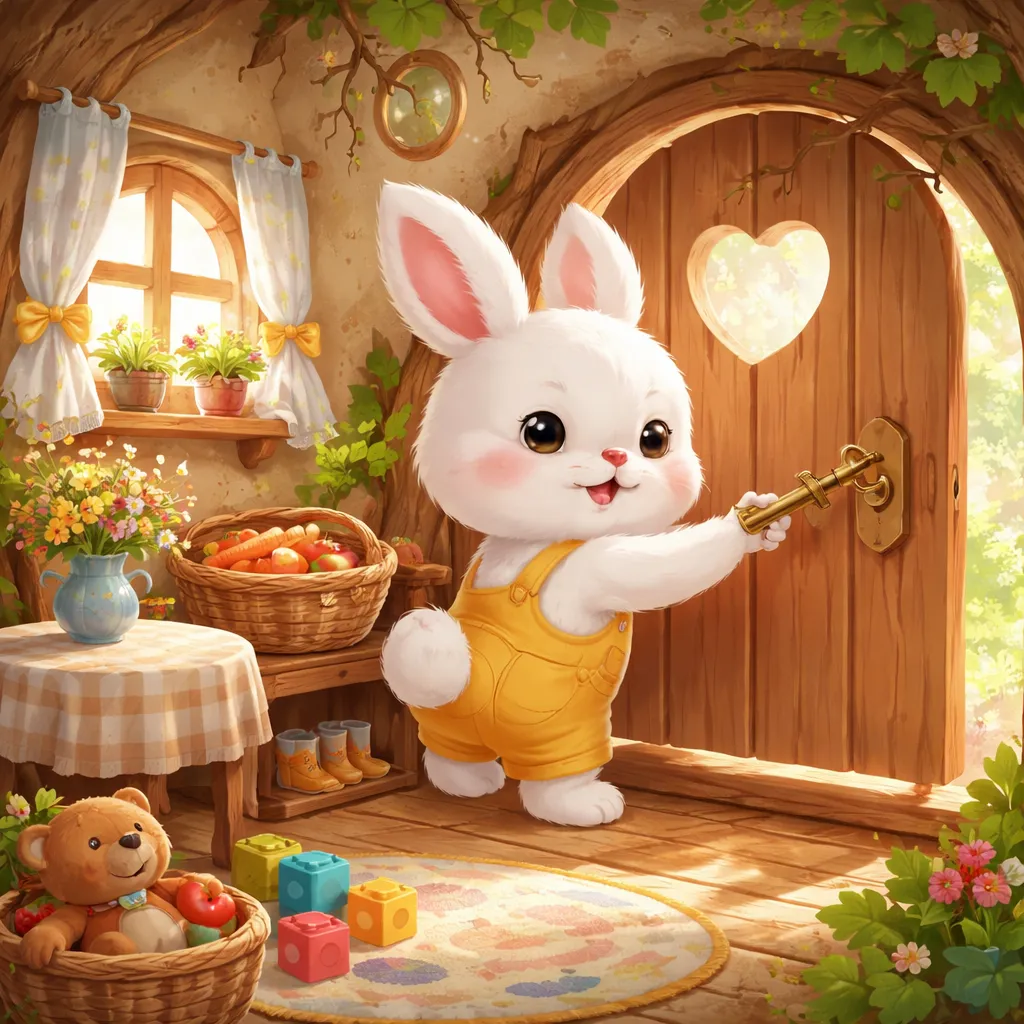

Have you ever been home with your family, and the doorbell rings? What do you do? In many families, children are taught a very important rule: do not open the door for someone you don’t know. In China, there is a famous, catchy song that teaches this exact lesson, but with a fun twist—it uses animal characters! Let’s learn about the clever and cautionary tune “Little Rabbit, Be Good” (小兔子乖乖, Xiǎo tùzi guāiguāi).
About the Song
Let’s read the playful, back-and-forth words of this classic song.
小兔子乖乖,把门儿开开。
快点儿开开,我要进来。
不开不开我不开,妈妈没回来。
谁来也不开。
小兔子乖乖,把门儿开开。
快点儿开开,我要进来。
就开就开我就开,妈妈回来了。
快点把门开。
English Translation:
Little rabbit, be good, open the door.
Open it quickly, I want to come in.
Won’t open, won’t open, I won’t open, Mommy hasn’t come back.
I won’t open for anyone.
Little rabbit, be good, open the door.
Open it quickly, I want to come in.
I’ll open, I’ll open, I’ll open, because Mommy is back.
I’ll open the door quickly.
This song is a very popular Chinese children’s song and game. It is a dialogue song, where one person sings the part of the character outside the door (originally a wolf pretending to be the mother rabbit), and another sings the part of the little rabbits inside. The song tells a mini-drama about safety. The little rabbits are home alone. Someone knocks and asks to be let in. The smart rabbits refuse, saying they won’t open the door for anyone until their mother returns. When their real mother comes home and sings, they happily let her in. The song is a staple in Chinese kindergartens, used to teach children about safety, listening to parents, and recognizing family voices.
What the Song is About
The song paints a clear picture of a safety test at home. The scene is a rabbit family’s house. The mother rabbit is away. Her little rabbits are inside. Then, a knock comes at the door. A voice (which is actually a wolf in disguise) calls out, pretending to be nice. It says, “Little rabbit, be good, open the door. I want to come in.”
The little rabbits are clever. They do not open the door. They talk back to the voice, saying firmly, “I won’t open! Mommy hasn’t come back. I won’t open for anyone!” This shows they are following a safety rule. Later, their real mother rabbit returns. She sings the same knock-knock song. The little rabbits recognize her voice and change their tune. They sing happily, “I’ll open! Because Mommy is back!” and they let her in. The song is a simple story about being cautious with strangers, obeying parents’ rules, and the happy reunion of a family.
Who Made It & Its Story
“Little Rabbit, Be Good” is a traditional Chinese children’s song, so its original author is unknown. It has been passed down through generations and became widely standardized in the 20th century. The song is based on a common folk tale motif found in many cultures, similar to “The Three Little Pigs” or “Little Red Riding Hood,” where a cunning predator tries to trick innocent animals. In China, it was adopted as a standard educational tool in early childhood education. The song’s simple call-and-response structure made it perfect for classroom role-playing. It reflects the cultural emphasis on teaching children about safety, filial obedience, and the importance of the family unit from a very young age.
This song has remained a fundamental favorite for three important reasons. First, its melody is incredibly simple, repetitive, and easy to remember, making the safety lesson stick in a child’s mind. Second, it turns a serious lesson about stranger danger into a fun, dramatic game that children love to act out, reducing fear and increasing understanding. Third, it clearly defines family roles and rules—the parent sets the rule, the child obeys, and the family is the safe haven—which are comforting and important concepts for young children.
When to Sing It
This song is perfect for playful learning about safety. You can sing it as a role-playing game with your family, taking turns being the wolf, the mother, and the little rabbits. You can chant it as a reminder before a parent leaves the house, reinforcing the rule of not opening the door. You can also sing it as a fun, dramatic performance with friends, using different voices for each character.
What Children Can Learn
This simple, dramatic song is a great teacher about safety, language, and family.
Vocabulary
The song teaches us key action and descriptive words. A “rabbit” (兔子, tùzi) is a small, furry animal with long ears. “Good” (乖乖, guāiguāi) here means well-behaved and obedient. To “open the door” (开门, kāimén) means to unlock and move the door so someone can enter. “Quickly” (快点, kuài diǎn) means to do something with speed. To “come in” (进来, jìnlái) means to enter a place. “Mommy” (妈妈, māmā) is a child’s word for mother. “Anyone” (谁, shéi) means any person.
Let’s use these words! You can say, “Please be good and wait quietly.” Or, “I won’t talk to anyone I don’t know.” New word: Caution. This means carefulness and paying attention to avoid danger. The song teaches caution.
Language Skills
This song is a masterful lesson in using the imperative mood for requests and negation for refusal. The outside character uses the imperative to make a request: “把门儿开开” (open the door). This is a command, but it’s softened by “乖乖” (be good).
The little rabbits use strong negation and repetition to refuse: “不开不开我不开” (Won’t open, won’t open, I won’t open). The “不” (bù) is the word for “not.” The song also practices the contrast between “没” (méi) for not yet and “了” (le) for a change of state: “妈妈没回来” (Mommy has not come back) vs. “妈妈回来了” (Mommy has come back). This is a key grammar point.
Sounds & Rhythm Fun
Listen to the bouncy, talking, singsong rhythm of the melody. The song is in a lively 2/4 time. The melody for the lines outside the door rises, sounding like a call. The rabbits’ reply has a firmer, more rhythmic pattern. The repetition of words like “不开不开” and “就开就开” makes it fun to say and easy to remember. The lyrics have a very clear, childlike rhyme: “开” (kāi) and “来” (lái), which repeats throughout.
The rhythm is steady and chanting. Try clapping on the beat: 小 兔 子 乖 乖,把 门 儿 开 开 (xiǎo tùzi guāiguāi, bǎ mén er kāi kāi). The melody is based on just a few notes, making it incredibly simple. This repetitive, call-and-response, and dramatic musical pattern is what makes the song so engaging and effective for teaching. You can create your own safety dialogue song! Use the same structure. Try: “Little kitten, be smart, don’t go with strangers. No, no, no, I won’t go, I’ll wait right here for my family.”
Culture & Big Ideas
“Little Rabbit, Be Good” is a foundational piece of Chinese childhood safety education. It comes from a time when stories and songs were the primary way to impart important life lessons to children. The song connects to the cultural value of obedience to parents (听话, tīnghuà) and the importance of the family as a protective unit. It also reflects a universal parental concern: child safety. The song is often used in the context of the Mid-Autumn Festival or other family gatherings, where stories are shared. It serves as an early lesson in critical thinking—the rabbits must identify the correct voice, teaching discernment. The song, in a gentle way, introduces the concept of a “trickster” (the wolf) and the need to be vigilant.
The song conveys three important ideas. First, it’s about safety and following family rules. The clear rule (“don’t open the door without Mom”) keeps the rabbits safe, teaching that rules are for protection. Second, it expresses the importance of listening and discernment. The rabbits must listen carefully to tell the difference between the wolf’s voice and their mother’s voice. Third, it highlights the joy of family reunion and trust. The happy ending where the mother returns and is welcomed reinforces that the family is a source of love and security.
Values & Imagination
Imagine you are a little rabbit in your cozy burrow. Your mother has just left. The walls are made of earth. It’s quiet. Then, a knock! How do you feel? Scared? Curious? How does the wolf’s voice sound? Friendly but strange? Now, imagine you hear your real mother’s voice. How can you tell it’s her? The sound? The tune? Draw a picture of the song’s story. Draw a big door in the middle. On the left, draw a wolf in a disguise, knocking. On the right, draw the mother rabbit with a basket, coming home. In a window in the door, draw the faces of the little rabbits looking out. Show a speech bubble with “不开!” (Won’t open!) pointing to the wolf, and a happy “就开!” (I’ll open!) pointing to the mother.
The song encourages following safety rules, careful listening, and appreciation for family. A lovely family activity is to create a “Family Password.” Just like the rabbits recognized their mother’s song, with your family, invent a simple, silly family password or secret knock. Practice it. Talk about how it could be used in a fun, pretend-safe way. This extends the song’s lesson into a modern, engaging safety habit.
So, as the last “open the door quickly” fades, think about the smart lesson in this simple tune. It is a vocabulary lesson in safety and family. It is a grammar lesson in making requests and strong refusals. It is a music lesson in a dramatic, call-and-response chant. From the first knock to the final happy reunion, it wraps lessons in safety, discernment, and family love in a melody that makes a serious rule fun to remember. “Little Rabbit, Be Good” teaches us that being obedient can be smart, that listening carefully is important, and that home is safest when we wait for the right voice to let in.
Your Core Takeaways
You are now an expert on the song “Little Rabbit, Be Good” (小兔子乖乖). You know it is a traditional Chinese song that teaches about not opening the door for strangers. You’ve learned words like “obedient,” “open the door,” and “anyone,” and you’ve practiced the imperative mood and negation. You’ve felt its bouncy, dramatic rhythm and created your own safety verse. You’ve also discovered the song’s role in safety education and its messages about following rules, careful listening, and the security of family.
Your Practice Missions
First, stage a “Door Safety” play. With your family, act out the song. Use a real door (or pretend). One person is the wolf, one is the mother, and the others are the little rabbits. Sing the dialogue. Switch roles so everyone gets to be the clever rabbits who say “不开!” (Won’t open!). This reinforces the lesson through drama.
Second, design a “Safety Rules” poster. The song is about one safety rule. Create a colorful poster for your home. In the center, draw a little rabbit. Around it, write or draw 2-3 other simple safety rules you follow (e.g., “Wear a helmet,” “Hold an adult’s hand to cross”). Decorate it. Hang it up. This activity lets you think about and visualize different ways to “be good” and safe, inspired by the song.