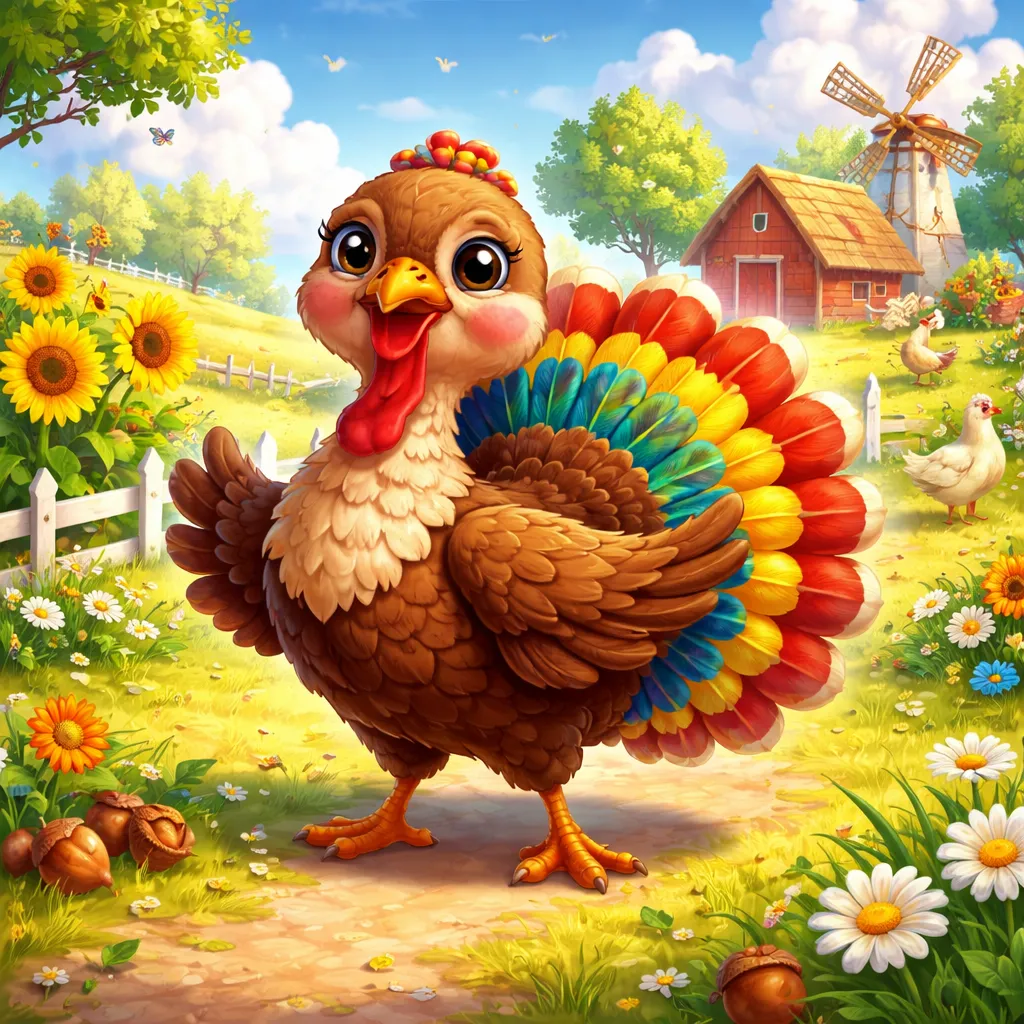

Have you ever seen a turkey? It is a big bird that can puff up its feathers and make a funny sound. In Germany, there is a famous, proud song all about a little turkey who thinks very highly of himself. It is a song about feeling important and special. Let’s puff out our chests and learn the boastful song “The Little Turkey (Der kleine Truthahn).”
About the Song
Here are the proud, strutting lyrics of a beloved traditional German children’s song:
Der kleine Truthahn, der kleine Truthahn,
der ist so stolz wie nochmal einer.
Der kleine Truthahn, der kleine Truthahn,
der plustert sich auf seine Federn.
Er macht Kollera, Kollera, Kollera,
und dreht sich stolz im Kreise her.
Der kleine Truthahn, der kleine Truthahn,
der ist der König auf dem Hof.
English Translation:
The little turkey, the little turkey,
he is as proud as can be.
The little turkey, the little turkey,
he puffs up all his feathers.
He goes Kollera, Kollera, Kollera,
and turns proudly in a circle.
The little turkey, the little turkey,
he is the king of the farmyard.
This is a classic and humorous German-language song for children. The song introduces us to a very proud little turkey. “The little turkey, the little turkey, he is as proud as can be,” it begins, telling us his main feeling right away. He is not shy. “The little turkey, the little turkey, he puffs up all his feathers,” it continues, showing us his special trick to look big and important. Then he makes his sound. “He goes Kollera, Kollera, Kollera,” a funny, gobbling turkey noise. And he shows off. “And turns proudly in a circle.” The song ends with his big opinion of himself. “The little turkey, the little turkey, he is the king of the farmyard.” The song is a playful look at confidence and showing off.
What the Song is About
The song paints a funny picture of a turkey who thinks he is the most important animal on the farm. Imagine a farmyard on a sunny day. A turkey with shiny feathers struts into the middle. “The little turkey, the little turkey, he is as proud as can be.” He holds his head high and looks around importantly.
He wants everyone to see him. “The little turkey, the little turkey, he puffs up all his feathers.” He makes his body look bigger and his feathers fan out, like a living balloon. Then he starts to make his famous sound. “He goes Kollera, Kollera, Kollera,” a loud, gobbling call. And he does not just stand there. “And turns proudly in a circle.” He spins around slowly, showing off his puffed-up feathers from every side. In his mind, he is the boss. “He is the king of the farmyard.” The song is all about a character who feels very special and wants the whole world to know it.
Who Made It & Its Story
“Der kleine Truthahn” is a popular traditional German folk song that belongs to a collection of fun animal character songs. Its specific creator is not known. The song humorously captures the turkey’s famously proud and somewhat comical appearance. In German culture, the phrase “stolz wie ein Truthahn” (proud as a turkey) is a common saying, and this song brings that image to life. While turkeys are native to the Americas, they are known in Germany and often appear in children’s media as funny, pompous characters. The song plays with this idea in a lighthearted way.
This funny, strutting song is loved for three great reasons. First, it is a fantastic way to learn the German word for a key emotion, “stolz” (proud), and other descriptive words. Second, it has a majestic, almost marching melody that fits the turkey’s proud strut, and the fun, repeated gobbling sound “Kollera” is incredibly fun to shout. Third, it playfully explores the idea of pride, self-confidence, and showing off, giving children a safe way to talk about and act out these big feelings.
When to Sing It
This song is perfect for any time you feel proud or silly. You can sing it with a puffed-up chest while marching around the room, turning in circles like the king of your own castle. You can chant it in the fall, especially near Thanksgiving, thinking about turkeys. You can also hum it as a playful way to tease a friend or family member who just did something great, telling them they are “stolz wie ein Truthahn” (proud as a turkey) in a funny, loving way.
What Children Can Learn
This proud, character-filled song is a wonderful teacher about animals, feelings, and making comparisons in German.
Vocabulary
The song teaches us clear words for animals, feelings, actions, and sounds in German. “The” (Der). “Little” (kleine). “Turkey” (Truthahn). “He” (der / er). “Is” (ist). “So” (so). “Proud” (stolz). “As” (wie). “Can be” (nochmal einer – an idiom). “Puffs himself up” (plustert sich auf). “His” (seine). “Feathers” (Federn). “Makes/Goes” (macht). “Kollera” (the gobbling sound). “And” (und). “Turns” (dreht sich). “In a circle” (im Kreise). “Around/here” (her). “The king” (der König). “On the” (auf dem). “Farmyard” (Hof).
Let’s use these words! You can describe a feeling: “Ich bin stolz.” (I am proud.) You can talk about an animal sound: “Der Truthahn macht Kollera.” (The turkey goes Kollera.) New word: Wichtig. This means “important,” just like the little turkey feels.
Language Skills
This song is excellent for learning about making comparisons, using the word “wie” (as/like). The key phrase is “so stolz wie nochmal einer” (as proud as can be / prouder than anyone).
Concept Definition: The little word “wie” means “as” or “like.” We use it to compare two things, to say how they are similar. In the song, we compare the turkey’s pride to something else. How proud is he? He is as proud as can be (“so stolz wie…”). It is a way to make a description stronger and more interesting.
Features and Types: We often use “wie” in a special pattern: “so [description] wie [thing we compare to].” This means “as [description] as [thing].” For example: “so groß wie ein Haus” (as big as a house), “so schnell wie der Wind” (as fast as the wind). The song uses a funny, fixed idiom: “so stolz wie nochmal einer” (as proud as can be).
How to Spot Them: Here is a simple “as what?” trick. When you see the word “wie” in a sentence, look at the word just before it. Is there a describing word (like “stolz” – proud) with “so” in front? If you see “so… wie…”, it is making a comparison. Ask: “As what?” The answer after “wie” is what we are comparing to.
How to Use Them: A great way to make fun descriptions is the “Super Comparison Formula”. The pattern is: “so + [Describing Word] + wie + [Thing you compare to].”
Example from the song: “Der Truthahn ist so stolz wie nochmal einer.” (The turkey is as proud as can be.)
Example you can make: “Mein Ball ist so rund wie der Mond.” (My ball is as round as the moon.) “Sie singt so schön wie ein Vogel.” (She sings as beautifully as a bird.) “Ich bin so stark wie ein Löwe.” (I am as strong as a lion.)
Sounds & Rhythm Fun
Listen to the proud, strutting rhythm of the melody. The song has a slow, majestic, almost marching tune that fits a turkey showing off. The repeated line “Der kleine Truthahn” starts each proud statement. The funny, gobbling sound “Kollera, Kollera, Kollera” is the song’s highlight, fun to say loudly.
The rhythm is steady and important-sounding. The melody for “und dreht sich stolz im Kreise her” has a turning, spinning feeling. The final line “der ist der König auf dem Hof” sounds grand and final, like a royal announcement. This musical pattern is perfect for creating your own proud animal song. You can write your own “Der kleine Pfau” (The Little Peacock) song! Try: “Der kleine Pfau, der kleine Pfau, der ist so schön wie nochmal einer. Der kleine Pfau, der kleine Pfau, der zeigt sein Rad aus Federn. Er macht ein Rufen, schrill und fein, und alle müssen staunend sein…” (The little peacock… is as beautiful as can be… shows his wheel of feathers… makes a call, shrill and fine, and everyone must be amazed…)
Culture & Big Ideas
“Der kleine Truthahn” connects to the German appreciation for animal characters in stories and songs, each with a personality. While turkeys are not native to Germany, they are well-known farm animals and, in popular culture, symbols of comic pride. The phrase “stolz wie ein Truthahn” is a common, funny saying. The song also lightly touches on the idea of the “farmyard hierarchy,” playfully crowning the turkey as king for a day.
The song conveys three playful, thoughtful ideas. First, it introduces the concept of healthy pride (“Stolz”) and self-confidence, showing it’s okay to feel good about yourself and show it sometimes. Second, it humorously looks at showing off and boasting, giving children a character to laugh with and learn about moderation. Third, it encourages imagination and role-play, allowing children to act out a big, proud character in a safe and fun way.
Values & Imagination
Imagine you are the proud “kleine Truthahn.” You walk into the farmyard, and all the other animals look at you. “The little turkey, the little turkey, he is as proud as can be,” you think, standing up very straight. You want to look your very best. “The little turkey, the little turkey, he puffs up all his feathers.” You take a big breath and make all your feathers stand out, big and round.
Then you announce yourself. “He goes Kollera, Kollera, Kollera,” you gobble loudly for everyone to hear. And you don’t just stand still. “And turns proudly in a circle.” You spin around slowly so every chicken, every duck, and every pig can see your magnificent feathers. Of course, you are the most important one here. “He is the king of the farmyard.” How do your puffed-up feathers feel in the sun? What do the other animals think when they hear your “Kollera”? Draw the little turkey as king. Draw a big, puffed-up turkey in the center of the paper. Draw a sun above like a crown. Draw smaller animals like chickens and ducks looking at the turkey from the sides. This shows the song’s theme of pride and feeling like the center of attention.
The song encourages us to recognize and celebrate our own moments of pride in a healthy way, to understand that feeling special is okay, and to have fun with playful boasting. A wonderful activity is the “König/Königin für einen Tag” (King/Queen for a Day) game. Choose a time, maybe for one hour, where you or a family member gets to be the “king of the home” or “queen of the playroom.” You can strut a little, make a silly announcement like “Kollera!”, and everyone can play along. This connects you to the song’s playful, regal spirit.
So, from the puffed-up feathers to the royal title, this song is a celebration of feeling grand. It is a vocabulary lesson in animals, feelings, and actions. It is a language lesson in using “so… wie…” (as… as…) to make fun comparisons. It is a music lesson in a proud, marching melody with a hilarious animal sound. “The Little Turkey (Der kleine Truthahn)” teaches us about the feeling of pride, how to describe it, and how to have fun pretending to be the king or queen of your own world.
Your Core Takeaways
You are now an expert on the song “The Little Turkey (Der kleine Truthahn).” You know it is a funny German song about a turkey who is very proud, puffs up his feathers, gobbles “Kollera,” turns in a circle, and acts like the king of the farmyard. You’ve learned German words like “Truthahn,” “stolz,” “Federn,” “plustert sich auf,” “Kollera,” and “König,” and you’ve practiced making comparisons using “so… wie…” (as… as…). You’ve felt its proud, strutting rhythm and created your own proud animal verse. You’ve also discovered the song’s message about healthy pride, playful boasting, and using imagination to be a character.
Your Practice Missions
First, play the “So… wie…” (As… as…) game. Look around and make funny comparisons. Say things like “Mein Kissen ist so weich wie eine Wolke!” (My pillow is as soft as a cloud!) or “Papa schnarcht so laut wie ein Bär!” (Dad snores as loud as a bear!). This mission helps you practice the song’s key language skill of making creative comparisons.
Second, have a “Truthahn-Parade” (Turkey Parade). Walk around your room proudly like the little turkey. Puff out your chest, take big, slow steps, turn in a circle, and proudly say your own version of “Kollera, Kollera, Kollera!” Finish by announcing “Ich bin der König/ die Königin!” (I am the king/queen!). This mission lets you act out the song’s core feeling of playful, confident pride.