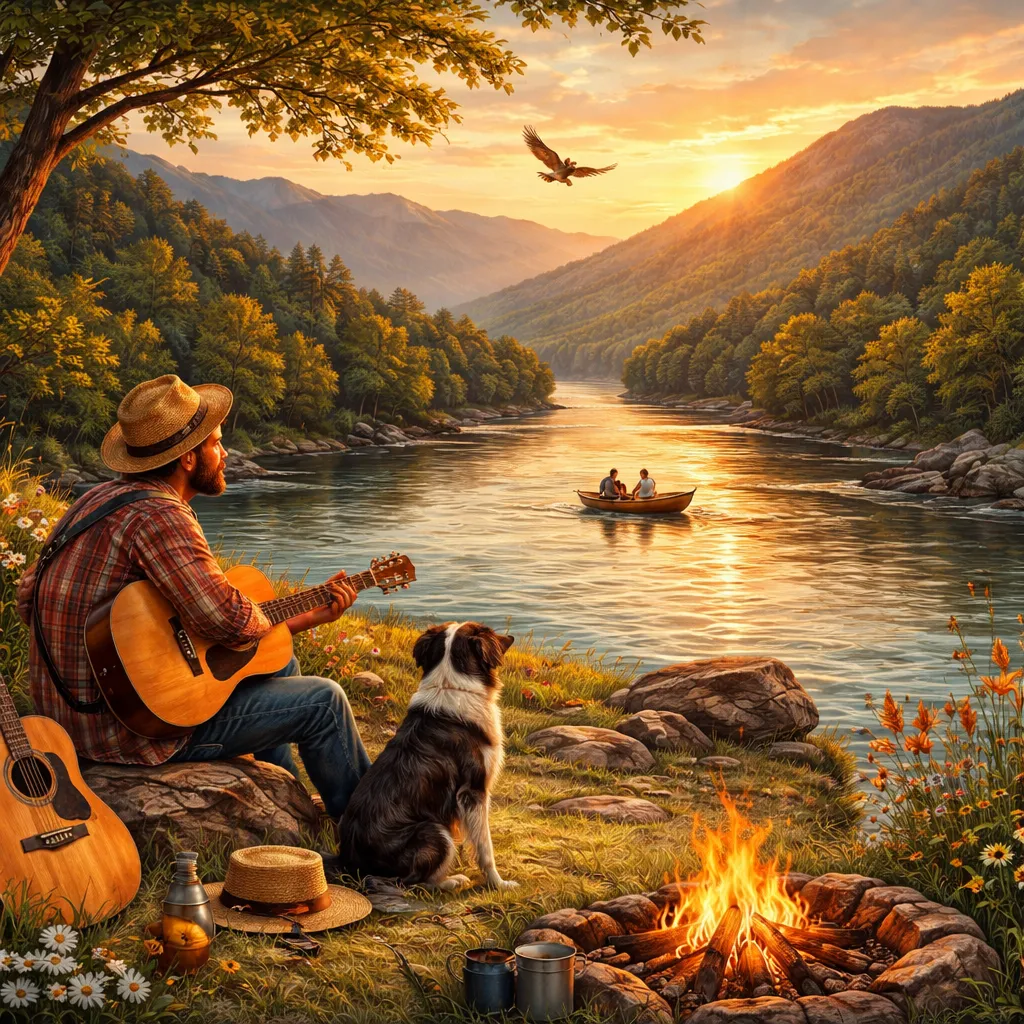

Have you ever looked at a map and seen a winding blue line that is a river? Rivers can be roads for boats, borders between lands, and symbols of home for many people. In America, there is a very old, beautiful song about a river that people have sung for over 200 years. It’s a song about love, distance, and a powerful longing for a beautiful place. Let’s learn about the folk ballad “Oh, Shenandoah.”
About the Song
Let’s read the flowing, longing words of this famous song.
Oh, Shenandoah, I long to hear you,
Away, you rolling river.
Oh, Shenandoah, I long to hear you,
Away, I’m bound away, ’Cross the wide Missouri.
Oh, Shenandoah, I love your daughter,
Away, you rolling river.
For her I’ve crossed the rolling water,
Away, I’m bound away, ’Cross the wide Missouri.
’Tis seven long years since last I saw you,
Away, you rolling river.
’Tis seven long years, I’ll soon be with you,
Away, I’m bound away, ’Cross the wide Missouri.
This song is a traditional American folk song and sea shanty. Its origins are unclear, but it dates back to at least the early 19th century. The song is a slow, flowing melody that expresses a deep longing for the Shenandoah River and Valley, located in the eastern United States. The singer addresses the river directly, saying they long to hear it and that they love the river’s “daughter,” which could be a literal person or a poetic way of loving the valley itself. The song mentions the “wide Missouri,” a huge river to the west, showing the singer is far away and bound on a journey. The song was sung by pioneers, fur traders, and sailors, making it a song of travel, memory, and love for a distant home.
What the Song is About
The song paints a picture of a traveler far from home. The singer is thinking of the Shenandoah River, calling it a “rolling river.” They say they “long to hear you,” meaning they miss the sound of its waters. They are “bound away,” meaning they are destined to travel, and they must cross the wide Missouri River, which is a symbol of a great distance and a barrier.
In the second verse, the singer says they love the river’s “daughter.” This could mean they love a woman who lives there, or it could be a way of saying they love the beauty and spirit of the valley itself. They say they crossed the “rolling water” for her. The last verse says it has been seven long years since they were there, but they promise they will return soon. The song is about the ache of being far from a beloved place or person, the hardship of travel, and the hope of return.
Who Made It & Its Story
“Oh, Shenandoah” is a traditional folk song, so its original author is unknown. It likely originated with French-Canadian voyageurs (fur traders) and was adopted by American pioneers and sailors in the 1800s. The song spread along the waterways and trails of North America. Its melody and theme made it a popular sea shanty, a work song for sailors. The song’s lyrics have many variations, sometimes referring to a Native American chief’s daughter, reflecting the interaction between cultures. It became a standard of American folk music and was famously recorded by many artists, including Paul Robeson. Its haunting tune and universal theme of longing have made it an unofficial anthem of the American frontier.
This ballad has remained powerful for three beautiful reasons. First, its melody is one of the most haunting and memorable in American music, with a wave-like rise and fall that feels like a river. Second, it is a masterpiece of geographical and emotional imagery, connecting personal feeling to the vast American landscape. Third, it captures the universal experience of homesickness and the promise of return, a feeling anyone who has ever missed home can understand.
When to Sing It
This song is perfect for quiet, thoughtful moments about place and distance. You can sing it softly while looking at a river or a map, thinking about faraway places. You can hum it on a long car trip, watching the landscape roll by. You can also sing it as a family when remembering a favorite vacation spot or a home you used to live in, as a way to share that feeling of longing.
What Children Can Learn
This poetic, geographical song is a deep well of lessons. Let’s explore its currents.
Vocabulary
The song teaches us rich, descriptive, and geographical words. The “Shenandoah” is a river and valley in the states of Virginia and West Virginia. To “long” for something means to want it very much. A “rolling river” is a river that moves in wide, gentle curves. “Bound away” means destined or determined to go away. The “Missouri” is a very long river in the central United States. “’Tis” is an old, poetic way of saying “it is.” “Seven long years” is a phrase meaning a very long time.
Let’s use these words! You can say, “I long to see my friend who moved away.” Or, “The rolling hills were beautiful.” New word: Nostalgia. This is a sentimental longing for the past or for a place far away. The singer feels nostalgia for Shenandoah.
Language Skills
This song is a masterful lesson in using the simple present tense to express enduring feelings and the present continuous to describe ongoing action. The singer uses the simple present to state a lasting emotion: “I long to hear you. I love your daughter.” This shows a feeling that is always true.
The song uses the present continuous in a special way: “I’m bound away.” This means “I am destined to go away,” which is a state of being. The phrase “’Cross” is a poetic shortening of “across.” The song also uses direct address, speaking right to the river (“Oh, Shenandoah”), and repetition to emphasize the distance (“Away, you rolling river”).
Sounds & Rhythm Fun
Listen to the slow, flowing, wave-like rhythm of the melody. The song is in a gentle 6/8 or 3/4 time, which gives it a rocking, boat-like feel. The repetition of the “Away, you rolling river” line acts like a refrain, like the chorus of a river. The lyrics have a soft, open rhyme: “you” and “you,” “daughter” and “water,” “saw you” and “with you.”
The rhythm is steady and swaying. Try a slow, even sway: Oh, Shen-an-DO-ah, I LONG to HEAR you. The melody rises and falls in long, beautiful phrases, like the river itself. This simple, repetitive, and flowing musical pattern is what makes the song so memorable and moving. You can write your own longing song! Use the same flowing rhythm. Try: “Oh, old treehouse, I long to see you, up in the branches, so high and so true. Oh, old treehouse, I’ll soon be with you, to watch the clouds in the sky so blue.”
Culture & Big Ideas
“Oh, Shenandoah” is a cornerstone of American frontier and folk music culture. It comes from the era of westward expansion in the 19th century, when rivers were the highways. The song reflects the interaction between European settlers, Native Americans, and the landscape. It connects to the experience of voyageurs, pioneers, and sailors—people whose lives were defined by travel and separation. The song is a piece of living history that tells of the emotional cost of building a nation, the love of the land, and the mix of cultures along America’s great rivers.
The song conveys three profound ideas. First, it’s about the powerful connection between people and landscape. The river is not just water; it is a being that is loved and missed, showing how places can become part of our identity. Second, it expresses the pain and promise of journeying. The singer is “bound away” by fate or duty, but holds the hope of return, teaching that leaving is often part of life. Third, it highlights time and patience in love. The “seven long years” shows that true longing lasts, and that reunion, though distant, is worth waiting for.
Values & Imagination
Imagine you are the traveler standing by the wide Missouri River. What do you see? A vast, muddy river? Prairie grasses? How do you feel? Now, imagine the Shenandoah in your mind. Is it clear and sparkling? Are there trees on its banks? Can you hear it? Draw a picture of the two rivers. On one side, draw the “wide Missouri,” big and powerful. On the other, draw the “rolling” Shenandoah, gentle and winding. Draw a small figure (the singer) in the middle, looking from one to the other. Draw a winding path between them, labeled “seven long years.”
The song encourages appreciation for the places we call home, understanding the feelings of those who travel or move, and patience in waiting for reunions. A lovely idea is to have a “Song of My Place” activity. With your family, talk about a place that feels like “home” to you (a house, a park, a grandparent’s town). Describe what you “long” to see or hear there. Draw that place. This personalizes the song’s theme of longing for a specific landscape.
So, as the last “’Cross the wide Missouri” fades, think about the journey in this old ballad. It is a vocabulary lesson in geography and emotion. It is a grammar lesson in expressing lasting feelings. It is a music lesson in a flowing, river-like rhythm. From the first call to the river to the final promise of return, it wraps lessons in love of place, the hardship of journeys, and enduring hope in a tune that feels as timeless as a river’s flow. “Oh, Shenandoah” teaches us that places can live in our hearts, that goodbyes are not forever, and that some songs are as deep and wide as the rivers they sing about.
Your Core Takeaways
You are now an expert on the song “Oh, Shenandoah.” You know it is a 19th-century American folk song about longing for the Shenandoah River while journeying west. You’ve learned words like “long,” “rolling river,” and “bound away,” and you’ve practiced the simple present tense for emotions. You’ve felt its slow, swaying rhythm and created your own longing verse. You’ve also discovered the song’s roots in frontier travel and its messages about the connection to landscape, the pain and promise of journeys, and the patience of love across time and distance.
Your Practice Missions
First, trace the “Journey of the Song.” With a grown-up’s help, look at a map of the United States. Find the Shenandoah River in Virginia and the Missouri River. Trace a path between them. Talk about how people might have traveled that distance 200 years ago (by boat, wagon, horse). This connects the song to real geography and history.
Second, create a “River of Memories” drawing. The song is about a river of memory. On a long piece of paper, draw a winding river. Along its banks, draw or write about your own happy memories, like pictures of your home, friends, or favorite trips. Let your river of memories flow. Share it with your family. This activity lets you create your own personal “Shenandoah.”