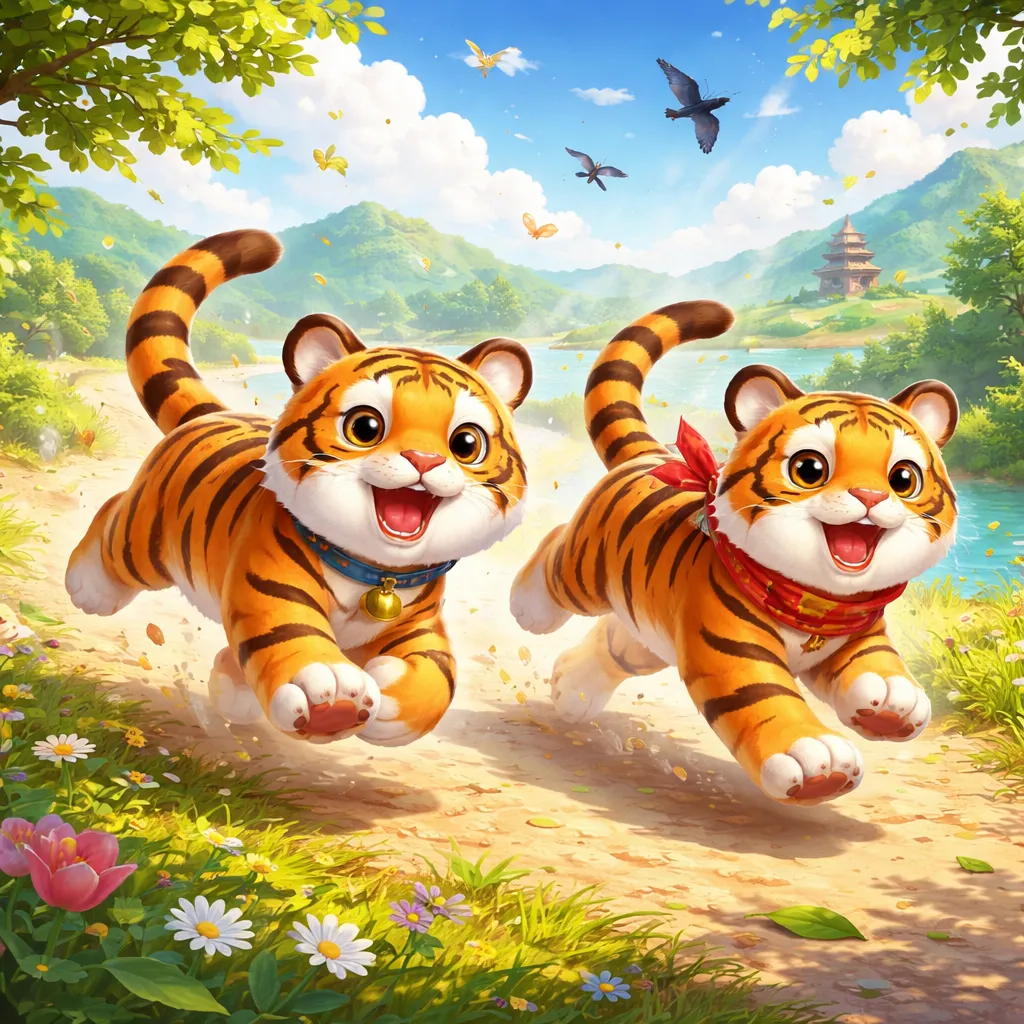

Have you ever seen a picture of a tiger? They are big, strong, and have beautiful stripes. Now, imagine two tigers running. But wait—these two tigers are a little different! They are missing some important parts. There is a very famous, silly song in China about exactly these two special tigers. Let’s learn about the playful children’s song “Two Tigers” (两只老虎, Liǎng zhī lǎohǔ).
About the Song
Let’s read the simple, funny words of this famous song.
两只老虎,两只老虎,
跑得快,跑得快。
一只没有眼睛,
一只没有尾巴,
真奇怪!真奇怪!
English Translation:
Two tigers, two tigers,
Running fast, running fast.
One has no eyes,
One has no tail,
How strange! How strange!
This song is a classic Chinese children’s song and nursery rhyme. The melody is originally from the French folk song “Frère Jacques” (Are You Sleeping, Brother John?). The same tune is used for a popular English round. The Chinese lyrics were adapted to this well-known melody, creating a fun and slightly silly song about two unusual tigers. The song describes two tigers running quickly, but one is missing its eyes, and the other is missing its tail. The singer finds this very strange! It is a staple in Chinese kindergartens and homes, often used to teach basic concepts in a humorous way.
What the Song is About
The song paints a funny, curious picture. The singer sees two tigers. The first thing they notice is that the tigers are running very, very fast. This is the normal part.
Then, the singer looks closer and sees something unusual. One of the tigers has no eyes. How can it see where it is running? The other tiger has no tail. Tigers use their tails for balance! The singer thinks this is very strange and says so twice: “How strange! How strange!” The song doesn’t tell a story with a beginning, middle, and end. It simply presents a silly, impossible situation and invites us to laugh and wonder about it. It’s about using imagination to create a funny, friendly mystery.
Who Made It & Its Story
The melody for “Two Tigers” is a traditional French tune. The Chinese lyrics are a folk adaptation, and the song became widely popular in China in the 20th century. Its exact origin is unclear, but it is deeply embedded in modern Chinese early childhood education. The song’s journey from a French round to a Chinese children’s standard shows how simple, catchy tunes can be adapted by different cultures. In China, it is one of the first songs children learn, helping with memory, rhythm, and vocabulary. The song’s gentle absurdity makes it very appealing to young children who enjoy playful, impossible scenarios.
This nursery rhyme has remained a favorite for three playful reasons. First, its melody is one of the most recognizable and easiest to sing in the world, using a simple, repeating pattern. Second, the lyrics are humorous and slightly absurd, which captures a child’s imagination and makes them giggle. Third, it is a perfect teaching tool for vocabulary (animals, body parts, speed) and for the concept of observation (“What’s missing?”).
When to Sing It
This song is perfect for active, playful moments. You can sing it while running around the room, pretending to be the two fast tigers. You can chant it as a group, taking turns pointing to your eyes and your tail (or pretending to miss them!). You can also sing it as a silly warm-up song before playing a game, to get your body and voice ready for fun.
What Children Can Learn
This simple, cross-cultural song is a fun package of lessons. Let’s see what we can learn.
Vocabulary
The song teaches us basic words for animals, body parts, and descriptions. “Tiger” (老虎, lǎohǔ) is a large, striped wild cat. “Two” (两, liǎng) is the number 2. “Run” (跑, pǎo) means to move very quickly on foot. “Fast” (快, kuài) means at high speed. “Eyes” (眼睛, yǎnjing) are the body parts we see with. “Tail” (尾巴, wěiba) is the long, thin part at the back of an animal. “Strange” (奇怪, qíguài) means unusual or weird.
Let’s use these words! You can say, “The rabbit can run very fast.” Or, “A peacock has a beautiful, long tail.” New word: Absurd. This means silly or ridiculous, often in a funny way. The song describes an absurd situation.
Language Skills
This song is a great lesson in using numbers and measure words and the structure for negation. The song starts with the number “two” and the measure word “只” (zhī) for animals: “两只老虎” (two tigers). In Chinese, you often need a measure word between a number and a noun.
The song uses the negation “没有” (méiyǒu), which means “does not have” or “has no”: “一只没有眼睛” (One has no eyes). This is a common way to say something is missing. The song also uses repetition for emphasis (“跑得快,跑得快” and “真奇怪!真奇怪!”) and the exclamation “真” (zhēn) to mean “really” or “how” in “How strange!”
Sounds & Rhythm Fun
Listen to the steady, marching, repeating rhythm of the melody. The song is in a clear 4/4 time. The melody is the same for each line, making it incredibly easy to remember. The lyrics have a simple, chant-like rhythm and a clear rhyme in Chinese: “虎” (hǔ) and “快” (kuài), “巴” (ba) and “怪” (guài).
The rhythm is bouncy and even. Try clapping on the beat: 两 只 老 虎,两 只 老 虎 (liǎng zhī lǎohǔ, liǎng zhī lǎohǔ). The melody uses only a few notes and is perfect for singing in a round, though the Chinese version is usually sung in unison. This simple, repetitive, and infectious musical pattern is what makes the song so easy for even the youngest child to sing. You can write your own silly animal song! Use the same tune. Try: “Two monkeys, two monkeys, jumping high, jumping high. One has no ears, one has no hair, oh my! Oh my!”
Culture & Big Ideas
“Two Tigers” is a foundational piece of modern Chinese early childhood culture. It connects to the importance of education and playful learning in Chinese families. The song is often used in kindergartens to teach children about animals and body parts in a fun, memorable way. The song’s theme of “strangeness” or things being “not quite right” can be a gentle introduction to the concept of differences and diversity—these tigers are missing parts, but they are still running fast and are the subjects of a fun song. The tune’s origin as “Frère Jacques” also makes it a subtle example of global cultural exchange, showing how music can be shared and adapted.
The song conveys three simple ideas. First, it’s about observation and description. The song encourages us to look at something (the tigers) and describe what we see, even if it’s unusual. Second, it expresses humor and acceptance of the absurd. The world can be a funny, strange place, and that’s okay! We can laugh about it. Third, it highlights the joy of shared, simple fun. The song is not complicated; it’s just a silly tune that everyone can sing together, building a sense of community and play.
Values & Imagination
Imagine the two tigers running. Where are they running? Through a jungle? A field? How do they run so fast without stumbling? Now, imagine the tiger with no eyes. How does it know where to go? Imagine the tiger with no tail. Does it wobble when it runs? Draw a picture of these two special tigers. Don’t draw them as scary. Draw them as friendly, funny tigers with big smiles, one with empty eye spots and one with a behind that is smooth with no tail. Show them running happily. This captures the song’s playful, not scary, spirit.
The song encourages observation, a sense of humor, and creativity in imagining friendly, funny creatures. A lovely idea is to play the “What’s Missing?” game. With your family, draw a simple animal on paper. Then, close your eyes and have a family member erase one part (like an ear or a leg). Open your eyes and guess what’s missing! This turns the song’s concept into an interactive game.
So, as the last “How strange!” fades, think about the playful curiosity of this simple tune. It is a vocabulary lesson in animals and body parts. It is a grammar lesson in counting and saying what is missing. It is a music lesson in a universally catchy, marching rhythm. From the first “two tigers” to the final exclamation, it wraps lessons in observation, humor, and shared fun in a melody that makes you want to clap, run, and laugh. “Two Tigers” teaches us that it’s fun to notice the world’s oddities, that a song can make the strange feel friendly, and that the simplest tunes are the ones that bring us together.
Your Core Takeaways
You are now an expert on the Chinese song “Two Tigers” (两只老虎). You know it uses a French melody and has funny lyrics about two tigers missing eyes and tails. You’ve learned words like “tiger,” “tail,” and “strange,” and you’ve practiced counting and using “has no” in a sentence. You’ve felt its bouncy, marching rhythm and created your own silly verse. You’ve also discovered the song’s role in Chinese childhood education and its messages about observation, humor, and the joy of shared, simple songs.
Your Practice Missions
First, stage a “Tiger Run” drama. With your family, pretend to be the two tigers. Sing the song while running (in place or in a safe space). When you sing “one has no eyes,” cover your eyes. When you sing “one has no tail,” turn around and point to where a tail should be. This makes the song a full-body activity.
Second, create a “Strange Animal” drawing. The song’s tigers are strange because they are missing parts. Draw your own friendly, strange animal. Maybe a rabbit with no ears or a fish with no fins. Give it a name and write one sentence about it, like “It hops quietly.” Share your drawing. This activity encourages creativity and celebrates friendly differences, just like the song.