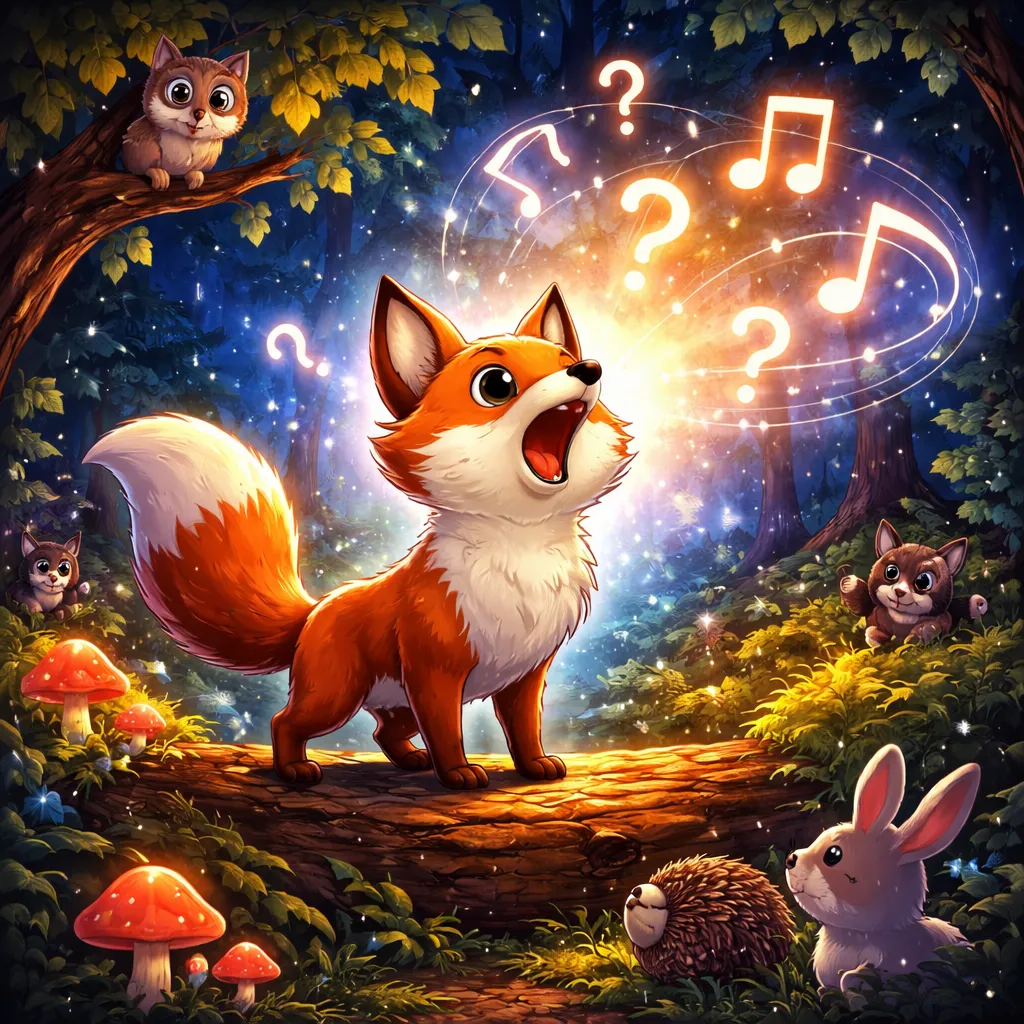

Have you ever wondered what sound an animal makes? Dogs say "woof," cats say "meow," and cows say "moo." But what about a fox? This question became the center of a hilarious, surprising song that took the whole world by storm. It’s a song that mixes real animal noises with completely silly, made-up ones. Let’s dive into the fun mystery of “The Fox (What Does the Fox Say?)”.
About the Song
Let’s read the funny, questioning words of this famous modern song.
Dog goes woof, cat goes meow,
Bird goes tweet, and mouse goes squeak.
Cow goes moo, frog goes croak,
And the elephant goes toot.
But there’s one sound that no one knows…
What does the fox say?
Ring-ding-ding-ding-dingeringeding!
Wa-pa-pa-pa-pa-pa-pow!
Hatee-hatee-hatee-ho!
Joff-tchoff-tchoff-tchoffo-tchoffo-tchoff!
This song, “The Fox (What Does the Fox Say?)”, is a comedy pop song by the Norwegian comedy duo Ylvis (Bård and Vegard Ylvisåker). It was released in 2013 and became a massive viral sensation on the internet. The song is built around a simple, curious question: while we know the sounds of common animals, what noise does a fox make? The verses list the familiar sounds, but the chorus breaks into a series of absurd, electronic, and hilarious nonsense words as the answer. The accompanying music video, with people in giant fox costumes dancing in the woods, made the song even more unforgettable. It is a perfect example of how a silly idea, catchy music, and the internet can create a global phenomenon.
What the Song is About
The song paints a picture of someone who is very curious about the natural world. The singer lists all the classic animal sounds we learn as children. Each animal has its clear, simple noise. But then, the singer hits a puzzle. The fox is a common animal, but its sound isn’t widely known like a dog’s bark or a cat’s meow.
This question becomes a big, dramatic mystery. The song asks, “What does the fox say?” over and over. The answer is not a real scientific fact. Instead, it is a burst of pure imagination: “Ring-ding-ding-ding-dingeringeding!” and “Wa-pa-pa-pa-pa-pa-pow!” The song is about celebrating curiosity, embracing the unknown, and having fun by inventing a wild, silly answer instead of taking things too seriously. It turns a simple question into a party.
Who Made It & Its Story
The song was created and performed by the Norwegian brothers Bård and Vegard Ylvisåker, known as Ylvis. They are comedians and talk show hosts. They made the song originally as a promo for their television show, expecting it to be funny only in Norway. To their surprise, the music video was uploaded to YouTube and spread around the world at incredible speed. It became a viral hit, getting over a billion views. The song’s success is a classic story of the internet age: a quirky, catchy, and visually funny video capturing everyone’s attention. Ylvis became international stars because of this one silly song about a fox.
This song became a massive hit for three hilarious reasons. First, its catchy, electronic dance beat is incredibly fun and easy to dance to, making it perfect for parties and videos. Second, it taps into a universal, simple childhood curiosity (what sound does that animal make?) and answers it in the most unexpectedly funny way. Third, the music video is unforgettable, with its serious singers, forest setting, and people in ridiculous furry fox costumes dancing wildly, which made people want to watch and share it again and again.
When to Sing It
This song is perfect for high-energy, silly moments. You can blast it at a party and dance like the foxes in the video, making the crazy “Ring-ding-ding” sounds. You can sing it on a car ride, taking turns trying to make the most ridiculous animal sounds you can invent. You can also chant it while playing outside, pretending to be different animals and saving the funniest sounds for the mysterious fox.
What Children Can Learn
This wildly fun song is a playground for learning about language, music, and creativity.
Vocabulary
The song teaches us classic animal sound words, or onomatopoeia. “Woof” is the sound a dog makes. “Meow” is for a cat. “Tweet” is for a bird. “Squeak” is for a mouse. “Moo” is for a cow. “Croak” is for a frog. “Toot” is a funny word for an elephant’s trumpet. The fox sounds—“Ring-ding-ding,” “Wa-pa-pa-pow”—are invented, nonsense words.
Let’s use these words! You can say, “The little bird gave a happy tweet.” Or, “The door made a loud squeak.” New word: Onomatopoeia. This is a word that sounds like the noise it describes, like “woof” or “bang.”
Language Skills
This song is a masterful lesson in the simple present tense and constructing questions. The song states facts using the simple present: “Dog goes woof. Cat goes meow.” This is how we describe habitual actions or facts.
The core of the song is a question in the present tense: “What does the fox say?” The structure is: Question word (What) + Auxiliary verb (does) + Subject (the fox) + Main verb (say). The song also practices listing and contrast: it lists many known sounds, then uses “But” to introduce the unknown one, creating a fun mystery.
Sounds & Rhythm Fun
Listen to the thumping, electronic, dance-club rhythm of the melody. The song has a very modern beat. The verses are spoken-sung, listing the animals clearly. Then the chorus explodes with the crazy fox sounds and a huge dance beat. The nonsense words are designed to be fun to say: “Hatee-hatee-hatee-ho!”
The rhythm is fast and driven. Try jumping to the beat: DOG goes WOOF, CAT goes MEOW. The melody is simple in the verse and chaotic in the chorus, mirroring the shift from order to wild fun. This combination of clear listing and explosive, silly release is what makes the song so catchy. You can invent your own animal sound song! Use the same structure. Try: “Bee goes buzz, snake goes hiss, lion roars, and fish goes blub. But there’s one sound that makes us wonder… what does the robot say? Beep-bop-zap-whirr-crash-boom!”
Culture & Big Ideas
“The Fox” is a quintessential product of 2010s internet culture. It shows how a video can go “viral,” spreading to millions of people online in just days. The song connects to a long tradition of comedy music and novelty songs, but its reach was powered by YouTube and social media. It also touches on how, in the age of information, we can still find joy in not knowing an answer and making up a hilarious one instead. The song is a time capsule of a moment when the whole world shared the same silly joke.
The song conveys three fun ideas. First, it’s about the joy of curiosity and questioning. It’s okay to wonder about simple things and to look for answers, even if the answer is playful. Second, it celebrates creativity and imagination over pure facts. Sometimes, inventing a fun, ridiculous answer is better than a boring, correct one. Third, it highlights how music and humor connect people globally. The song became a shared experience for people all over the world, showing that laughter and a good beat are universal languages.
Values & Imagination
Imagine you are in the deep, dark forest like in the video. What do you see? Tall trees? What do you hear? Real animal sounds? Now, imagine the fox appears. What does it look like? Does it open its mouth and say “Ring-ding-ding”? How would that sound echoing in the woods? Draw a picture of the fox concert. Draw a stage in the forest. On the stage, draw a fox wearing sunglasses, holding a microphone, and singing “Wa-pa-pa-pow!” to an audience of other forest animals. This captures the song’s silly, musical spirit.
The song encourages curiosity, creative thinking, and not being afraid to be silly and have fun. A lovely idea is to have a “Silly Sound Inventor” game. With your family, gather in a circle. One person names an uncommon animal or object (like a jellyfish, a cloud, or a soccer ball). Everyone takes turns inventing and performing the sound it might make. The funnier, the better! This activity stretches the imagination just like the song does.
So, as the last electronic beat fades, think about the global giggle this song started. It is a vocabulary lesson in animal sounds and nonsense. It is a grammar lesson in asking questions and listing facts. It is a music lesson in a modern, viral dance rhythm. From the first “woof” to the final “tchoffo-tchoff,” it wraps lessons in curiosity, creative invention, and shared joy in a tune that makes you want to dance and laugh without worrying about the answer. “The Fox” teaches us that it’s fun to ask questions, that imagination is the best answer, and that sometimes, the whole world just wants to say “Wa-pa-pa-pa-pa-pa-pow!” together.
Your Core Takeaways
You are now an expert on the song “The Fox (What Does the Fox Say?)”. You know it is a viral comedy song by the Norwegian duo Ylvis that asks a silly question about animal sounds. You’ve learned onomatopoeia words like “woof” and “meow” and invented ones like “Ring-ding-ding”. You’ve practiced the simple present tense and how to ask “What does… say?”. You’ve felt its energetic, electronic rhythm and created your own animal sound verse. You’ve also discovered the song as a piece of internet culture and its messages about joyful curiosity, the power of creative answers, and how humor can connect the world.
Your Practice Missions
First, stage a “Fox Chorus” performance. Watch the official music video with your family. Then, try to recreate the dance moves from the chorus, especially the part with the crazy fox sounds. Perform your own family version. This connects you to the song’s viral video roots.
Second, design a “Mystery Animal” card game. Make cards with pictures of animals whose sounds are not well-known (like a giraffe, a turtle, a butterfly). On the back of each card, invent a funny, onomatopoeic sound for that animal, just like the song did for the fox. Play a game where someone draws a card and makes the sound, and others guess the animal. This turns the song’s core idea into a playful, creative game.