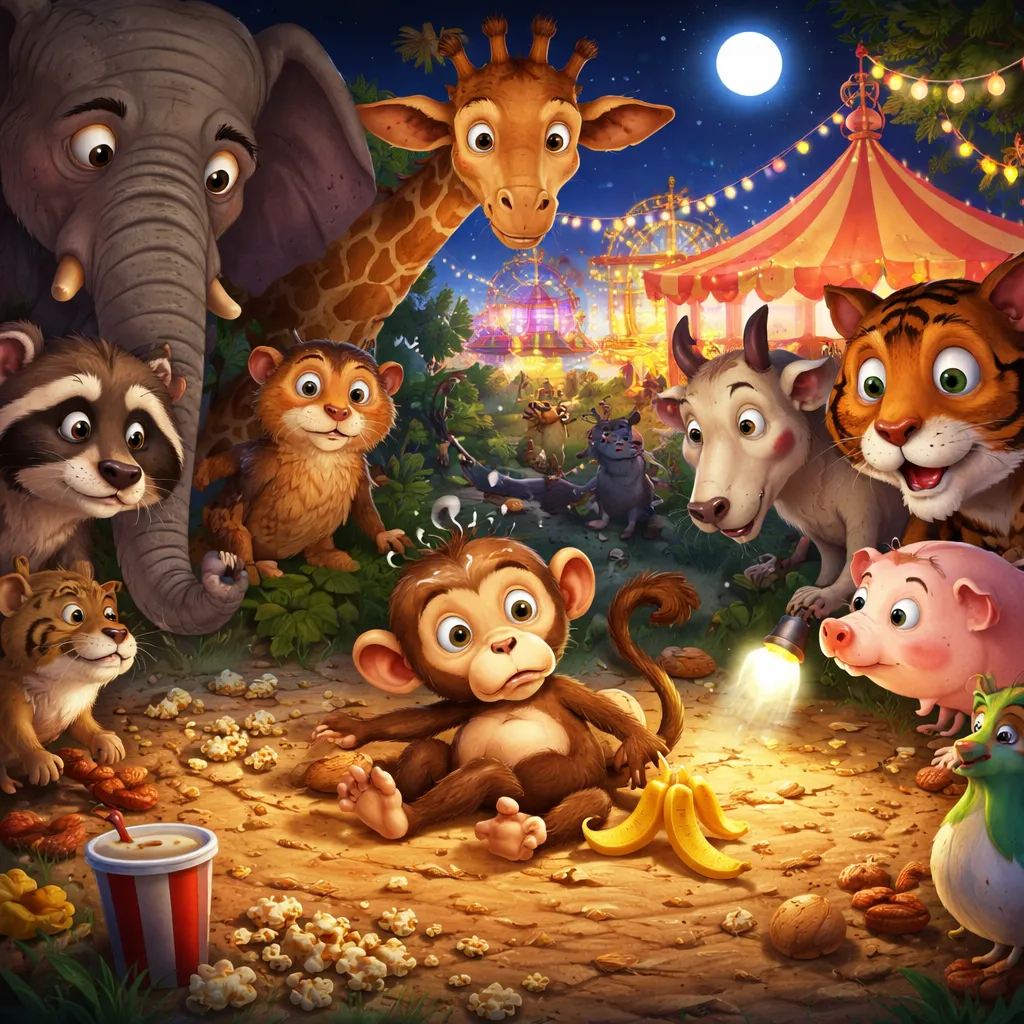

Imagine a fair, but instead of rides and games, it’s filled with every animal you can think of! A lion, a parrot, and even a big baboon. There is a very old, very silly song that tells the story of a visit to this wild party, where one small mistake leads to a very funny disaster. Let’s visit the musical “Animal Fair.”
About the Song
Let’s read the funny, story-filled words of this classic tune.
I went to the animal fair,
The birds and the beasts were there.
The big baboon, by the light of the moon,
Was combing his auburn hair.
The monkey, he got drunk,
And sat on the elephant’s trunk.
The elephant sneezed and fell on his knees,
And that was the end of the monk, the monk, the monk.
This song is a traditional American nonsense folk song. It is a short, humorous, and cumulative rhyme that tells the story of a visit to a fantastical animal fair. The song is famous for its playful, slightly absurd story and its easy-to-remember rhythm. The first known published version appeared in the late 19th century, but it was likely sung for much longer. The song paints a vivid, silly picture of animal misbehavior and its unexpected, dramatic consequences, all in just a few lines.
What the Song is About
The song paints a wild and funny nighttime scene. The singer is telling us about their visit to a special fair for animals. All sorts of creatures, both birds and beasts, are there. The first animal we see clearly is a “big baboon.” This large monkey is doing something very human—he is combing his reddish-brown (“auburn”) hair by the light of the moon.
Then, the scene shifts to a monkey. This monkey has had too much to drink (“got drunk”). Feeling unsteady, he looks for a place to sit and chooses the worst possible spot: the elephant’s long nose, or “trunk.” The elephant, tickled by the monkey on its sensitive nose, has to sneeze. The sneeze is so powerful that it makes the elephant fall down on its knees. And the poor, drunk monkey? The song tells us with a repeated, final line that this was “the end of the monk.” The silly mistake leads to a funny, exaggerated punishment.
Who Made It & Its Story
“The Animal Fair” is a traditional folk song, so its original author is unknown. It was first published in 1898 in a collection of college songs. The song likely comes from the rich tradition of American nonsense and camp songs that were popular in the late 19th and early 20th centuries. It shares the silly, cumulative style of songs like “The Green Grass Grew All Around.” The song became a favorite with children and at summer camps because of its easy tune and the hilarious image of the monkey’s fate.
This song has remained a favorite for three silly reasons. First, its melody is incredibly simple, repetitive, and easy to sing, making it perfect for group singing. Second, it tells a complete, funny story with a clear beginning, middle, and end in just eight lines. Third, it is delightfully absurd. The idea of a baboon combing its hair and a drunk monkey sitting on an elephant’s trunk is so silly that it makes children laugh and sparks their imagination.
When to Sing It
This song is perfect for playful, storytelling moments. You can sing it on a family trip to the zoo, imagining what the animals do when no one is looking. You can sing it as a dramatic, silly story at a campout or sleepover, using funny voices for each animal. You can also chant it while playing with animal toys, acting out the scene with your stuffed elephant and monkey.
What Children Can Learn
This short, funny song is packed with learning opportunities. Let’s explore the fairgrounds of knowledge.
Vocabulary
The song teaches us wonderful descriptive and animal words. An “animal fair” is a gathering or market for animals. A “beast” is another word for a large animal. A “baboon” is a large type of monkey with a long face. “Auburn” is a reddish-brown color. A “trunk” is an elephant’s long nose. To “sneeze” is to have a sudden, loud burst of air from your nose and mouth. “Monk” is a short, funny way to say “monkey.”
Let’s use these words! You can say, “My cousin has beautiful auburn hair.” Or, “The elephant used its trunk to pick up a peanut.” New word: Consequence. This is the result of an action. The monkey sitting on the trunk had a funny consequence.
Language Skills
This song is a great lesson in using the simple past tense to tell a story and the past continuous tense to set a scene. The whole song is a story, so it uses past tense verbs: “I went… they were… he got… he sat… the elephant sneezed and fell.”
The song also uses the past continuous to describe an ongoing action in the past: “The big baboon… was combing his auburn hair.” This paints a picture of what was happening at that moment. The structure “that was the end of…” is a common way to conclude a story about a mistake or an accident.
Sounds & Rhythm Fun
Listen to the bouncy, marching rhythm of the melody. The song uses a clear and funny rhyme scheme: “fair” and “there,” “moon” and “hair,” “drunk” and “trunk,” “knees” and “monk.” The repetition of “the monk, the monk, the monk” at the end adds a playful, final touch.
The rhythm is a steady, walking 4/4 time. Try clapping on the beat: I WENT to the AN-i-mal FAIR. The melody is simple, uses a small range of notes, and is very easy to remember. This clear, rhythmic, and repetitive musical pattern makes the story easy to tell and fun to sing. You can write your own animal song! Use the same rhythm. Try: “I went to the jungle gym, the kids were playing there. A silly squirrel, without a care, was braiding his own tail hair. My brother, he got bold, and jumped to grab a hold. The squirrel shook and the branch, it broke, and that was the end of the hold, the hold, the hold!”
Culture & Big Ideas
“The Animal Fair” is a classic example of American nonsense folklore. It comes from a time when funny, slightly naughty songs for children were popular. The idea of an “animal fair” might come from the old traveling menageries or circuses that visited towns, which were exciting and strange events. The song reflects a love for anthropomorphism—giving human traits to animals—which is a common and fun way to tell stories.
The song conveys three lighthearted ideas. First, it’s about cause and effect and unexpected consequences. One small, silly action (the monkey sitting) leads to a big, surprising reaction (the elephant sneezing). Second, it celebrates silliness and imagination. The song invites us to imagine a world where animals act like people in the funniest ways. Third, it’s a lesson in story structure. In just a few lines, it sets a scene, introduces characters, creates a problem, and delivers a punchline, teaching the basics of how to tell a good, short story.
Values & Imagination
Imagine you are at the animal fair at night. What do you see? Cages? Tents? What do you hear? Roars, chirps, chatter? What does the baboon’s comb look like? Fancy? How did the monkey get drunk? On fermented fruit? Imagine the elephant’s huge sneeze. How loud was it? Did it blow leaves off trees? What happened to the monkey? Did he fly through the air? Land in a pond? Draw a picture of the exact moment the elephant sneezes. Show the monkey in mid-air, the elephant on its knees, and the baboon watching and dropping his comb in surprise.
The song encourages us to use our imagination and to see the humor in mistakes. A lovely idea is to play the “What Happened Next?” game. The song ends with “the end of the monk.” But what if that wasn’t the end? With your family, make up a sequel. Did the monkey land in a pile of hay? Did he learn a lesson? This encourages creative storytelling and positive thinking about consequences.
So, as the last “monk” fades, think about the power of this tiny tale. It is a vocabulary lesson in animals and description. It is a grammar lesson in past tense storytelling. It is a music lesson in a bouncy, rhythmic melody. From the first line about going to the fair to the final, repeated punchline, it wraps a lesson in cause, effect, and humor in a tune that is as fun and unforgettable as a sneeze from an elephant. “The Animal Fair” teaches us that stories can be short and silly, that actions have reactions, and that a little bit of nonsense is the perfect ingredient for a fun song.
Your Core Takeaways
You are now an expert on the song “The Animal Fair.” You know it is a traditional American nonsense song about a funny accident at an animal gathering. You’ve learned words like “baboon,” “auburn,” and “trunk,” and you’ve practiced using the past tense to tell a quick story. You’ve felt its bouncy, clapping rhythm and created your own version. You’ve also discovered the song’s playful look at cause and effect, its celebration of imagination, and its perfect example of how to structure a short, funny story.
Your Practice Missions
First, stage a “Animal Fair” puppet show. Use socks, paper bags, or your hands to make a baboon, a monkey, and an elephant puppet. Act out the song. Make a big “ACHOO!” sound for the elephant. Put on a show for your family. This helps you remember the sequence of the story.
Second, design a “Wanted” poster. The song says it was “the end of the monk.” But what if the monkey learned his lesson? Create a “Wanted” poster for the monkey, but instead of a crime, say he is “Wanted for Being Too Silly.” Draw his picture, describe his silly crime (sitting on an elephant’s trunk), and what his punishment should be (maybe cleaning up the fairgrounds?). This lets you think about consequences in a creative way.