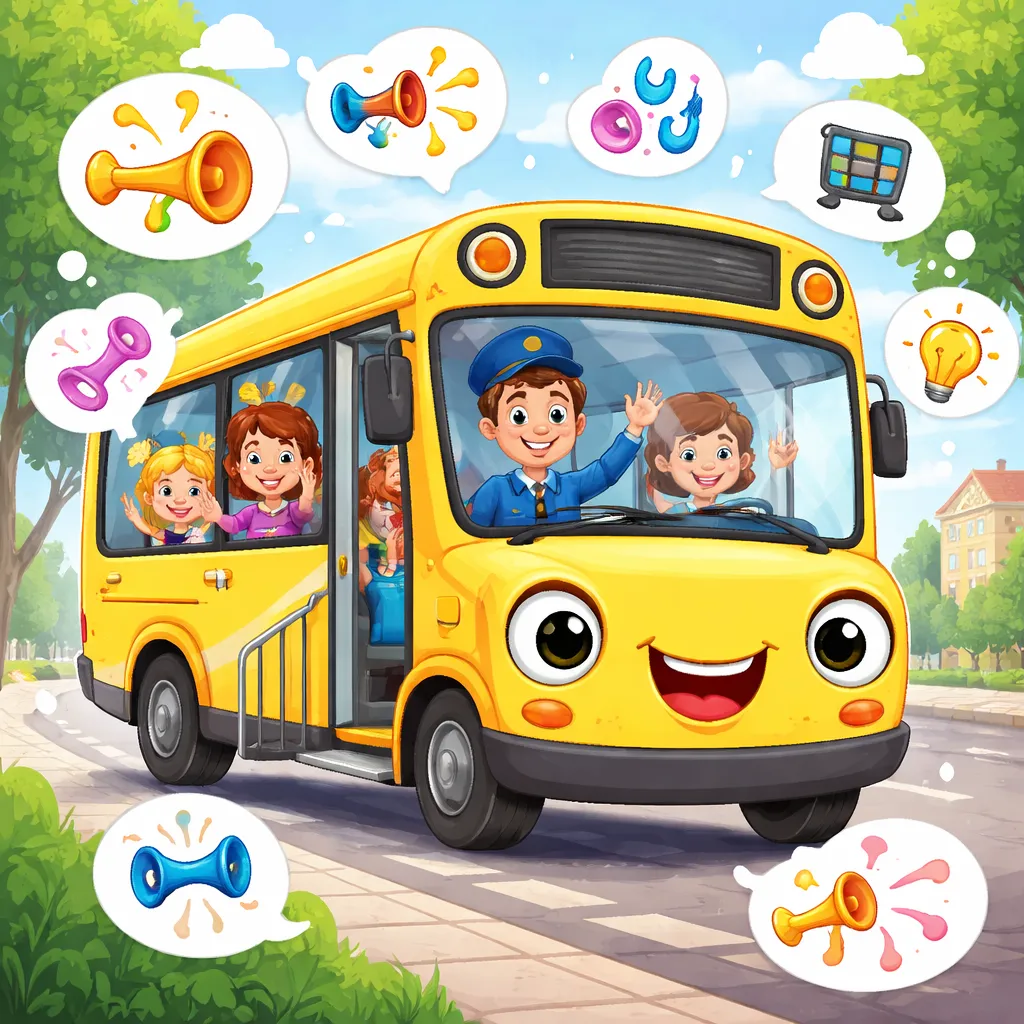

Have you ever ridden on a big, rumbling bus? It is a whole world of wonderful noises! The engine hums, the doors open and close, and the wheels go round and round. There is a song that collects all these sounds and turns them into music. In Russian, the song is called “Колеса автобуса” (The Wheels of the Bus). Let’s climb aboard and learn all the sounds in the Russian song “The Wheels on the Bus (Колеса автобуса)”!
About the Song
Here is the fun and lively Russian version of this classic cumulative song:
Колеса автобуса крутятся-крутятся,
Крутятся-крутятся, крутятся-крутятся.
Колеса автобуса крутятся-крутятся,
Весь день.
Двери автобуса открываются-закрываются…
Весь день.
Стеклоочистители шуршат-шуршат…
Весь день.
Гудок автобуса бип-бип-бип…
Весь день.
Младенцы в автобусе уа-уа-уа…
Весь день.
Мамы в автобусе тш-тш-тш…
Весь день.
English Translation:
The wheels on the bus go round and round,
Round and round, round and round.
The wheels on the bus go round and round,
All day long.
The doors on the bus go open and close…
All day long.
The windshield wipers go swish-swish-swish…
All day long.
The horn on the bus goes beep-beep-beep…
All day long.
The babies on the bus go wa-wa-wa…
All day long.
The moms on the bus go shh-shh-shh…
All day long.
This is the beloved Russian adaptation of the English-American children’s classic “The Wheels on the Bus.” Like its English cousin, it is a “cumulative” action song, where each verse adds a new part of the bus and its sound. The song takes the everyday experience of a bus ride and turns it into a playful symphony of sounds and movements that children can act out. It is a staple in Russian kindergartens, turning any room into a moving, noisy, happy bus.
What the Song is About
The song is a playful tour of a busy bus. It starts with the most important part: the wheels. “Колеса автобуса крутятся-крутятся.” The wheels spin and spin. You can make your hands go round and round like wheels turning. Then, the doors. “Двери автобуса открываются-закрываются.” The doors open and close. You can swing your arms like big bus doors.
Next, the weather changes! The “стеклоочистители” (windshield wipers) go “шуршат-шуршат” (swish-swish-swish). Your arms can move side to side. The driver presses the horn: “Гудок… бип-бип-бип!” You can beep an imaginary horn. Then we meet the people. Babies cry “уа-уа-уа,” and moms soothe them with “тш-тш-тш” (shh-shh-shh). The song builds a whole busy, noisy, loving world on one bus, all day long.
Who Made It & Its Story
“The Wheels on the Bus” is a traditional folk song for children, with origins in the mid-20th century United States. The Russian version, “Колеса автобуса,” is a direct and charming translation and adaptation that became deeply embedded in Russian-speaking childhood. It is loved for three big reasons. First, it is incredibly interactive and physical—children get to do the actions of spinning wheels, swishing wipers, and beeping horns. Second, it is a fantastic teaching tool for vocabulary and sounds, introducing parts of a vehicle and their associated onomatopoeic noises. Third, it creates a sense of community and shared play, as a whole group of children can pretend to be on the same bus, doing the same actions together.
When to Sing It
This song is perfect for turning travel or waiting time into fun. You can sing it on a real bus or car ride, matching the actions to what you see outside. You can sing it during playtime with friends, making a long line of chairs your bus and all being passengers together. You can also sing it in a group circle, with everyone doing the synchronized actions loudly and proudly.
What Children Can Learn
This energetic and descriptive song is a wonderful teacher for learning about vehicles, actions, and playful sounds in Russian.
Vocabulary
The song teaches us clear words for bus parts and the sounds they make. “Wheels” (Колеса / ka-LYO-sa). “Bus” (автобуса / av-TO-boo-sa). “Go round and round” (крутятся-крутятся / KROO-cha-tsa KROO-cha-tsa). “All day” (Весь день / Vyes’ dyen’). “Doors” (Двери / DVYE-ri). “Open and close” (открываются-закрываются / at-kry-VA-yut-sa za-kry-VA-yut-sa). “Windshield wipers” (Стеклоочистители / Stek-la-o-CHI-sti-te-li). “Go swish-swish-swish” (шуршат-шуршат / shoor-SHAT shoor-SHAT). “Horn” (Гудок / goo-DOK). “Goes beep-beep-beep” (бип-бип-бип / beep-beep-beep). “Babies” (Младенцы / MLA-dyen-tsy). “Cry wa-wa-wa” (уа-уа-уа / wa-wa-wa). “Moms” (Мамы / MA-my). “Go shh-shh-shh” (тш-тш-тш / tsh-tsh-tsh).
Let’s use these words! You can describe a bus: “Колеса автобуса крутятся.” (The wheels of the bus spin.) New word: Пассажир (pas-sa-ZHEER). This means “passenger.” You can say, “Мы пассажиры в автобусе.” (We are passengers on the bus.)
Language Skills
This song is excellent for learning about nouns in the plural form, like “колеса” (wheels) and “двери” (doors), and how they are used with verbs. It also introduces the present tense for repetitive actions: “крутятся” (they spin), “шуршат” (they swish).
Concept Definition: We are learning about words for more than one thing, like “wheels” instead of just one “wheel.” We are also learning about action words that describe what things are doing right now, over and over again.
Features and Types: Many Russian nouns change their ending when there is more than one. “Колесо” (one wheel) becomes “Колеса” (wheels). “Дверь” (one door) becomes “Двери” (doors). The verbs that go with them often end with “-ятся” or “-ат” when we talk about what “they” are doing.
Example from the song: Plural Nouns: “Колеса автобуса…” “Двери автобуса…” Present Tense Actions: “…крутятся-крутятся.” “…шуршат-шуршат.”
How to Spot Them: Here is the “More-Than-One Finder” trick. Look for words that end with “-а” or “-и” when talking about objects, like “колеса” or “двери”. Ask: “Is the singer talking about one thing or many?“ For the actions, listen for words that end with “-ятся” or “-ат” and are repeated. Ask: “Is the singer describing a sound or action that happens again and again?“
How to Use Them: A great way to talk about a busy scene is the “Много [Things] [Do This]” (Many [Things] [Do This]) formula. Name the plural thing, then say what it does with a repeating action verb.
Example from the song: “Колеса автобуса крутятся-крутятся.“
Example you can make: “Шарики в коробке прыгают-прыгают.“ (The balls in the box jump and jump.)
Sounds & Rhythm Fun
The melody of “Колеса автобуса” is bouncy, repetitive, and incredibly catchy, like the motion of a bus. The rhythm has a steady “rolling” feel that perfectly matches the spinning wheels.
The sounds are the best part! The repetition in “крутятся-крутятся” mimics the endless turning. The onomatopoeia is fantastic: “шуршат” sounds like wipers on glass, “бип” is the perfect beep, “уа” is a baby’s cry, and “тш” is the universal shush. The repeated “весь день” (all day) at the end of each verse gives the song a comforting, predictable structure. This pattern makes it easy to invent new verses. Try a new one: “Кошки в автобусе мяу-мяу-мяу, мяу-мяу-мяу, мяу-мяу-мяу. Кошки в автобусе мяу-мяу-мяу, Весь день.“ (The cats on the bus go meow-meow-meow… All day long.)
Culture & Big Ideas
While the song is international, the Russian version fits perfectly into the culture of group activities and public transportation. Trolleybuses and trams are common in Russian cities, making the bus a very familiar setting. The song is a fixture in детский сад (DET-skiy sad, kindergarten), promoting group coordination and playful learning.
The song conveys three wonderful ideas. First, it develops observation skills by encouraging children to notice and name the different parts of a vehicle (wheels, doors, wipers) and connect them to their functions and sounds. Second, it celebrates onomatopoeia and playful language, showing how fun it is to imitate the sounds of the world around us, from mechanical beeps to human shushes. Third, it depicts a mini-community, showing how different people (babies, moms, the driver) coexist in a shared space, each with their own role and sound, fostering early social awareness.
Values & Imagination
Imagine you and your friends are building a bus out of pillows and chairs. You are the driver. You start the engine. “Колеса автобуса крутятся-крутятся!” Everyone moves their arms in big circles. The bus is moving! You shout, “Двери открываются-закрываются!” as friends pretend to get on and off.
Oh no, it starts to rain! Everyone shouts, “Стеклоочистители шуршат-шуршат!” and moves their arms side to side like wipers. A friend pretends to be a crying baby: “Уа-уа-уа!” Another friend becomes a comforting mom: “Тш-тш-тш.” Your bus is full of life, sound, and care, rolling along “весь день” – all day long. Draw your own magical bus. Instead of just wheels and doors, what funny parts could it have? Maybe wings that go “вжик-вжик” (vzhik-vzhik) or a cookie machine that goes “ням-ням-ням” (nyam-nyam-nyam). Draw these parts and write their sounds. This shows the song’s power to spark imagination.
The song encourages us to be curious observers of the machines and people around us, to find joy and music in everyday sounds, and to work together to create a fun, imaginative play scene. A wonderful activity is to go on a “Звуковая Охота” (Sound Hunt). The next time you are on a bus or in a car, close your eyes and listen. What sounds do you hear? Can you make a Russian sound for it, like “гр-гр” for the engine or “скрип” for the door?
So, from the spinning wheels to the beeping horn and the gentle “тш-тш-тш,” the Russian song “The Wheels on the Bus (Колеса автобуса)” is a joyful ride through language and sound. It is a vocabulary lesson in vehicle parts and noises. It is a language lesson in plural nouns and repeated actions. It is a music lesson in catchy, cumulative rhythm. It teaches us to listen, to imitate, and to build a noisy, happy world together.
Your Core Takeaways
You are now an expert on the Russian song “The Wheels on the Bus (Колеса автобуса).” You know it is an action song that describes all the parts of a bus and the sounds they make, from spinning wheels to crying babies. You’ve learned Russian words like “колеса,” “крутятся,” “двери,” “шуршат,” “бип,” and “тш,” and you’ve practiced naming groups of things (plural nouns) and saying what they do with repeating action verbs. You’ve felt its bouncy, rolling rhythm. You’ve also discovered the song’s message about observing the world closely, having fun with sounds, and imagining a whole community on a journey together.
Your Practice Missions
First, play the “Что в Автобусе?” (What’s on the Bus?) game. Look around your room or outside. Choose an object and imagine it is on your magic bus. Say: “[Thing] в автобусе [sound]-[sound]-[sound], [sound]-[sound]-[sound], [sound]-[sound]-[sound]. [Thing] в автобусе [sound]-[sound]-[sound], Весь день.“ For example, “Собаки в автобусе гав-гав-гав… Весь день.“ (Dogs on the bus go woof-woof-woof… All day.) This mission helps you create your own verses using the song’s perfect pattern.
Second, be a “Дирижер Автобуса” (Bus Conductor). Gather your family or toys. You are the song leader. Sing the song, and for each verse, show everyone the action (spinning arms for wheels, shushing for moms). Lead your “bus” through all the verses, getting everyone to do the actions and make the sounds together. This mission lets you experience the joy of leading the communal fun of the song.