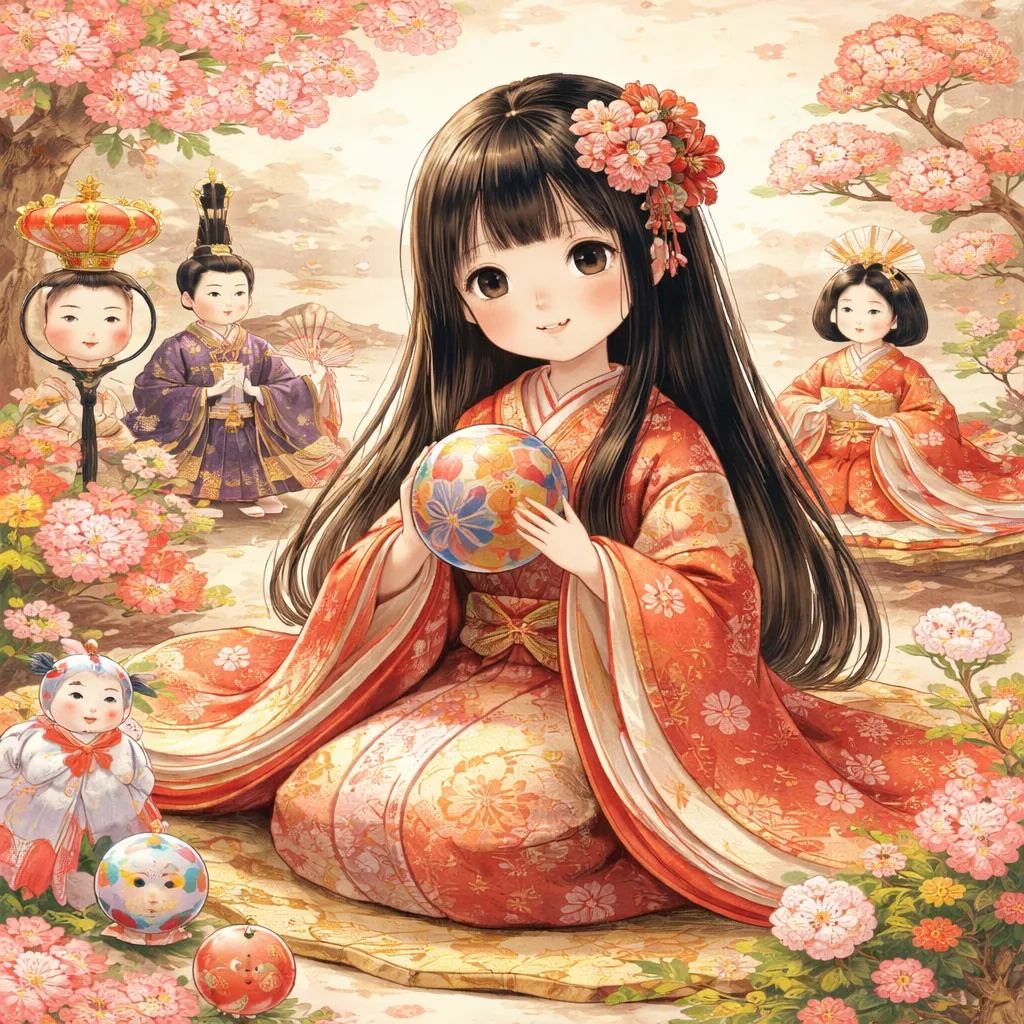

Have you ever seen a very special doll? Not a doll for playing rough games, but a doll dressed in a beautiful, delicate kimono, sitting quietly on a shelf. Maybe in a friend’s house, a museum, or in a book. These dolls seem to hold quiet stories in their painted eyes. In Japan, dolls are more than toys; they are treasures of art and love. There is a famous song that sings about this special feeling. Let’s discover the Japanese Song: The Doll of Japan (にっぽんのまり).
About the Song Here are the gentle and beautiful lyrics of this song: にっぽんのまりは よいまり (Nippon no mari wa yoi mari) The dolls of Japan are fine dolls おひなさまも かみしもも (Ohinasama mo kamishimo mo) The princess dolls and the lord dolls かわいい かわいい にっぽんのまり (Kawaii kawaii Nippon no mari) Lovely, lovely dolls of Japan
きものをきて かんざしさし (Kimono o kite kanzashi sashi) Wearing kimonos and hairpins おいて かざる ひなまつり (Oite kazaru Hina Matsuri) We display and decorate for Hina Matsuri かわいい かわいい にっぽんのまり (Kawaii kawaii Nippon no mari) Lovely, lovely dolls of Japan
This song’s original Japanese name is “にっぽんのまり” (Nippon no Mari), and it is a beloved classic. The song talks about the traditional dolls displayed during a special spring festival. It doesn’t just call them dolls; it calls them “fine dolls” and describes their beautiful clothes. The song is like a gentle, musical tour of a doll display, filled with admiration and care. It teaches us to look closely and appreciate beauty and tradition.
What the Song is About The song paints a picture of a careful, pretty display. First, it shows us many beautiful dolls. Some are “princess dolls” in fancy, multi-layered kimonos. Others are “lord dolls” wearing special samurai outfits called kamishimo. The singer tells us these are wonderful, lovely dolls. Then, we look closer. We see the tiny details on each doll’s kimono—the patterns of flowers, birds, or rivers. We see the delicate hairpins in their hair. The song explains that families bring out these special dolls and arrange them on stepped stands for a festival called Hina Matsuri. The whole scene is one of beauty, respect, and quiet celebration.
Who Made It & Its Story The song was written by a famous Japanese lyricist, Inoue Tetsu (井上赳), and composed by Motoori Nagayo (本居長世). It was created to celebrate Japanese culture and teach children about the Hina Matsuri (Doll Festival) tradition. In Japan, families with daughters display a set of ornamental dolls every spring to wish for the girls’ health and happiness. This Japanese Song: The Doll of Japan (にっぽんのまり) is like a musical part of that celebration. It is popular for three main reasons. First, its melody is sweet, simple, and very easy for children to remember and sing. Second, it connects children directly to a beautiful and important cultural tradition in a joyful way. Third, it fosters a feeling of care and respect for beautiful objects that represent family history and good wishes.
When to Sing It You can sing this song happily with your family while helping to carefully set up or look at a special doll display at home, maybe during a cultural celebration. It’s lovely to hum while drawing or coloring pictures of dolls in beautiful, detailed kimonos, imagining their patterns. You could also sing it with friends at school during an international day, sharing a piece of Japanese festival joy.
But the Japanese Song: The Doll of Japan (にっぽんのまり) is more than a festival tune. It is a gentle teacher hiding lessons about careful words, cultural stories, and kind feelings. When we listen to its sweet melody, we can learn about language, rhythm, and the big ideas of taking care and showing respect.
What Children Can Learn
Vocabulary This song introduces us to special words about tradition and beauty. Display: To show something in a careful, pretty way so people can look at it. Museums display art. We display trophies on a shelf. “We will display the dolls on the red steps.”
Delicate: Very fine, light, or easy to break. A butterfly’s wing is delicate. A soap bubble is delicate. “The doll’s kimono has delicate embroidery.”
Admire: To look at something with pleasure and think it is beautiful or good. You admire a colorful sunset. You admire a friend’s drawing. “I admire the careful craft of the doll maker.”
Heirloom: A valuable object that belongs to a family for a very long time, passed from grandparents to parents to children. An old watch or a special piece of jewelry can be an heirloom. “These festival dolls are a family heirloom.”
Tradition: A special way of doing something that a group of people has done for a long time. Celebrating birthdays is a tradition. Your family’s holiday meals are traditions. “Hina Matsuri is a spring tradition in Japan.”
Cherish: To love and care for something very, very much because it is important to you. You cherish a favorite stuffed animal. You cherish happy memories. “We cherish our time with family during festivals.”
Language Skills This song is a perfect example of using the Simple Present Tense. This tense is for talking about things that are always true, habits, or facts. What Is It?: Think of the Simple Present Tense as the “Always True” or “Usually Does” tense. It tells us about things that happen all the time, or about general facts, not just right now.
Finding the Secret: Look for the main verb (action word). In the simple present, for most nouns (like “dolls,” “families,” “I,” “you,” “we,” “they”), the verb looks plain. The secret clue is that for “he,” “she,” or “it” (like “The doll”), we often add an ‘s’ to the verb. Ask: “Is this something that is generally true or usually happens?”
Using It:
◦   For facts: [Thing] + [Verb]. “The sun rises in the east.” “Dolls wear kimonos.”

◦   For habits: [Person] + [Verb] + [Time]. “I brush my teeth every morning.” “We display dolls in March.”

In our song, it says “The dolls of Japan are fine dolls.” This is a general fact about these dolls. It says “We display and decorate for Hina Matsuri.” This is a habit or tradition that happens every year.
Sounds & Rhythm Fun Listen to the gentle, bouncing sound of the song. The Japanese words have soft, repeated sounds that are nice to say, like “kawaii kawaii” (lovely, lovely). In the song, the phrase “Nippon no mari” (dolls of Japan) repeats, making it easy to remember. The rhythm of the song is not too fast and not too slow. It has a steady, gentle bounce, like a happy, careful walk. This steady, friendly rhythm makes the song easy to clap along to and helps the words stick in your memory. You can use this same bouncy, steady rhythm to make a song about your own favorite thing to collect or display, like rocks, shells, or drawings.
Culture & Big Ideas This song is deeply connected to the Japanese festival called Hina Matsuri (雛祭り), or Doll’s Day, celebrated on March 3rd. Families with daughters set up a special display of dolls on a red-carpeted stand. The dolls represent the Emperor, Empress, and their court in beautiful ancient clothes. People display them to pray for the health and happiness of the girls in the family. They often eat special food like colorful diamond-shaped rice cakes (hishimochi) and sweet rice crackers. The song teaches us three big ideas. First, Cultural Heritage: It shows how objects like dolls can carry history, art, and family wishes from one generation to the next. Second, Careful Observation: It encourages us to look closely at beautiful things to see all the details and hard work that went into making them. Third, Celebration of Growth: The festival, and the song, are about celebrating children and wishing them a good, happy future.
Values & Imagination Close your eyes and listen to the song. Can you imagine being tiny, standing in front of the grand doll display? Can you see the tiny folds of the kimono, the small painted faces, the little fans and instruments in their hands? The Japanese Song: The Doll of Japan (にっぽんのまり) invites you to imagine the story of each doll. Who made them? How many little girls have admired them over the years? The song teaches us to respect and take gentle care of things that are old, beautiful, or full of meaning. It also teaches us to appreciate the love and effort families put into their traditions. A simple idea: Look around your home. Find one object that is old or special to your family. Ask a grown-up to tell you its story. By listening, you are showing respect, just like the song does for the beautiful dolls.
Your Core Takeaways The Japanese Song: The Doll of Japan (にっぽんのまり) is a beautiful window into Japanese culture and a lesson in gentle respect. You learned words like “heirloom” and “tradition” to talk about important family customs. You saw how the Simple Present Tense is used to talk about facts and habits that are always or usually true. You felt the song’s steady, bouncy rhythm. You also learned about the Hina Matsuri festival and its dolls, which represent good wishes for children. Most importantly, the song teaches you to observe beauty carefully, to value family heritage, and to handle precious things—and precious traditions—with care and love.
Your Practice Missions
- Be a Detail Detective. Find a picture of a detailed object (a doll, a decorated cake, a fancy costume in a book). Look at it for one full minute. Then, tell a friend or family member three small details you noticed that you’ve never seen before. This practice in careful observation is what the song encourages.
- Create a “Special Object” Song Line. Think of one special item in your house (a family photo, a souvenir, a cozy blanket). Write one line about it using the song’s bouncy rhythm. Try this pattern: “My [object], so [adjective] and [adjective], it makes me feel [feeling].” For example: “My soft blanket, so warm and blue, it makes me feel cozy and new.” Say your line with a happy, steady beat.