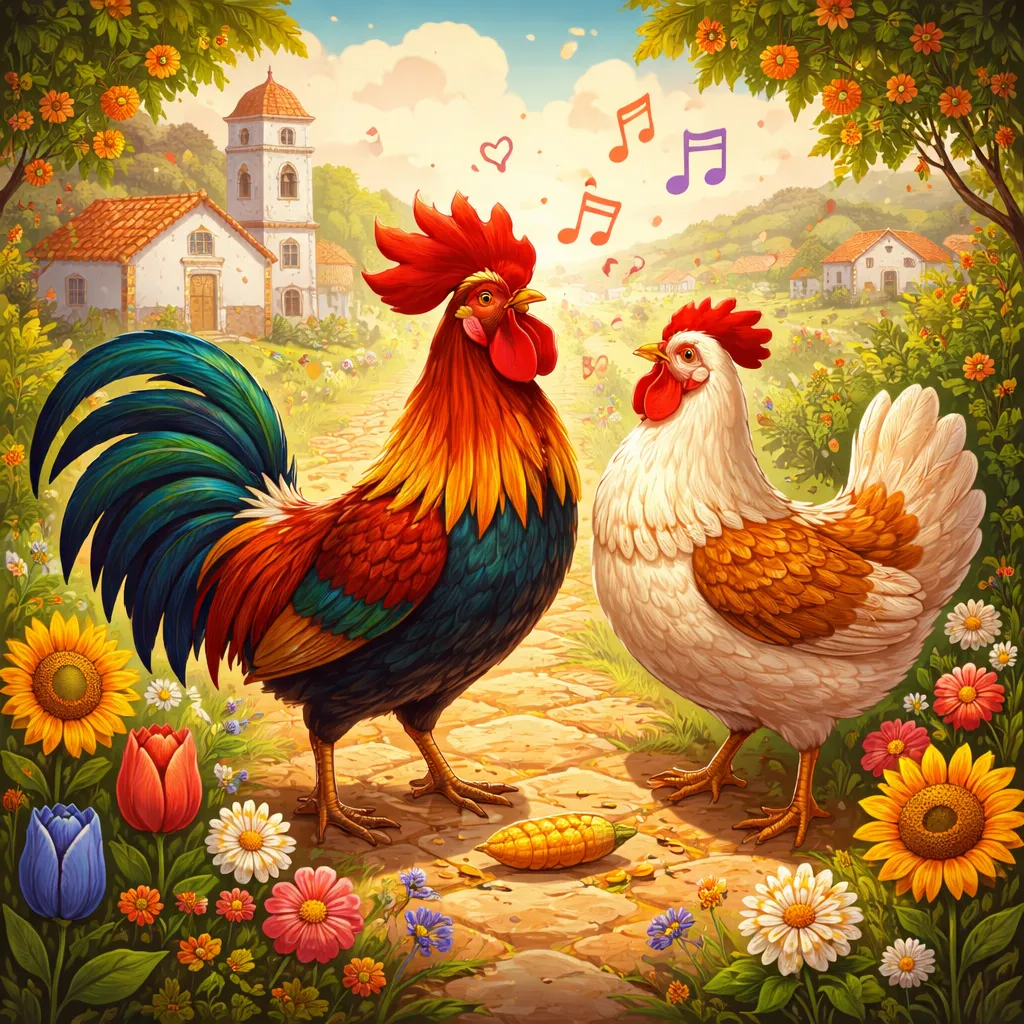

Have you ever woken up early in the morning and heard a rooster crowing? Have you seen a hen scratching the ground, looking for food? In the countryside of Brazil, these animals are part of the daily music of life. There is a fun, back-and-forth song that imagines a playful conversation between them. Let’s visit the farmyard and learn the classic, chatty song “The Rooster and the Hen (O Galo e a Galinha).”
About the Song
Here are the playful, call-and-response lyrics of a very popular traditional Brazilian children’s song. This version focuses on their famous sounds and actions:
O galo canta: "Cocoricó!"
A galinha canta: "Có có có!"
O galo canta: "Cocoricó!"
A galinha canta: "Có có có!"
O galo bate asa, có có có!
A galinha no terreiro, cocoricó!
O galo come milho, có có có!
A galinha põe o ovo, cocoricó!
English Translation:
The rooster sings: "Cock-a-doodle-doo!"
The hen sings: "Cluck cluck cluck!"
The rooster sings: "Cock-a-doodle-doo!"
The hen sings: "Cluck cluck cluck!"
The rooster flaps his wing, cluck cluck cluck!
The hen in the yard, cock-a-doodle-doo!
The rooster eats corn, cluck cluck cluck!
The hen lays the egg, cock-a-doodle-doo!
This is a classic Portuguese-language children’s song from Brazil that celebrates farm animals and their sounds. The word “galo” means rooster, and “galinha” means hen. The song is built like a funny conversation or a mixed-up puzzle. First, they each make their own famous sound: the rooster cries “Cocoricó!” and the hen answers “Có có có!”. Then, the song gets playful. It starts to switch their sounds around! It says the rooster flaps his wing but makes the hen’s sound (“có có có”), and the hen is in the yard but makes the rooster’s sound (“cocoricó”). This silly mix-up makes the song fun and surprising, showing the animals in a joyful, bustling farm scene.
What the Song is About
The song paints a lively picture of a morning on a farm. First, you hear the rooster. He is standing tall on a fence post as the sun rises. He sings his loud, famous song, “Cocoricó!”. Then, you hear the hen. She is walking in the dusty yard with her chicks. She answers with her own sound, “Có có có!”. They call back and forth.
Then, the scene gets busy and playful. The rooster gets excited and flaps his strong wings. But the sound he makes is the hen’s “cluck cluck cluck!”. The hen is busy in the yard, but she lets out a big “cock-a-doodle-doo!”. The rooster pecks at the ground, eating yellow corn, and says “cluck cluck cluck!”. The hen settles in her nest, lays a warm, white egg, and proudly says “cock-a-doodle-doo!”. The song is not a real story, but a happy, mixed-up snapshot of farm sounds and actions, full of energy and silliness.
Who Made It & Its Story
“O Galo e a Galinha” is a beloved traditional Brazilian folk song, part of a large family of songs about animals and farm life. Like many folk songs, it was passed down through generations by singing, not writing. It reflects the familiar sights and sounds of life in many parts of Brazil, where even today, families might keep chickens in their yards. The song’s playful swapping of the animals’ sounds is a classic element of children’s humor, making the ordinary seem funny and new. It is a staple in Brazilian preschools and homes, used to teach animal names, sounds, and to encourage vocal play and imitation.
This joyful song is loved for three clear reasons. First, it is a fantastic and fun way to learn the names and iconic sounds of two very common farm animals in Portuguese. Second, its simple, repetitive, and predictable structure makes it incredibly easy for young children to remember, sing along, and anticipate the silly sound swaps. Third, it invites physical play and acting out—children can pretend to be the rooster crowing and flapping wings or the hen pecking and laying an egg, turning the song into an active game.
When to Sing It
This song is perfect for playful, energetic moments. You can sing it loudly in the morning when you wake up, pretending to be the rooster announcing the new day. You can chant it with a friend during playtime, taking turns being the galo and the galinha and acting out their movements. You can also use it in the car or on a walk, making the animal sounds together for fun.
What Children Can Learn
This lively, funny song is a wonderful teacher about animals, sounds, and simple Portuguese sentences.
Vocabulary
The song teaches us words for animals, their actions, and places in Portuguese. “The rooster” (O galo) is the male chicken who crows. “Sings” or “crows” (canta) is the sound he makes. “Cocoricó!” is the Portuguese sound for a rooster’s crow. “The hen” (A galinha) is the female chicken. “Có có có!” is the Portuguese sound for a hen’s cluck. “Flaps his wing” (bate asa). “In the yard” (no terreiro) means the open ground area. “Eats corn” (come milho). “Lays the egg” (põe o ovo).
Let’s use these words! You can say, “O galo canta de manhã.” (The rooster sings in the morning.) Or, “A galinha põe um ovo.” (The hen lays an egg.) New word: Barnyard. This is the area around a farm building where animals like chickens often live and walk around, like the “terreiro” in the song.
Language Skills
This song is a great lesson in making simple present tense sentences to describe what animals (or people) usually do, and in using the correct word for “the” (O for masculine, A for feminine).
Concept Definition: The simple present tense tells us about things that happen regularly or are always true. Animals do these things as habits. The words “O” and “A” both mean “the” in English, but in Portuguese, every noun has a gender. “O” is for masculine words, and “A” is for feminine words.
Features and Types: Look at the sentences in the song. They all describe what the animals do: “O galo canta.” (The rooster sings.) “A galinha canta.” (The hen sings.) The verbs (canta, bate, come, põe) are in the simple present tense. Notice the first word in each line: “O galo” (The rooster) and “A galinha” (The hen). “Galo” is a masculine word, so it uses “O”. “Galinha” is a feminine word, so it uses “A”.
How to Spot Them: Here is a simple “habit detective” trick. Ask: “What does this animal do every day?” The answer is often a simple present tense sentence. To know if you need “O” or “A,” listen for the word ending. Many masculine words end in -o (like galo), and many feminine words end in -a (like galinha). This is a helpful clue!
How to Use Them: A great way to talk about animals is the “Animal Action Formula”. The pattern is: “O/A + [Animal Name] + [Action Verb].”
Example from the song: “O galo canta.” (The rooster sings.) “A galinha canta.” (The hen sings.)
Example you can make: “O cachorro corre.” (The dog runs.) “A gata dorme.” (The cat sleeps.)
Sounds & Rhythm Fun
Listen to the bright, bouncy rhythm of the melody. The song has a quick, cheerful pace that matches the busy farmyard. The best part is the funny swap of the animal sounds! The rooster’s “Cocoricó!” is long and crowing. The hen’s “Có có có!” is short and clucking. When the song mixes them up (“O galo bate asa, có có có!”), it creates a silly surprise that makes everyone laugh. This playful swap is the heart of the song’s fun.
The rhythm is steady and easy to clap along to. The repeating back-and-forth pattern (rooster line, hen line) makes the song easy to remember and perfect for singing as a duo. This musical structure is perfect for creating your own animal mix-up song! You can write your own “O Cachorro e o Gato” (The Dog and Cat) song! Use the same tune. Try: “O cachorro late: ‘Au au!’ O gato mia: ‘Miau!’ O cachorro brinca, miau miau! O gato corre, au au au!” (The dog barks: ‘Woof woof!’ The cat meows: ‘Meow!’ The dog plays, meow meow! The cat runs, woof woof woof!)
Culture & Big Ideas
“O Galo e a Galinha” connects to the everyday life in many parts of Brazil, where homes in smaller towns and rural areas often have space for chickens. Waking up to the sound of a rooster is a common experience. The song captures this familiar morning scene. It also connects to the culture of “cantigas de roda” (circle songs) and playful animal songs that are used to teach children about the world in a fun, engaging way.
The song conveys three simple but important ideas. First, it helps with animal recognition and the association of specific sounds with specific animals, a key early learning concept. Second, it introduces the concept of daily routines and habits in the animal world—the rooster crows in the morning, the hen lays eggs, both eat. Third, it encourages playfulness, humor, and creative thinking by breaking the expected pattern and swapping the sounds, showing that it’s okay to be silly and mix things up in a fun way.
Values & Imagination
Imagine you are the “galo.” You stand on a wooden fence as the first light of dawn appears. You puff out your chest, take a big breath, and let out your powerful “Cocoricó!” to tell the whole world the sun is rising. You feel strong and important. Then, you flap your bright wings and hop down to the yard. You scratch the earth and find delicious corn. You gobble it up happily. Now, imagine you are the “galinha.” You strut around the “terreiro” with your fluffy feathers. You chatter “Có có có” to your chicks. You find a quiet, cozy spot in the hay. You settle down and work hard to lay a smooth, warm egg. You feel proud. Draw the farmyard scene. Draw the rooster on a fence, crowing. Draw the hen in a cozy nest with an egg. Make sure to write their sounds in big letters above them: “COCORICÓ!” and “CÓ CÓ CÓ!”. This shows the song’s main characters.
The song encourages us to observe animals, learn their habits, and find joy and humor in their sounds and behaviors. A wonderful activity is a “Backyard Sound Safari.” Sit quietly in your garden or look out your window. Listen for birds. Can you hear different songs? Try to make a sound for each bird you hear, just like the song does for the rooster and hen. This connects you to the song’s spirit of listening and playful imitation.
So, from the first crow of the rooster to the final mixed-up line, this song creates a joyful, noisy picture of farm life. It is a vocabulary lesson in animals and their actions. It is a language lesson in making simple sentences and using “O” and “A.” It is a music lesson in a bouncy, call-and-response rhythm with a silly twist. “The Rooster and the Hen (O Galo e a Galinha)” teaches us about animal friends, finds fun in daily routines, and shows that mixing things up can be wonderfully funny.
Your Core Takeaways
You are now an expert on the song “The Rooster and the Hen (O Galo e a Galinha).” You know it is a playful Brazilian folk song about a rooster and a hen having a mixed-up conversation with their sounds. You’ve learned Portuguese words like “galo,” “galinha,” “canta,” “bate asa,” “come,” and “põe,” and you’ve practiced making simple present tense sentences with the correct “O” or “A.” You’ve enjoyed its bouncy, funny rhythm and created your own animal sound-swap verse. You’ve also discovered the song’s message about observing animals, understanding daily habits, and the pure fun of playful silliness.
Your Practice Missions
First, have a “Farmyard Duet.” Find a partner—a friend, sibling, or parent. One of you is the “galo” and the other is the “galinha.” Sing the song, each making your animal’s sound. When you get to the mixed-up parts, act out the action (flap wings, peck for corn) but say the other animal’s sound! This mission helps you practice the song’s vocabulary and its core joke.
Second, create an “Animal Action Card.” Draw a picture of your favorite animal. Below the picture, write a simple Portuguese sentence about it using the “O/A + Animal + Action” formula. For example, “A borboleta voa.” (The butterfly flies.) or “O leão ruge.” (The lion roars.). Say your sentence out loud with the action. This mission helps you use the sentence structure you learned from the song.