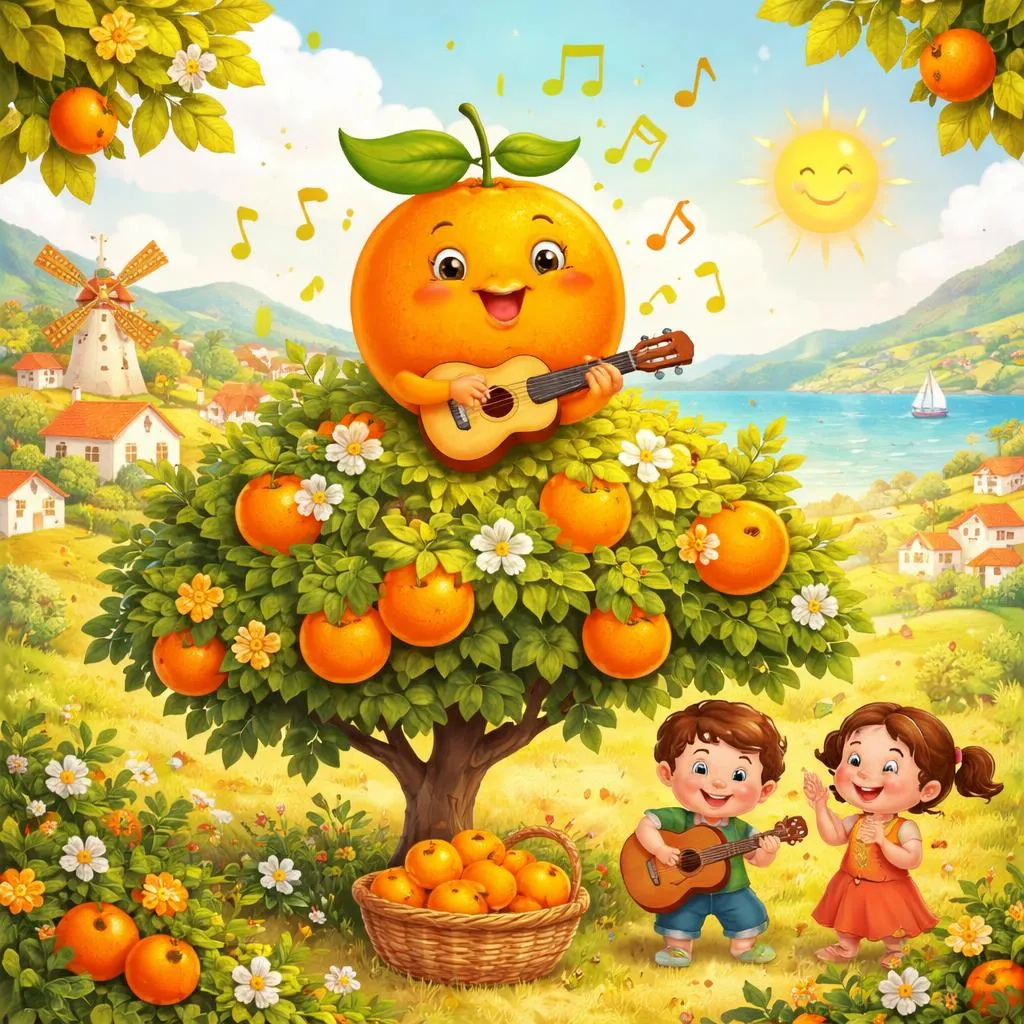

Have you ever held a round, bright orange in your hands? Have you felt its bumpy skin, smelled its sweet, zesty scent, or imagined the juicy slices inside? In Brazil, there is a sweet, playful song that is all about getting to know a little orange using all your senses. It is a song of questions, discoveries, and the simple joy of a piece of fruit. Let’s explore and learn the delightful, descriptive song “The Little Orange (A Laranja).”
About the Song
Here are the charming, curious lyrics of the popular traditional Brazilian children’s song. This version celebrates the orange through playful description:
A laranja é amarela
É amarela ou verde?
É verde, não é amarela
A laranja é verde.
A laranja quando é nova
Tem a casca bem verdinha
Mas depois que vai ficando madura
Fica bem coradinha.
Eu boto a laranja
Desta forma no prato
Pego a faca de prata
E descasco o meu retrato.
Laranja madura
Tá na hora de descascar
Pego a faca de prata
E vou logo fatiar.
English Translation:
The orange is yellow
Is it yellow or green?
It is green, it is not yellow
The orange is green.
The orange when it is new
Has a skin very green
But later as it gets ripe
It gets all colored / reddish.
I put the orange
This way on the plate
I take the silver knife
And I peel my portrait.
Ripe orange
It is time to peel
I take the silver knife
And I go ahead and slice it.
This is a classic Portuguese-language children’s song from Brazil, often sung as a playful game or a rhythmic chant. The song talks directly to and about the orange, a very common and beloved fruit in Brazil. The word “laranja” means orange. The song starts with a playful debate about its color: is it yellow (“amarela”) or green (“verde”)? It decides it’s green when new, but becomes beautifully colored (“coradinha”) when ripe. Then, the singer describes the action of preparing it: putting it on a plate, taking a silver knife (“faca de prata”), peeling it, and slicing it. The song is a mini-celebration of the fruit’s life cycle and the simple, joyful act of getting it ready to eat.
What the Song is About
The song is a close-up, sensory exploration of an orange. Imagine you are holding a small, firm orange. The song starts by looking at it and talking about its color. “The orange is yellow. Is it yellow or green?” You look closely. Maybe it has hints of both! The song decides, “It is green, it is not yellow. The orange is green.” This is like having a friendly chat about what you see.
Then, the song explains why. It describes the orange’s life: when it is new, its peel is very green. But as it grows ripe under the sun, its skin changes to a beautiful, warm color. Next, you get ready to eat it. You place the orange carefully on a plate. You pick up a shiny knife. You carefully peel away the skin. The song calls the orange “my portrait,” which is a poetic way of saying it’s a beautiful picture or treasure. Finally, you slice the ripe orange into pieces. The song is a step-by-step guide to seeing, understanding, and enjoying a simple, wonderful fruit.
Who Made It & Its Story
“A Laranja” is a beloved traditional Brazilian folk song for children, part of the rich tradition of songs about everyday life, food, and playful observation. Brazil is a major producer of oranges, and the fruit is a common part of daily life, from fresh juice to snacks. This song reflects that close relationship, turning a simple fruit into a character for a song. It is often used in preschools and homes to teach colors, the concept of ripening, and even kitchen safety and skills in a fun, musical way. The “silver knife” adds a touch of ceremony and care to the simple act.
This sweet, observational song is loved for three clear reasons. First, it is a fantastic, engaging way to teach colors, opposites (green/yellow), and the concept of change over time (ripening) through a familiar object. Second, it turns an everyday action (peeling fruit) into a small, poetic adventure, celebrating mindfulness and the joy of simple tasks. Third, its gentle, descriptive melody and clear, repetitive lyrics make it easy for young children to learn, sing along, and act out, combining music with playful learning and imagination.
When to Sing It
This song is perfect for hands-on, everyday moments. You can sing it while helping to prepare a snack in the kitchen, acting out the peeling and slicing with a real orange. You can chant it during a learning time about colors or fruits, pointing to different colored objects. You can also hum it on a walk, noticing how other fruits on trees change color as they grow.
What Children Can Learn
This descriptive, gentle song is a wonderful teacher about nature, food, and Portuguese language.
Vocabulary
The song teaches us words for fruits, colors, actions, and objects in Portuguese. The “orange” (a laranja) is the round, citrus fruit. “Is” (é) tells us what something is like. “Yellow” (amarela) and “green” (verde) are colors. “Or” (ou) lets us choose between options. “Not” (não) makes a word negative. “When it is new” (quando é nova) means when it is young. “Skin” or “peel” (a casca) is the outer layer. “Very green” (bem verdinha) – “vinha” makes it sound extra green. “But later” (mas depois) introduces a change. “Gets ripe” (fica madura). “Colored” / “reddish” (coradinha) describes the ripe color. “I put” (eu boto) means I place. “Plate” (prato), “silver knife” (faca de prata), “I peel” (descascar), “my portrait” (meu retrato), “time” (hora), and “I slice” (fatiar) are all action and object words.
Let’s use these words! You can say, “The banana is yellow, not green.” Or, “I put the apple on the plate and slice it.” New word: Ripe. This means a fruit is ready to eat, having grown to full flavor and often changed color, like the “laranja madura” in the song.
Language Skills
This song is an excellent lesson in using adjectives to describe nouns and in making simple negative statements with “não é” (is not).
Concept Definition: An adjective is a word that describes a noun (a person, place, or thing). It tells us what something is like. The song is full of adjectives describing the orange. A negative statement tells us something is not true. We use “não” + the verb to make a simple negative in Portuguese.
Features and Types: Look at the adjectives and negatives in the song. The first line uses an adjective: “A laranja é amarela.” (The orange is yellow.) “Amarela” describes the orange’s color. Then, the song asks a question with “ou” (or): “É amarela ou verde?” (Is it yellow or green?). The answer uses a negative statement: “É verde, não é amarela.” (It is green, it is not yellow.) “Não é” clearly says “is not.” Later, we see more adjectives: “casca bem verdinha” (skin very green), “madura” (ripe), “coradinha” (colored/reddish).
How to Spot Them: Here is a simple “description detective” trick. Ask about the noun: “What is the [noun] like?” The word that answers is often an adjective. For the orange: What is it like? Yellow. Green. Ripe. To find a negative, listen for the word “não” right before a verb like “é” (is) or other action words. It flips the meaning to “is not” or “does not.”
How to Use Them: A great way to describe something is the “is and is not recipe”. The pattern is: “[Thing] + [é] + [Adjective 1]. [Thing] + [não é] + [Adjective 2].”
Example from the song: “A laranja é verde, não é amarela.” (The orange is green, it is not yellow.)
Example you can make: “A maçã é vermelha, não é azul.” (The apple is red, it is not blue.)
Sounds & Rhythm Fun
Listen to the gentle, storytelling rhythm of the melody. The song has a calm, steady pace, perfect for singing while doing an activity like peeling fruit. The repetition of the structure “A laranja é…” and the contrasting words “amarela” and “verde” make the first part easy to remember and almost like a little debate. The words have a musical quality: “verdinha” and “coradinha” rhyme and have a sweet, diminutive “-inha” ending that sounds affectionate. The second half has a more narrative rhythm, describing the actions with words like “boto,” “prato,” “prata,” and “retrato,” which have a nice rhythmic flow.
The rhythm is not too fast, it’s smooth and clear. This gentle melody helps you remember the sequence of ideas: the color talk, the ripening, and the peeling steps. This musical pattern is perfect for creating a song about another fruit or object. You can write your own “A Maçã” (The Apple) song! Use the same tune. Try: “A maçã é vermelha, é vermelha ou verde? É vermelha, não é verde, a maçã é vermelha…” (The apple is red, is it red or green? It is red, it is not green, the apple is red…)
Culture & Big Ideas
“A Laranja” connects to Brazil’s identity as a land of abundant fruits and its culture of enjoying fresh, natural foods. Visiting a “feira livre” (open-air market) in Brazil means seeing mountains of colorful fruits, including many types of oranges. The song reflects the everyday pleasure of preparing and eating fresh fruit. The mention of the “faca de prata” (silver knife) adds a sense of care and even a small ceremony to the act, showing respect for food and the process of enjoying it.
The song conveys three gentle, important ideas. First, it encourages close observation and using the senses (sight, touch, smell, taste) to explore and understand the world, starting with a simple fruit. Second, it teaches about change and growth over time—the orange is not just one color forever; it grows, ripens, and transforms, which is a beautiful part of nature. Third, it celebrates mindfulness and the joy in simple, everyday routines, turning snack preparation into a moment of focus, description, and even poetry.
Values & Imagination
Imagine you are the little orange, the “laranja.” You start as a tiny, hard green bud on a tree in a sunny orchard. The sun warms you, and the rain gives you drinks. Slowly, you grow bigger. Your green skin starts to warm, turning patches of gold and orange. You become heavy, sweet, and full of juice. A hand picks you. You hear a voice singing about your color. You feel gentle hands place you on a cool plate. You feel the careful touch of a knife peeling away your skin, freeing the sweet slices inside. How does the sun feel? How does it feel to be ripe and ready? Now, imagine you are the person holding the orange. You look at its colors. You feel its slightly bumpy skin. You smell the sharp, sweet scent as you peel it. The juice might spray a little. You separate a slice and taste it. Draw the orange at two times. On one side, draw it small and very green on a branch. On the other side, draw it big, orange, and sliced open on a plate. This shows the song’s story of change.
The song encourages us to look closely at the fruits we eat, to appreciate their journey, and to find joy in preparing and sharing them. A wonderful activity is a “Fruit Exploration.” Choose a piece of fruit—an apple, a banana, a pear. Look at it closely. What color is it? Feel its skin. Smell it. Then, with a grown-up’s help, carefully cut it open. Look inside. Describe it in simple words, maybe even in Portuguese: “É amarelo por dentro.” (It is yellow inside.) This connects you to the song’s spirit of discovery.
So, from the first debate about color to the final slice, this song takes you on a sweet, sensory journey with a simple fruit. It is a vocabulary lesson in colors, fruits, and actions. It is a language lesson in using descriptive words and saying “is” and “is not.” It is a music lesson in a gentle, descriptive melody. “The Little Orange (A Laranja)” teaches us to observe the world closely, to appreciate growth and change, and to find small moments of wonder in our everyday lives.
Your Core Takeaways
You are now an expert on the song “The Little Orange (A Laranja).” You know it is a gentle Brazilian song that describes an orange’s color change and the careful act of peeling and slicing it. You’ve learned Portuguese words like “laranja,” “amarela,” “verde,” “madura,” and “descascar,” and you’ve practiced using adjectives and the “não é” (is not) pattern. You’ve felt its calm, storytelling rhythm and created your own fruit description verse. You’ve also discovered the song’s message about careful observation, the beauty of natural change, and the mindfulness in simple tasks.
Your Practice Missions
First, hold a “Color Debate.” Take a piece of fruit that is not fully one color—maybe a banana with a green tip or a peach with a red blush. Look at it and have a friendly debate, just like the song. Say: “A banana é amarela. É amarela ou verde?” (The banana is yellow. Is it yellow or green?) Point and describe what you see. This mission helps you practice the song’s playful questioning and describing in Portuguese.
Second, perform the “Orange Ceremony.” With a grown-up’s help, take a real orange. As you carefully wash it, place it on a plate, and peel it (or watch it being peeled), sing or say the last verse of the song: “Laranja madura, tá na hora de descascar…” Pay close attention to the smells, the feel of the peel, the sight of the slices. Then, share the slices with someone. This turns the song into a real-life, mindful experience of preparing and sharing food.