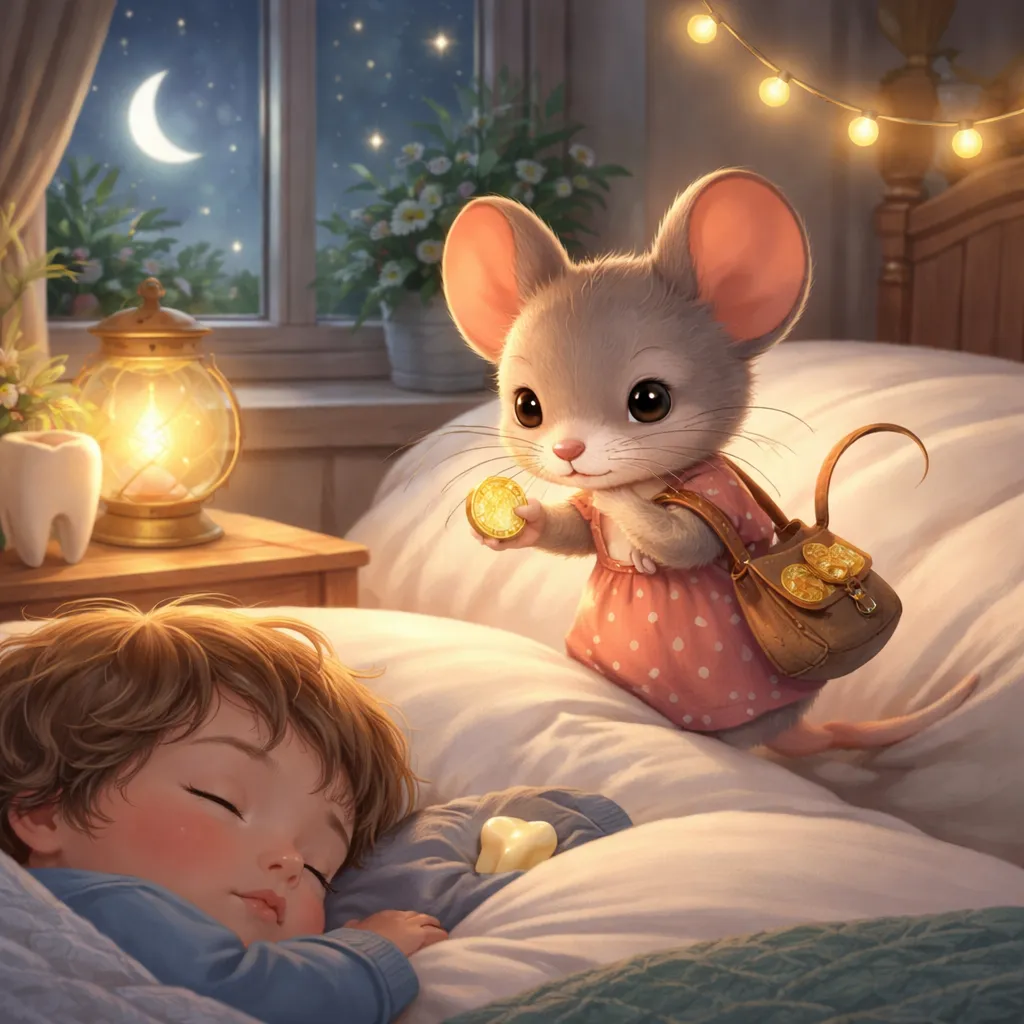

Have you ever lost a tooth? You put it under your pillow, and in the morning, a coin or a small gift is there! In many places, the Tooth Fairy comes. But in France, a different tiny creature visits. What if the gift-bringer was a magical little mouse? There is a charming French song all about this special nighttime visitor. Let’s meet “The Little Mouse (La petite souris).”
About the Song
Here are the gentle and magical lyrics of this classic French children’s song:
La petite souris,
La petite souris,
Vient chercher la dent
Qui bouge, qui bouge.
La petite souris,
La petite souris,
Vient chercher la dent
Qui bouge sur mon oreiller.
Et pendant la nuit,
Tout doucement,
Elle prend la dent
Et laisse de l'argent.
Merci, petite souris,
Pour la pièce brillante!
Maintenant, je vais acheter
Un joli cadeau.
English Translation:
The little mouse,
The little mouse,
Comes to get the tooth
That is wobbly, that is wobbly.
The little mouse,
The little mouse,
Comes to get the tooth
That is wobbly on my pillow.
And during the night,
Very softly,
She takes the tooth
And leaves some money.
Thank you, little mouse,
For the shiny coin!
Now, I will buy
A pretty present.
This is a tender and traditional French folklore song for children. The song tells the story of “La petite souris,” a magical mouse who visits children when they lose a tooth. Instead of a fairy, this little mouse sneaks in at night. She takes the wobbly tooth left under the pillow and replaces it with a small coin. The song imagines the mouse’s quiet visit and the child’s happy “thank you.” It is a song about a special childhood tradition, magic, and saying goodbye to a baby tooth.
What the Song is About
The song is a quiet story about a magical nighttime exchange. First, you have a wobbly tooth. “La dent qui bouge.” It feels funny on your tongue. Finally, it falls out. You are excited. You carefully place the tiny tooth on your soft pillow before you go to sleep.
You whisper, “La petite souris, la petite souris…” calling for the little mouse. You imagine her small, grey shape in the moonlight. She is looking for your tooth. She tiptoes “tout doucement” (very softly) into your room. She is so quiet you do not wake up.
You see her in your mind. She finds your white tooth on the white pillow. With her tiny paws, she picks it up. “Elle prend la dent.” Then, from her little mouse bag, she leaves something behind. A shiny coin! “Et laisse de l’argent.” In the morning, you find the surprise. You are so happy. “Merci, petite souris!” you say. Now you can think of a small gift to buy.
Who Made It & Its Story
“La petite souris” is a traditional French folk song. Its specific creator is unknown. It is deeply connected to the widespread French and Francophone tradition of “La petite souris,” the magical mouse who replaces lost baby teeth with a small gift, a charming alternative to the Anglo-Saxon Tooth Fairy. This song is sung in families to comfort and excite children who have lost a tooth, turning a potentially scary moment into a magical story.
This enchanting song is loved for three wonderful reasons. First, it provides a gentle, reassuring narrative for a common childhood milestone (losing a tooth), transforming a moment of physical change into an exciting, magical event, which helps reduce any anxiety. Second, it celebrates a unique and beloved piece of French childhood folklore, connecting children to a shared cultural experience and tradition that is a special part of growing up in French-speaking families. Third, it teaches gratitude and manners through the child’s “thank you” in the song, framing the magical exchange as a polite transaction and encouraging children to express appreciation for small kindnesses, even imaginary ones.
When to Sing It
This song is perfect for special childhood moments. You can sing it softly at bedtime on the night a tooth falls out, creating a magical anticipation for the morning. You can sing it during a playful pretend game, acting out the mouse taking a button (a “tooth”) from under a pillow and leaving a pretend coin. You can also sing it as a sweet “goodnight” song even when you haven’t lost a tooth, just to dream about friendly nighttime visitors.
What Children Can Learn
This magical, gentle song is a lovely teacher of household nouns, polite phrases, and the concept of possession.
Vocabulary
The song teaches us sweet French words for magical creatures, body parts, and polite actions. “The” (La). “Little” (petite). “Mouse” (souris). “Comes” (Vient). “To look for/to get” (chercher). “The tooth” (la dent). “That” (qui). “Is wobbly” (bouge). “On my pillow” (sur mon oreiller). “And” (Et). “During the night” (pendant la nuit). “Very softly” (tout doucement). “She takes” (Elle prend). “Leaves” (laisse). “Some money” (de l’argent). “Thank you” (Merci). “For the” (Pour la). “Shiny coin” (pièce brillante). “Now” (Maintenant). “I will buy” (je vais acheter). “A pretty present” (un joli cadeau).
Let’s use these words! You can talk about your own things: “Ma dent bouge!” (My tooth is wobbly!). “Mon oreiller est doux.” (My pillow is soft.) New word: Cadeau. This means “gift” or “present.” You can say, “J’ai un cadeau pour toi.” (I have a gift for you.)
Language Skills
This song nicely introduces how to talk about where things are and, importantly, who they belong to. We see the prepositions “sur” (on) and “dans” (in), and we see the little words that show possession: “mon” (my) and “ma” (my).
Concept Definition: We are learning about small words that tell us who something belongs to. Words like “mon” (my) and “ma” (my) are possessive adjectives. They come before a thing to show it is yours. “Mon oreiller” means “my pillow.” We are also using little words like “sur” (on) to tell us where the tooth is.
Features and Types: In French, the word for “my” changes. For masculine things, like “oreiller” (pillow), we say “mon.” For feminine things, like “dent” (tooth), we say “ma.” The pattern is: “[mon/ma] + [thing].” For “on,” we use “sur.” The pattern is: “[thing] + est + sur + [place].” or “[action] + sur + [place].”
How to Spot Them: Here is the “Owner Check” trick. Look for the little words “mon,” “ma,” “ton,” “ta,” “son,” “sa” right before the name of an object. Ask yourself: “Does this word tell me whose object this is?” If yes, it’s showing possession. For “on,” look for “sur.” Ask: “Is this telling me the position of something? Is it on something else?” The song shows both: “sur mon oreiller” (on my pillow).
How to Use Them: A great way to talk about your things and where they are is the “My Place” formula. The pattern is: “[mon/ma] + [thing] + est + [preposition] + [location].”
Example from the song: The tooth is “sur mon oreiller.”
Example you can make: “Mon livre est sur la table.” (My book is on the table.) “Ma tasse est dans la cuisine.” (My cup is in the kitchen.)
Sounds & Rhythm Fun
Listen to the soft, lullaby-like melody of the song. The tune for “La petite souris” is gentle and smooth, perfect for a bedtime story. It has a rocking feeling, like being gently tucked in. The repetition of the first line “La petite souris” twice at the start of each verse is calming and inviting.
The sounds are soft. The “s” sound in “souris” and “chercher” sounds like a whisper. The “ou” in “souris” and “on” sound in “bonne” are round, cozy sounds. The rhythm is slow and steady, like tiptoeing. This gentle melody is perfect for creating your own quiet visitor song. Try an owl song: “Le petit hibou, le petit hibou, vient chanter une chanson tout doucement pour toi…” (The little owl, the little owl, comes to sing a song very softly for you…).
Culture & Big Ideas
“La petite souris” is directly connected to the beloved French family tradition of the tooth mouse. When a French child loses a baby tooth, they place it under their pillow or sometimes in a slipper. During the night, “La petite souris” visits, takes the tooth, and leaves a small coin or gift. This song is a musical part of that ritual, blending everyday life with a touch of magic.
The song conveys three beautiful and comforting ideas. First, it helps children navigate a physical change (losing a tooth) by framing it not as a loss, but as a magical exchange, easing fears and building positive anticipation. Second, it introduces the concept of gratitude and polite exchange (“thank you for the coin”), teaching social manners within a magical, rewarding context. Third, it fosters a sense of wonder and imagination about the hidden, gentle magic in the world, suggesting that kind, secret helpers might exist just out of sight, which enriches a child’s inner world.
Values & Imagination
Imagine you are the little mouse. You are tiny and grey with soft fur and bright, kind eyes. You have a little bag made of a leaf. You wait until the house is quiet and dark. You hear a child sleeping. You climb up the bedpost, one tiny paw after the other. “Tout doucement.” You do not make a sound.
You reach the pillow. There it is! A small, white baby tooth. It is smooth. You pick it up carefully and put it in your leaf bag. It is a treasure for the mouse kingdom. Then, you take out a shiny, new coin from your bag. You place it right where the tooth was. The coin glints a little in the moonlight. You look at the sleeping child and smile a little mouse smile. Then you climb back down and disappear into the night. How does it feel to be a secret, kind helper? Draw the mouse’s visit. Draw a child sleeping in bed. Under the pillow, draw the tiny mouse taking a tooth and leaving a coin. Draw a little thought bubble from the child, showing a happy dream of the mouse. This shows the song’s magical moment.
The song encourages us to find magic in small, everyday events, to be grateful for small surprises, and to imagine the secret, kind lives of little creatures around us. A wonderful activity is to make a “Petite Boîte à Dents” (Little Tooth Box). Decorate a small box with drawings of mice and stars. When you or a friend loses a tooth, you can place it in the box and sing the song, making the tradition extra special.
So, from the wobbly tooth to the shiny morning surprise, this song is a gentle ritual. It is a vocabulary lesson in body parts, bedtime items, and polite words. It is a language lesson in using “mon/ma” (my) and “sur” (on). It is a music lesson in a soft, soothing lullaby. “The Little Mouse (La petite souris)” teaches us about cultural traditions, gratitude, and nighttime magic.
Your Core Takeaways
You are now an expert on the song “The Little Mouse (La petite souris).” You know it is a gentle French song about the magical mouse who visits children at night to take a lost baby tooth and leave a coin or small gift. You’ve learned French words like “souris,” “dent,” “oreiller,” “argent,” “merci,” and “cadeau,” and you’ve practiced possessive words like “mon oreiller” (my pillow) and the preposition “sur” (on). You’ve felt its soft, lullaby rhythm and imagined the mouse’s quiet visit. You’ve also discovered the song’s connection to a special French tradition, and its messages about magic, gratitude, and gentle surprises.
Your Practice Missions
First, play the “Où est ma dent?” (Where is my tooth?) game. Take a small object like a pebble or a button to be the “tooth.” Hide it “sur” (on) or “dans” (in) different things in your room: “sur la table” (on the table), “dans le livre” (in the book). Ask a friend to find it by saying “Elle est sur la table?” This mission helps you practice the location words from the song.
Second, be a “Petit Artiste pour la Souris” (Little Artist for the Mouse). Draw a thank-you card for La petite souris. Write “Merci, petite souris!” at the top. Draw a picture of the mouse, the tooth, the coin, or a happy child. You can even leave this drawing next to your pillow if you lose a tooth, as an extra thank you. This mission lets you use the song’s key word “merci” and express gratitude creatively.