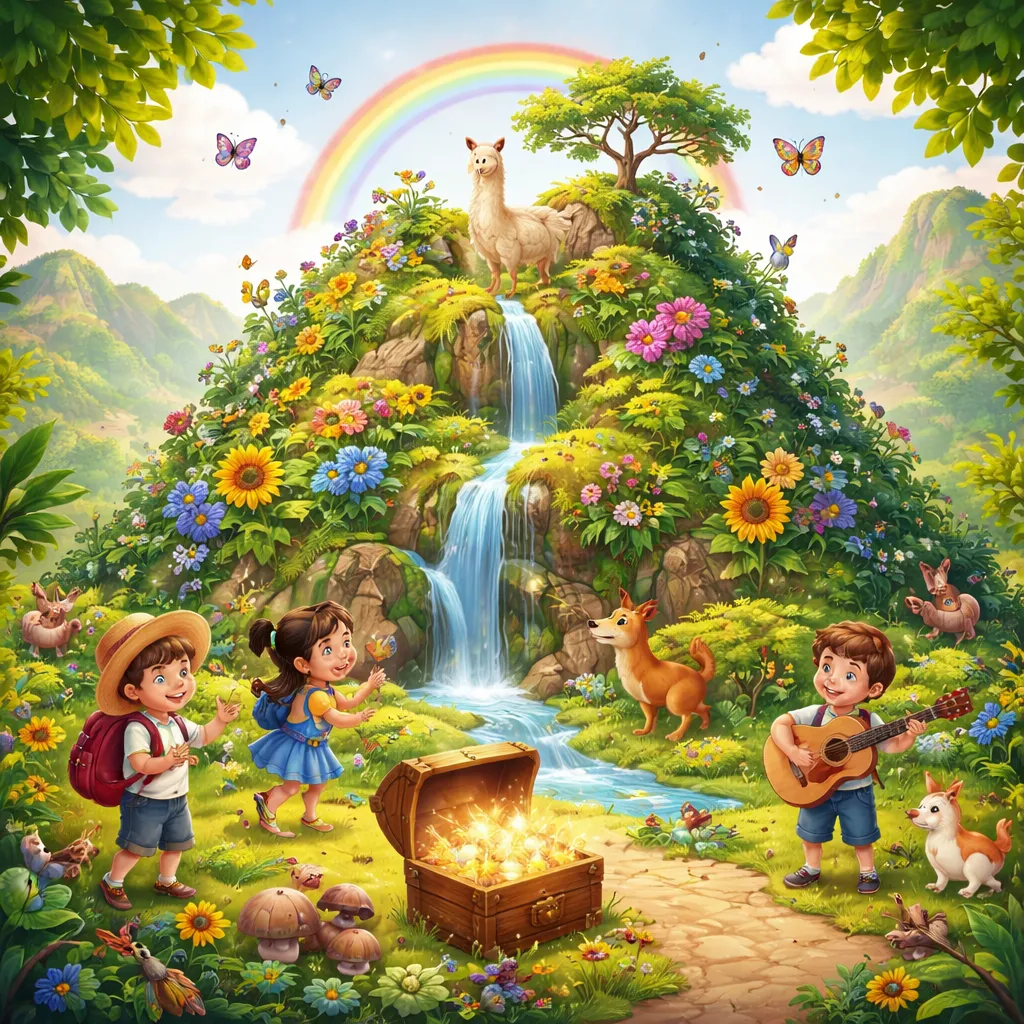

Have you ever looked at a hill or a mountain and wondered what was on the other side? In Spanish, there is a song of adventure and surprise that takes you on a journey over a little mountain. It is a song about climbing, discovering, and the joy of seeing what’s new. Let’s put on our explorer hats and learn the climbing, joyful song “The Little Mountain (La montañita).”
About the Song
Here are the adventurous, playful words of this traditional Spanish folk song. This is a common and energetic version:
A la montañita me voy,
a la montañita me voy.
A ver a mi Chavela,
Chavela, Chavela, sí.
Y cuando ya esté allá arriba,
y cuando ya esté allá arriba.
Le voy a decir: "¡Hola, Chavela!"
"Chavela, Chavela, sí."
Y de la montañita me vengo,
y de la montañita me vengo.
Cantando esta canción,
canción, canción, sí.
English Translation:
To the little mountain I go,
to the little mountain I go.
To see my Chavela,
Chavela, Chavela, yes.
And when I am already up there,
and when I am already up there.
I am going to say to her: "Hello, Chavela!"
"Chavela, Chavela, yes."
And from the little mountain I come back,
and from the little mountain I come back.
Singing this song,
song, song, yes.
This is a classic Spanish folk song and playful journey song. The affectionate word “montañita” uses the small ending “-ita” to mean “dear little mountain,” making the adventure feel friendly and manageable. The song tells a simple story of a trip. Someone is going to the mountain for a specific, happy reason: to visit a person named Chavela. The song celebrates the action of the journey itself—the going, the arriving, and the returning—more than the destination. The melody is usually bouncy, repetitive, and full of cheerful energy, perfect for walking or moving to the beat.
What the Song is About
The song paints a clear, active picture of a short trip to visit a friend. Imagine a person, maybe a child, standing at the foot of a small, green hill. They look up the path, feeling excited, and sing out loud, “To the little mountain I go!” They are on a mission. They are going to see their friend Chavela, who lives on the other side. Maybe Chavela is a cousin, a grandparent, or a friend. The singer is so happy about the visit that they sing the friend’s name twice with a cheerful “yes!”
The singer starts walking, maybe even skipping, up the path. The climb is fun. The singer imagines the moment they reach the top. They sing, “And when I am already up there…” They picture seeing Chavela, waving, and calling out a big, happy “Hello!” The song lets you feel the anticipation of that friendly meeting at the end of the walk. After the visit, it is time to go home. The singer starts the journey back down, singing, “And from the little mountain I come back.” The adventure isn’t over yet! The singer is so happy that they come back down the path still singing the very same song. The whole trip, there and back, is filled with music and joy.
Who Made It & Its Story
“The Little Mountain (La montañita)” is a beloved traditional Spanish folk song and game song. Its origins are in the oral tradition, often sung as a walking song or a simple circle game where children act out going up and down. The name “Chavela” is a common, affectionate nickname for “Isabel” in Spanish, giving the song a personal, friendly feel. The song reflects a culture where walking to visit neighbors or family in nearby villages or over hills was a common part of life. It turns an ordinary journey into a musical celebration. It is often used in preschools and playgrounds to teach prepositions (to, from), verbs of motion (go, come), and to encourage imaginative, active play.
This energetic song is loved for three adventurous reasons. First, it frames a simple journey as an exciting narrative with a clear purpose (to see a friend), making everyday travel feel like an adventure. Second, its highly repetitive structure and call-and-response style (“Chavela, Chavela, sí”) make it incredibly easy to learn, remember, and sing in a group. Third, it celebrates the simple joys of anticipation, friendly visits, and the fun of the journey itself, both going and coming back.
When to Sing It
This song is perfect for active, on-the-go moments. You can sing it loudly while walking or hiking on a trail, making each step part of the beat. You can chant it while climbing up a big slide or a play structure, pretending the top is the “montañita.” You can also sing it as a greeting song when a friend comes to visit, changing “Chavela” to your friend’s name.
What Children Can Learn
This journey-filled, repetitive song is a wonderful teacher about movement, Spanish language, and friendship.
Vocabulary
The song teaches us words for places, actions, and people in Spanish. The “little mountain” (montañita) is a small mountain or a big hill. The word “to” (a) shows direction towards a place. “I go” (me voy) means I am leaving to go somewhere. “To see” or “to watch” (a ver) means to visit and look at someone. “My Chavela” (mi Chavela) is a person’s name, like saying “my friend Isabel.” “And when” (y cuando) connects two things in time. “Already” (ya) means right now or at that moment. “Up there” (allá arriba) means high in that place. “I am going to say” (le voy a decir) means I will tell her. “Hello” (Hola) is a friendly greeting. “From” (de) shows the starting point of movement. “I come back” or “I return” (me vengo) means I am coming from there to here. “Singing” (cantando) is making music with your voice. “This song” (esta canción) is the music you are making right now.
Let’s use these words! You can say, “I go to the park to see my friend.” Or, “From school, I come back singing.” New word: Destination. This is the place where you are going, just like the little mountain is the singer’s destination to see Chavela.
Language Skills
This song is a fantastic lesson in using simple prepositions of movement (“a” and “de”) and the verb “ir” (to go) to talk about the future.
Concept Definition: A preposition of movement is a small word that shows where something is moving to or from. In this song, “a” means movement towards a place (to the mountain), and “de” means movement away from a place (from the mountain). The phrase “voy a” is a special way to talk about what you are going to do soon.
Features and Types: Look at the movement in the song. “A la montañita me voy” uses “a” to show the direction: to the mountain. “De la montañita me vengo” uses “de” to show the origin: from the mountain. For talking about future plans, the song uses “voy a” + [verb]: “Le voy a decir” (I am going to say). This is a very common and useful way to talk about the immediate future in Spanish.
How to Spot Them: Here is a simple “movement clue.” When you hear “a” followed by a place (a la escuela, al parque), it often means “to” that place. When you hear “de” followed by a place (de la casa, del colegio), it often means “from” that place. For future plans, listen for “voy a” or “vas a” right before an action word. Ask yourself: “Is the singer talking about going somewhere or coming from somewhere? Are they talking about what they will do next?”
How to Use Them: A great way to talk about your trips is the “trip recipe”. The pattern is: [A + Place] + [voy/vengo].
Example from the song: “A la montañita me voy.” (To the little mountain I go.) “De la montañita me vengo.” (From the little mountain I come back.)
Example you can make: “A la casa de mi abuela voy.” (To my grandma’s house I go.)
To talk about what you’ll do, use: [Yo] + [voy a] + [Action].
Example: “Voy a jugar fútbol.” (I am going to play soccer.)
Sounds & Rhythm Fun
Listen to the marching, climbing rhythm of the melody. The song has a strong, walking beat that makes you want to move your feet. The repetition of each line (“A la montañita me voy”) is powerful and helps everyone sing along easily, just like footsteps. The playful, singsong repetition of the name “Chavela, Chavela, sí” acts like a happy chorus or a call-and-response part. Words like “montañita,” “Chavela,” and “canción” have a musical, lyrical quality that is fun to say. The melody often rises on “allá arriba” (up there) as if climbing, and comes back down smoothly on “me vengo” (I come back).
The rhythm is steady and march-like. Try walking in place to the beat: A la mon-ta-ñi-ta me voy, a la mon-ta-ñi-ta me voy. The clear, repetitive structure of going, being there, and coming back makes the song’s story incredibly easy to remember and act out. This marching, repetitive musical pattern is perfect for action songs. You can write your own “journey song”! Use the same marching melody. Try: “Al parque bonito me voy, al parque bonito me voy. A ver a mi amigo, Luis, Luis, sí.” (To the pretty park I go, to the pretty park I go. To see my friend, Luis, Luis, yes.)
Culture & Big Ideas
“La montañita” connects to the Spanish tradition of walking, pilgrimage, and community visits. In many regions, towns are connected by paths over hills, and visiting neighboring villages or family is a common activity. The song simplifies this into a child’s adventure. It reflects a culture where personal connections and the journey itself are valued. The destination (“a ver a mi Chavela”) is a person, not just a place, highlighting the importance of friends and family. The song can also remind us of the famous “Camino de Santiago” (Way of Saint James), a long walking pilgrimage in Spain, but for children, it’s a simple, joyful trip to see a friend.
The song conveys three important ideas. First, it’s about having a clear and happy goal. The singer isn’t just wandering; they are going to the mountain for the specific, joyful purpose of seeing Chavela. Second, it expresses the joy found in the process of travel—the going, the arriving, and the returning are all celebrated with song. Third, it highlights connection and greeting. The climax of the journey is the friendly “¡Hola!” which celebrates seeing someone you care about.
Values & Imagination
Imagine you are the singer. You stand at the bottom of a soft, grassy hill—your “montañita.” The path winds up ahead. You take your first step and sing, “A la montañita me voy!” What do you see as you climb? Maybe a butterfly, a funny-shaped rock, or a stream. The higher you go, the more you can see behind you. How does the world look from halfway up? You reach the top, a little out of breath but excited. You see a little house with a red roof on the other side. That’s where Chavela lives! You wave and call out, “¡Hola, Chavela!” How does it feel to finally arrive? After a nice visit, you start back down. The journey home feels different. You sing the same song, but now you’re thinking about the fun visit. Now, imagine you are Chavela. You hear your friend singing as they climb the mountain. You run to your window and see them at the top, waving. How do you feel? Draw the journey. Draw a winding path up a hill. At the bottom, draw a little person singing. At the top, draw the same person waving. On the other side of the hill, draw a house with a person waving from the window. Draw a path back down. This shows the whole adventure there and back.
The song encourages goal-setting, perseverance, and the joy of friendship. A wonderful activity is to create a “Journey Map.” Choose a short journey you make often, like walking to a friend’s house, to the park, or to the mailbox. Draw a simple map. Mark the start and end points. Draw what you see along the way. Then, sing the song “La montañita,” but change the words to fit your journey. For example, “A la casa de Leo me voy…” This turns your everyday walk into a musical adventure.
So, as the final “sí” fades and the imaginary journey ends, think about the simple adventure in this walking tune. It is a vocabulary lesson in movement and places. It is a language lesson in using “to” and “from” and talking about future plans. It is a music lesson in a strong, marching rhythm. From the first step towards the mountain to the return trip singing, it wraps lessons in purpose, friendship, and joyful travel in a melody that makes you want to get up and go. “The Little Mountain (La montañita)” teaches us that journeys are fun when we have a friend to visit, that getting there is part of the adventure, and that a happy song makes the trip even better.
Your Core Takeaways
You are now an expert on the song “The Little Mountain (La montañita).” You know it is a traditional Spanish song about a journey to visit a friend and the happy travel back. You’ve learned Spanish words like “montañita,” “voy,” and “vengo,” and you’ve practiced using “a” and “de” to talk about going to and coming from places. You’ve felt its strong, marching rhythm and created your own journey verse. You’ve also discovered the song’s message about having a happy goal, enjoying the journey, and the warmth of greeting a friend.
Your Practice Missions
First, be a “Journey Singer.” The next time you walk somewhere with a clear purpose—like to the kitchen for a snack, to your room to get a toy, or to the garden—sing about it. Use the song’s pattern: “A la [place] me voy, a la [place] me voy. A ver a mi [person or thing], sí!” This turns a simple walk into a mini-adventure with music.
Second, create a “Greeting Card Journey.” Think of a friend or family member you’d like to “visit.” Draw a path on a piece of paper leading from your house to theirs. At the end of the path, draw their house. Along the path, draw things you might “see” on your way (a tree, a cat, a car). Give the card to them and explain your drawing. This mission connects the song’s idea of a purposeful journey to someone you care about.