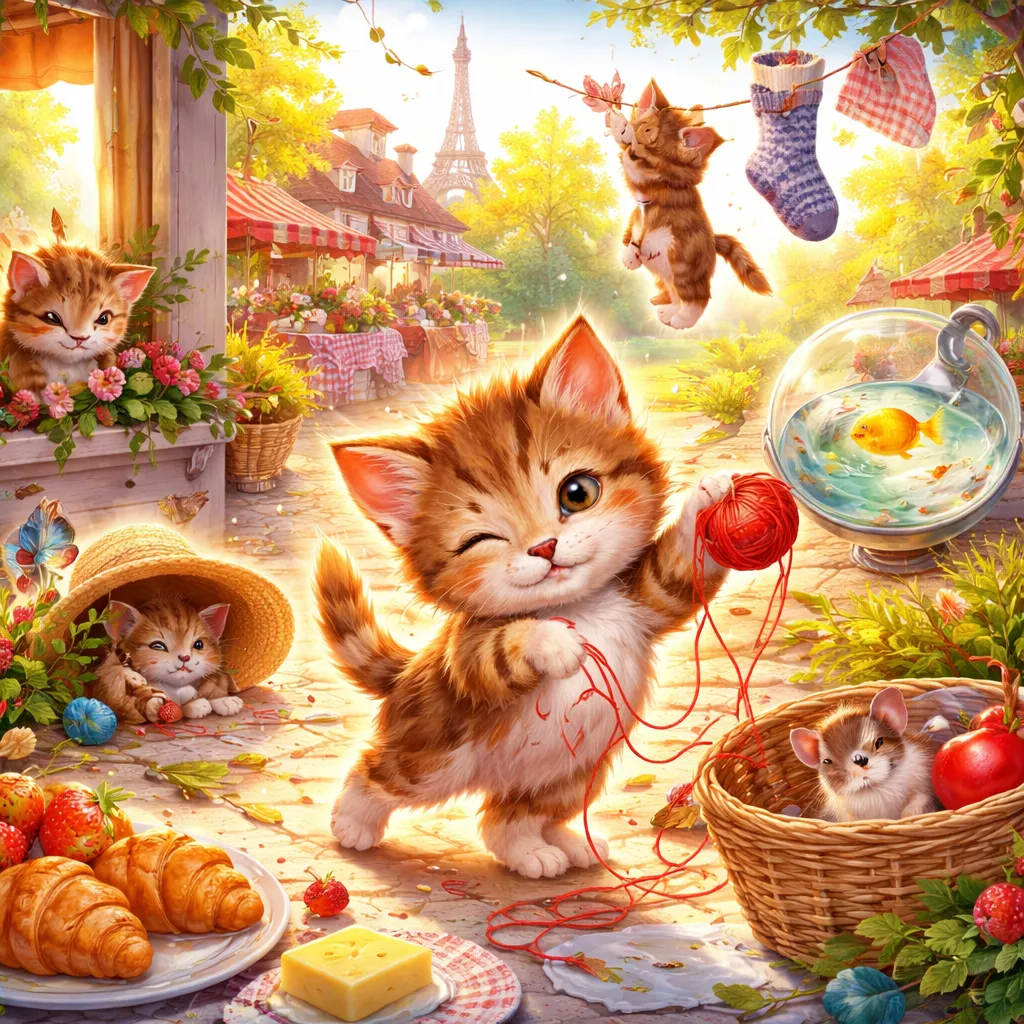

Have you ever watched a cat? They can be so silly! They chase their own tails, pounce on invisible things, and rub their heads against your leg. Have you ever wished you could tell a cat what to do? There is a funny and classic French song that lets you do just that. It is a song about giving a little cat playful commands. Let’s learn the song “The Little Cat (Le petit chat)” and tell a cat how to be silly.
About the Song
Here are the playful and commanding lyrics of this beloved French children’s song:
Petit chat, petit chat,
Petit chat, petit chat.
Tourne, tourne, tourne-toi.
Petit chat, petit chat.
Petit chat, petit chat,
Petit chat, petit chat.
Frotte, frotte, frotte ton nez.
Petit chat, petit chat.
(Common additional verses:)
Lève, lève, lève ta patte.
Petit chat, petit chat.
Saute, saute, saute en l'air.
Petit chat, petit chat.
Dors, dors, dors maintenant.
Petit chat, petit chat.
English Translation:
Little cat, little cat,
Little cat, little cat.
Turn, turn, turn around.
Little cat, little cat.
Little cat, little cat,
Little cat, little cat.
Rub, rub, rub your nose.
Little cat, little cat.
(Common additional verses:)
Lift, lift, lift your paw.
Little cat, little cat.
Jump, jump, jump in the air.
Little cat, petit chat.
Sleep, sleep, sleep now.
Little cat, little cat.
This is a simple and interactive French action song for children. The song is a friendly chant to a little cat. The singer calls the cat, saying “Petit chat, petit chat” over and over. Then, the singer gives the cat a command: “Tourne, tourne, tourne-toi” (Turn, turn, turn around). The song repeats the call and then gives a new command, like “Frotte ton nez” (Rub your nose) or “Lève ta patte” (Lift your paw). It is a song that mixes calling a pet with giving it funny things to do.
What the Song is About
The song is a playful game of pretend commands. Picture yourself looking at a cute little cat. You call it gently, “Petit chat, petit chat,” to get its attention. The cat looks at you with its big eyes.
You have an idea. You tell the cat to do a trick. You say, “Tourne-toi!” (Turn around!). In your mind, you see the little cat spin in a circle, maybe looking a bit dizzy. You call the cat again, “Petit chat, petit chat.”
Now you give a new command. “Frotte ton nez!” (Rub your nose!). Maybe the cat uses its paw to rub its little pink nose, just like cats do when they are washing their face. This is followed by more fun ideas: “Lève ta patte” (Lift your paw) like it is waving hello, “Saute en l’air” (Jump in the air) for a happy bounce, and finally, “Dors maintenant” (Sleep now) to end the game quietly. It is a whole playtime with an imaginary cat.
Who Made It & Its Story
“Le petit chat” is a traditional French folk song. Its specific creator is unknown. It is a staple of French playgroups, kindergartens, and family fun, often used as a movement game where children pretend to be the cat and follow the actions. The repetitive call-and-response structure makes it perfect for engaging young children.
This charming interactive song is loved for three wonderful reasons. First, it is a highly engaging physical game that encourages children to listen, follow simple commands, and move their bodies, promoting coordination and listening skills in a fun, musical way. Second, it introduces the imperative mood (command form) in French naturally and playfully, teaching children how to give and follow instructions through the familiar context of playing with a pet, which feels natural and engaging. Third, it builds vocabulary for body parts (nez, patte) and actions (tourne, frotte) through direct, memorable association with the physical movement, making language learning active and embodied rather than passive.
When to Sing It
This song is perfect for active play and following directions. You can sing it during playtime, acting out all the cat commands yourself with big, silly movements. You can sing it as a clean-up transition song, telling your toy “petit chat” to “saute” (jump) into the toy box. You can also sing it as a gentle, winding-down song before a nap, ending with “Dors maintenant” (Sleep now) as you pretend to curl up and sleep.
What Children Can Learn
This active, playful song is a fantastic teacher of body parts, action verbs, and how to give friendly commands.
Vocabulary
The song teaches us clear French words for animals, body parts, and actions. “Little” (Petit). “Cat” (chat). “Turn (yourself) around” (Tourne-toi). “Rub” (Frotte). “Your” (ton). “Nose” (nez). “Lift” (Lève). “Paw/leg” (patte). “Jump” (Saute). “In the air” (en l’air). “Sleep” (Dors). “Now” (maintenant).
Let’s use these words! You can talk to a toy: “Tourne-toi, petit chien!” (Turn around, little dog!). New word: Tête. This means “head.” You can add your own verse: “Touche, touche, touche ta tête.” (Touch, touch, touch your head.)
Language Skills
This song is a perfect introduction to a very useful way of speaking: the imperative mood. This is how we give commands, instructions, or friendly invitations. The song is full of commands to the little cat.
Concept Definition: We are learning about special, short forms of verbs we use to tell someone (or a pet!) to do something. In the song, we are telling the cat what to do: “Tourne!” (Turn!), “Frotte!” (Rub!). Think of it as the “Do It!” form of a word. It is like when your friend says, “Look!” or “Run!” or when you say, “Please sit.”
Features and Types: In French, the imperative for “you” (tu) is often the same as the normal verb form, but we remove the “tu.” It is direct and simple. The pattern in the song is: “[Command Verb] + [Optional ‘toi’ for ‘yourself’] + [Object].” Examples: “Tourne-toi!” (Turn yourself!). “Frotte ton nez.” (Rub your nose.). “Lève ta patte.” (Lift your paw.). “Dors maintenant.” (Sleep now.).
How to Spot Them: Here is the “Bossy Word” trick. Listen for a verb that is by itself at the start of a sentence, telling someone to do something. It often has an exclamation mark (!) in writing. Ask yourself: “Is this word telling me to do an action right now?” If yes, it is likely an imperative. In the song, every action word is a command to the cat.
How to Use Them: A great way to make a simple command is the “Action Now!” formula. The pattern is: “[Verb in command form] + [person/thing] (optional) + [what/where] (optional).”
Example from the song: “Saute en l’air!” (Jump in the air!)
Example you can make: “Mange ta pomme.” (Eat your apple.) “Regarde le chien!” (Look at the dog!)
Sounds & Rhythm Fun
Listen to the rhythmic, chant-like quality of the melody. The tune for “Petit chat” is simple and repetitive, almost like a nursery rhyme you can clap to. The big fun is in the call-and-response structure. The long call “Petit chat, petit chat” (said four times) builds anticipation. Then comes the quick, three-time command: “Tourne, tourne, tourne-toi!” It feels like a game.
The repetition of the action word three times (“frotte, frotte, frotte”) makes it fun to say and easy to remember. The “-otte” sound in “frotte” and the “-atte” sound in “patte” are playful. The rhythm is steady and bouncy, perfect for doing the actions along with the words. This musical pattern is perfect for creating your own command songs. Try a robot song: “Petit robot, petit robot… Marche, marche, marche tout droit.” (Little robot, little robot… Walk, walk, walk straight ahead.)
Culture & Big Ideas
“Le petit chat” connects to the French tradition of “comptines” (nursery rhymes) and “jeux de doigts” (fingerplays) that blend language learning with physical play. This song is often used in “crèches” (nurseries) to develop motor skills and listening comprehension, showing how French early education values learning through playful, structured games.
The song conveys three important playful ideas. First, it teaches impulse control and body awareness through the game of listening to a command and then physically performing the correct action, which is a key developmental skill for young children. Second, it empowers the child by putting them in the role of the gentle “commander” speaking to the cat, allowing them to practice leadership and direction in a safe, imaginary context. Third, it fosters observation and empathy for animals by having the child imagine a cat performing these natural actions (rubbing its nose, lifting a paw), encouraging them to notice and mimic real animal behavior.
Values & Imagination
Imagine you are the one talking to the little cat. It is a soft, grey kitten with bright green eyes. You kneel down and say softly, “Petit chat, petit chat.” It comes closer, its tail in the air. You smile and give your first command: “Tourne-toi!” The little cat looks at you, then does a funny, wobbly spin. It looks a bit dizzy and makes you laugh.
You call it again. “Petit chat, petit chat.” You point to your own nose. “Frotte ton nez!” The cat stops, lifts a paw, and gives its little pink nose a quick rub with its fur. It is so cute. Next, you say, “Lève ta patte.” The kitten lifts one front paw, as if it is asking for a high-five. How does it feel to play with an animal friend using just your words and your imagination? Draw your playtime with the cat. Draw four small boxes. In the first, draw yourself calling “Petit chat.” In the next, draw the cat spinning. In the third, draw it rubbing its nose. In the last, draw it giving a high-five with its paw. This shows the song’s sequence of call-and-action.
The song encourages us to play pretend, to be gentle leaders in games, and to observe how animals move so we can imitate them in play. A wonderful activity is the “Jeu des Statues Musicales” (Musical Statues Game) with commands. Play music. When it stops, call out a command from the song in French, like “Saute!” or “Tourne-toi!” Everyone must do the action and freeze. This connects the song’s core theme of listening and moving to commands in a fun, group setting.
So, from calling the cat to telling it to sleep, this song is a playful conversation. It is a vocabulary lesson in body parts and action words. It is a language lesson in using the friendly command form (imperative). It is a music lesson in a call-and-response chant perfect for movement. “The Little Cat (Le petit chat)” teaches us about playful instruction, body movement, and caring for pets through imaginative play.
Your Core Takeaways
You are now an expert on the song “The Little Cat (Le petit chat).” You know it is a French action song where you call a little cat and give it playful commands like turn around, rub its nose, lift its paw, jump, and sleep. You’ve learned French words like “chat,” “tourne,” “frotte,” “nez,” “patte,” “saute,” and “dors,” and you’ve practiced the imperative mood for giving friendly commands like “Tourne-toi!”. You’ve felt its call-and-response rhythm and created your own command verse. You’ve also discovered the song’s message about playful instruction, body awareness, and observing animals.
Your Practice Missions
First, play “Maestro du Chat” (Cat Maestro). Pretend your hand is a little cat. Use your other hand to point and give the commands from the song in French. Make your “cat” hand do the actions: turn in a circle, rub its “nose” (your knuckle), lift a “paw” (a finger), jump, and curl up to sleep. This mission helps you connect the French commands directly to physical actions.
Second, be an “Instructeur d’Animal Imaginaire” (Imaginary Animal Instructor). Choose a different animal, like a dog (“chien”) or a rabbit (“lapin”). Make up two new, silly commands for it in French, using the song’s pattern. For a rabbit: “Saute, saute, saute très haut!” (Jump, jump, jump very high!) or “Mange, mange, mange ta carotte.” (Eat, eat, eat your carrot.). Act it out. This mission lets you use the song’s command structure creatively with new vocabulary.