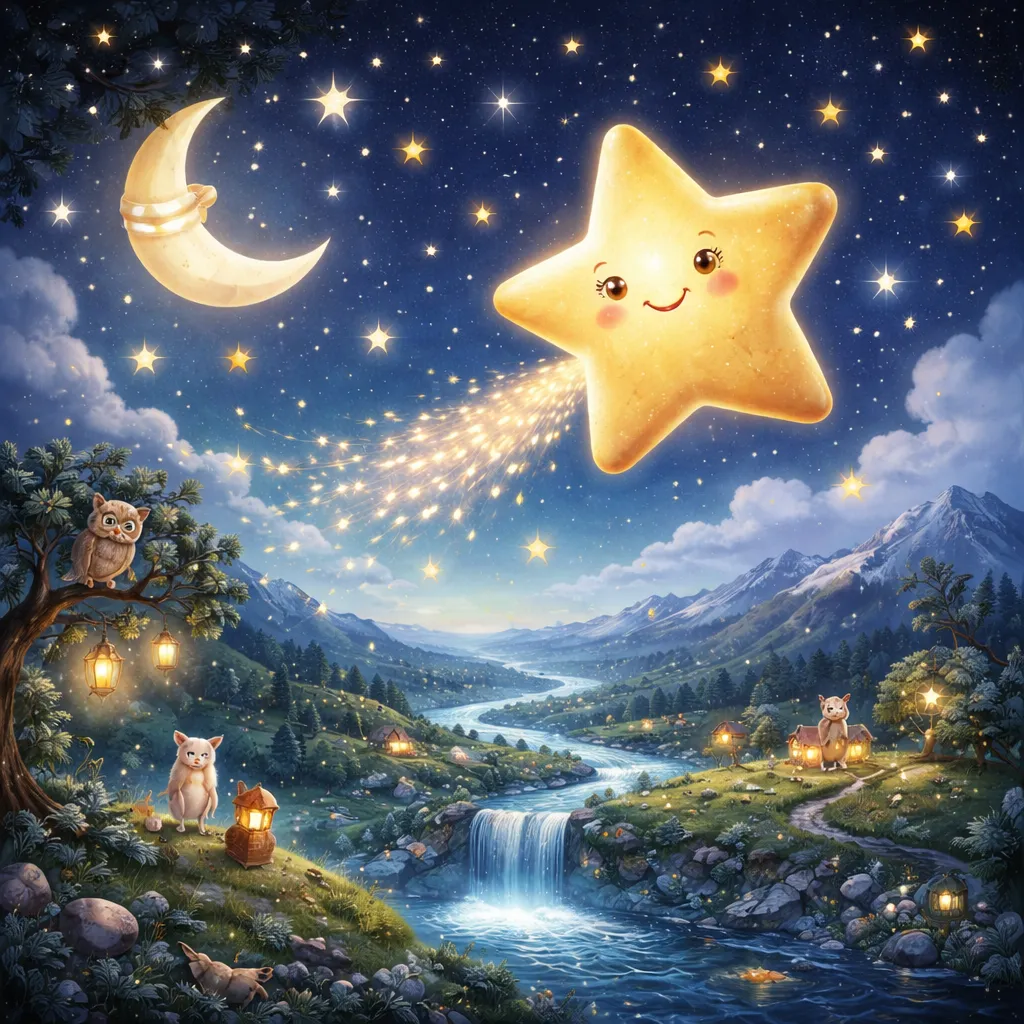

Have you ever looked up at the night sky and seen a star twinkling all alone? It looks like a tiny, shiny diamond in the deep, dark blue. There is a gentle, beautiful French song that speaks directly to that little star. It is a song of wonder, questions, and quiet friendship with the night. Let’s look up and learn the magical song “Twinkle, Twinkle, Little Star (Brille, brille, petite étoile).”
About the Song
Here are the wondering, poetic lyrics of the beloved French version:
Brille, brille, petite étoile,
Je me demande vraiment ce que tu es.
Au-dessus du monde, si haut,
Comme un diamant dans le ciel.
Quand le soleil a disparu,
Que l’on ne voit plus sa clarté,
Alors tu montres ta petite lumière,
Brille, brille toute la nuit.
Puis le voyageur dans l’obscurité,
Te remercie pour ta clarté.
Il ne saurait où aller,
Si tu ne brillais pas autant.
Brille, brille, petite étoile,
Je me demande vraiment ce que tu es.
English Translation:
Twinkle, twinkle, little star,
How I wonder what you are.
Up above the world so high,
Like a diamond in the sky.
When the blazing sun is gone,
When he nothing shines upon,
Then you show your little light,
Twinkle, twinkle, all the night.
Then the traveler in the dark,
Thanks you for your tiny spark.
He could not see which way to go,
If you did not twinkle so.
Twinkle, twinkle, little star,
How I wonder what you are.
This is the poetic French adaptation of the classic English lullaby, which itself uses the melody from an old French tune called “Ah! vous dirai-je, maman” (Oh! Shall I tell you, Mama). The song is a quiet conversation with a star. “Brille, brille, petite étoile, Je me demande vraiment ce que tu es,” it begins. The singer is looking at a shining star and wondering, with great curiosity, what it really is. The song then paints pictures with words: the star is like a diamond in the sky, it shines all night after the sun sets, and it even acts as a friendly guide for lost travelers in the dark. It is a song full of beauty, gratitude, and mystery.
What the Song is About
The song is a gentle poem sung to a star. Imagine you are lying on a soft blanket on a clear, dark night. You see one bright star. You sing to it: “Twinkle, twinkle, little star, how I wonder what you are.” The star sparkles back, high above everything, as beautiful as a perfect diamond.
You think about the day. The sun, so bright and warm, has now gone to sleep. The world is dark. But your star friend is there! It shows its “little light,” twinkling kindly all through the night. Then, you imagine a traveler walking on a lonely, dark road. This traveler looks up, sees your little star, and feels less lost. The star’s tiny spark shows the way. The song ends as it began, with that same feeling of quiet wonder about the star’s true nature.
Who Made It & Its Story
The lyrics are the French translation of the famous English poem “The Star” by Jane Taylor, written in the early 1800s. The incredibly famous and gentle melody, however, is much older and comes from France. It is from a traditional French folk song called “Ah! vous dirai-je, maman,” which was a popular melody long before the star poem was written. This makes the song a wonderful blend of English poetry and French musical heritage.
This timeless, gentle song is loved for three profound reasons. First, it captures a universal feeling of childlike wonder and curiosity about the natural world, putting beautiful, simple words to the mystery of a twinkling star. Second, it uses vivid, gentle imagery and similes (“like a diamond in the sky”) that are easy for children to picture, building a sense of beauty and poetry. Third, its soft, rolling, and incredibly familiar melody is deeply calming, making it a perfect lullaby that comforts and connects generations of singers and listeners around the world.
When to Sing It
This song is perfect for calm, quiet, and wondering moments. You can sing it softly as a lullaby at bedtime, looking out the window to see if you can spot the first star. You can sing it while lying on your back in the grass on a summer night, watching the real stars appear. You can also hum it quietly to yourself when you feel curious or thoughtful, as a way to wonder about the big, beautiful world.
What Children Can Learn
This poetic, wondering song is a wonderful teacher of descriptive vocabulary, the language of comparison, and how to ask big, beautiful questions.
Vocabulary
The song teaches us beautiful French words for talking about the night, light, and wonder. “Twinkle/Shine” (Brille). “Little” (petite). “Star” (étoile). “I wonder” (Je me demande). “Really/truly” (vraiment). “What” (ce que). “You are” (tu es). “Above” (Au-dessus). “World” (monde). “High” (haut). “Like” (Comme). “Diamond” (diamant). “Sky” (ciel). “Sun” (soleil). “Light” (lumière/clarté). “Night” (nuit). “Traveler” (voyageur). “Dark” (obscurité).
Let’s use these words! You can describe the night: “Je vois une petite étoile. Elle brille.” (I see a little star. It twinkles.) New word: La lune. This means “the moon.” You can talk about the whole sky: “La lune et les étoiles brillent dans le ciel.” (The moon and the stars shine in the sky.)
Language Skills
This song is beautiful for learning about comparing one thing to another using the word “comme” (like/as), as in “Comme un diamant dans le ciel” (Like a diamond in the sky). This is called a simile.
Concept Definition: We are learning a magic trick with words that helps us describe something by saying it is similar to something else. In French, we use the little word “comme,” which means “like” or “as.” When we say, “The star is like a diamond,” we are not saying it is a diamond. We are saying it sparkles, it is beautiful, and it is high up, just like a diamond. It helps people picture exactly what we mean.
Features and Types: We use “comme” to create pictures in the listener’s mind. In the song, the star is compared to a “diamond” because both are shiny, precious, and high up (diamants are found deep in the earth, but up high in the sky, the idea is of something valuable and bright). We can compare many things. We can compare how something looks (“Tes yeux sont comme le ciel” – Your eyes are like the sky). We can compare how something acts (“Il court comme un lion” – He runs like a lion). The pattern is simple: “[Thing] + [is/are] + comme + [thing it is similar to].”
How to Spot Them: Here is the “Just Like” trick. Look for the word “comme.” This word is your signal that a comparison is happening. Ask yourself: “What two things is the singer comparing?” The word before “comme” is the first thing. The words after “comme” describe the second thing. “Petite étoile (first thing)… comme un diamant (second thing).”
How to Use Them: A great way to make your descriptions more beautiful is the “Painting with ‘Comme’” formula. The pattern is: “[Thing you describe] + est/sont + comme + [something familiar and descriptive].”
Example from the song: The star is described: “Elle est comme un diamant dans le ciel.” (It is like a diamond in the sky.)
Example you can make: “Sa voix est douce comme du miel.” (Her voice is soft like honey.) “Les nuages sont blancs comme de la barbe à papa.” (The clouds are white like cotton candy.)
Sounds & Rhythm Fun
Listen to the gentle, rocking rhythm of the melody. The tune for “Brille, brille, petite étoile” is soft, smooth, and feels like a gentle sway. It is the same tune as “ABC Song” and “Baa, Baa, Black Sheep,” which makes it feel wonderfully familiar and easy to sing.
The song has a lovely, quiet music in its words. The “ille” sound in “brille” and “étoile” makes a soft, shimmering sound, just like twinkling light. The lines rhyme in a gentle, predictable way (étoile/ciel, clarté/nuit), which makes the poem sound beautiful and easy to remember. The melody rises and falls slowly, like a calm breath or a rocking cradle. This musical pattern is perfect for creating your own gentle wondering songs. Try a song about the moon: “Lune, lune, dans la nuit, Je me demande où tu t’en vas. Au-dessus de la ville qui dort, Comme un bateau d’argent qui vogue.” (Moon, moon, in the night, I wonder where you go. Above the sleeping city, Like a silver boat that sails.)
Culture & Big Ideas
“Brille, brille, petite étoile” connects to the deep human tradition of storytelling, poetry, and finding guidance in the night sky. In many cultures, including in France, stars have been used for navigation by sailors (“marins”) and travelers. The song reflects the romantic and artistic appreciation for beauty, mystery, and the comforting presence of light in darkness, a common theme in French poetry and art.
The song conveys three deep and beautiful ideas. First, it encourages curiosity and wonder about the natural world, framing the unknown (what a star is) not as scary, but as beautiful and worthy of a gentle question. Second, it highlights the importance of small, steady lights (like a star’s spark or a kind act) in guiding others through darkness, teaching about quiet helpfulness and hope. Third, it models the use of poetic language and simile (“like a diamond”) to express beauty and create vivid pictures in the mind, nurturing an early love for creative expression.
Values & Imagination
Imagine you are the traveler in the song. It is a very dark night, and the path through the woods is hard to see. The trees are tall shadows. You are not sure which way to walk. You feel a little scared. Then, you look up. Through a gap in the leaves, you see one bright, steady star. “Brille, brille, petite étoile.” Its light is small, but in the deep dark, it is a friendly friend. It helps you see the path. You whisper, “Merci” (Thank you) to the star, just like in the song. How does that tiny light make you feel? Brave? Less alone? Draw your guiding star. On a big piece of black or dark blue paper, draw a night sky. In one corner, draw a single, bright, shining star with lots of points. Use yellow or white. At the bottom, draw a tiny traveler on a path, looking up at the star. This shows the song’s idea of guidance and hope.
The song encourages us to be curious about the world, to appreciate beauty in small things like a star’s light, and to think about how we, like the star, can be a small, steady light for others—with a kind word or a helpful hand. A wonderful activity is the “Étoile de Gentillesse” (Kindness Star) game. At night, think of one small, kind thing you did that day or that someone did for you. That kind act is like your “little star” that shone in the world. You can even say, “Aujourd’hui, ma petite étoile était… [partager mon jouet].” (Today, my little star was… [sharing my toy].) This connects the song to everyday kindness.
So, from the first twinkle to the grateful traveler, this song is a lullaby of wonder and light. It is a vocabulary lesson in poetry and the night sky. It is a language lesson in using “comme” (like) to paint beautiful pictures with words. It is a music lesson in a gentle, universal melody that soothes and connects. “Twinkle, Twinkle, Little Star (Brille, brille, petite étoile)” teaches us about curiosity, beauty, and being a light for others.
Your Core Takeaways
You are now an expert on the song “Twinkle, Twinkle, Little Star (Brille, brille, petite étoile).” You know it is a gentle French poem set to a classic French melody, where a person wonders about a star, compares it to a diamond, and thanks it for guiding travelers in the dark. You’ve learned French words like “brille,” “étoile,” “diamant,” “ciel,” “lumière,” and “voyageur,” and you’ve practiced using “comme” (like) to make beautiful comparisons. You’ve felt its soft, rocking rhythm perfect for lullabies and created your own wondering verse. You’ve also discovered the song’s message about curiosity, the power of small lights, and poetic expression.
Your Practice Missions
First, play the “Comme…” (Like…) game. Look at an object or a person. Describe it using the “Painting with ‘Comme’” formula. For example, looking at a fluffy cat: “Le chat est doux comme une couverture.” (The cat is soft like a blanket.) Or watching the rain: “La pluie tombe comme mille petits tambours.” (The rain falls like a thousand little drums.) This mission helps you practice the song’s key language skill of making similes.
Second, have a “Soirée des Étoiles” (Starry Evening). On a clear night, or even by drawing a starry sky, find one “little star” to sing to. Sing the French song “Brille, brille, petite étoile” quietly. Then, tell your star one thing you wonder about. It could be “Je me demande ce que tu es vraiment” (I wonder what you really are) from the song, or your own wonder like “Je me demande si tu as des amis” (I wonder if you have friends). This mission connects you to the song’s core spirit of wonder and quiet conversation with the world.