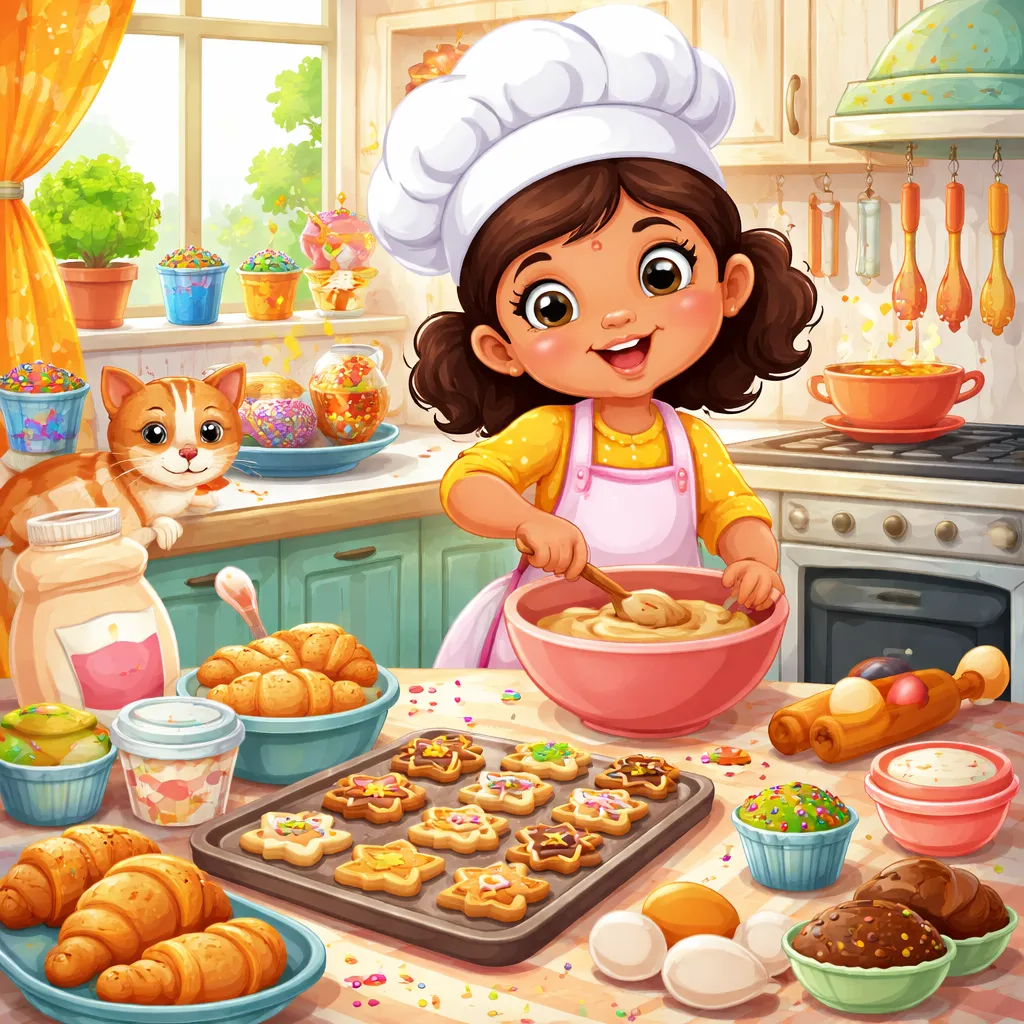

Have you ever helped in the kitchen, measuring flour or stirring batter? Have you watched through the oven door as cookies turn from pale dough to golden treats, filling the house with a warm, sweet smell? Baking is like a delicious science experiment! In India, a land of festivals and feasts, there’s a joyful song that celebrates creating food to share. Let’s preheat the oven and learn the Hindi Song: The Little Baker (बेकर).
About the Song Here is a verse from this sweet and catchy song in Hindi and English: मैं एक छोटा बेकर, एप्रन मेरा नीला (Main ek chhota baker, apron mera neela) I am a little baker, my apron is blue आटा, चीनी, दूध मिलाऊंगा, बनाऊंगा स्वादिष्ट केक (Aata, cheeni, doodh milaunga, banaunga swadisht cake) I will mix flour, sugar, milk, I will make a tasty cake ओवन में रखूँगा, गर्मी का इंतज़ार (Oven mein rakhunga, garmi ka intezaar) I will put it in the oven, waiting for the heat सबके चेहरे पर लाऊंगा, मुस्कान मीठी सी (Sabke chehre par launga, muskan meethi si) I will bring a sweet smile to everyone's face
This song’s original name uses the word “बेकर” (Baker), borrowed from English into Hindi. It is a popular modern Indian children’s song. The song is sung from the proud and excited perspective of a child who imagines running their own bakery. The music is often upbeat, cheerful, and rhythmic, with a melody that might make you think of mixing and stirring. The Hindi Song: The Little Baker (बेकर) is a musical recipe for fun, turning the careful steps of baking into a playful celebration of creating joy for others.
What the Song is About The song is a recipe for happiness. First, the little baker puts on a special blue apron, getting ready for the messy, fun work. They list their simple ingredients: “I will mix flour, sugar, milk.” The song pictures them carefully measuring each one into a big bowl and stirring with a large spoon. Then comes the exciting part: “I will put it in the oven, waiting for the heat.” The baker watches through the glass door as the cake rises and turns a beautiful brown. But the baking isn’t done for themselves. The best part is sharing: “I will bring a sweet smile to everyone's face.” The song shows that the real reward of baking is seeing the joy it brings to family and friends when they take that first delicious bite.
Who Made It & Its Story This song comes from the genre of modern Indian children’s music that celebrates everyday skills and joys. While specific creators aren’t widely listed, the song connects to India’s vibrant culture of sharing food, especially during countless festivals and celebrations. From sweet shops on every corner to home kitchens filled with the smell of fresh treats, baked goods are a part of happy occasions. The Hindi Song: The Little Baker (बेकर) taps into that universal joy. It is popular for three delightful reasons. First, it makes a practical life skill (following a recipe) feel like a magical, creative act. Second, it emphasizes the social joy of sharing what you make, tying the activity to kindness. Third, its tune is catchy and bouncy, perfect for singing along while pretending to bake or during real kitchen adventures with a grown-up.
When to Sing It Sing this song with a family member while baking real or pretend cookies, chanting the steps as you go. It’s perfect to hum while playing with modeling clay or playdough, pretending to make colorful cupcakes and cakes. You could also sing it as a class before a shared snack time, celebrating the bakers and cooks who made the food possible.
The Hindi Song: The Little Baker (बेकर) gives us the ingredients for a fun time. But every good baker follows a recipe. This song is our recipe for learning. It teaches us the language of cooking, how to talk about future plans with certainty, and the cultural importance of food as a way to show love. Let’s put on our learning aprons and measure out the lessons.
What Children Can Learn
Vocabulary This song helps us learn the specific language of baking, ingredients, and sharing. Recipe: A set of instructions for preparing a dish, including a list of ingredients. A baker follows a recipe to make a cake.
Ingredients: The different foods that you mix together to make a dish. Flour, sugar, and milk are ingredients for a cake.
Measure: To find out the exact size or amount of something. You must measure the flour carefully for the recipe to work.
Knead: To press and fold dough with your hands to make it smooth. You knead dough for bread.
Batch: A quantity of baked goods made at one time. The baker made a batch of twelve cookies.
Nourish: To provide the food needed for health and growth. Sharing a homemade treat can nourish the heart and the body.
Language Skills This song is a great example of using the Future Tense with “Going to” for Definite Plans. We use this to talk about intentions and plans that are very certain, especially when we’ve already decided to do them. What Is It?: Think of “going to” as your baker’s promise. It describes something you intend or plan to do, and you are already preparing for it. The little baker has a clear plan. “I am going to make a cake.”
Finding the Secret: Look for the structure “am/is/are + going to + [base verb].” It points to a future action that is already decided. Ask: “Has this person already made a decision about what they will do?”
Using It:
◦   Formula: [Subject] + am/is/are + going to + [base verb].

◦   Examples: “I am going to mix the ingredients.” “She is going to preheat the oven.” “We are going to share the cake.”

◦   In the song, the plan is clear: “I am going to mix… I am going to make…” The baker is describing their decided steps.
Sounds & Rhythm Fun Listen to the mixing rhythm! The Hindi Song: The Little Baker (बेकर) often has a cheerful, bouncy, and repetitive beat. It might sound like the steady plop-plop of spoon mixing or the tick-tock of the oven timer. The melody is usually simple and very catchy, making it easy to remember the sequence of steps. This fun, rhythmic pattern mirrors the step-by-step process of a recipe and makes the song easy to sing while doing actions. It helps the order of the baking process (apron, mix, bake, share) stick in your mind. You can use this same bouncy, step-by-step rhythm to make up a song about any step-by-step activity, like getting dressed or brushing your teeth.
Culture & Big Ideas This song connects to the heart of Indian hospitality and celebration, where food is a central expression of love. A festival that showcases this is Diwali, the festival of lights. During Diwali, families prepare and share an enormous variety of sweets and snacks, symbolizing the sweetness of life and community. The act of offering food is a sign of respect and affection. The Hindi Song: The Little Baker (बेकर) teaches three important ideas. First, Precision with Purpose: Baking requires careful measurement (science) for a delicious result (art), showing that following steps leads to success. Second, The Joy of Sharing: The greatest satisfaction comes not from eating alone, but from giving to others and seeing their happiness. Third, Patience and Anticipation: Good things, like a baking cake, require waiting. The wait makes the reward even sweeter.
Values & Imagination Imagine you are the little baker. What kind of cake are you making? Is it for a birthday, a holiday, or just a Tuesday? Who will you invite to share it? This song teaches you the value of following instructions carefully and the creativity of adding your own special touch. It shows that making something with your own hands to give to others is a powerful way to show you care. A simple idea: The next time you have a snack, think of one person you’d like to share it with. Offer them a piece, or even just a bite. You are practicing the baker’s spirit of sharing.
Your Core Takeaways The Hindi Song: The Little Baker (बेकर) is a delightful recipe for creativity, precision, and kindness. You learned cooking words like “recipe,” “ingredients,” and “knead.” You discovered how to use “going to” to talk about your definite plans and intentions. You moved to the song’s bouncy, mixing rhythm. You also connected the act of baking to Indian cultural traditions of sharing food, especially during festivals like Diwali. Most importantly, the song teaches that careful work leads to sweet results, that sharing what you make multiplies happiness, and that a little patience creates the most wonderful treats—for the stomach and the heart.
Your Practice Missions
- Be a “Going to” Recipe Planner. With a grown-up, look at a simple recipe for something like a sandwich or a glass of lemonade. Say your plan out loud using “going to” for each step. Example: “First, I am going to get the bread. Then, I am going to spread the butter…” Follow your plan to make the snack.
- Host a “Sharing Circle” Bake-Off. Using playdough, clay, or even drawn paper, create your own pretend “baked goods.” Make a few different items. Then, gather your stuffed animals or family members. Present your treats and say, “I made this for you to share.” Explain what each item is. This playful activity practices the baker’s core mission: creating to make others smile.