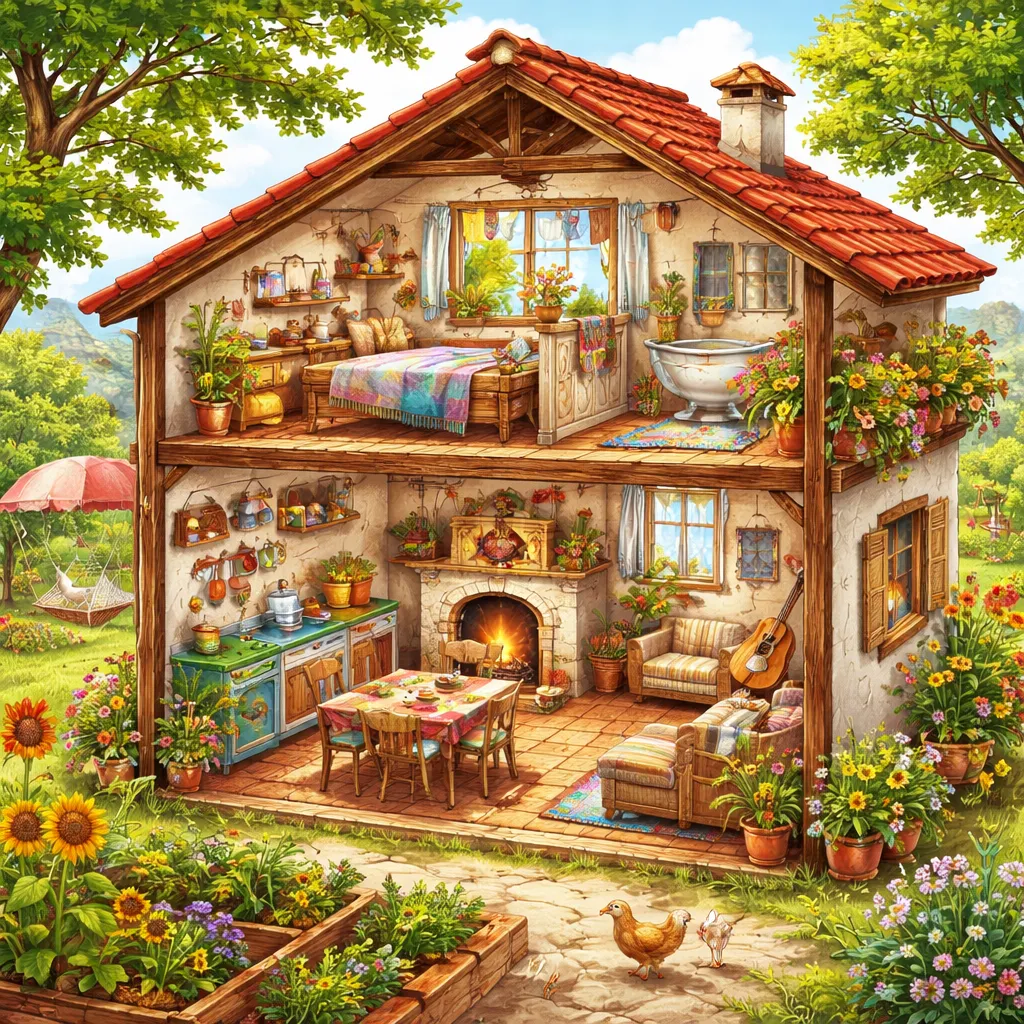

Have you ever seen a cute little house and wondered what it looks like inside? What color is the door? Are there flowers by the window? In Spanish, there is a warm, welcoming song that invites us into a friendly little house. It is a song about describing a cozy home, room by room, and the feeling of being safe and welcome inside. Let’s walk up to the door and learn the descriptive, happy song “The Little House (La casita).”
About the Song
Here are the simple, descriptive words of a popular and traditional Spanish folk song. This version is often sung by children to describe a house:
Esta es la casita, la casita, la casita,
esta es la casita donde vivo yo.
Tiene una puerta y una ventana,
con su cortina y un balcón.
Aquí está la sala, muy limpia y brillante,
aquí está la cocina, con su olor rico.
Aquí está el dormitorio, donde yo descanso,
¡y esta es mi casita, mi hogar querido!
English Translation:
This is the little house, the little house, the little house,
this is the little house where I live.
It has a door and a window,
with its curtain and a balcony.
Here is the living room, very clean and shiny,
here is the kitchen, with its delicious smell.
Here is the bedroom, where I rest,
and this is my little house, my dear home!
This is a classic Spanish folk and vocabulary-building song. The song acts as a friendly tour of a home. The affectionate “-ita” ending in “casita” makes the house feel small, cozy, and loved. The singer proudly shows us their house, starting from the outside and then taking us inside to the main rooms. The song points to each part, naming it and saying something nice about it. The melody is often cheerful, steady, and clear, with a rhythm that feels like walking from room to room, making it perfect for learning words about the home.
What the Song is About
The song is a proud and happy tour of someone’s special home. Imagine you are standing outside a little house. The song begins, “This is the little house, the little house, the little house, this is the little house where I live.” You point to it proudly. Then, you walk closer and describe the outside: “It has a door and a window, with its curtain and a balcony.” You can see a colorful curtain behind the window and maybe a flower box on the balcony.
Then, you open the door and go inside! You walk into the first room and say, “Here is the living room, very clean and shiny.” You imagine a tidy room where the sun shines on the floor. Next, you go to the kitchen: “Here is the kitchen, with its delicious smell.” Maybe you smell something yummy cooking. Then, you go to your favorite room: “Here is the bedroom, where I rest.” You think of your own cozy bed. Finally, you smile and say, “And this is my little house, my dear home!” The song is about knowing and loving the place where you live, and happily sharing it with others through words.
Who Made It & Its Story
“The Little House (La casita)” is a beloved traditional Spanish children’s song used widely in homes and schools. Like many folk songs, it was created and shared by many people to teach children about their immediate world. The song reflects the cultural importance of home (hogar) and family as a center of warmth, safety, and pride in Spanish-speaking cultures. The house is not just a building; it is a “hogar querido” (dear home), full of life, smells, and comfort. The song serves as a simple, joyful tool for teaching children the names of rooms and parts of a house, helping them describe their own world with pride and affection.
This welcoming song is loved for three cozy reasons. First, it organizes a familiar space (a house) into easy-to-remember parts, using a clear, room-by-room tour that makes vocabulary learning natural and logical. Second, it uses positive, sensory descriptions like “limpia y brillante” (clean and shiny) and “olor rico” (delicious smell), which helps children connect words to feelings and senses, not just objects. Third, its repetitive, declarative structure (“Esta es…”, “Aquí está…”) builds confidence in speaking, allowing children to point to and name things in their own environment using the same easy pattern.
When to Sing It
This song is perfect for playful exploration and learning moments. You can sing it while tidying up your own home, naming each room as you go into it. You can hum it while drawing a picture of a house, pointing to the door, window, and rooms as you name them in the song. You can also sing it as a “tour guide” game, giving a pretend tour of a dollhouse or a blanket fort to a stuffed animal, using the song’s words.
What Children Can Learn
This descriptive, proud song is a wonderful teacher about the home, Spanish language, and a sense of place.
Vocabulary
The song teaches us words for parts of a home and describing words in Spanish. The “little house” (casita) is where someone lives. “This is” (Esta es) points to something. “Where I live” (donde vivo yo) tells the location of your home. It “has” (tiene) means it possesses something. A “door” (puerta) is how you go in and out. A “window” (ventana) is for looking outside. A “curtain” (cortina) is cloth that covers a window. A “balcony” (balcón) is a small platform outside a window. “Here is” (Aquí está) also points to something close. The “living room” (sala) is a common family room. “Very clean and shiny” (muy limpia y brillante) means it is not dirty and it sparkles. The “kitchen” (cocina) is where food is made. “With its delicious smell” (con su olor rico) describes a good aroma. The “bedroom” (dormitorio) is for sleeping. “Where I rest” (donde yo descanso) is the place for relaxing. “My dear home” (mi hogar querido) is a loving way to say the place you live and feel you belong.
Let’s use these words! You can say, “This is my room, where I play.” Or, “The kitchen has a delicious smell of cookies.” New word: Cozy. This means warm, comfortable, and safe, a perfect word for a “casita” that is your “hogar querido.”
Language Skills
This song is an excellent lesson in using location words (prepositions) and phrases to point to and describe where things are. The most important ones here are “en” (implied) and phrases like “Esta es” (This is) and “Aquí está” (Here is).
Concept Definition: Prepositions and location phrases are words that tell us where something is. They help us point, show, and describe the place of people and things. The song is like a map made of words, using these pointers to guide us around the house.
Features and Types: Look at the location words in the song. First, we have pointing phrases: “Esta es la casita…” (This is the little house…). “Esta” (this) points to something you can see. Then, we have “Aquí está la sala…” (Here is the living room…). “Aquí” (here) points to a specific spot. The word “donde” (where) is also a location word that connects a place to an action: “la casita donde vivo yo” (the little house where I live) and “el dormitorio donde yo descanso” (the bedroom where I rest). The preposition “en” (in) is not said but is felt everywhere: I live in the house, I rest in the bedroom.
How to Spot Them: Here is a simple “pointer detective” trick. Ask: “Is the singer showing me where something is or pointing to it?” The words that answer are often location words. Look for words like “esta” (this), “aquí” (here), and “donde” (where). Also, ask “Where?” The answer will often use a preposition like “en” (in), “sobre” (on), or “debajo de” (under).
How to Use Them: A great way to give a tour is the “showing and telling recipe”. The pattern is: [Pointing Word/Phrase] + [Thing] + [more details].
Example from the song: “Esta es la casita donde vivo yo.” (This is the little house where I live.) Pointing phrase: “Esta es”.
Example from the song: “Aquí está la cocina, con su olor rico.” (Here is the kitchen, with its delicious smell.) Pointing word: “Aquí está”.
Example you can make: “Aquí está mi mochila, debajo de la silla.” (Here is my backpack, under the chair.)
Sounds & Rhythm Fun
Listen to the clear, marching rhythm of the melody. The song often has a steady, walking beat that makes it easy to point to things in time with the music. The repetition of “la casita, la casita, la casita” and the structure of “Esta es…” and “Aquí está…” at the beginning of lines creates a strong, memorable pattern. The descriptions “muy limpia y brillante” and “con su olor rico” have a nice, flowing sound. The song ends with the warm, proud phrase “mi hogar querido,” which feels happy and complete.
The rhythm is like a confident walk through a house. Try pointing to different corners of your room as you sing: “A-quí es-tá la sa-la…” The repetitive and formulaic structure makes it very easy to remember the order of the tour and to replace words. This clear, pointing musical pattern is perfect for describing any space. You can write your own “tour song”! Use the same tune. Try: “Esta es mi escuela, mi escuela, mi escuela, esta es mi escuela donde aprendo yo. Tiene una puerta y una pizarra, con muchos libros y un salón…” (This is my school, my school, my school, this is my school where I learn. It has a door and a blackboard, with many books and a classroom…)
Culture & Big Ideas
“La casita” reflects the deep cultural value of home and family as the heart of life in Spanish-speaking communities. The home is often a place of gathering, warmth, and pride. The song doesn’t just list objects; it describes a feeling: cleanliness, good smells, and rest. This connects to the idea of making a home not just a building, but a welcoming and cared-for space. The final phrase, “mi hogar querido,” is very important. “Hogar” means more than just “house” (casa); it implies the emotional home, the hearth, the place of belonging.
The song conveys three important ideas. First, it’s about knowing and naming your own space. By learning the words for each part of a house, children can better understand and communicate about their immediate world. Second, it expresses pride and care for one’s environment. Describing the home as clean, shiny, and smelling good shows a positive and caring attitude towards where you live. Third, it highlights the feeling of safety, rest, and belonging. The bedroom is “where I rest,” and the whole place is a “dear home,” teaching that home is a safe haven.
Values & Imagination
Imagine you are the little house, “la casita.” The sun warms your walls. You have a bright red door and a window with a yellow curtain that flutters in the breeze. A family lives inside you. In the morning, you smell delicious food from the kitchen. In the living room, you hear laughter. At night, in the bedroom, everything is quiet and peaceful. How do you feel, holding this family safe and warm inside you? Now, imagine you are the singer giving the tour. What does your own “casita” look like? Is your front door blue or green? What do you see from your window? What smells come from your kitchen? What makes your bedroom a perfect place to rest? Draw your “hogar querido.” Start with the outside: the door, window, curtain, and balcony (or a garden!). Then, draw the inside: the living room, kitchen, and bedroom. Add details that are special to you. This helps you connect the song’s words to your own world.
The song encourages observation, descriptive language, and appreciation for one’s home. A wonderful activity is a “Proud Home Tour.” Walk around your own home with a family member or a stuffed animal. Point to different rooms and objects. Use the song’s pattern: “This is the kitchen. It has a big table.” “Here is the living room. It is very comfortable.” Say “mi hogar querido” at the end. This turns your everyday space into a place to practice language and feel pride.
So, from the proud announcement of “This is the little house” to the final, warm “my dear home,” this song takes you on a welcoming tour. It is a vocabulary lesson in home and description. It is a language lesson in pointing to and locating things. It is a music lesson in a steady, descriptive rhythm. “The Little House (La casita)” teaches us to look at our homes with care, to name the parts of our world with pride, and to feel grateful for the safe, cozy place where we live and rest.
Your Core Takeaways
You are now an expert on the song “The Little House (La casita).” You know it is a traditional Spanish song that gives a proud, room-by-room tour of a cozy, loved home. You’ve learned Spanish words like “casita,” “puerta,” “sala,” and “hogar,” and you’ve practiced using pointing phrases like “Esta es” and “Aquí está” to describe where things are. You’ve felt its clear, marching rhythm and created your own tour verse. You’ve also discovered the song’s message about knowing your space, taking pride in your home, and appreciating the safety and comfort it provides.
Your Practice Missions
First, be a “Home Reporter.” Choose one room in your house, like your bedroom or the kitchen. Make a short, three-sentence report about it, just like in the song. Use the pattern: “This is the [room name]. It has a [object] and a [object]. It is very [describing word].” Say it out loud in English, and try to use one Spanish word from the song, like “ventana” (window) or “limpia” (clean). This mission helps you observe and describe like the song does.
Second, build a “Casita of Dreams.” Using pillows, blankets, and chairs, build a cozy fort. This is your dream “casita.” Give it a pretend “puerta” (door) and “ventana” (window). Once inside, point and say: “Esta es mi casita. Aquí está mi sala. ¡Mi hogar querido!” Then, read a book or rest inside it. This mission lets you physically create the cozy, safe space the song describes.