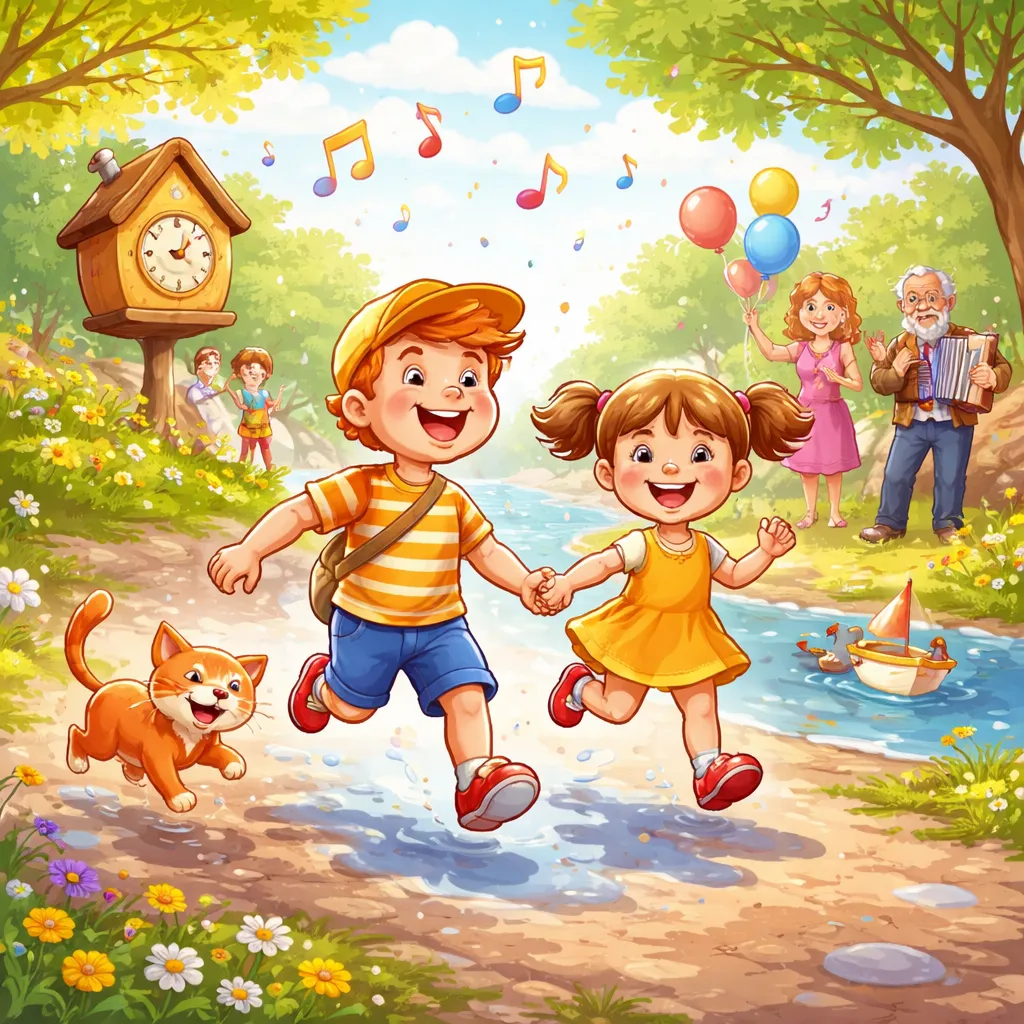

Have you ever been excited to give a friend a birthday present? You might even run a little funny because you’re so happy! In a very famous Russian cartoon, a kind crocodile named Gena gets a surprise birthday party from his friends. The happy song from that cartoon is all about this joyful, clumsy run. Let’s discover the friendly world of the Russian song “Let Them Run Awkwardly (Пусть бегут неуклюже).”
About the Song
Here is the joyful and famous chorus from the song “Let Them Run Awkwardly,” written for the beloved Soviet cartoon “Cheburashka”:
Пусть бегут неуклюже,
Пешеходы по лужам,
А вода по асфальту рекой.
И неясно прохожим
В этот день непогожий,
Почему я весёлый такой.
А я играю на гармошке
У прохожих на виду.
К сожаленью, день рожденья
Только раз в году!
English Translation:
Let them run awkwardly,
Pedestrians through puddles,
And the water flows like a river on the asphalt.
And it’s unclear to the passersby
On this nasty, rainy day,
Why I am so cheerful.
But I play the accordion
In full view of the passersby.
Unfortunately, a birthday
Is only once a year!
This is a classic Russian cartoon song from the film “Cheburashka.” The music was written by Vladimir Shainsky, and the words are by Yuri Entin. The song is sung by the friendly crocodile Gena. He is so happy about his surprise birthday that he does not mind the rainy, “nasty” day at all. He happily watches people running clumsily through puddles, and he himself plays his accordion on the street, full of joy. The song celebrates friendship, kindness, and finding happiness on a special day, no matter what the weather is like.
What the Song is About
The song is about pure happiness on a special day. The singer looks at the rainy street. He sees people walking, “пешеходы.” They are running through puddles. “Пусть бегут неуклюже.” He says, “Let them run awkwardly!” He does not mind. The water flows like a little river on the road.
The people passing by are confused. “И неясно прохожим.” They do not understand. It is a rainy, “непогожий” day. Why is this person so very happy? “Почему я весёлый такой.” They do not know his secret!
Then he tells us his secret. He is playing music. “А я играю на гармошке.” He plays his accordion for everyone to see. He is happy because it is his birthday! “День рожденья!” He says it is a pity that this wonderful day only comes one time each year. He is making the most of his happy day.
Who Made It & Its Story
The song was created for the iconic Soviet cartoon series about Cheburashka, a funny unknown animal, and his friend, the polite crocodile Gena. The composer was Vladimir Shainsky, and the poet was Yuri Entin. It was first heard in the 1971 cartoon “Cheburashka.” In the story, Gena is feeling lonely, but his new friend Cheburashka and other friends organize a surprise birthday party for him. This song expresses Gena’s overflowing joy and gratitude.
It is beloved for three main reasons. First, its melody is incredibly catchy, optimistic, and easy to sing, making it an instant classic. Second, its lyrics perfectly capture a childlike, defiant joy—being so happy that even rain and clumsy running look amusing. Third, it is forever connected to the beloved characters Cheburashka and Crocodile Gena, who represent kindness, friendship, and helping others, making the song a symbol of these warm feelings for generations.
When to Sing It
This song is perfect for joyful and celebratory moments. You can sing it loudly on a rainy day to make the weather feel more fun. You can sing it while walking or skipping, especially if you see puddles. You can also sing it to celebrate a friend’s or your own birthday, capturing that special “once a year” feeling.
What Children Can Learn
This happy song is a wonderful teacher for learning about expressing wishes, describing the weather, and talking about feelings in Russian.
Vocabulary
The song teaches us vivid Russian words for movement, weather, feelings, and special occasions. “Let them” (Пусть / Pust’). “Run” (бегут / begut). “Awkwardly/clumsily” (неуклюже / neuklyuzhe). “Pedestrians” (Пешеходы / Peshekhody). “Through puddles” (по лужам / po luzham). “Water” (вода / voda). “Asphalt/road” (асфальту / asfal’tu). “Like a river” (рекой / rekoy). “Unclear” (неясно / neyasno). “Passersby” (прохожим / prokhozhim). “Day” (день / den’). “Nasty weather” (непогожий / nepogozhiy). “Why” (Почему / Pochemu). “Cheerful” (весёлый / vesyolyy). “I play” (я играю / ya igrayu). “On the accordion” (на гармошке / na garmoshke). “Unfortunately” (К сожаленью / K sozhalen’yu). “Birthday” (день рожденья / den’ rozhden’ya). “Only” (Только / Tol’ko). “Once a year” (раз в году / raz v godu).
Let’s use these words! You can describe a scene: “Вода по асфальту.” (Water on the asphalt.) New word: Настроение (nastroveniye). This means “mood.” You can say, “У меня весёлое настроение!” (I have a cheerful mood!)
Language Skills
This song is excellent for learning about the word “пусть,” which is used to express a wish or permission, meaning “let” or “may.” It also teaches us the preposition “по” with different meanings: “through” (as in по лужам) and “on” a surface (as in по асфальту). We also see descriptive words for weather and feelings.
Concept Definition: We are learning about the special word “пусть” that lets you say you are okay with something happening or that you wish for it to happen. We are also learning the small but powerful word “по” that can tell us movement through something or location on a surface.
Features and Types: The pattern for a wish is: “Пусть + [who] + [action].“ The pattern for “по” meaning “through” is: “[action] + по + [thing you move through].“ The pattern for “по” meaning “on” is: “[action] + по + [surface].“
Example from the song: Wish: “Пусть бегут…“ (Let them run…) Through: “бегут по лужам.“ (run through puddles.) On: “вода по асфальту.“ (water on the asphalt.)
How to Spot Them: Here is the “Wish Spotter” trick. Look for sentences that start with “Пусть”. This word gives a signal that someone is saying “it’s okay if…” or “I hope that…”. Ask: “Is the singer saying they are happy for something to happen?“ For the word “по,” ask: “Is the action happening through something (like puddles) or on top of something (like a road)?“
How to Use Them: A great way to express a happy wish is the “Пусть-По” formula. Wish: “Пусть [someone] [does something]…“ Where: “…по [place].“
Example from the song: “Пусть бегут пешеходы по лужам.“
Example you can make: “Пусть дети играют по двору.“ (Let the children play in the yard.)
Sounds & Rhythm Fun
Listen to the bouncy, cheerful melody of the song. The tune for “Пусть бегут неуклюже” is incredibly upbeat and memorable, with a rhythm that feels like a happy, slightly clumsy march or a dance. It is a classic earworm.
The words have a wonderful, playful flow. The opening line “Пусть бегут неуклюже” has a funny, bouncy sound that matches the meaning. The contrast between the gloomy weather words (“непогожий”) and the cheerful declaration (“весёлый такой”) is fun. The most famous part, “К сожаленью, день рожденья только раз в году!” is sung in a catchy, sighing-then-joyful way that everyone remembers. This joyful rhythm is perfect for creating your own “let them” song. Try a sunny day song: “Пусть летят высоко, Воздушные змеи…“ (Let them fly high, The kites…).
Culture & Big Ideas
This song is a central part of Russian and Soviet animation culture. The cartoon “Cheburashka” and his friend Crocodile Gena are beloved icons. The song is not just for birthdays; it’s a general anthem for choosing joy, kindness, and friendship, values strongly promoted in the cartoons. Singing it is a nostalgic and happy act for many.
The song conveys three wonderful and positive ideas. First, it celebrates choosing joy and a positive attitude, as the singer is cheerfully playing music on a rainy day, showing that our own happiness can brighten any situation. Second, it promotes acceptance and finding fun in imperfection, as the singer watches people run “неуклюже” (awkwardly) through puddles and finds it amusing rather than criticizing, teaching us to be kind and laugh with others. Third, it cherishes special occasions and friendship, highlighting the unique joy of a “день рожденья” (birthday) and, by extension, the celebration of friends who make us happy.
Values & Imagination
Imagine you are Crocodile Gena. It’s your birthday, and it’s raining! But you don’t care. You see people on the street. “Пусть бегут неуклюже.” You think, let them run in a funny, clumsy way through the puddles. You see the water flowing down the street like a little river. People look at you, confused. “Почему я весёлый такой?” Why are you so happy on this “непогожий” day?
You have a secret! You have friends who care about you. You take out your accordion. “А я играю на гармошке!” You play music right there on the street to share your joy. You remember, “день рожденья только раз в году!” A birthday is only once a year, so you will enjoy every moment, rain or shine. How does it feel to be so happy that you want to play music for everyone? Draw the happy scene. Draw the rainy street with puddles. Draw people running. Draw yourself (or Gena) playing an accordion with a big smile, ignoring the rain. This shows the song’s story of inner joy.
The song encourages us to find happiness inside ourselves, to be kind and accepting of others (even their clumsy moments), and to celebrate friendship and special days with open hearts. A wonderful activity is to have a “Пусть Party.” On a drizzly day, put on the song and dance “неуклюже” (awkwardly) with family, celebrating the fun of being silly together. Say, “Пусть мы танцуем неуклюже!” (Let us dance awkwardly!).
So, from the cheerful permission “let them run awkwardly” to the joyful accordion playing in the rain, this song is a lesson in choosing happiness. It is a vocabulary lesson in weather, feelings, and actions. It is a language lesson in using “пусть” for wishes and “по” for paths and surfaces. It is a music lesson in an irresistibly happy tune. “Let Them Run Awkwardly (Пусть бегут неуклюже)” teaches us to cultivate joy, embrace imperfection, and celebrate friendship.
Your Core Takeaways
You are now an expert on the Russian song “Let Them Run Awkwardly (Пусть бегут неуклюже).” You know it is a happy song from a cartoon where Crocodile Gena, on his birthday, cheerfully watches people run clumsily in the rain, plays his accordion, and celebrates because a birthday comes only once a year. You’ve learned Russian words like “пусть,” “бегут,” “неуклюже,” “по лужам,” “непогожий,” “весёлый,” “играю,” and “день рожденья,” and you’ve practiced using “пусть” to express a wish and “по” to mean “through” or “on.” You’ve felt its upbeat, catchy rhythm. You’ve also discovered the song’s message about choosing a positive attitude, accepting others happily, and celebrating special days and friendships.
Your Practice Missions
First, play the “Пусть Дождь!” (Let the Rain!) game. On a rainy day, look out the window. Say sentences with “Пусть” about what you see. For example, “Пусть идёт дождь! Пусть машины едут по воде. Пусть я пью какао.” (Let the rain fall! Let the cars drive through the water. Let me drink cocoa.) This mission helps you master the “Пусть + [action]” pattern for expressing acceptance and wishes.
Second, create your own “Друг之歌” (Friend’s Song). Think of a friend. Write or say two lines. One about accepting something funny about them (e.g., “Пусть мой друг смеётся громко!” – Let my friend laugh loudly!). One about something you do together to celebrate friendship (e.g., “А мы играем в саду!” – And we play in the garden!). Sing it to the tune of “Пусть бегут неуклюже.” This mission lets you use the song’s structure to celebrate friendship.