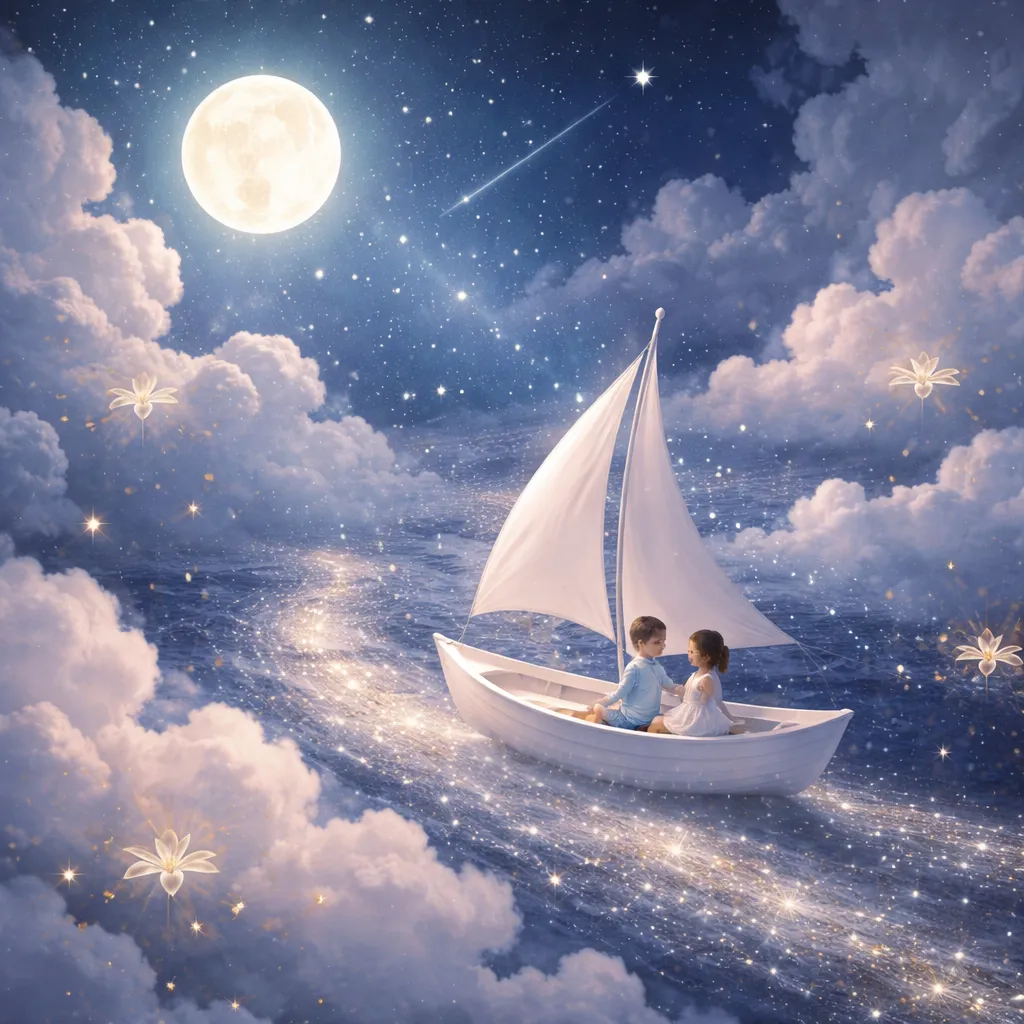

Look up at the night sky. What do you see? A bright, white moon, shining like a lonely, beautiful boat floating on a dark, blue sea. In both Korea and China, there is a very famous, gentle song that turns that moon into a magical vessel for our dreams. It’s a lullaby that invites you on a peaceful journey to the stars. Let’s set sail with the soothing song “Little White Boat” (小白船, Xiǎo bái chuán).
About the Song
Let’s read the dreamy, poetic words of this famous lullaby.
蓝蓝的天空银河里,
有只小白船。
船上有棵桂花树,
白兔在游玩。
桨儿桨儿看不见,
船上也没帆。
飘呀飘呀,飘向西天。
English Translation:
In the blue sky, the Milky Way,
There is a little white boat.
On the boat, there is an osmanthus tree,
A white rabbit plays there.
Oars, oars cannot be seen,
There is also no sail on the boat.
Drifting, drifting, drifting to the western sky.
This song is originally a Korean folk song and nursery rhyme. The Chinese version was adapted and popularized in the mid-20th century. The song is a slow, ethereal, and slightly mysterious lullaby. It describes a scene not on Earth, but in the starry “Milky Way,” which is imagined as a river. Floating on this star-river is a “little white boat,” which is a metaphor for the moon. On this moon-boat grows a magical osmanthus tree (from Chinese legend), and a white jade rabbit plays. The boat has no oars or sail, yet it drifts peacefully toward the west. The song blends astronomy with folklore, creating a perfect, calming image for bedtime.
What the Song is About
The song paints a picture of a silent, magical journey through the cosmos. The singer looks up at the deep blue night sky, filled with stars (the “Milky Way”). There, they see a small, white boat. This is the moon, imagined as a delicate vessel.
Looking closer at the boat, the singer sees surprising things. There’s an osmanthus tree, which in Chinese stories grows on the moon. There’s also a white rabbit playing, referring to the Jade Rabbit of the Moon in folklore. The singer notices the boat moves mysteriously—it has no visible oars or sails. Yet, it keeps moving, drifting slowly and peacefully toward the far horizon (“the western sky”). The song doesn’t tell a story with a plot. Instead, it captures a single, wondrous sight: the moon’ nightly voyage, explained through beautiful, dreamlike details. It’s about using imagination to explain the world and find comfort in its gentle mysteries.
Who Made It & Its Story
“Little White Boat” is originally a Korean children’s song. The Chinese lyrics were adapted by Chinese musicians in the 1950s. The song’s origin in Korean culture and its adoption in China is a beautiful example of cultural exchange in children’s music. The Chinese version retains the original melody’s haunting, peaceful quality. The lyrics incorporate distinctly Chinese mythological elements, like the osmanthus tree and the jade rabbit, which come from the legend of Chang’e, the Moon Goddess. This blending created a song that feels both universal (about the moon) and culturally specific. It became a standard lullaby and music class piece in China, loved for its ability to calm and inspire wonder about the night sky.
This lullaby has remained a timeless favorite for three dreamy reasons. First, its melody is hauntingly beautiful, slow, and incredibly soothing, making it one of the most effective lullabies to quiet a busy mind. Second, it is a masterpiece of imaginative metaphor, transforming a common celestial object (the moon) into a magical boat with a rich story, teaching children to see the world poetically. Third, it creates a powerful sense of peace and safe journeying. The image of the boat drifting without effort towards the west is deeply calming, suggesting that we can all be carried gently into rest or dreams.
When to Sing It
This song is perfect for the quietest, most peaceful moments. You can sing it very, very softly as a lullaby at bedtime, while looking at the moon or a night light. You can hum it on a clear night during a car ride, watching the moon “follow” you. You can also sing it slowly and gently in a group, like a class choir, to create a shared moment of calm and wonder before resting.
What Children Can Learn
This poetic, cross-cultural song is a gateway to lessons about language, astronomy, and myth.
Vocabulary
The song teaches us celestial and descriptive words. The “Milky Way” (银河, yínhé) is the band of stars that looks like a river across the night sky. A “boat” (船, chuán) is a vehicle for traveling on water. “Osmanthus tree” (桂花树, guìhuā shù) is a tree with sweet-smelling flowers, said to grow on the moon. A “white rabbit” (白兔, báitù) is a small animal with white fur; here it’s the mythical Jade Rabbit. “Oars” (桨, jiǎng) are used to row a boat. A “sail” (帆, fān) is a piece of cloth that catches the wind to move a boat. “Drift” (飘, piāo) means to be carried slowly by water or air.
Let’s use these words! You can say, “We could see the Milky Way clearly in the dark countryside.” Or, “The leaf began to drift down the stream.” New word: Celestial. This means relating to the sky or outer space. The song is about a celestial journey.
Language Skills
This song is a wonderful lesson in describing existence and location and using metaphor. The song uses the structure “有…” (there is/are) to state what exists in a place: “银河里,有只小白船” (In the Milky Way, there is a little white boat). This is a fundamental way to describe scenes.
The entire song is built on a metaphor: the moon is a little white boat. It doesn’t say “the moon is like a boat”; it directly calls it a boat, which is a stronger, more poetic comparison. The song also uses the progressive aspect with “在” (zài) to show an ongoing action: “白兔在游玩” (The white rabbit is playing). This makes the scene feel alive.
Sounds & Rhythm Fun
Listen to the slow, floating, waltz-like rhythm of the melody. The song is in a gentle 3/4 time, which gives it a rocking, boat-on-waves feeling. The tempo is very slow, allowing each word to linger. The melody uses a narrow range of notes and has a circular, drifting quality. The Chinese lyrics have a soft, melodic rhyme: “船” (chuán) and “玩” (wán), “见” (jiàn) and “帆” (fān), “天” (tiān) and itself.
The rhythm is steady and hypnotic. Try a slow, gentle sway: 蓝 蓝 的 天 空 银 河 里 (lán lán de tiānkōng yínhé lǐ). The repetition of “飘呀飘呀” (drift, drift) mimics the slow, endless drifting motion. This simple, repetitive, and ethereal musical pattern is what makes the song so soothing and dreamlike. You can write your own celestial lullaby! Use the same floating rhythm. Try: “High above the sleepy town, there’s a golden crown. It’s not a jewel you can hold, it’s a story softly told. Shining, shining, through the night, giving off a gentle light.”
Culture & Big Ideas
“Little White Boat” is a beautiful example of East Asian cultural blending. Its Korean melody carries Chinese mythological lyrics, showing how art transcends borders. The song connects directly to the Mid-Autumn Festival, a major Chinese holiday where families gaze at the moon, eat mooncakes, and tell the story of Chang’e, the moon goddess, her osmanthus tree, and her jade rabbit. The song is a gentle introduction to this rich folklore. It reflects the traditional value of finding poetry and story in nature, and of using music to soothe and cultivate a peaceful, contemplative mind. The song teaches that the night sky is not empty but full of stories and gentle journeys.
The song conveys three profound ideas. First, it’s about finding magic and story in the natural world. The moon is not just a rock; it’s a boat, a garden, and a playground, encouraging a sense of wonder. Second, it expresses a feeling of peaceful surrender and journeying. The boat drifts without effort, suggesting a trust in the gentle flow of the universe, which is a comforting thought. Third, it highlights the connection between different cultures’ imaginations. Both Korean and Chinese people looked at the same moon and created beautiful, soothing art about it, showing our shared human curiosity and creativity.
Values & Imagination
Imagine you are in the little white boat. What does the “Milky Way” river look like? Is it made of liquid starlight? Can you smell the sweet osmanthus flowers? Can you hear the white rabbit hopping softly? Now, look back at Earth. How does it look from so far away? Draw a picture of the moon-boat. Don’t draw a crescent. Draw a small, elegant boat with a white sail. On the boat, draw a tree and a rabbit. Around it, draw swirls of blue and silver for the Milky Way. Draw a tiny Earth in the corner. This captures the song’s unique perspective.
The song encourages imagination, calmness, and an appreciation for the stories we tell about the universe. A lovely idea is to have a “Moon Story” time. On a clear night, go outside or look out a window at the moon. Sing the song softly. Then, with your family, make up a very short story about one journey the “little white boat” took tonight. Where did it go? Who did it meet? This extends the song’s imaginative invitation.
So, as the last “drifting to the western sky” fades, think about the peaceful journey in this old tune. It is a vocabulary lesson in the night sky and myth. It is a grammar lesson in describing what exists and using metaphor. It is a music lesson in a floating, waltzing lullaby. From the first blue sky to the final drift westward, it wraps lessons in wonder, peaceful trust, and cultural storytelling in a melody that feels like a gentle rocking into dreams. “Little White Boat” teaches us that the moon is a ship for our imaginations, that drifting can be a kind of travel, and that the most familiar sight in the night sky can be the source of the most beautiful, shared dreams.
Your Core Takeaways
You are now an expert on the song “Little White Boat” (小白船). You know it is originally a Korean folk song adapted into Chinese, using the moon as a metaphor for a magical boat carrying a rabbit and a tree. You’ve learned words like “Milky Way,” “osmanthus,” and “drift,” and you’ve practiced stating what exists and using metaphors. You’ve felt its slow, floating rhythm and created your own celestial verse. You’ve also discovered the song’s connection to the Mid-Autumn Festival and its messages about finding magic in nature, peaceful journeying, and the blending of cultural stories.
Your Practice Missions
First, host a “Starry Lullaby” concert. Gather your family in a dimly lit room. Use a flashlight or a lamp to project a “boat” shape (like a crescent) on the wall or ceiling. Sing the song very slowly and softly, watching your little white boat. This creates a calming, immersive experience.
Second, create a “Moon Myth” passport. The song mentions the osmanthus tree and the rabbit. Research one sentence about the Chinese Moon Goddess, Chang’e. Draw a simple “passport” page for the Little White Boat. On it, draw the boat, and write/stamp its “cargo”: 1 Osmanthus Tree, 1 Jade Rabbit. Add your own imaginary “passenger” or “cargo” for the boat. This connects the song to myth and personal creativity.