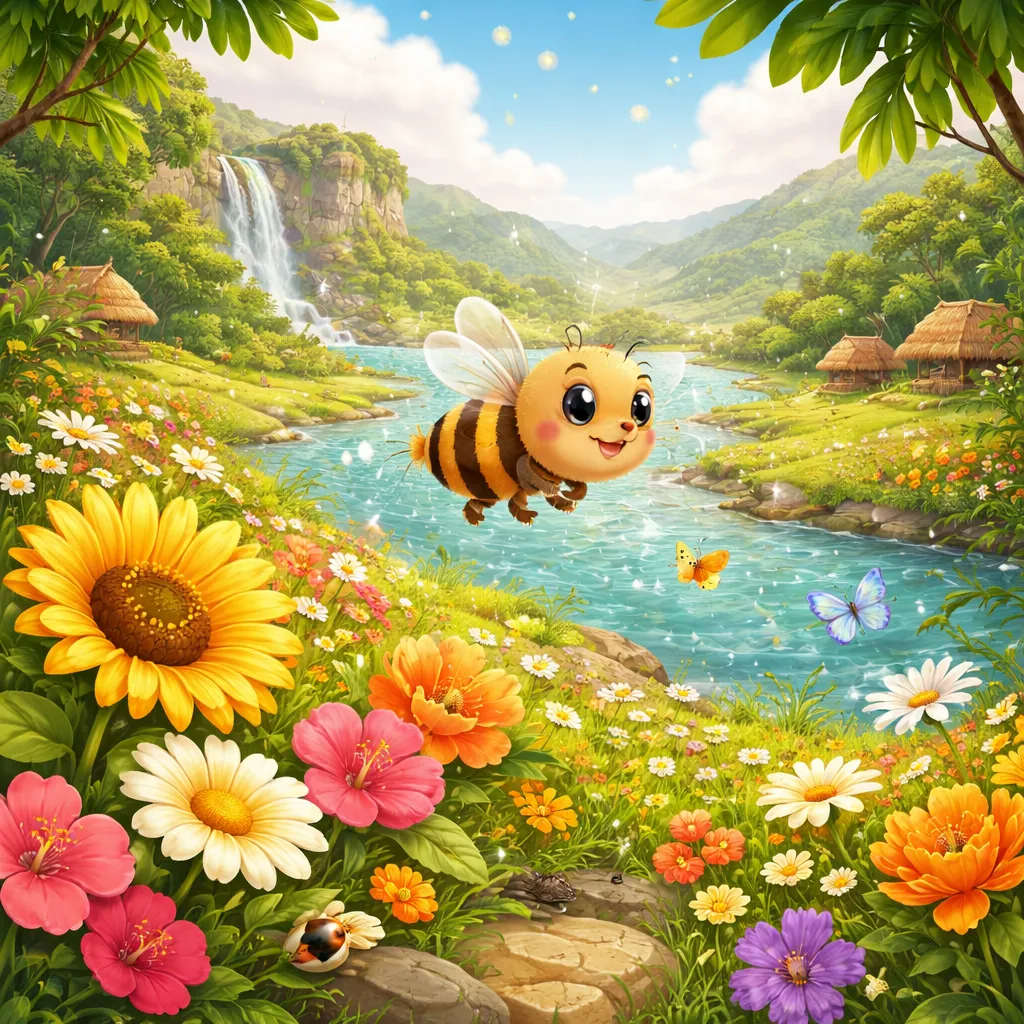

Have you ever heard a gentle buzz near a flower? That is the sound of a busy bee! Bees are amazing insects. They have beautiful wings, and they fly from flower to flower. In Indonesia, the word for bee is “lebah,” and there is a happy, buzzing song about a little bee that works hard. Let’s follow the journey of “The Little Bee (Lebah Kecil).”
About the Song
Here are the sweet and busy lyrics of a popular traditional Indonesian children’s song about a little bee:
Lebah kecil, lebah kecil,
Terbang, terbang di taman.
Dari bunga ke bunga,
Mengambil sari madu.
Bekerja, bekerja, lebah kecil,
Sepanjang hari.
Hasilnya manis, madu murni,
Untuk kita semua.
English Translation:
Little bee, little bee,
Fly, fly in the garden.
From flower to flower,
Taking nectar for honey.
Work, work, little bee,
All through the day.
The result is sweet, pure honey,
For all of us.
This is a charming and gentle Indonesian folk song for children. The song is a beautiful picture of a bee’s important job. We see the “lebah kecil” flying busily in the garden. “Terbang, terbang di taman.” It moves “dari bunga ke bunga,” from flower to flower. Its job is to take nectar, “mengambil sari madu,” which it uses to make honey. The bee works hard all day. “Bekerja, bekerja, lebah kecil, sepanjang hari.” And because of its hard work, we get a sweet result: pure honey for everyone. It is a song about nature’s tiny helpers.
What the Song is About
The song shows us a day in the life of a very important little insect. You are in a sunny garden. You see a “lebah kecil.” It is flying. “Terbang, terbang di taman.” It does not fly randomly. It has a mission. It flies “dari bunga ke bunga,” visiting one colorful flower, then another, then another.
What is it doing? It is “mengambil sari madu.” It is using its long tongue to take the sweet nectar from inside the flowers. This is its work. “Bekerja, bekerja, lebah kecil.” It does this work “sepanjang hari,” all through the day, without stopping much. This hard work has a wonderful result. “Hasilnya manis, madu murni.” The result is sweet, pure honey. And this honey is not just for the bee. It is “untuk kita semua,” for all of us to enjoy. The song thanks the little bee for its hard work.
When to Sing It
This song is perfect for gentle, focused moments. You can sing it while gently “flying” your fingers like a bee from one toy flower to another on the floor. You can sing it during a quiet craft time, like drawing a garden with bees flying between flowers. You can also sing it as a thank you song when you eat a spoonful of sweet honey, thinking of the little bee’s hard work.
What Children Can Learn
This sweet, descriptive song is a wonderful teacher for learning about movement and location using prepositions, and for talking about ongoing work in Indonesian.
Vocabulary
The song teaches us beautiful Indonesian words for nature, actions, and results. “Bee” (Lebah). “Small/little” (kecil). “To fly” (terbang). “In” (di). “Garden” (taman). “From” (dari). “Flower” (bunga). “To/towards” (ke). “To take” (mengambil). “Nectar” (sari). “Honey” (madu). “To work” (bekerja). “Along” (sepanjang). “Day” (hari). “Result” (hasil). “Sweet” (manis). “Pure” (murni). “For” (untuk). “All” (semua).
Let’s use these words! You can talk about movement: “Kupu-kupu terbang.” (The butterfly flies.) “Dia pergi dari rumah ke sekolah.” (He goes from home to school.) New word: Sayap. This means “wings.” You can say, “Lebah punya sayap.” (A bee has wings.)
Language Skills
This song is excellent for learning how to describe movement from one place to another using the prepositions “dari” (from) and “ke” (to). It also shows us how to talk about an action happening right now with a repeated verb.
Concept Definition: We are learning about showing a starting point with “dari” (from) and a destination with “ke” (to). We are also seeing how to describe a continuous action by repeating the verb, like “terbang, terbang” (fly, fly) and “bekerja, bekerja” (work, work).
Features and Types: The pattern for movement is: “Dari [Place A] ke [Place B].” This tells us the journey from a starting place to an ending place. The pattern for a continuous action is: “[Subject] + [repeated verb] + [location].” This shows the action is ongoing.
How to Spot Them: Here is the “Journey Path” trick. Look for the word “dari” followed by a place, and soon after, the word “ke” followed by another place. This draws a line in your mind from one spot to another. Ask: “Does this sentence tell me where something starts and where it goes?” For actions, listen for a verb said twice. Ask: “Is this word an action that is happening right now, again and again?”
How to Use Them: A great way to describe a bee’s trip is the “From-To Flight” formula. The pattern is: “[Animal] terbang dari [Place A] ke [Place B].”
Example from the song: The bee’s action is continuous: “Lebah kecil, terbang, terbang di taman.” Its journey is: “Dari bunga ke bunga.”
Example you can make: “Burung terbang dari pohon ke langit.” (The bird flies from the tree to the sky.) “Aku lari, lari di lapangan.” (I run, run on the field.)
Sounds & Rhythm Fun
Listen to the busy, buzzing melody of the song. The tune for “Lebah Kecil” often has a light, fluttering sound for the flying part and a steady, hard-working rhythm for the “bekerja, bekerja” part. It makes you think of gentle wings and happy work.
The words have a soft, flowing sound. The “b” sound in “lebah,” “bunga,” and “bekerja” is gentle. The repeated words “terbang, terbang” and “bekerja, bekerja” sound like the steady, repeated actions of the bee. The phrase “dari bunga ke bunga” is smooth and fun to say, like flying. The song’s melody often goes up and down, like a bee flying between flowers. This flowing rhythm is perfect for creating your own pollinator song. Try a butterfly song: “Kupu-kupu, kupu-kupu, Terbang, terbang di taman… Dari bunga ke bunga…” (Butterfly, butterfly, Fly, fly in the garden… From flower to flower…).
Culture & Big Ideas
“Lebah Kecil” reflects the importance of nature, hard work, and community in Indonesian culture. Bees are seen as wise and diligent creatures. Their work of making honey, a natural sweetener, is highly valued. The song connects the bee’s individual effort (“bekerja”) to a sweet result (“madu”) that benefits the whole group (“untuk kita semua”), mirroring the communal spirit of “gotong royong” (mutual assistance).
The song conveys three beautiful and important ideas. First, it teaches careful observation of nature’s processes by showing the bee’s specific, purposeful path from flower to flower to collect nectar, helping us see the connectedness in nature. Second, it celebrates diligence and the value of work (“bekerja”), showing that steady, focused effort throughout the day leads to a positive and sweet outcome. Third, it highlights sharing and community benefit, as the bee’s hard work ultimately creates something (“madu murni”) that is not just for itself but “untuk kita semua” (for all of us), teaching about contributing to the greater good.
Values & Imagination
Imagine you are the little bee. You are a fuzzy, yellow and black “lebah kecil.” Your wings hum softly as you “terbang, terbang di taman.” Your mission is clear. You fly “dari bunga ke bunga,” visiting a red flower, then a purple one, then a yellow one. At each one, you carefully “mengambil sari madu.”
You are not playing. You are working. “Bekerja, bekerja, lebah kecil, sepanjang hari.” You know this work is important. Back in your hive, you and your thousands of sisters will turn this nectar into golden honey. “Hasilnya manis, madu murni.” And this honey will be food for your colony and a sweet gift for others. How does it feel to do work that helps your family and brings sweetness to the world? Draw the bee’s journey. Draw a big garden (“taman”) with many flowers (“bunga”). Draw a dotted line from one flower to another. On the line, draw a little bee. At the end, draw a honey pot and write “madu” on it. Draw arrows from the flowers to the pot. This shows the song’s story of hard work.
The song encourages us to observe nature’s workers with respect, to understand the value of patience and diligent effort, and to appreciate how our own work can help and sweeten the lives of others. A wonderful activity is the “Penerbangan Bunga” (Flower Flight) game. Place several cushions or pieces of colored paper on the floor as “flowers.” Pretend to be the bee. Start at one cushion (“dari bunga”), then fly (hop or tiptoe) to another cushion (“ke bunga”). As you move from cushion to cushion, say “dari bunga ke bunga!” This connects the song’s key phrase to playful movement.
So, from following the bee’s flight to thanking it for the honey, this song is a celebration of nature’s tiny, hard-working hero. It is a vocabulary lesson in nature, movement, and work. It is a language lesson in using “dari… ke…” for journeys and repeated verbs for ongoing action. It is a music lesson in a gentle, buzzing tune. “The Little Bee (Lebah Kecil)” teaches us about purposeful work, nature’s gifts, and sharing.
Your Core Takeaways
You are now an expert on the Indonesian song “The Little Bee (Lebah Kecil).” You know it is a song about a little bee that flies from flower to flower in the garden, works hard all day to take nectar, and makes sweet honey for everyone. You’ve learned Indonesian words like “lebah,” “terbang,” “dari,” “bunga,” “ke,” “bekerja,” “madu,” and “semua,” and you’ve practiced the journey phrase “dari… ke…” and continuous actions like “terbang, terbang.” You’ve felt its gentle, hard-working rhythm. You’ve also discovered the song’s message about observing nature, valuing hard work, and sharing the results with others.
Your Practice Missions
First, play the “Dari Mana Ke Mana?” (From Where to Where?) game. Use two toys. Place one toy (a car) at a start point (a book). Place another toy (an animal) at an end point (a pillow). Move the car from the book to the pillow and say, “Mobil pergi dari buku ke bantal.” (The car goes from the book to the pillow.) Try with different toys and places. This mission helps you practice the “dari… ke…” pattern for any journey.
Second, have a “Hari Lebah Kecil” (Little Bee Day). For one hour, be as helpful as the little bee! Choose a small task like putting your toys in the box (“bekerja” like the bee). After you finish, enjoy a sweet reward like a small spoon of honey or a piece of fruit. As you enjoy it, say, “Hasilnya manis, untuk kita semua!” (The result is sweet, for all of us!). This mission lets you live the song’s value of hard work and sweet sharing.