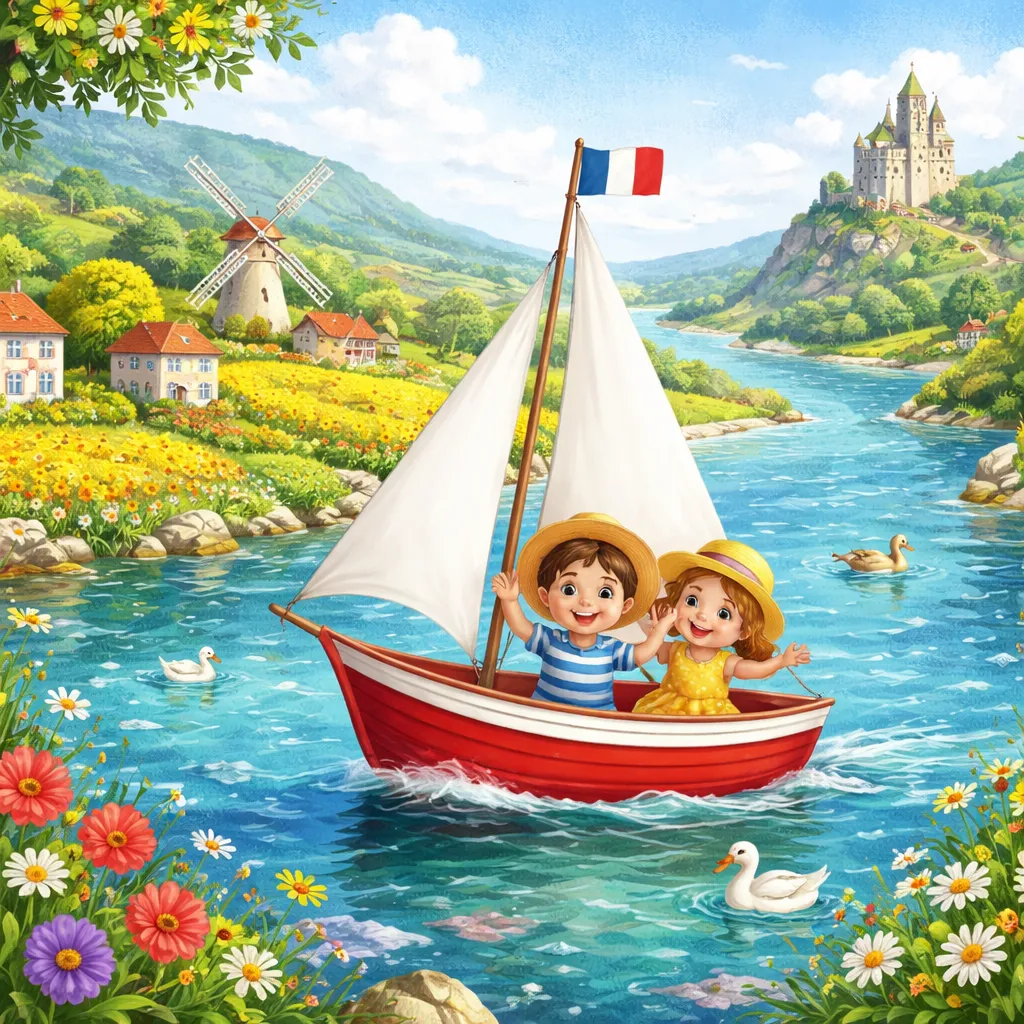

Have you ever put a tiny paper boat in a puddle or a stream and watched it float away? Have you wondered where it might go? There is a gentle, wondering French song that asks this same question about a little boat on the water. It is a song about travel, curiosity, and the flow of a river. Let’s launch our imagination and learn the flowing song “The Little Boat (Bateau sur l'eau).”
About the Song
Here are the simple, flowing lyrics of the traditional French children’s song:
Bateau sur l'eau,
La rivière, la rivière,
Bateau sur l'eau,
La rivière au bord de l'eau.
L'eau ça monte, ça descend,
Ça monte, ça descend,
Bateau sur l'eau,
La rivière au bord de l'eau.
Petit bateau, où va-t-il?
Où va-t-il? Où va-t-il?
Petit bateau, où va-t-il?
Petit bateau, sans maman.
English Translation:
Boat on the water,
The river, the river,
Boat on the water,
The river at the water’s edge.
The water goes up, it goes down,
It goes up, it goes down,
Boat on the water,
The river at the water’s edge.
Little boat, where is it going?
Where is it going? Where is it going?
Little boat, where is it going?
Little boat, without mama.
This is a classic French-language children’s song. The song is a soft, thoughtful look at a boat’s journey. “Boat on the water, the river, the river,” it begins, painting a clear picture. “Boat on the water, the river at the water’s edge,” it repeats, making us see the scene. Then it watches the water move. “The water goes up, it goes down, it goes up, it goes down,” maybe from little waves or the river’s flow. Finally, the singer wonders about the boat’s journey. “Little boat, where is it going? Where is it going? Where is it going? Little boat, without mama.” The song is a quiet thought about travel, independence, and the path of a river.
What the Song is About
The song shows us a small boat’s adventure on a gentle river. Imagine a sunny day by a calm, winding river. A little wooden boat floats on the surface. “Boat on the water, the river, the river,” it rests lightly on the moving stream. “Boat on the water, the river at the water’s edge,” the boat is between the water and the shore.
The water is not still. “The water goes up, it goes down, it goes up, it goes down,” small waves make the boat bob gently up and down. The boat floats along, following the current. Someone watches it and starts to wonder. “Little boat, where is it going? Where is it going? Where is it going?” The boat is on its own journey. “Little boat, without mama.” It is a simple scene that makes us think about travel, direction, and being on your own.
Who Made It & Its Story
“Bateau sur l'eau” is a beloved traditional French nursery rhyme and singing game. Its specific creator is not known. It is a classic song taught in French homes and schools, often accompanied by gentle rocking motions or a simple game where children’s hands represent the boat and the water. The song reflects a common and beautiful sight in France: rivers and canals (“les canaux”) that have been central to travel, trade, and daily life for centuries. It captures the simple childhood wonder of watching things float away on the water.
This gentle, thoughtful song is loved for three wonderful reasons. First, it uses very simple, repetitive French vocabulary perfect for young learners, focusing on basic nouns (“bateau,” “eau,” “rivière”) and a key preposition (“sur”), which we will learn about. Second, it has a calm, flowing melody that mimics the motion of water and a boat, making it soothing and easy to remember. Third, it gently introduces big ideas about journeys, independence, and curiosity in a safe, child-friendly way, using the boat as a symbol.
When to Sing It
This song is perfect for calm, thoughtful, or playful moments near water. You can sing it softly while taking a bath, making your toy boat go “up and down” on the water. You can hum it on a walk by a river, pond, or even a large puddle, watching the water flow. You can also sing it as a gentle lullaby, rocking a teddy bear like a boat on the water, wondering where it might dream of going.
What Children Can Learn
This gentle, flowing song is a wonderful teacher of basic French nouns, the idea of movement, and the important little word “sur” (on), which tells us where the boat is.
Vocabulary
The song teaches us clear, useful French words for nature and travel. “Boat” (Bateau). “On” (sur). “The water” (l'eau). “The river” (La rivière). “At the edge of” (au bord de). “The water” (l'eau) again. “It/That” (Ça). “Goes up” (monte). “Goes down” (descend). “Little” (Petit). “Where” (où). “Is it going?” (va-t-il?). “Without” (sans). “Mama/Mom” (maman).
Let’s use these words! You can describe a scene: “Le bateau est sur l'eau.” (The boat is on the water.) You can talk about movement: “L'eau monte.” (The water rises.) New word: Le courant. This means “the current,” the flow of the river that carries the little boat.
Language Skills
This song is perfect for learning about the important little word “sur” (on), which we first see in the title and opening line: “Bateau sur l'eau” (Boat on the water).
Concept Definition: The word “sur” means “on” or “on top of.” It is a preposition. We use it to tell the position of one thing in relation to another. The boat is not in the water (under it) or next to the water. The boat is on the surface of the water. “Sur” gives us that specific location.
Features and Types: “Sur” is for when one thing is touching the top surface of another. Other French prepositions for place are “dans” (in), “sous” (under), and “à côté de” (next to). “Sur” tells us about contact with a surface. The book is on the table (“sur la table”). The cat sleeps on the bed (“sur le lit”). The picture hangs on the wall (“sur le mur”).
How to Spot Them: Here is a simple “is it on top?” trick. Look at where something is. Ask: “Is it touching the top of something else?” If yes, you probably need “sur”. The boat floats. Is it on top of the water? Yes -> “sur l'eau”. I put the plate. Is it on top of the table? Yes -> “sur la table”.
How to Use Them: A great way to describe where something is located is the “On Top Formula”. The pattern is: [Thing] + sur + [the other thing/article + noun].
Example from the song: “Bateau sur l'eau” (Boat on the water).
Example you can make: “Le chat est sur la chaise.” (The cat is on the chair.) “La pomme est sur l'assiette.” (The apple is on the plate.) “Nous sommes sur le pont.” (We are on the bridge.) [Like in “Sur le pont d'Avignon”!]
Sounds & Rhythm Fun
Listen to the gentle, waving rhythm of the melody. The song has a smooth, flowing tune that feels like water moving. The line “Bateau sur l'eau” is sung on a few notes that rock back and forth, just like a boat. The repetition of “La rivière, la rivière” and “Ça monte, ça descend” sounds like the river flowing or waves lapping.
The melody for “Petit bateau, où va-t-il?” has a wondering, questioning sound that goes up, just like when we ask a real question. The rhythm is slow and steady, perfect for rocking or swaying. This musical pattern is great for creating your own wondering song. You can write your own “Oiseau dans le ciel” (Bird in the sky) song! Try: “Oiseau dans le ciel, Le nuage, le nuage, Oiseau dans le ciel, Le nuage près du soleil. Il vole haut, il vole bas, Il vole haut, il vole bas, Petit oiseau, où vas-tu? Où vas-tu? Où vas-tu?” (Bird in the sky, the cloud… It flies high, it flies low… Little bird, where are you going?)
Culture & Big Ideas
“Bateau sur l'eau” connects to the central role of rivers and canals in French geography, history, and leisure. France has many famous rivers like the Seine and the Loire. People love walking “au bord de l'eau” (at the water’s edge), having picnics, and watching boats. The song also touches on the simple pleasure of playing with toy boats in fountains or parks, a classic childhood pastime.
The song conveys three gentle, thoughtful ideas. First, it observes and describes the natural movement of water (“ça monte, ça descend”), encouraging close looking at the natural world. Second, it explores the theme of journey and curiosity (“où va-t-il?”), wondering about destinations and paths. Third, it very subtly touches on feelings of independence and perhaps a tiny bit of loneliness (“sans maman”) in a safe, metaphorical way, using the boat to talk about being on your own.
Values & Imagination
Imagine you are sitting on a grassy bank by a wide, slow river. You have just set a little leaf boat onto the water. “Boat on the water, the river, the river,” you whisper as it starts to float. “Boat on the water, the river at the water’s edge,” it follows the curve of the shore.
You watch the tiny waves. “The water goes up, it goes down, it goes up, it goes down,” your boat bobs on each tiny ripple. It starts to float faster, carried by the current. You feel a little wonder and maybe a little worry. “Little boat, where is it going? Where is it going? Where is it going?” you ask the air. “Little boat, without mama.” Will it be okay on its own? Where will the river take it? How does the cool grass feel under your hands? Can you smell the wet earth and plants by the river? Draw the little boat’s journey. Draw a wavy line for the river. Draw a simple little boat on the line. Draw an arrow showing the direction it is floating. On the riverbank, draw a simple stick figure watching. This shows the song’s scene of watching and wondering.
The song encourages us to be curious observers of nature, to think about journeys and where things go, and to understand that it is okay to wonder about being on your own sometimes, just like the little boat. A wonderful activity is the “Bateau en Papier” (Paper Boat) mission. Find some paper, make a simple paper boat, and float it in a basin, bathtub, or puddle. As it floats, sing the song to your boat. Gently make waves (“l'eau ça monte, ça descend”) and ask it “où vas-tu?”. This connects you directly to the song’s playful and thoughtful heart.
So, from the boat on the water to the wondering question, this song is a gentle ride for the imagination. It is a vocabulary lesson in nature and travel words. It is a language lesson in using the preposition “sur” (on) to describe location. It is a music lesson in a flowing, questioning melody. “The Little Boat (Bateau sur l'eau)” teaches us about observation, curiosity about journeys, and the peaceful flow of water.
Your Core Takeaways
You are now an expert on the song “The Little Boat (Bateau sur l'eau).” You know it is a gentle French song about a boat floating on the river, the water going up and down, and someone wondering where the little boat is going without its mama. You’ve learned French words like “bateau,” “eau,” “rivière,” “monte,” “descend,” “où,” and “sans maman,” and you’ve practiced using the preposition “sur” (on) to say where things are. You’ve felt its flowing, wave-like rhythm and created your own wondering verse. You’ve also discovered the song’s message about observing nature, being curious about journeys, and thinking gently about independence.
Your Practice Missions
First, play the “Où est…? Sur…” (Where is…? On…) game. Look around your room and find three things that are on something else. Say the sentence in French using the “[Thing] + est + sur + [Place]” formula. For example, “Le livre est sur l'étagère.” (The book is on the shelf.) “Le coussin est sur le canapé.” (The cushion is on the sofa.) This mission helps you practice the song’s key language skill of describing location with “sur.”
Second, have a “Voyage du Bateau” (Boat’s Journey) moment. Find a small leaf, a cork, or a paper boat. Place it in a stream of water in a sink, a basin, or outside. As it floats, describe its journey in simple French. Say “Bateau sur l'eau” and “L'eau monte et descend.” Gently ask it “Petit bateau, où vas-tu?” Watch where it goes. This mission lets you act out the song’s core action of observing and wondering about a journey.