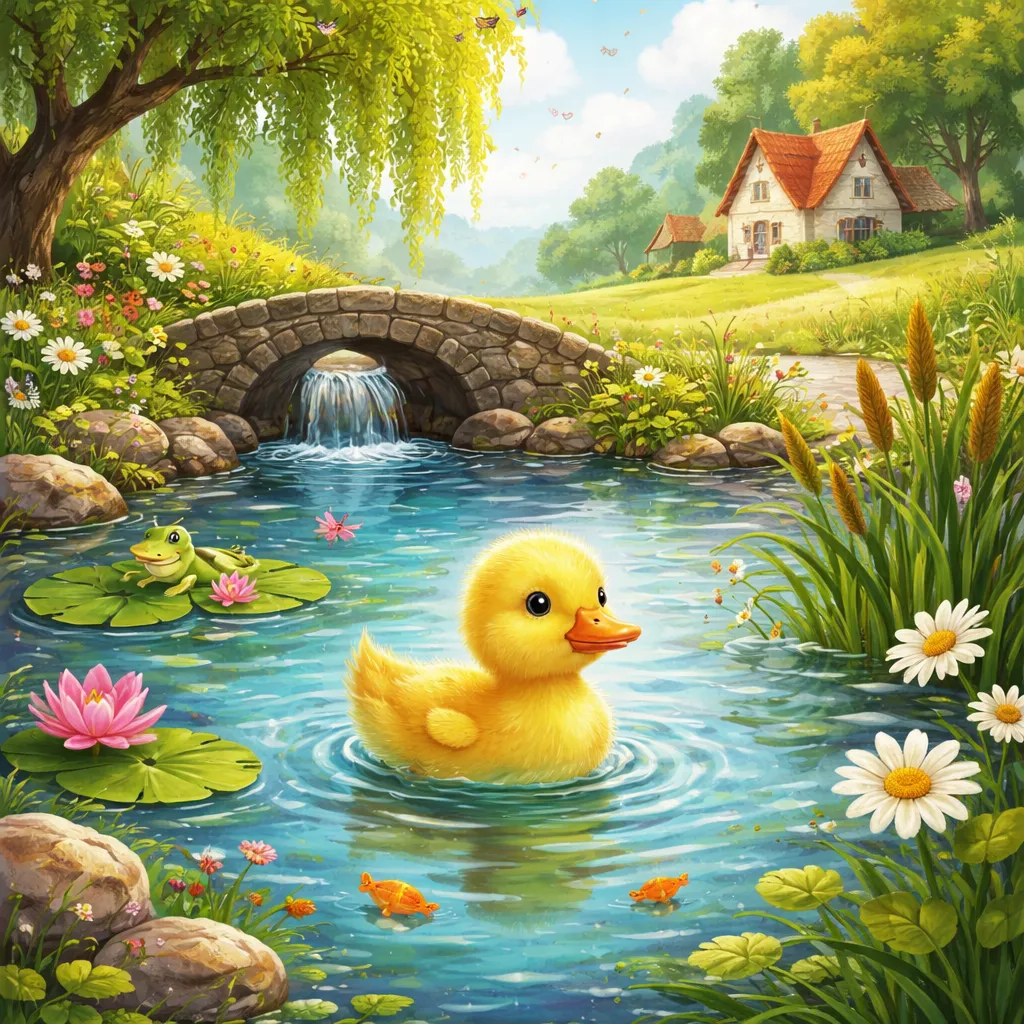

Have you ever watched a duck in a pond? Have you seen it paddle its feet, dip its head underwater, or waddle on the grass? Ducks are funny, friendly birds that live near water all over the world, including in Portugal. There is a gentle, happy song that describes a little duck’s simple day. Let’s sit by the water’s edge and learn the calm, observing song “The Little Duck (O Patinho).”
About the Song
Here are the peaceful, descriptive lyrics of a lovely traditional Portuguese children’s song. This version paints a quiet picture of the duck’s activities:
O patinho, o patinho
Nada no lago, nada no lago.
O patinho, o patinho
Mergulha na água, mergulha na água.
O patinho, o patinho
Come a graminha, come a graminha.
O patinho, o patinho
Faz quá quá quá, faz quá quá quá!
English Translation:
The little duck, the little duck
Swims in the lake, swims in the lake.
The little duck, the little duck
Dives in the water, dives in the water.
The little duck, the little duck
Eats the little grass, eats the little grass.
The little duck, the little duck
Makes quack quack quack, makes quack quack quack!
This is a sweet Portuguese-language children’s song from Portugal that describes the everyday actions of a duck. The word “patinho” means “little duck” or “duckling.” The song is like a friendly list of what a duck does. It does not tell a story with a problem, but simply shows us the duck’s world. We see the little duck swimming calmly in the lake. We watch it dive under the water. We see it eating grass. Finally, we hear its famous sound: “quá quá quá!” which is the Portuguese way to write a duck’s quack. The song is a gentle observation of nature, helping us appreciate the simple, quiet life of a little duck.
What the Song is About
The song is a quiet picture of a duck’s day. Imagine a small, fuzzy yellow duckling. It is on a calm, blue lake. The song begins, and you see it smoothly swimming. Its webbed feet paddle under the water, leaving little ripples behind. “The little duck swims in the lake,” the song says, and you can see it moving.
Then, the duck takes a breath and dips its head right under the water. “The little duck dives in the water.” Maybe it is looking for a little plant to eat. Next, the duck waddles onto the soft, green grass near the edge of the lake. It pecks at the ground gently. “The little duck eats the little grass.” Finally, the duck looks up. It opens its beak and lets out a happy sound. “The little duck makes quack quack quack!” The song shows us the simple, beautiful actions that make up a duck’s day.
Who Made It & Its Story
“O Patinho” is a traditional Portuguese folk song, part of a rich collection of animal songs used to teach young children about the natural world. Like many folk songs, it was not written by one person but has been sung by parents and teachers to children for many, many years. The song reflects a common sight in Portugal’s countryside, rivers, and parks—ducks living peacefully near water. It is a staple in Portuguese preschools, used to develop vocabulary, mimic animal sounds, and foster an early appreciation for animals and their habitats through gentle, repetitive music.
This calm song is loved for three gentle reasons. First, it is a perfect, simple introduction to common verbs and prepositions in Portuguese through easy, observable actions. Second, its melody is very soft, slow, and soothing, making it perfect for quiet time, gentle movement, or even as a lullaby. Third, it encourages careful observation and appreciation of nature by focusing calmly on what an animal actually does, fostering curiosity and calm attention.
When to Sing It
This song is perfect for calm, observant moments. You can hum it softly during a quiet playtime with toy animals, moving a duck toy through the air as if it’s swimming and diving. You can sing it gently during bath time, pretending your hands or a toy are the duck in the water. You can also whisper it while visiting a real pond or park, watching the ducks and singing about what you see them do.
What Children Can Learn
This observant song is a wonderful teacher about nature, simple actions, and location words in Portuguese.
Vocabulary
The song teaches us words for animals, actions, places, and sounds in Portuguese. “The little duck” (O patinho). “Swims” (Nada). “In the lake” (no lago). “Dives” (Mergulha). “In the water” (na água). “Eats” (Come). “The little grass” (a graminha). “Makes” or “does” (Faz). “Quack quack quack” (quá quá quá) is the duck’s sound.
Let’s use these words! You can say, “O patinho nada.” (The little duck swims.) Or, “O pássaro canta.” (The bird sings.) New word: Observe. This means to watch something carefully to learn about it, just like the song carefully watches what the little duck does.
Language Skills
This song is a lovely, clear lesson in using prepositions of place to tell us where something happens, specifically the Portuguese word “em” (in/on/at) and its combined forms “no” (in the) and “na” (in the).
Concept Definition: A preposition of place is a small word that tells us the location of something—where it is or where an action happens. The word “em” is a very important one in Portuguese. It can mean “in,” “on,” or “at.” When “em” meets the words for “the” (“o” or “a”), they often combine to make “no” (em + o) and “na” (em + a).
Features and Types: Look at the locations in the song. The duck does things in specific places. It swims “no lago” (in the lake). It dives “na água” (in the water). “No” is used because “lago” (lake) is a masculine word. “Na” is used because “água” (water) is a feminine word. They both show the action is happening inside that place.
How to Spot Them: Here is a simple “location detective” trick. Ask yourself: “Where is the action happening?” The answer often starts with a little word like “no” or “na.” In the song, ask: “Where does the duck swim?” Answer: “no lago” (in the lake). This helps you find the prepositional phrase.
How to Use Them: A great way to describe an animal’s action is the “Animal Place Pattern”. The pattern is: “[Animal] + [Action] + no/na + [Place].”
Example from the song: “O patinho nada no lago.” (The little duck swims in the lake.) “O patinho mergulha na água.” (The little duck dives in the water.)
Example you can make: “O gato dorme no sofá.” (The cat sleeps on the sofa.) “O peixe vive na água.” (The fish lives in the water.)
Sounds & Rhythm Fun
Listen to the gentle, flowing rhythm of the melody. The song has a slow, smooth, and wavy pace, like water moving gently. The repetition of each line, like “nada no lago, nada no lago,” feels calming and helps us remember the words. The sound “quá quá quá” is fun to say and sounds like a real duck! The melody is simple and rises and falls softly, easy for anyone to sing.
The rhythm is not for dancing; it is for swaying gently. It helps paint a peaceful picture in our minds. The repeating structure makes it very easy to learn. This musical pattern is perfect for creating your own quiet animal observation song. You can write your own “O Passarinho” (The Little Bird) song! Use the same tune. Try: “O passarinho, o passarinho, canta na árvore, canta na árvore. O passarinho, o passarinho, voa no céu, voa no céu…” (The little bird, the little bird, sings in the tree, sings in the tree. The little bird, the little bird, flies in the sky, flies in the sky…)
Culture & Big Ideas
“O Patinho” connects to the appreciation of simple, everyday nature that is part of life in many parts of Portugal, with its rivers, ponds, and coastal areas where ducks are common. The song reflects a calm, observant approach to learning about the world, encouraging children to look closely at animals and describe what they see simply and accurately. It is a gentle part of early childhood education, focusing on the here and now.
The song conveys three quiet, important ideas. First, it teaches focused observation of the natural world, noticing and naming specific animal behaviors. Second, it builds basic vocabulary in a very contextual and memorable way, linking the action word directly to a clear picture (swimming in the lake). Third, it fosters a sense of calm appreciation and gentle curiosity about animals, presenting the duck’s life as something peaceful and interesting to watch.
Values & Imagination
Imagine you are the “patinho.” You are a soft, yellow duckling floating on a cool, calm lake. The sun is warm on your back. You paddle your feet slowly under the water, moving smoothly. “I swim in the lake,” you think. You see something shiny below. You take a deep breath and dip your whole head under the water. The world is quiet and green. “I dive in the water.” Later, you waddle onto the soft, dewy grass. You nibble on the sweet, green blades. “I eat the little grass.” Feeling happy and full, you look at the blue sky and let out a cheerful call. “Quá! Quá! Quá!” How does the cool water feel on your feathers? How does the grass taste? Draw the little duck’s world. Draw a lake, some grass, and a happy little duck. Show the duck doing the three things from the song: swimming, diving, and eating. You can even draw little “quá quá quá” sounds coming from its beak. This shows the song’s simple story.
The song encourages us to watch animals quietly, learn about their habits, and feel calm and happy in nature. A wonderful activity is “Quiet Animal Watching.” The next time you see a bird, a squirrel, or even a pet cat, watch it for one minute without making a sound. In your mind, describe what it is doing in simple words, like in the song: “The squirrel runs on the fence. The squirrel eats a nut.” This connects you to the song’s spirit of gentle observation.
So, from the first smooth swim to the final happy quack, this song creates a calm, loving picture of a little duck’s day. It is a vocabulary lesson in animal actions and places. It is a language lesson in using “no” and “na” to tell where things happen. It is a music lesson in a gentle, flowing, repetitive melody. “The Little Duck (O Patinho)” teaches us to observe nature closely, learn new words from what we see, and find simple joy in the peaceful life of an animal.
Your Core Takeaways
You are now an expert on the song “The Little Duck (O Patinho).” You know it is a gentle Portuguese song that describes a duck swimming, diving, eating grass, and quacking. You’ve learned Portuguese words like “patinho,” “nada,” “lago,” “mergulha,” “água,” and “graminha,” and you’ve practiced using “no” and “na” to say where actions happen. You’ve felt its calm, flowing rhythm and created your own animal observation verse. You’ve also discovered the song’s message about careful observation, learning from nature, and appreciating the simple, quiet lives of animals.
Your Practice Missions
First, do a “Duck Action Pantomime.” Sing the song slowly. For each line, do the action with your body. For “nada no lago,” move your arms like you’re swimming. For “mergulha na água,” pretend to dive down. For “come a graminha,” pretend to peck at the ground. For “faz quá quá quá,” open and close your hand like a duck’s beak. This mission helps you connect the Portuguese words to their meanings through movement.
Second, go on a “No/Na Hunt.” Look around your room or outside. Find one thing that is in a place. Make a simple Portuguese sentence about it using the “no/na” pattern. For example, “O livro está na mesa.” (The book is on the table.) or “O carro está na rua.” (The car is on the street.) Say your sentence out loud. This mission helps you practice the location words you learned from the song.