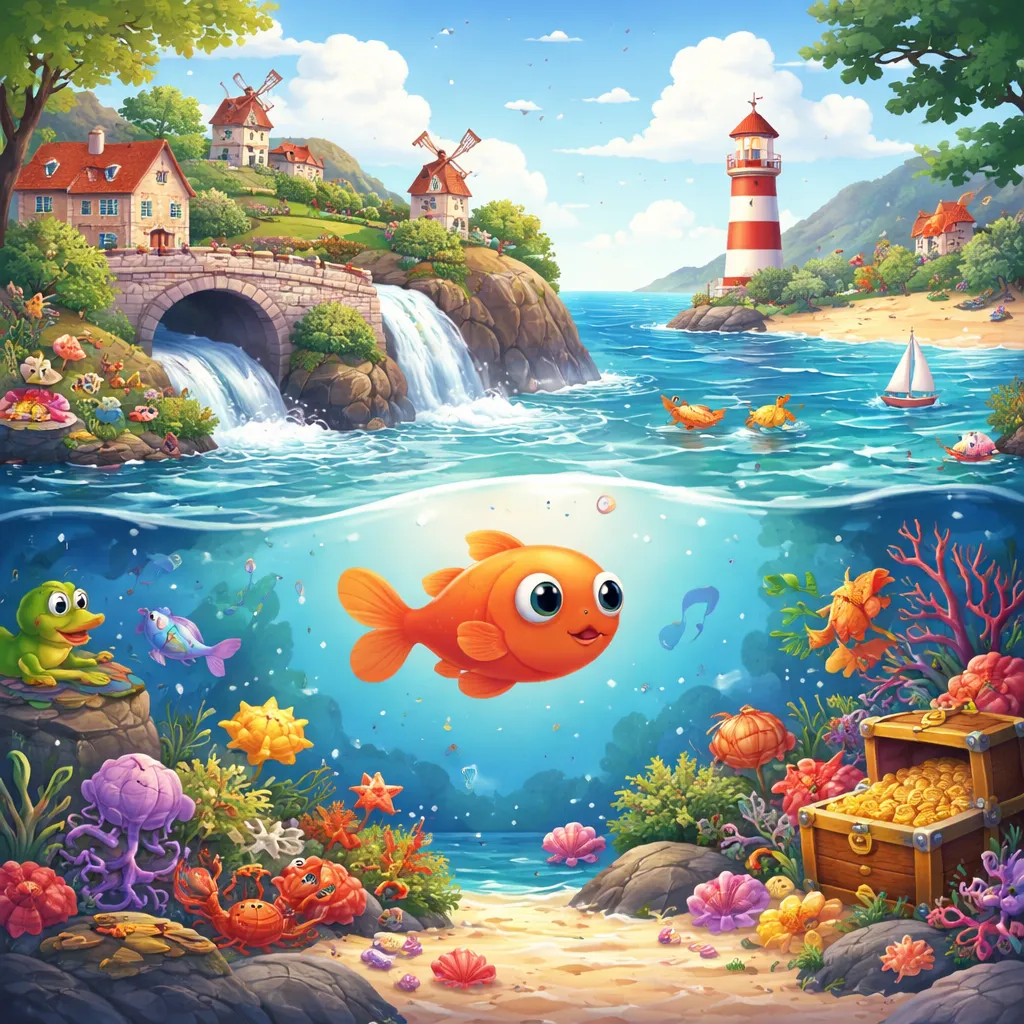

Have you ever watched fish swim in a bowl, a pond, or at the aquarium? They glide so smoothly through the water, going wherever they wish. What if a little fish could swim in all sorts of places? There is a gentle and popular French song that takes a small fish on a big adventure. It is a song about seeing the world from a fish’s point of view. Let’s dive in and learn the sweet song “The Little Fish (Le petit poisson).”
About the Song
Here are the gentle and descriptive lyrics of this classic French children’s song:
Il était un petit poisson
Qui nageait, nageait, nageait
Il était un petit poisson
Qui nageait dans l'eau.
Il était un petit poisson
Qui nageait, nageait, nageait
Il était un petit poisson
Qui nageait dans la soupe.
(Common additional verses:)
Qui nageait dans la pluie.
Qui nageait dans la mer.
English Translation:
There was a little fish
That swam, swam, swam
There was a little fish
That swam in the water.
There was a little fish
That swam, swam, swam
There was a little fish
That swam in the soup.
(Common additional verses:)
That swam in the rain.
That swam in the sea.
This is a charming and simple French folk song for children. The song introduces us to a little fish whose only action is to swim. “Il était un petit poisson qui nageait, nageait, nageait,” it begins, creating a calm, rhythmic image. The magic of the song is in where the fish chooses to swim. First, it swims in the water (“dans l’eau”), which is normal. But then, the song playfully changes the location. The same little fish swims in the soup (“dans la soupe”)! In other verses, it might swim in the rain or in the vast sea. It is a short, repetitive song that sparks the imagination.
What the Song is About
The song is a simple, imaginative journey for a little fish. First, picture a tiny, shiny fish in a clear glass of water. “Il nageait dans l’eau.” It swishes its tail and moves its fins. It swims in circles, exploring its small, watery world.
Then, imagine a big, warm bowl of soup on the table. Maybe it is a vegetable soup with carrots and peas. Our little fish magically appears there! “Il nageait dans la soupe.” It swims between the floating vegetables, as if the soup is a new, tasty ocean.
Next, look outside the window. It is raining. The raindrops are falling, making puddles. The little fish is there too, swimming in the rain (“dans la pluie”). It swims through each falling drop as if they are tiny pools.
Finally, think of the huge, blue sea with big waves. The little fish is there as well, swimming in the vast, open ocean (“dans la mer”). From a small glass to a giant sea, the same little fish can swim anywhere in our imagination.
Who Made It & Its Story
“Le petit poisson” is a traditional French folk song. Its specific creator is unknown. It is a beloved song in French nurseries and homes, often used as a gentle fingerplay or lap game for very young children, making it one of the first songs many French children learn. A caregiver might gently move a child’s fingers like a swimming fish, or bounce them to the rhythm.
This deceptively simple song is loved for three beautiful reasons. First, it masterfully introduces and reinforces the key French preposition “dans” (in) by placing the same action (swimming) in different, often surprising locations, building vocabulary in a memorable and fun context. Second, it has a soothing, repetitive, and predictable structure that is easy for even the youngest singers to remember and join in on, providing a sense of comfort and linguistic confidence. Third, it encourages playful imagination and observation by asking children to picture a familiar creature (a fish) in unexpected, whimsical settings (soup, rain), blending everyday life with fantasy.
When to Sing It
This song is perfect for calm, imaginative moments. You can sing it during bath time, making your hand or a toy fish “swim” in the bathwater, then pretending to swim in a “soup” of bubbles. You can sing it at the dinner table, quietly watching your soup and imagining the little fish’s adventure among the noodles. You can also sing it on a rainy day, watching the drops race down the windowpane and pretending your little fish is swimming along with them.
What Children Can Learn
This gentle, imaginative song is a wonderful teacher of basic vocabulary, the essential preposition “in,” and how to describe where things are.
Vocabulary
The song teaches us clear French words for animals, actions, and places. “There was” (Il était). “A” (un). “Little” (petit). “Fish” (poisson). “That/Who” (qui). “Swam” (nageait). “In the” (dans l’, dans la). “Water” (eau). “Soup” (soupe). “Rain” (pluie). “Sea” (mer).
Let’s use these words! You can describe where things are: “Le chat est dans la maison.” (The cat is in the house.) “Le livre est dans le sac.” (The book is in the bag.) New word: Verre. This means “glass.” You can talk about the fish: “Le petit poisson nage dans le verre d’eau.” (The little fish swims in the glass of water.)
Language Skills
This song perfectly illustrates the use of a very important little word: the preposition “dans,” which means “in” or “inside.” It tells us where something is happening.
Concept Definition: We are learning about small words that tell us the location of a person, animal, or thing. The word “dans” is like a label for a container or a space. In the song, the fish is always swimming dans something: in the water, in the soup. Think of your toy in a box (“dans la boîte”), a friend in the park (“dans le parc”), or you in your bed (“dans le lit”). “Dans” shows the space where something is.
Features and Types: The word “dans” is a preposition, a word that shows relationship. It is often followed by another word that names the place. The word for the place (like “eau,” “soupe”) often needs a little word like “le,” “la,” or “l’” in front. “Dans l’eau” (in the water), “dans la soupe” (in the soup), “dans la mer” (in the sea). The pattern is: “[Thing/Person] + [is/does something] + dans + [the place].”
How to Spot Them: Here is the “Location Finder” trick. Listen for the word “dans.” Ask the question: “Où?” (Where?). The answer that tells you the place will often start with “dans.” In the song, ask: “Où nage le poisson?” (Where does the fish swim?). The answers are all “dans l’eau,” “dans la soupe,” etc. “Dans” is your signal for location.
How to Use Them: A great way to describe where you or things are is the “My Place” formula. The pattern is: “[Subject] + [verb] + dans + [article] + [place].”
Example from the song: “Le poisson nage dans l’eau.” (The fish swims in the water.)
Example you can make: “Je joue dans le jardin.” (I play in the garden.) “Maman est dans la cuisine.” (Mom is in the kitchen.)
Sounds & Rhythm Fun
Listen to the soft, flowing rhythm of the melody. The tune for “Il était un petit poisson” is gentle and swaying, like the movement of a fish swimming slowly. The repetition is the heart of the song. The first three lines are exactly the same in every verse: “Il était un petit poisson, qui nageait, nageait, nageait, il était un petit poisson.”
This makes it incredibly easy to learn and sing. Only the last line changes with the new location (“qui nageait dans la soupe”). The “-ait” sound in “nageait” is repeated three times, making a soothing, watery sound. The melody is simple and smooth, helping the words stick in your memory. This musical pattern is perfect for creating your own “dans” songs. Try a bird song: “Il était un petit oiseau qui volait, volait, volait… qui volait dans le ciel.” (There was a little bird that flew, flew, flew… that flew in the sky.)
Culture & Big Ideas
“Le petit poisson” connects to the French appreciation for simple, poetic observation of everyday life. Even a bowl of soup or a rainy day can become a setting for a small, magical story. This song reflects a cultural love for finding wonder in ordinary moments and using them to spark a child’s imagination gently.
The song conveys three gentle, important ideas. First, it builds spatial awareness and the understanding of containment (“in”) by playfully placing the same subject (the fish) inside different, familiar containers (water, soup bowl, raindrop, sea), making the concept of “inside” concrete and fun. Second, it encourages close observation and imaginative connection, asking children to look at a bowl of soup not just as food, but as a possible “ocean” for a tiny creature, fostering creative thinking. Third, it provides a sense of security and predictability through its repetitive structure, while the changing last line offers a gentle surprise, balancing comfort with gentle novelty which is ideal for young learners.
Values & Imagination
Imagine you are the little fish. Your world is cool and blue. You swish your tail and glide through the clear water in your glass. “Je nage dans l’eau.” It is your home.
Then, you jump! You land in a warm, steamy place. It is full of floating orange carrots and green peas. You swim around a piece of pasta. “Je nage dans la soupe.” It is a delicious, warm new world to explore.
A raindrop falls and catches you. You are now swimming down from the sky, inside a clear, moving drop of water. “Je nage dans la pluie.” You slide down a windowpane on your watery slide.
Finally, you dive into the biggest place of all. The water is deep and blue and stretches forever. Big fish swim by slowly. You are a tiny dot in the huge, wonderful sea. “Je nage dans la mer.” How does it feel to be so small in such a big, beautiful world? Draw the fish’s journey. Draw four circles. In the first, draw a fish in a glass. In the second, draw a fish in a bowl with a spoon. In the third, draw a fish in a raindrop. In the fourth, draw a tiny fish in a giant ocean. This shows all the “dans” places from the song.
The song encourages us to look at everyday things with new, imaginative eyes, to think about where creatures live, and to see the world as full of possible adventures, even in a bowl of soup. A wonderful activity is the “Où est-il?” (Where is it?) game. Take a small toy animal. Hide it “dans” different places: in a cup (“dans la tasse”), in a shoe (“dans la chaussure”), in a drawer (“dans le tiroir”). Ask a friend to find it by saying “Il est dans la tasse?” This connects the song’s core language to a fun game.
So, from the water glass to the vast sea, this song is a journey for a little fish. It is a vocabulary lesson in everyday places and the word for “in.” It is a language lesson in using the preposition “dans” to say where something is. It is a music lesson in a soft, repetitive tune that is easy and comforting to sing. “The Little Fish (Le petit poisson)” teaches us about observation, imagination, and the simple joy of “what if?”
Your Core Takeaways
You are now an expert on the song “The Little Fish (Le petit poisson).” You know it is a gentle French song about a little fish that swims in different places: in water, in soup, in rain, and in the sea. You’ve learned French words like “poisson,” “nageait,” “dans,” “eau,” “soupe,” “pluie,” and “mer,” and you’ve mastered the key preposition “dans” (in) for telling where things are. You’ve felt its soft, repetitive, and soothing rhythm and created your own “dans” verse. You’ve also discovered the song’s message about observing the world, using imagination, and finding wonder in everyday places.
Your Practice Missions
First, play the “Où est le poisson?” (Where is the fish?) game. Draw a simple little fish on a small piece of paper. Place it “dans” different spots around a room: in a bowl (“dans le bol”), in a book (“dans le livre”), in your pocket (“dans la poche”). Each time, say out loud in French: “Le petit poisson est dans le bol!” This mission helps you practice the song’s key word “dans” in real life.
Second, go on a “Chasse au ‘Dans’” (‘In’ Hunt). Look around your house or outside. Find five different things that are “dans” something else. Say a sentence for each one in French, like the song. For example: “Le crayon est dans la trousse.” (The pencil is in the case.) “L’oiseau est dans l’arbre.” (The bird is in the tree.) “Je suis dans le jardin.” (I am in the garden.) This mission lets you use the song’s core idea of describing location all around you.