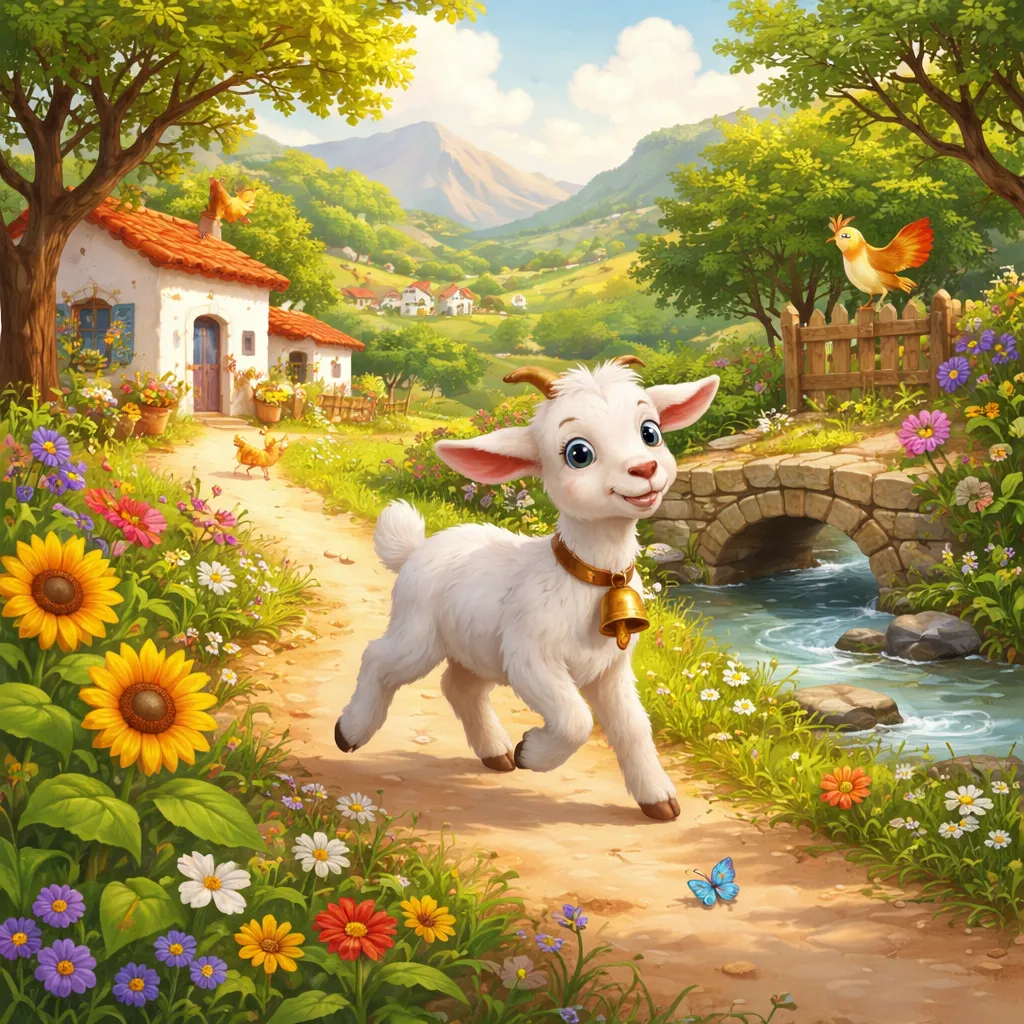

Have you ever watched a goat? They are funny, friendly animals that love to climb, eat, and say "baa!" In the countryside of Spanish-speaking places, there is a happy song all about a little goat's busy day. Let's follow the steps and sounds of the playful "The Little Goat (La cabrita)."
About the Song
Let’s read the simple, action-packed words of this traditional song. There are a few common versions. Here is a popular one:
La cabrita, la cabrita,
que se va al monte.
Camina, camina, cabrita,
camina, camina, ya.
La cabrita, la cabrita,
que come hierba.
Come, come, cabrita,
come, come, ya.
La cabrita, la cabrita,
que se va a dormir.
Duerme, duerme, cabrita,
duerme, duerme, ya.
English Translation:
The little goat, the little goat,
that goes to the hill.
Walk, walk, little goat,
walk, walk, now.
The little goat, the little goat,
that eats grass.
Eat, eat, little goat,
eat, eat, now.
The little goat, the little goat,
that goes to sleep.
Sleep, sleep, little goat,
sleep, sleep, now.
This is a traditional Spanish folk song and children’s rhyme. The word "cabrita" is a sweet way to say "little female goat" or "kid." The song is a simple story about a farm animal's daily routine. It describes the goat doing three main things: going for a walk to the hill, eating grass, and going to sleep. The song is often sung with hand movements or actions for each part, making it a fun, interactive game for children. The melody is usually cheerful, bouncy, and very repetitive, perfect for singing and moving along.
What the Song is About
The song paints a picture of a little goat's simple, happy day. Imagine a sunny morning on a farm. A small, white goat with little horns is full of energy. The song begins, and the little goat starts her adventure. She is heading to the "monte," which means the hill or the countryside. She walks with quick, funny steps. We can imagine her hopping over rocks on a dirt path, her bell going "ting-a-ling." The song encourages her: "Walk, walk, little goat, walk, walk, now!"
Next, the goat gets hungry. She finds a patch of soft, green grass. She lowers her head and starts to munch. Her mouth moves side to side as she chews the tasty grass. The song tells her: "Eat, eat, little goat, eat, eat, now!" After a long day of walking and eating, the little goat feels tired. The sun is setting, painting the sky orange. She finds a cozy, safe spot, maybe under a tree. She curls up, tucks her legs, and closes her eyes. The song whispers: "Sleep, sleep, little goat, sleep, sleep, now." The song shows the gentle rhythm of an animal's day.
Who Made It & Its Story
"The Little Goat (La cabrita)" is a classic Spanish folk song for children. Its specific author is unknown, as it comes from a long tradition of oral songs and games passed down in families, schools, and playgrounds across Spain and Latin America. The song reflects a life close to nature and farm animals, which was very common for many people. It is a simple, joyful way to teach children about animals and their habits. The song is often used as a "finger play" or action song, where children use their fingers to "walk" on their legs, pretend to eat, and put their hands together by their face to sleep. This makes learning about sequences and routines fun and physical.
This action song is loved for three playful reasons. First, its structure is super clear and repetitive, with three easy-to-remember verses about walking, eating, and sleeping. Second, it is a perfect song for physical movement and imitation, helping children learn through action and play. Third, it teaches a simple, comforting sequence of daily activities that even children can relate to: going somewhere, eating, and resting.
When to Sing It
This song is perfect for active, playful moments. You can sing and act it out loudly during playtime, walking like a goat, pretending to eat grass, and pretending to fall asleep on the floor. You can chant it on a walk in the park or on a hike, pretending to be explorers or animals climbing a hill. You can also sing it as a gentle winding-down song before naptime or bed, ending with the quiet "sleep" verse.
What Children Can Learn
This cheerful, simple song is a wonderful teacher about animals, Spanish language, and daily routines.
Vocabulary
The song teaches us words for an animal, actions, and places in Spanish. A "little goat" or "kid" (cabrita) is a young goat. A "hill" or "countryside" (monte) is a high area of land or a wild, natural place. "Grass" (hierba) is the green plant that covers the ground in fields. To "walk" (caminar) means to move forward on your feet. To "eat" (comer) means to put food in your mouth. To "sleep" (dormir) means to rest with your eyes closed. "Now" or "already" (ya) is a word that shows something is happening or is finished.
Let’s use these words! You can say, "The little goat likes to walk to the hill." Or, "After I eat my lunch, I feel ready for a nap." New word: Graze. This is what animals like goats and cows do when they eat grass growing in a field, just like the cabrita in the song.
Language Skills
This song is a fantastic lesson in using action verbs in commands and talking about daily routines in the present tense.
Concept Definition: A command is a word that tells someone (or something!) to do an action. It is direct and clear. In the song, the singer tells the little goat what to do. Think of it as a "telling word." We also see verbs describing what the goat does as part of her routine.
Features and Types: In the song, we see two types. First, direct commands like "Camina" (Walk!), "Come" (Eat!), and "Duerme" (Sleep!). These are friendly orders telling the goat to do something. Second, descriptive verbs that tell us what the goat does: "se va" (she goes), "come" (she eats). These describe her normal activities.
How to Spot Them: Here is a simple "finding secret." For commands, ask yourself: "Is the singer talking directly to the goat and telling it to do something right now?" If the answer is "yes," you have found a command! Look for the action word that is the instruction, like "Camina." For descriptive verbs, ask: "Is this word telling me what the goat usually or actually does?" That's a descriptive verb, like "come" (eats).
How to Use Them: A great way to use commands is with a simple "instruction recipe". The pattern is: [Command Verb] + [Who/What you are talking to].
Example from the song: "Camina, cabrita." (Walk, little goat.) Command=Camina, Who=cabrita.
Example from the song: "Come, come, cabrita." (Eat, eat, little goat.) Command=Come, Who=cabrita.
You can make your own friendly commands! "Run, puppy!" or "Jump, friend!" In Spanish, that could be "Corre, perrito!" or "Salta, amigo!" Just use the recipe: Command Verb + who you are talking to.
Sounds & Rhythm Fun
Listen to the bouncy, steady, and very repetitive rhythm of the melody. The song has a walking, marching rhythm that matches the goat's steps. The repetition of the word "cabrita" and the action words ("camina, camina," "come, come," "duerme, duerme") makes the song easy to learn and fun to chant. The melody is often simple and jumps a little, especially on the last "ya," which sounds like a happy little hop. The Spanish words have a nice, playful sound: "cabrita" ends with "-ita," a common, cute ending for small things in Spanish. The words "monte," "hierba," and "dormir" give each verse a different focus but keep the same musical pattern.
The rhythm is clear and steady. Try walking in place to the beat: La ca-bri-ta, la ca-bri-ta, que se va al mon-te (Lah cah-bree-tah, lah cah-bree-tah, keh seh vah ahl mohn-teh). The strong repetition is what makes it so easy to remember and act out. This clear, bouncy, and repetitive musical pattern is perfect for action songs. You can write your own "animal routine" song! Use the same walking rhythm. Try: "El perrito, el perrito, que va a jugar. Corre, corre, perrito, corre, corre, ya." (The little dog, the little dog, that goes to play. Run, run, little dog, run, run, now.)
Culture & Big Ideas
"La cabrita" connects us to the rural, farm-based life that is an important part of Spanish and Latin American heritage. Goats are common animals in the countryside, providing milk, cheese, and companionship. The song reflects a close, observant relationship with farm animals and the natural rhythms of a day. It is a simple celebration of pastoral life. The song is often sung in homes, preschools, and community gatherings as a way to teach children about animals and daily cycles in a fun, engaging way. It shows how daily life, even for an animal, has a predictable and comforting order.
The song conveys three simple but important ideas. First, it’s about observing and appreciating animals and their natural behaviors. The goat walks, eats, and sleeps—just like it should! Second, it expresses the comfort and security of a daily routine. Having a pattern for the day (activity, meal, rest) feels good for everyone, goats and children alike. Third, it highlights gentle guidance and care. The singer lovingly tells the goat what to do next, showing a kind and caring relationship with the animal.
Values & Imagination
Imagine you are the little goat. The morning sun is warm on your back. You are heading to the hill. How does the dirt path feel under your hooves? Dry and dusty? You see the tall grass ahead. How does the fresh grass smell? Sweet and green? You munch and munch until your tummy is full. Now, as the day ends, you find a soft spot under your favorite tree. How does the cool earth feel as you lie down? You close your eyes, listening to the evening sounds. Now, imagine you are the goat's friend. What do you say to encourage her to walk? Do you point out a tasty bush? How do you know when she is tired and ready to sleep? Draw the goat's day in three pictures. First, draw the goat walking up a hill. Second, draw her happily eating grass. Third, draw her curled up and sleeping under a starry sky. This shows the story from beginning to end.
The song encourages observation of nature, an understanding of routines, and gentle care for animals. A wonderful activity is to "Act Out an Animal Day." Choose your favorite animal. What does it do in the morning? (Hop? Fly? Swim?) What does it eat? Where does it sleep? Act out these three things with your body while singing your own version of the song for that animal. This connects the song's pattern to your own imagination and movement.
过渡段
This cheerful song about a little goat’s day is more than just a simple rhyme. It is a doorway into learning about life on a farm, the Spanish language, and the steady, comforting beat of daily routines. By singing about the cabrita walking, eating, and sleeping, we join her in her simple adventures. The song’s clear words and bouncy rhythm make it easy to remember and even easier to act out. Now, let’s look closer at all the fun things we can learn from this goat’s busy day, from new words and how to use them, to the music in the words, and the big ideas about caring for animals and enjoying each part of our day.
Your Core Takeaways
You are now an expert on the song "The Little Goat (La cabrita)." You know it is a traditional Spanish folk song about a goat's daily routine of walking, eating, and sleeping. You’ve learned Spanish words like "cabrita," "monte," and "hierba," and you’ve practiced using command verbs to give friendly instructions. You’ve felt its clear, bouncy rhythm and created your own animal verse. You’ve also discovered the song’s connection to farm life and its messages about observing animals, enjoying routines, and gentle care.
Your Practice Missions
First, play "Follow the Goat's Day." With a friend or family member, take turns being the leader. The leader gives the commands from the song: "Camina!" (Walk!), "Come!" (Eat!), "Duerme!" (Sleep!). Everyone must act out the command. You can do this while singing the song. This mission turns the song into a fun, physical game.
Second, create a "Daily Routine" comic for your pet or favorite animal. Think about a cat, a bird, or even a fish. Draw three pictures. What does your animal do in the morning? (Play? Chirp?) What does it do at lunchtime? (Eat seeds? Swim?) What does it do at night? (Sleep in a bed? Rest on a branch?) Write a simple caption for each picture using the song’s pattern: "El gatito... que va a jugar" (The kitten... that goes to play). This activity helps you connect the song to your own observations and creativity.