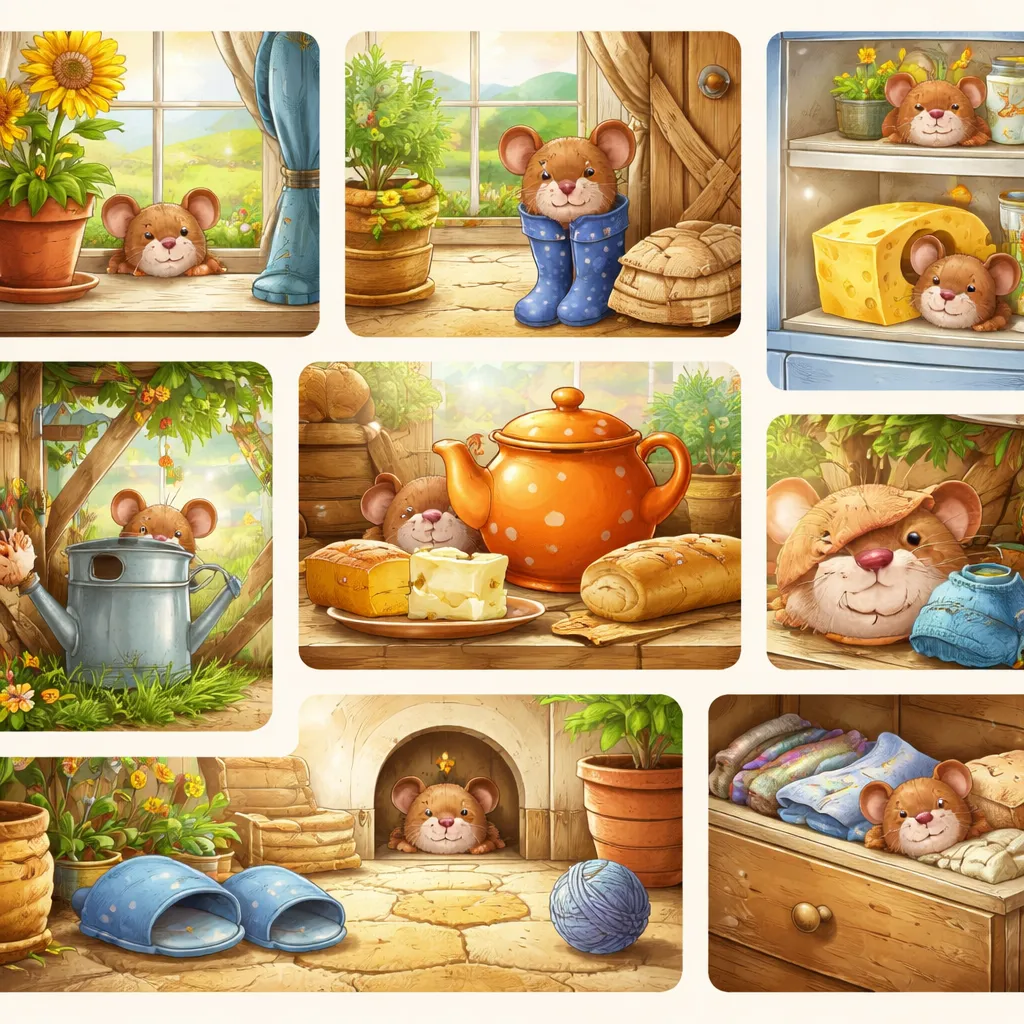

Have you ever seen a tiny, quick shadow run along the wall? Or heard a little scratching sound? Sometimes, a small, curious visitor might be in the house. In Germany, there is a playful and gentle song about a little mouse looking for a home. It is a game of hide-and-seek you can sing with your hands. Let’s tiptoe quietly and learn the searching song “The Little Mouse (Die kleine Maus).”
About the Song
Here are the short, sweet lyrics of a beloved traditional German children’s song, which is also a finger play game:
Die kleine Maus, die läuft nach Haus.
Wo ist die Maus? Versteckt im Haus.
English Translation:
The little mouse, it runs to the house.
Where is the mouse? Hidden in the house.
This is a classic German-language children’s song and finger play from Germany. The song is a mini story about a small creature’s adventure. “The little mouse, it runs to the house,” the song begins. We imagine a tiny, furry mouse with quick feet scurrying towards a safe place. But then, the mouse disappears! “Where is the mouse?” the song asks us, inviting us to look. The answer is a happy secret. “Hidden in the house.” The little mouse has found a perfect, cozy spot to hide. The song is a simple, loving game of peek-a-boo with a tiny animal, full of curiosity and a happy ending.
What the Song is About
The song is a tiny, two-line adventure. Imagine a sunny garden path. A little grey mouse with shiny black eyes and tiny whiskers is on a mission. “The little mouse, it runs to the house,” the song tells us. The mouse’s little feet move so fast as it heads for the big, safe house.
The mouse gets closer and closer, and then—poof!—it is gone. “Where is the mouse?” we all wonder, looking around. We search with our eyes. Is it under the step? Behind the flowerpot? Then we smile, because we know the answer. “Hidden in the house.” The clever mouse has found a secret spot inside, maybe a little hole in the wall or a cozy corner. It is safe and snug, playing its own game of hide-and-seek with us. The song is about movement, a playful search, and the cozy safety of home.
Who Made It & Its Story
“Die kleine Maus” is a traditional German folk song and finger play (Fingerspiel), a staple in German kindergartens and homes. Its specific creator is unknown, as it has been sung for generations. The song is a perfect example of the German “Fingerspiel” tradition, where simple songs are paired with hand motions to develop fine motor skills, language, and cognitive abilities in young children. It connects to a cultural appreciation for gentle, educational play that sparks imagination about the small creatures in our world.
This charming song is loved for three wonderful reasons. First, it is a short and perfect way to learn basic German sentence structure and a very important question: “Wo ist…?” (Where is…?). Second, it combines a simple, clear story with easy hand motions, making it interactive and helping children connect words to actions and images. Third, it taps into a child’s natural sense of curiosity and delight in hide-and-seek games, making the learning process feel like a fun, shared secret.
When to Sing It
This song is perfect for cozy, playful moments. You can sing it softly while playing with a toy mouse or looking for real little creatures in the garden. You can chant it as a fun finger play with a friend, one person asking “Wo ist die Maus?” and the other hiding their “mouse” finger. You can also whisper it as a gentle bedtime rhyme, tucking an imaginary mouse into its little house.
What Children Can Learn
This short song is a wonderful teacher about animals, movement, and asking questions in German.
Vocabulary
The song teaches us key words for animals, places, actions, and questions in German. “The” (Die). “Little” (kleine). “Mouse” (Maus). “It runs” (die läuft). “To the” (nach). “House” or “home” (Haus). “Where is” (Wo ist). “Hidden” (Versteckt). “In the” (im). “House” (Haus).
Let’s use these words! You can ask about anything: “Wo ist der Ball?” (Where is the ball?). You can describe an action: “Die Katze läuft.” (The cat runs.). New word: Verstecken. This is the German word for the game “hide-and-seek” or the action “to hide,” just like the mouse is “versteckt” (hidden) in the song.
Language Skills
This song is excellent for learning how to ask a simple question in German using “Wo ist…?” (Where is…?). This is one of the most useful question phrases you can learn. The song also shows us a simple statement with a verb: “Die kleine Maus… läuft…” (The little mouse… runs…).
Concept Definition: The phrase “Wo ist…?” is a question phrase we use to find the location of something or someone. It is like a friendly detective’s tool. In the song, we become detectives looking for the mouse: “Wo ist die Maus?” (Where is the mouse?). We use it when we can’t see something and want to find it.
Features and Types: “Wo ist…?” is a fixed phrase. You start with “Wo ist” and then add the thing you are looking for. “Wo ist der Schlüssel?” (Where is the key?). “Wo ist Mama?” (Where is mom?). The answer will often be a place, like “Versteckt im Haus” (Hidden in the house) or “Auf dem Tisch” (On the table).
How to Spot Them: Here is a simple “looking-for clue” trick. When you hear or see “Wo ist” at the beginning of a sentence, someone is asking a “where is” question. They are searching for something. In the song, the very next words are the thing we’re looking for: “die Maus.”
How to Use Them: A great way to find anything is the “Search Question Formula”. The pattern is: “Wo ist + [The thing/person you are looking for]?”
Example from the song: “Wo ist die Maus?” (Where is the mouse?)
Example you can make: “Wo ist mein Buch?” (Where is my book?) or “Wo ist der Park?” (Where is the park?)
Sounds & Rhythm Fun
Listen to the simple, catchy rhythm of the melody. The song is often sung in a gentle, curious tune. The first line, “Die kleine Maus, die läuft nach Haus,” has a flowing, storytelling melody that rises and falls like the mouse running. The second line starts with the clear question “Wo ist die Maus?” which often sounds a little higher and curious. The answer, “Versteckt im Haus,” is usually sung on a lower, more resolved note, as if sharing a secret. The rhyme is the best part! The words “Maus” (mouse) and “Haus” (house) sound almost the same at the end. This “-aus” rhyme makes the song fun to say and very easy to remember.
The rhythm is steady and bouncy, perfect for tapping your foot or gently bouncing a toy mouse along an imaginary path. The rhyming pair “Maus”/“Haus” acts like a musical hook that sticks in your mind. This simple, two-line pattern is perfect for creating your own tiny animal adventure song. You can write your own “Die kleine Biene” (The Little Bee) song! Try: “Die kleine Biene, die fliegt zur Blume. Wo ist die Biene? Versteckt im Duft.” (The little bee, it flies to the flower. Where is the bee? Hidden in the scent.)
Culture & Big Ideas
“Die kleine Maus” connects to the German love for “Fingerspiele” (finger plays) and gentle stories about the small creatures and “Heimat” (home/homeland). Mice are common characters in German children’s stories, like the famous “Die Sendung mit der Maus,” a beloved educational TV show. The song reflects a cultural enjoyment of observing nature’s small details and finding cozy, safe spaces. The “Haus” represents safety and warmth, a very important concept.
The song conveys three gentle, important ideas. First, it encourages careful observation and curiosity about the world, asking “Where is it?” and inspiring children to look closely. Second, it introduces the concept of safe spaces and “home” as a place of comfort and hiding, a reassuring idea for little ones. Third, it celebrates imaginative play with simple elements, transforming a quick mouse run into a whole story, fostering creativity and narrative thinking.
Values & Imagination
Imagine you are as small as a mouse. You are the “kleine Maus” on a big adventure. The grass is like a tall forest. You see a giant, welcoming “Haus” in the distance. “The little mouse, it runs to the house,” you whisper, scampering quickly on your tiny feet. You reach the house and squeeze into a perfect, secret spot. Now, from outside, someone is asking, “Where is the mouse?” You stay very, very still and quiet in your cozy hideout, smiling. “Hidden in the house,” is the happy answer. How does your little mouse heart beat? How cozy is your hiding spot? Draw the little mouse’s journey. Draw a long, winding path from a garden to a big house. Draw a tiny mouse running on the path. Draw a question mark “?” near the house. Then, draw the inside of the house with the mouse hidden in a little hole in the wall. Write the words “Wo ist…?” and “Versteckt im Haus” in the right places. This shows the song’s search and discovery.
The song encourages us to be curious, to look for hidden things, and to appreciate the feeling of a safe, cozy home. It also teaches us to care for even the smallest creatures. A wonderful activity is the “Wo ist…?” treasure hunt. Hide a small toy, like a button or a little figure. Ask a friend or family member “Wo ist [der Name des Spielzeugs]?” (Where is the [toy’s name]?). Give hints in German or English until they find it, hidden in its own little “Haus.” This connects you to the song’s spirit of playful searching and finding.
So, from the quick run to the cozy hideaway, this song is a tiny story of adventure and home. It is a vocabulary lesson in animals, places, and actions. It is a language lesson in asking the important question “Wo ist…?” (Where is…?). It is a music lesson in a simple, rhyming, storytelling melody. “The Little Mouse (Die kleine Maus)” teaches us to be curious observers, to ask questions, and to love the safety of a hidden, happy place.
Your Core Takeaways
You are now an expert on the song “The Little Mouse (Die kleine Maus).” You know it is a German song about a little mouse that runs home and hides. You’ve learned German words like “Maus,” “läuft,” “Haus,” “Wo ist,” and “versteckt,” and you’ve practiced asking “where is” questions. You’ve felt its simple, rhyming rhythm and created your own tiny animal verse. You’ve also discovered the song’s message about curiosity, searching, and the cozy feeling of a safe home.
Your Practice Missions
First, play the “Wo ist…?” search game. Look around your room. Choose three objects (like a book, a shoe, a cup). Ask a friend or say out loud in German: “Wo ist das Buch?” (Where is the book?). Find it and say: “Hier ist das Buch!” (Here is the book!). Do this for all three objects. This mission makes you an expert at the song’s most useful question.
Second, be a “Verstecken” (Hide-and-Seek) storyteller. Take a small toy animal. Make it “laufen” (run) to a “Haus” (like a shoe box or under a blanket). Hide it. Then, tell the two-line story in German: “Die kleine [Tier], die läuft nach Haus. Wo ist die [Tier]? Versteckt im Haus.” (Replace [Tier] with your animal, like “Katze” for cat). This mission lets you act out the whole song with your own little creature.