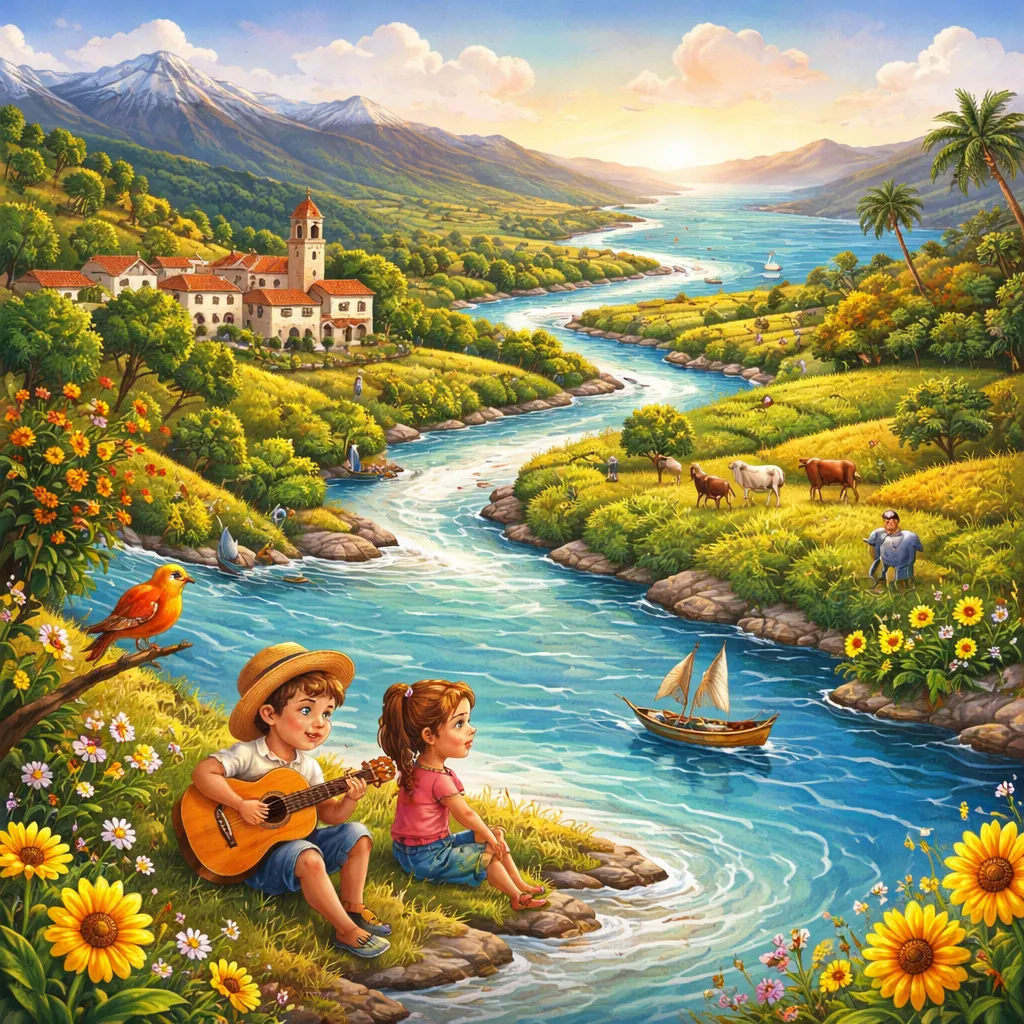

Have you ever sat by a little stream or a river, watching the water move and wondering where it is going? In Spanish, there is a flowing, traveling song that follows the journey of a little river. It is a song about movement, sound, and the constant flow of water. Let’s follow the current and learn the winding, bubbling song “The Little River (El río).”
About the Song
Here are the flowing, descriptive words of a common Spanish folk song about a river. This is a popular and rhythmic version:
El río, el río, el río va corriendo,
va corriendo, va corriendo hacia el mar.
El río, el río, hace ruido al pasar,
pasa y pasa sin parar.
El río, el río, lleva hojas verdes,
lleva barcos de papel, y un cantar.
El río, el río, me quiere saludar,
con su voz de cristal.
English Translation:
The river, the river, the river goes running,
goes running, goes running towards the sea.
The river, the river, makes noise as it passes,
it passes and passes without stopping.
The river, the river, carries green leaves,
carries paper boats, and a song.
The river, the river, wants to greet me,
with its voice of crystal.
This is a classic Spanish folk song and nature chant. The song describes the river (“el río”) as an active, living traveler. It focuses on the river’s constant action: running, making noise, passing by, and carrying things. The river is given a friendly personality—it wants to greet the listener with its crystal-clear voice. The melody often has a flowing, continuous quality, with a rhythm that mimics the steady, unstoppable movement of water, making it both calming and full of energy.
What the Song is About
The song paints a vivid picture of a river’s journey from its source to the sea. Imagine standing on the bank of a bright, chattering stream. You see the water moving quickly over rocks. The song starts, “The river, the river, the river goes running.” You watch it flow, and flow, and flow, always heading in one direction: “towards the sea.” The river never stops; it just keeps passing by.
As it moves, it makes sounds. It gurgles over stones and whispers against the banks. The song says, “The river makes noise as it passes.” You listen to its watery music. Then, you look at the surface of the water. You see “green leaves” floating like little boats. You imagine a child’s “paper boat” sailing on the current, going on a big adventure. The river carries all these things. The song makes the river seem friendly, saying it “wants to greet me” with its “voice of crystal,” which is the clear, ringing sound of clean, flowing water. The song is about watching, listening, and imagining the life and journey of a river.
Who Made It & Its Story
“The Little River (El río)” is a beloved traditional Spanish children’s song that comes from the rich tradition of nature poetry and music for young children. Like many folk songs, its author is unknown, as it was passed down through families and schools. The song reflects a deep cultural appreciation for rivers as sources of life, metaphor, and beauty in Spanish-speaking lands. Rivers are often central to geography, history, and daily life. This song personifies the river, turning it into a cheerful companion on a long journey. It is used to teach children about the water cycle, flow, and the sounds of nature in a poetic and memorable way.
This flowing song is loved for three refreshing reasons. First, it captures the endless motion and sound of a river in simple, repetitive language, helping children visualize and hear nature’s movement. Second, it uses beautiful personification, making the river a friendly character that “runs,” “makes noise,” and “wants to greet” us, which builds empathy for the natural world. Third, its melody and rhythm often mimic the sound of flowing water, making it a perfect tool for movement play, calming moments, or learning about the natural world’s rhythm.
When to Sing It
This song is perfect for moments of observation and gentle movement. You can sing it while walking alongside a stream or river, matching your steps to the song’s flow. You can hum it while playing with water or sailing toy boats in a puddle or bathtub. You can also chant it during a quiet time, using your hands to make flowing, wavy motions like a river’s current.
What Children Can Learn
This active, descriptive song is a wonderful teacher about nature, Spanish language, and observation.
Vocabulary
The song teaches us words for nature, movement, and sounds in Spanish. The “river” (río) is a large, natural stream of flowing water. “Goes running” or “is running” (va corriendo) means it is moving fast like someone who runs. “Towards” (hacia) shows the direction something is moving. The “sea” (mar) is the big, big area of salt water where many rivers end. “Makes noise” (hace ruido) means it creates sound. “As it passes” (al pasar) means while it goes by. “Without stopping” (sin parar) means it never pauses. “Carries” (lleva) means it takes things with it as it moves. “Leaves” (hojas) are the green parts of a tree. “Paper boats” (barcos de papel) are toys you make and float. A “song” (cantar) is a piece of music. “Wants to greet” (quiere saludar) means it wishes to say hello. “Voice” (voz) is the sound something makes. “Of crystal” (de cristal) means like clear, shiny glass.
Let’s use these words! You can say, “The water in the gutter goes running towards the drain.” Or, “The wind carries leaves in the fall.” New word: Current. This is the steady, flowing movement of water in a river or stream, just like the river’s journey in the song.
Language Skills
This song is a beautiful lesson in using action words (verbs) in the present tense to describe what is happening right now, and using the “-ing” form (gerund) in Spanish to show ongoing action.
Concept Definition: A present tense verb tells us what someone or something does now, as a habit, or as a general truth. The river runs, it makes noise, it carries things. The “-ing” form in Spanish (the gerund) shows an action that is in progress or happening at this very moment. In the song, the river isn’t just a runner; it “va corriendo” (is running), which makes the action feel alive and continuous, like a movie instead of a photo.
Features and Types: Look at the verbs in the song. The main action is “va corriendo” (goes running/is running). Here, “va” (goes) is a present tense verb, and “corriendo” (running) is the “-ing” form, showing the continuous run. Other present tense verbs are “hace” (makes), “pasa” (passes), and “lleva” (carries). The phrase “sin parar” (without stopping) emphasizes this continuous action. The verb “quiere saludar” (wants to greet) shows a desire, an action the river intends to do.
How to Spot Them: Here is a simple “action detective” trick. Ask: “What is the subject doing right now?” The word that answers is often the verb. For the “-ing” form in Spanish, listen for verbs ending in “-ando” (for -ar verbs like “cantar” -> “cantando”) or “-iendo” (for -er/-ir verbs like “correr” -> “corriendo”). In our song, “corriendo” comes from “correr” (to run).
How to Use Them: A great way to describe what you see is the “right now recipe”. The pattern is: [Thing] + [ir in present] + [verb with -ando/-iendo].
Example from the song: “El río va corriendo.” (The river is running.) Verb: correr -> corriendo.
Example you can make: “El niño va cantando.” (The boy is singing.) Verb: cantar -> cantando.
You can also describe habits with: [Thing] + [Present Tense Verb].
Example: “El río lleva hojas.” (The river carries leaves.)
Sounds & Rhythm Fun
Listen to the flowing, bubbling rhythm of the melody. The song often has a steady, rolling rhythm that feels like water moving over pebbles. The repetition of phrases like “va corriendo, va corriendo” and “pasa y pasa” mimics the constant, never-ending flow of a river. The repetition of “El río, el río” at the start of each verse is like the persistent sound of water. Words like “corriendo,” “pasar,” and “cantar” have liquid, flowing sounds. The description of the river’s “voice of crystal” invites you to imagine a clear, tinkling, musical sound.
The rhythm is smooth and continuous. Try moving your arms in slow, wavy lines like a river’s current: El rí-o, el rí-o, el rí-o va co-rrien-do. The repetitive, wave-like structure of the lyrics makes the song’s description of endless movement easy to remember and act out. This flowing, repetitive musical pattern is perfect for describing movement. You can write your own “flowing song”! Use the same rolling melody. Try: “El viento, el viento, el viento va silbando, va silbando, va silbando en el jardín…” (The wind, the wind, the wind goes whistling, goes whistling, goes whistling in the garden…)
Culture & Big Ideas
“El río” connects to the profound importance of rivers in Spanish and Latin American geography and culture. Rivers are often seen as the lifeblood of regions, providing water, transportation, and inspiration for stories and songs. The song reflects a poetic view of nature, where elements like the river are given voice and intention. This personification is common in folk traditions, teaching children to see the natural world as full of character and spirit. The image of paper boats (“barcos de papel”) is a universal childhood game, connecting the song to simple, joyful play.
The song conveys three important ideas. First, it’s about constant movement and journey. The river is always going somewhere (the sea), teaching us about direction, purpose, and the flow of time. Second, it expresses attentive listening to nature. The song asks us to hear the river’s “noise” and its “voice of crystal,” turning simple sounds into a friendly greeting. Third, it highlights how nature carries and connects. The river carries leaves and paper boats, just as it could carry our thoughts or dreams downstream, showing how things in nature are connected and in motion.
Values & Imagination
Imagine you are a single drop of water in the little river. You start high in the cool mountains. You join other drops and begin to run. How does the rock feel under you? Smooth? Bumpy? You rush around bends, under bridges, and through sunny spots and shade. You are always moving, “towards the sea.” You carry a tiny green leaf on your back. You see a colorful paper boat sailing above you. You make sounds as you go—gurgles, splashes, whispers. You pass by a child standing on the bank, and you try to say “hello” with your bubbly voice. Now, imagine you are the child. You put your hand in the cool, moving water. Can you feel it pulling gently? You put a leaf or a stick in the water and watch it float away. Where will it go? Draw the river’s journey. Draw a wavy line from one side of the paper to the other. At the start, draw mountains. Along the line, draw rocks, a fish, a leaf, and a paper boat. At the end, draw the big sea. This shows the river’s path and what it carries.
The song encourages observation, listening, and thinking about journeys. A wonderful activity is the “Message Boat.” Find a small leaf or make a tiny paper boat. Think of a wish or a friendly thought. Whisper it to your boat. Gently place it in a stream of water (a real stream, a fountain, or even in the sink with water running slowly). Sing “El río” as you watch it float away, imagining it carrying your message on a long journey. This connects the song’s image of the carrying river to a personal act of imagination and kindness.
So, as the last image of the crystal voice fades, think about the endless journey in this flowing tune. It is a vocabulary lesson in movement and nature. It is a language lesson in using action words that are happening right now. It is a music lesson in a smooth, rolling rhythm. From the first mention of the running river to its friendly greeting, it wraps lessons in motion, observation, and nature’s sounds in a melody that moves like water itself. “The Little River (El río)” teaches us to watch the constant flow of nature, to listen to its many voices, and to see ourselves and our dreams as part of a beautiful, ongoing journey.
Your Core Takeaways
You are now an expert on the song “The Little River (El río).” You know it is a traditional Spanish song that describes the journey, sound, and friendly nature of a flowing river. You’ve learned Spanish words like “río,” “corriendo,” and “lleva,” and you’ve practiced using present tense verbs and the “-ing” form to describe ongoing actions. You’ve felt its flowing, repetitive rhythm and created your own movement verse. You’ve also discovered the song’s message about constant movement, attentive listening, and the connected journey of all things in nature.
Your Practice Missions
First, be a “River Sound Detective.” Find a source of flowing water—a real river, a stream, a fountain, or even a running tap. Close your eyes and listen for a minute. What sounds do you hear? Is it a gurgle, a trickle, a splash? Try to sing the line “El río hace ruido al pasar” (The river makes noise as it passes) and then make the sound you hear. This mission connects the song’s words to the real music of water.
Second, create a “Carried by the River” drawing. Think of three things the river in the song carries: green leaves, paper boats, and a song. Now, draw your own version. What else could a friendly river carry? Draw a happy river and in it, draw three things you would like it to carry on a journey (a smiling rock, a message in a bottle, a flower). Label one in Spanish using the verb “lleva” (carries): e.g., “El río lleva una flor.” This helps you imagine the river’s journey and practice the song’s key word.