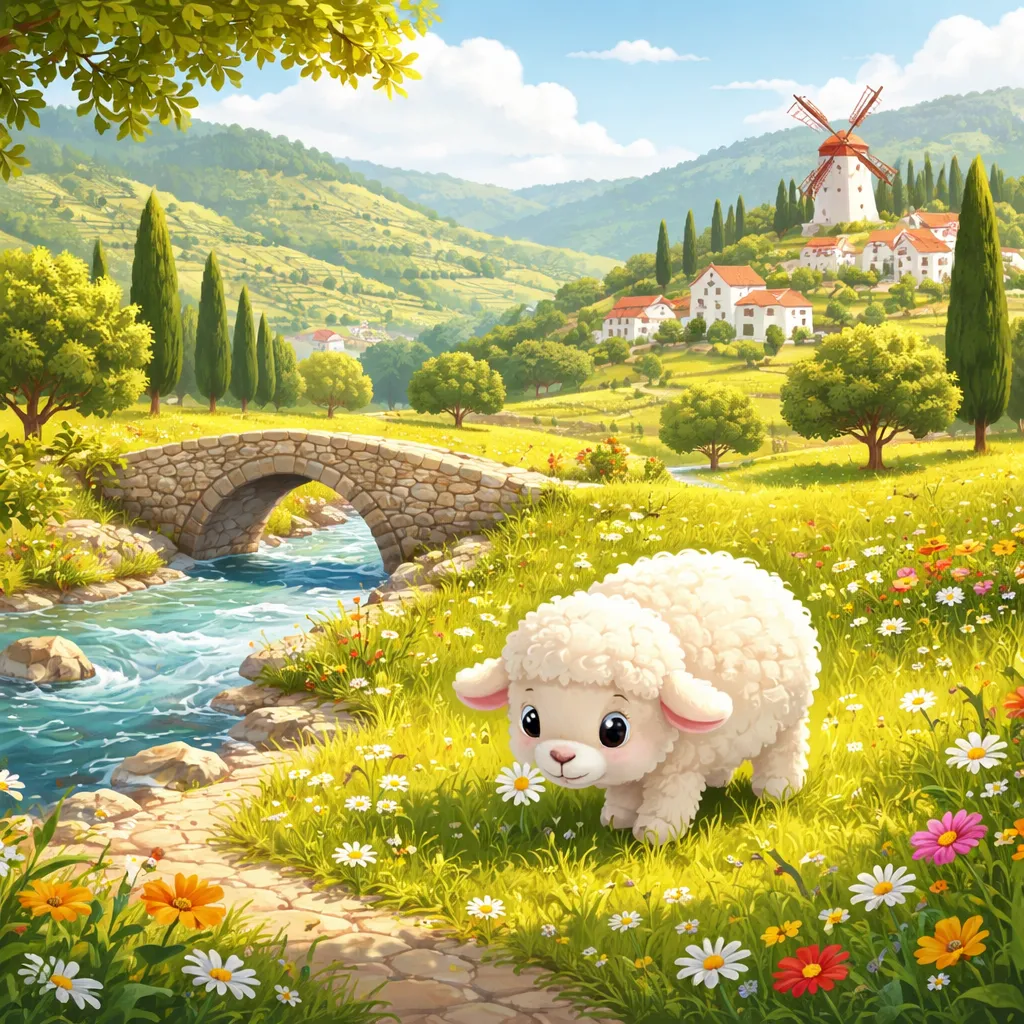

Have you ever touched a cloud? A fluffy, white sheep looks like a soft, gentle cloud walking on the hills. Sheep are calm animals that give us warm wool and say a sweet "baa." In Portugal, there is a peaceful, gentle song about a little sheep in the countryside. Let's take a quiet walk and learn the soothing song "The Little Sheep (A Ovelhinha)."
About the Song
Here are the simple, sweet lyrics of a beloved traditional Portuguese children's song. This version describes the sheep in its natural home:
A ovelhinha, a ovelhinha
É branquinha, é branquinha.
A ovelhinha, a ovelhinha
Come a relva, a relva.
A ovelhinha, a ovelhinha
Diz bééé, bééé, bééé.
A ovelhinha, a ovelhinha
Vive no campo, no campo.
English Translation:
The little sheep, the little sheep
Is white, is white.
The little sheep, the little sheep
Eats the grass, the grass.
The little sheep, the little sheep
Says baa, baa, baa.
The little sheep, the little sheep
Lives in the countryside, in the countryside.
This is a gentle Portuguese-language children's song from Portugal that paints a quiet picture of a farm animal's life. The word "ovelhinha" is the affectionate, diminutive form for "little sheep" or "lamb." The song is a calm description. It introduces us to a little sheep with a very soft, pure color. "The little sheep is white, is white," the song tells us softly. What does a little sheep eat? Its favorite green food! "The little sheep eats the grass, the grass." The sheep talks to us with its gentle, familiar sound. "The little sheep says baa, baa, baa." And where does this peaceful animal call home? A wide, open space. "The little sheep lives in the countryside, in the countryside." The song is about observing, describing, and appreciating a gentle farm animal in its peaceful home.
What the Song is About
The song is a serene portrait of a sheep's daily life. Imagine a sunny, green hill under a blue sky. A fluffy, white lamb is standing quietly. "The little sheep is white, is white," the song says gently. Its wool looks as clean and soft as fresh snow.
It lowers its head and begins to nibble on the sweet, green grass. "The little sheep eats the grass, the grass." You can almost hear the soft munching sounds. The lamb looks up, its mouth full of grass, and lets out a soft call. "The little sheep says baa, baa, baa." This is the sound of a happy, content animal. The song looks around at the wide, beautiful fields. This is the sheep's big, open home. "The little sheep lives in the countryside, in the countryside." The song shows us a calm, simple, and beautiful moment in nature.
Who Made It & Its Story
"A Ovelhinha" is a classic Portuguese folk song, deeply connected to the rural and agricultural traditions of the Portuguese countryside. Its specific creator is unknown, as it has been sung to children for generations to teach them about farm animals. The song reflects the importance of sheep farming in Portugal's history, especially for wool. It connects to a peaceful image of life in the "campo" (countryside), full of green fields and gentle animals. The song is a staple in Portuguese early childhood, used to teach animal names, colors, and the sounds of nature in a calm, lullaby-like way.
This peaceful song is cherished for three gentle reasons. First, it is a perfect, simple way to learn descriptive words and colors in Portuguese, like "branquinha" (white), and nouns about nature, like "relva" (grass) and "campo" (countryside). Second, it uses a very soft, repetitive, and soothing melody that is easy to remember and sing, almost like rocking a toy animal to sleep. Third, it creates a feeling of peace and connection to the natural world, teaching children to observe and appreciate the calm, simple life of farm animals and the beauty of rural landscapes.
When to Sing It
This song is perfect for calm, quiet moments. You can sing it softly while cuddling a fluffy white toy or looking at pictures of sheep in a book. You can hum it during a quiet car ride, imagining the green fields and the little sheep. You can also chant it gently with a friend, taking turns describing the sheep's color, what it eats, its sound, and its home.
What Children Can Learn
This descriptive song is a wonderful teacher about farm animals, colors, and habitats in Portuguese.
Vocabulary
The song teaches us words for animals, colors, actions, sounds, and places in Portuguese. "The little sheep" (A ovelhinha). "Is" (É). "White" (branquinha). "Eats" (Come). "The grass" (a relva). "Says" (Diz). "Baa" (Bééé). "Lives" (Vive). "In the" (no). "Countryside" or "field" (campo).
Let's use these words! You can say, "A nuvem é branquinha." (The cloud is white.) Or, "O coelho vive no campo." (The rabbit lives in the countryside.) New word: Pasture. This is a field of green grass where farm animals like sheep and cows eat, just like the "relva" and "campo" in the song.
Language Skills
This song beautifully introduces the concept of descriptive words, specifically adjectives that describe a noun's quality, like the color "branquinha" (white). It also shows how to state simple facts using the verb "é" (is) to link a subject to its description.
Concept Definition: Descriptive words are special words that tell us more about a person, animal, or thing. They can tell us about its color, size, shape, or how it feels. In the song, the word "branquinha" is a descriptive word. It describes the color of the little sheep. "Branquinha" means "white" and it tells us how the sheep looks.
Features and Types: Descriptive words can describe many things. They can describe color (like "branquinha" - white), size (like "pequenina" - tiny), or feeling (like "fofinha" - fluffy). In the song, we learn about color. The sheep is "branquinha." This descriptive word comes right after the verb "é" (is) to tell us about the sheep.
How to Spot Them: Here is a simple "is it like?" question trick. Find the main thing (like "ovelhinha"). Then ask: "What is the [thing] like?" The word that answers that question is often a descriptive word. In the song: What is the little sheep like? It is "branquinha" (white). That's our descriptive word!
How to Use Them: A great way to describe the world is the "What Is It Like? Formula". The pattern is: "[The Thing] + é + [Descriptive Word]."
Example from the song: "A ovelhinha é branquinha." (The little sheep is white.)
Example you can make: "O céu é azul." (The sky is blue.) "A bola é redonda." (The ball is round.)
Sounds & Rhythm Fun
Listen to the soft, flowing rhythm of the melody. The tune is often slow, gentle, and calming, like a sheep wandering in a field. The repetition of each line, like "é branquinha, é branquinha," makes the description peaceful and easy to remember. The best part is the gentle sound effect: "Diz bééé, bééé, bééé." This is the sweet sound a sheep makes, and it's fun to say in a soft, low voice. The "ã" sound in "ovelhinha" and "branquinha" gives the song a soft, musical feel.
The rhythm is steady and soothing, perfect for gentle rocking or slow swaying. The repeating lines help you learn the phrases like a calm chant. The "bééé, bééé, bééé" is a peaceful and fun part to sing together. This musical pattern is perfect for creating your own descriptive farm animal song. You can write your own "A Vaca" (The Cow) song! Use the same tune. Try: "A vaquinha, a vaquinha, é malhada, é malhada. A vaquinha, a vaquinha, come a erva, a erva... Diz muuu, muuu, muuu... Vive no estábulo, no estábulo..." (The little cow, the little cow, is spotted, is spotted. The little cow, the little cow, eats the grass, the grass... Says moo, moo, moo... Lives in the barn, in the barn...)
Culture & Big Ideas
"A Ovelhinha" connects to the tranquil, rural life and traditional sheep farming found in the Portuguese countryside ("o campo"), especially in regions like the Alentejo. Sheep are important for their wool, milk, and meat. The song reflects a simple, close-to-nature lifestyle that is valued in Portuguese culture. It connects to images of peaceful green hills, known as "pastagens," where animals graze freely, a common and beautiful sight outside Portuguese cities.
The song conveys three gentle, important ideas. First, it teaches careful observation and description of the natural world, encouraging children to notice an animal's color, food, sound, and home. Second, it introduces the concept of animal habitats and basic needs—the sheep lives in the countryside and eats grass, showing where it belongs and what it needs to live. Third, it fosters a sense of peace, simplicity, and appreciation for gentle farm animals and the calm rhythm of rural life.
Values & Imagination
Imagine you are sitting on a soft hill in the "campo." You see the "ovelhinha." It stands so still, its wool bright against the green grass. "The little sheep is white, is white," you think. It slowly moves its head down to eat. "The little sheep eats the grass, the grass." You hear a soft, gentle sound. "The little sheep says baa, baa, baa." It looks at you with calm, dark eyes. All around it is the wide, open field, its home. "The little sheep lives in the countryside, in the countryside." How soft does the wool look? How green is the grass? Draw the little sheep's world. Draw a big, green hill under a blue sky. Draw the white sheep. Draw lines to show it eating grass. Draw a speech bubble with "BÉÉÉ" inside. Write the word "CAMPO" on the hills. This shows the song's peaceful scene.
The song encourages us to observe nature quietly, appreciate gentle animals, and find beauty in simple, calm scenes. A wonderful activity is the "Peaceful Observer" moment. Find a calm animal, like a pet, a bird, or even a stuffed toy. Look at it quietly. Describe it in simple Portuguese sentences. Say its color: "É [color]." Say what it might eat: "Come [food]." Say where it lives: "Vive [place]." This connects you to the song's spirit of gentle observation and description.
So, from its white wool to its home in the fields, this song is a calm portrait. It is a vocabulary lesson in farm animals, colors, and nature. It is a language lesson in using descriptive words with "é" (is). It is a music lesson in a soft, repetitive, peaceful melody. "The Little Sheep (A Ovelhinha)" teaches us to describe animals, understand their homes, and feel the peace of the countryside.
Your Core Takeaways
You are now an expert on the song "The Little Sheep (A Ovelhinha)." You know it is a Portuguese song about a white sheep that eats grass, says baa, and lives in the countryside. You've learned Portuguese words like "ovelhinha," "branquinha," "relva," "bééé," and "campo," and you've practiced using descriptive words to tell how things look. You've felt its gentle, soothing rhythm and created your own descriptive farm animal verse. You've also discovered the song's message about observing nature, understanding animal homes, and appreciating calm, simple beauty.
Your Practice Missions
First, play the "É + Color" game. Look around your room. Point to different objects and say their color in Portuguese using the "What Is It Like?" formula. Say: "A parede é branca." (The wall is white.) or "O lápis é amarelo." (The pencil is yellow.) See how many colors you can name. This mission helps you practice the core descriptive language from the song.
Second, be a "Habitat Detective." Think of your favorite animal. In Portuguese, describe where it lives. Say: "O [animal] vive no [place]." (The [animal] lives in the [place].) For example, "O peixe vive no mar." (The fish lives in the sea.) or "O pássaro vive na árvore." (The bird lives in the tree.) This mission helps you use the song's structure to think about where animals call home.