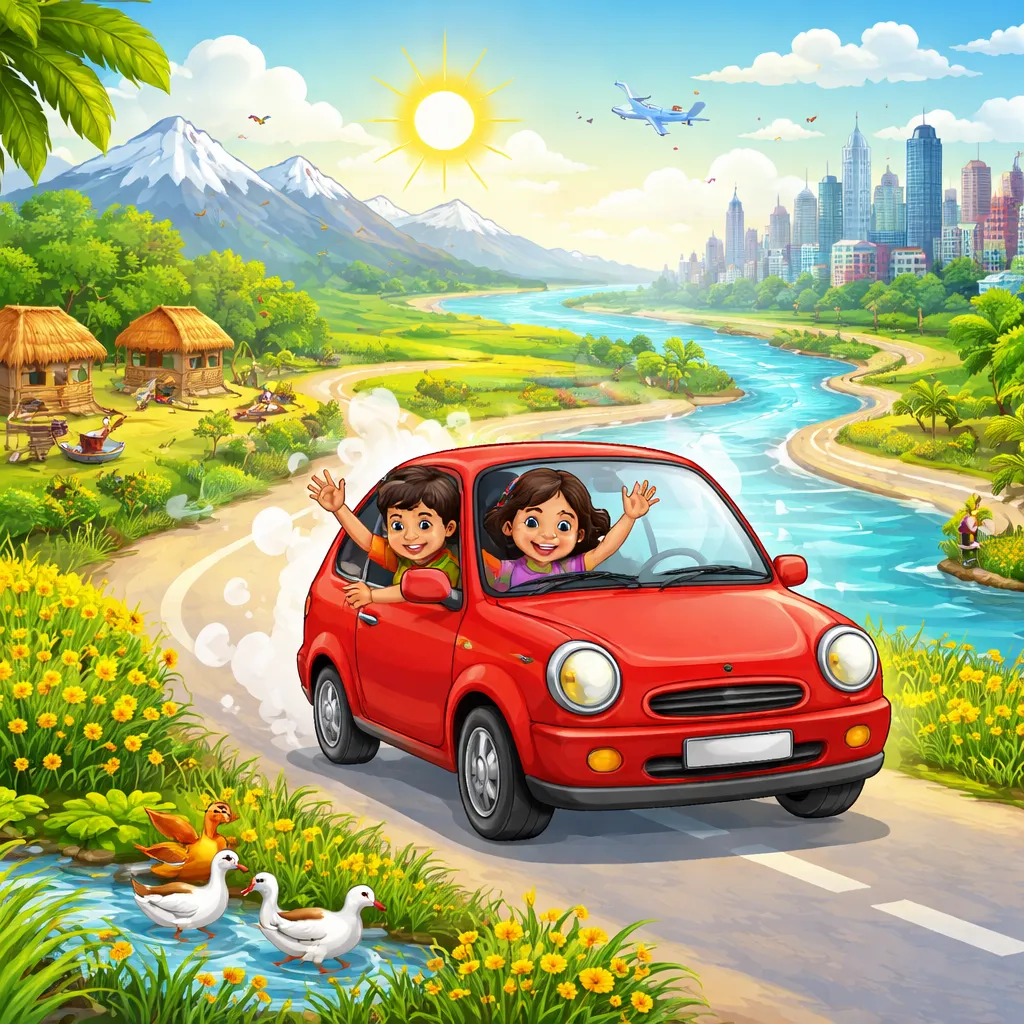

Have you ever watched cars go by on a busy street? Have you been on a family drive, watching the world blur past your window? Cars can take you to school, to the park, or on a big adventure. In Bangladesh and West Bengal, a region buzzing with life, there is a cheerful song that celebrates the fun of a car ride. Let’s buckle up and listen to the Bengali Song: The Little Car (মোটর গাড়ি).
About the Song
Here is a lively verse from this popular children’s song in Bengali and English:
মোটর গাড়ি, মোটর গাড়ি, ছোট্ট গাড়ি
(Motor gaari, motor gaari, chhoto gaari)
Motor car, motor car, little car
তুমি যাও কোন পথে?
(Tumi jao kon pathe?)
Which path are you taking?
হন হন শব্দে, ছুটে চলেছ
(Hon hon shobde, chhute cholochho)
With a honk honk sound, you are running fast
নিয়ে যাও আমাকে সাথে
(Niye jao amake shathe)
Take me along with you
This song’s original name is “মোটর গাড়ি” (Motor Gaari), which means “Motor Car” in Bengali. It is a beloved modern Bengali children’s song. The song talks directly to a little car, asking it a curious question. The music is upbeat, fast, and full of energy, with sounds that mimic a car’s horn and engine. The Bengali Song: The Little Car (মোটর গাড়ি) is a musical invitation to a journey, full of the excitement of speed and the wish to join the ride.
What the Song is About
The song is a friendly shout to a passing car. First, we call out to it twice, excitedly: “Motor car, motor car, little car!” We are curious about its route, so we ask, “Which path are you taking?” The song then describes how the car moves: “With a honk honk sound, you are running fast.” We can hear the beep-beep and imagine the car zipping down a wide road. The singer doesn’t just want to watch; they want to be part of the trip. They make a wish: “Take me along with you.” The whole song feels like waving at a cool car and dreaming of hopping in to see where it goes, sharing the fun of the journey.
Who Made It & Its Story
This song is a popular modern addition to Bengali children’s music, often heard on kids' TV shows and in schools. While the specific creators aren’t widely listed, it reflects the vibrant, fast-paced modern life in Bengal’s cities, where cars, rickshaws, and buses fill the streets. The song captures a child’s fascination with vehicles. The Bengali Song: The Little Car (মোটর গাড়ি) is a hit for three energetic reasons. First, it taps into the universal childhood love for cars and things that go fast. Second, its lyrics are simple, repetitive, and full of action, making it easy to learn and act out. Third, the melody is super catchy and energetic, perfect for singing and dancing, and the “hon hon” sound effect makes it incredibly fun and interactive.
When to Sing It
You can sing this song during a family car ride, especially when you see other interesting cars on the road. It’s perfect to chant while pushing a toy car across the floor, making “hon hon” sounds as it goes. You could also sing it with friends in the playground, running in a line like a train of cars, taking turns being the leader.
The Bengali Song: The Little Car (মোটর গাড়ি) gives us a quick, fun ride. But every good driver needs to know the rules of the road! This song is our fun driving lesson. It teaches us new words about travel, how to ask for details, and a little about modern life in Bengal. Let’s start the engine of our learning and see where it takes us!
What Children Can Learn
Vocabulary
This song helps us learn words for vehicles, movement, and travel.
Vehicle: A machine used for transporting people or goods, like a car, bus, or bicycle.
Route: The way or course taken in getting from a starting point to a destination. Which route will the car take?
Passenger: A person who is traveling in a vehicle but is not the one driving it. The singer wants to be a passenger.
Accelerate: To begin to move more quickly. The car accelerates and runs fast.
Transportation: The action of moving people or things from one place to another. Cars are a form of transportation.
Destination: The place where someone or something is going. The car’s destination is a mystery.
Language Skills
This song is a great example of using the Present Continuous Tense for actions happening now. We use this tense to talk about actions that are in progress at the moment of speaking.
What Is It?: Think of the Present Continuous as the “Right Now” tense. It describes actions that are happening at this very moment. The car isn’t just fast in general; it is running fast right now.
Finding the Secret: Look for the two-part formula: the verb “to be” (am, is, are) + a main verb ending in “-ing.” Ask yourself: “Is this action happening right this minute?”
Using It:
◦   Formula: [Subject] + am/is/are + [verb-ing].

◦   Examples: “The car is running.” “I am singing.” “We are traveling.”

◦   In the song, the action is clear: “You are running fast.” (তুমি ছুটে চলেছ). This describes the car’s current action.
Sounds & Rhythm Fun
Vroom vroom! The Bengali Song: The Little Car (মোটর গাড়ি) has a quick, zippy, and driving rhythm. It sounds like a car revving its engine and speeding up. The “hon hon” sound is repeated, acting like the song’s musical horn. This fast, energetic rhythm makes you want to move quickly and helps the simple, repetitive lyrics stick in your head instantly. You can use this same speedy, revving rhythm to make up a song about any fast-moving object, like an airplane, a train, or even a running dog.
Culture & Big Ideas
This song connects to the modern, bustling life in Bengali cities like Dhaka (Bangladesh) and Kolkata (India). A time when streets are full of colorful transportation is during Durga Puja (in West Bengal) or Durga Puja/Eid celebrations, when families go out to see decorations and visit relatives, often caught in cheerful traffic jams. The Bengali Song: The Little Car (মোটর গাড়ি) teaches three big ideas. First, Curiosity About Destination: It’s natural to wonder where others are going, which is a form of friendly curiosity about the world. Second, The Joy of Movement: There is a simple, pure happiness in moving swiftly and freely. Third, The Desire to Share an Adventure: The wish to join someone (“take me along”) shows that adventures are more fun with company.
Values & Imagination
Imagine you are the little red car. Where is your favorite place to drive? To the hills? To the sea? Who do you like to carry in your seats? This song teaches you to be curious and to express your wishes politely. It encourages you to observe the different vehicles around you and imagine their stories. A simple idea: Next time you’re in a car or bus, play a game. Silently guess where the car in front of you might be going. Make up a silly or grand destination for it. You are practicing curiosity and storytelling.
Your Core Takeaways
The Bengali Song: The Little Car (মোটর গাড়ি) is a zippy, joyful celebration of movement, curiosity, and shared adventure. You learned vehicle words like “route,” “passenger,” and “accelerate.” You discovered how to use the Present Continuous tense (is running, are going) to talk about actions happening right now. You moved to the song’s fast, energetic rhythm. You also connected the song to modern Bengali city life and festive times like Durga Puja. Most importantly, the song teaches that it’s fun to wonder about the journeys of others, that speed and motion can be exciting, and that asking to join in is a wonderful way to start an adventure.
Your Practice Missions
- Be a “Right Now” Reporter. For two minutes, look out a window. Say out loud what vehicles or people are doing right now using “is ___ing” or “are ___ing.” Example: “A bicycle is riding by. Two birds are flying. That car is stopping at the light.” This practices the Present Continuous tense.
- Design Your Dream Car Ride. Draw a picture of a car. Around it, draw or write about where it is going (the destination), what sound it makes, and who is inside (passengers). Then, show your drawing to someone and tell them, “My car is taking this route to the beach. It is honking happily!” You are the director of your own car song.