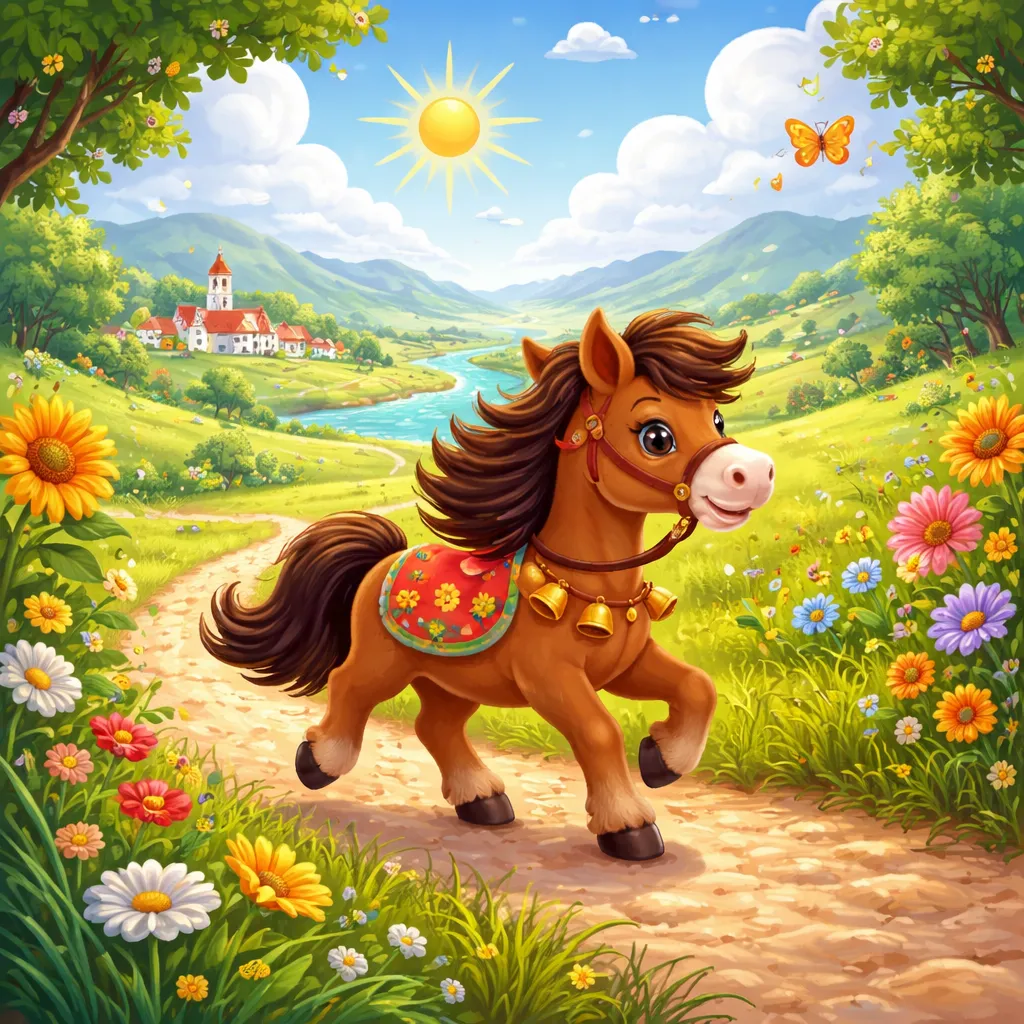

Have you ever had a favorite toy animal that you talk to and take care of? Maybe a stuffed bear you tell secrets to, or a plush dog you pretend to feed. Now, imagine if that toy could talk back about its little aches and needs. A long time ago in Spain, a very gentle song was made about a child and their little wooden horse that did just that. Let’s rock gently with the loving tune of “The Little Horse (El caballito).”
About the Song
Let’s read the soft, caring words of this traditional Spanish lullaby.
Mi caballito, mi caballito,
me duele el diente.
Mamá, dame un besito,
pónme un pañuelito
al dolor de mi diente.
Mi caballito, mi caballito,
me duele la oreja.
Mamá, dame un besito,
pónme una cadenita
al dolor de mi oreja.
Mi caballito, mi caballito,
me duele la cabeza.
Mamá, dame un besito,
pónme una gorrita
al dolor de mi cabeza.
English Translation:
My little horse, my little horse,
my tooth hurts me.
Mama, give me a little kiss,
put a little handkerchief
on the pain of my tooth.
My little horse, my little horse,
my ear hurts me.
Mama, give me a little kiss,
put a little chain
on the pain of my ear.
My little horse, my little horse,
my head hurts me.
Mama, give me a little kiss,
put a little cap
on the pain of my head.
This is a traditional Spanish children’s song and lullaby, very similar in style and theme to “El burrito.” The song is a gentle, repetitive dialogue. A child holds a toy wooden horse (a caballito) and speaks for it. The little horse tells the child about its small pains: a toothache, an earache, a headache. For each pain, the child asks their mother for help: first for a comforting kiss, and then to place a tiny item (a handkerchief, a little chain, a cap) on the sore spot to make it better. The song beautifully mixes a child’s imaginative play with the universal comfort of a mother’s care. The melody is slow, soft, and perfect for rocking to sleep.
What the Song is About
The song paints a quiet, imaginative scene of care. A child is playing with a favorite toy, a little wooden horse. The child pretends the horse is talking. The horse says, “I have a pain.” First, it’s a toothache. The child, wanting to help their toy, calls to their mother. The child asks for two things: first, the gentle magic of a mother’s little kiss. Then, a physical comfort: a tiny handkerchief to wrap around the horse’s sore tooth.
Then, the horse has a new pain—its ear hurts. Again, the child asks Mama for a kiss and a remedy. This time, the remedy is a delicate “little chain,” perhaps a tiny necklace or charm to make the ear feel special and better. Finally, the horse’s head hurts. The child asks for the familiar kiss and a new solution: a “little cap” to keep the head warm and safe. The song is about using love and imagination to care for others, and about how a mother’s comfort is the first and best medicine for any hurt, real or pretend.
Who Made It & Its Story
“El caballito” is a very old, traditional Spanish folk song. Like “El burrito,” its original author is unknown. It belongs to the rich oral tradition of Spanish and Latin American lullabies and nursery rhymes. The song likely comes from a time when simple wooden toys were cherished, and children spent much time in imaginative, quiet play. The “caballito de palo” (stick horse) is a classic toy. The song reflects the deep cultural importance of the mother figure (“Mamá”) as the ultimate source of comfort and remedy. It also shows the early teaching of empathy, as the child learns to care for the “hurt” toy just as the mother cares for the child. The song has been sung for generations, passing from mothers to children as a soothing ritual of bedtime and play.
This lullaby is cherished for three gentle reasons. First, its melody is profoundly soothing, repetitive, and dreamlike, designed to calm and lull a child to sleep. Second, it validates a child’s imaginative world by taking the toy’s “pain” seriously, showing respect for the child’s play. Third, it reinforces the secure bond between child and parent. The child knows exactly who to turn to for help (Mamá), and the help given is always loving and creative, building a sense of safety and trust.
When to Sing It
This song is perfect for the quietest, most comforting moments. You can sing it very softly as a lullaby at bedtime, while rocking a stuffed animal or doll. You can hum it during a quiet playtime with toys, pretending to doctor them. You can also sing it gently to comfort a younger sibling or friend who has a small hurt, showing you care like the mother in the song.
What Children Can Learn
This tender, imaginative song is a wonderful teacher about care, Spanish language, and family bonds.
Vocabulary
The song teaches us body parts, simple objects, and caring words in Spanish. A “horse” (caballito) is a large animal you can ride; here it’s a toy. A “tooth” (diente) is the hard, white part in your mouth for chewing. An “ear” (oreja) is the body part you hear with. The “head” (cabeza) is the top part of your body. A “kiss” (besito) is a touch with the lips to show love. A “handkerchief” (pañuelito) is a small piece of cloth. A “chain” (cadenita) is a series of connected metal links. A “cap” (gorrita) is a small, soft hat. “Pain” or “hurt” (dolor) is the feeling when something is sore.
Let’s use these words! You can say, “I put a small bandage on my doll’s arm where she had a pain.” Or, “The little chain on the necklace was very delicate.” New word: Empathy. This is the ability to understand and share the feelings of another, like the child feeling empathy for the toy horse’s pain.
Language Skills
This song is a perfect lesson in expressing pains and needs and using affectionate, diminutive words. The key phrase is “me duele…” (… hurts me). “Me duele el diente” means “My tooth hurts me.” This is the standard way to talk about an ache in Spanish.
The song uses many diminutives (words ending in -ito, -ita) to show smallness and affection: caballito, besito, pañuelito, cadenita, gorrita. This makes everything sound small, cute, and loved. The child also uses the command “pónme” (put on me), from the verb “poner” (to put), which is a direct way to ask for help.
Sounds & Rhythm Fun
Listen to the slow, rocking, and deeply repetitive rhythm of the melody. The song has a lullaby’s gentle, swaying rhythm, often in 3/4 or 6/8 time. The repetition of “Mi caballito, mi caballito” is incredibly calming. The melody rises slightly on the plea to “Mamá” and then falls gently, like a sigh. The Spanish lyrics have a soft, lyrical rhyme: “diente” and “pañuelito,” “oreja” and “cadenita,” “cabeza” and “gorrita.” The “-ita” and “-ito” endings create a musical, sing-song quality.
The rhythm is slow and steady, like a heartbeat. Try a gentle rock: Mi ca-ba-lli-to, mi ca-ba-lli-to (Mee cah-bah-yee-toh, mee cah-bah-yee-toh). The repetitive, predictable structure makes it very easy to memorize and very soothing to sing. This gentle, repetitive, and nurturing musical pattern is the heart of the song’s magic. You can write your own “comforting a toy” song! Use the same gentle, rocking rhythm. Try: “My little rabbit, my little rabbit, my paw is feeling sore. Mama, give me a little hug, put a soft sock on the pain of my paw.”
Culture & Big Ideas
“El caballito” is a beautiful example of the Spanish tradition of nanas (lullabies) that blend love, care, and gentle pedagogy. It reflects the central role of the mother and the warm, physical affection (“un besito”) common in Hispanic families. The song connects to the cultural value of “cariño” (tenderness) in raising children. The act of asking the mother for help with the toy also subtly teaches about seeking guidance and support from family. While a lullaby for any night, it embodies the quiet, intimate atmosphere of the Spanish siesta (afternoon rest) or bedtime. It teaches that love involves attentive listening (to the toy’s pains) and taking creative, gentle action to soothe them.
The song conveys three profound ideas. First, it’s about nurturing empathy and care through imagination. By caring for the toy, the child practices being kind and responsible. Second, it expresses that comfort often comes in layers—first emotional (the kiss), then practical (the object). The kiss is always the first remedy, showing love comes before all else. Third, it highlights the secure base a parent provides. The child feels safe to explore the world of imagination and “hurt” because they know “Mamá” is there to help fix anything.
Values & Imagination
Imagine you are the child holding the wooden horse. It feels smooth in your hands. How does its painted mouth look when it says it has a toothache? Now, imagine calling your mother. How does her voice sound when she answers? Imagine her giving the horse a little kiss. Where does she kiss it? On its wooden nose? Now, imagine tying a tiny, white handkerchief around the horse’s head. Does it look funny? Does the horse feel better? Draw a picture of the caring scene. Draw the child holding the little horse. Draw a line from the horse’s mouth to a speech bubble that says “Me duele el diente.” Draw the mother leaning down, with a lip-print for a kiss near the horse. Draw a tiny handkerchief tied in a bow. This shows the song’s action.
The song encourages nurturing behavior, empathetic imagination, and appreciation for parental comfort. A lovely family activity is to have a “Toy Care Clinic.” Gather a few stuffed animals or dolls. Take turns being the “toy,” the “child,” and the “Mamá.” The “toy” says what hurts (in Spanish or English), the “child” listens and asks “Mamá” for a kiss and a remedy, and “Mamá” provides them with a soft cloth or a pretend bandage. Sing the song as you play. This turns care into a loving, imaginative game.
So, as the last line about the little cap fades, think about the layers of comfort in this simple tune. It is a vocabulary lesson in body parts and care items. It is a grammar lesson in expressing pain and using affectionate diminutives in Spanish. It is a music lesson in a deep, rocking lullaby rhythm. From the first complaint of the little horse to the final loving remedy, it wraps lessons in empathy, layered comfort, and secure attachment in a melody that feels like a warm, safe blanket. “The Little Horse (El caballito)” teaches us to listen with our hearts, to care with creativity, and that a mother’s kiss is the first and most powerful medicine for any hurt in the world.
Your Core Takeaways
You are now an expert on the song “The Little Horse (El caballito).” You know it is a traditional Spanish lullaby about a child caring for a toy horse with a mother’s help. You’ve learned Spanish words like “diente,” “oreja,” and “besito,” and you’ve practiced the “me duele” structure and diminutive endings. You’ve felt its soothing, rocking rhythm and created your own caring verse. You’ve also discovered the song’s cultural background and its messages about nurturing empathy, the power of layered comfort, and the security of a parent’s love.
Your Practice Missions
First, perform a “Lullaby for a Toy.” Choose your favorite stuffed animal or doll. Hold it gently and sing the song “El caballito” to it. When you sing “pónme un pañuelito,” gently tie a small, soft cloth or a ribbon around your toy. This mission brings the song’s gentle care to life.
Second, create a “Comfort Kit” for a toy. Decorate a small box or bag. Inside, place three tiny “remedies” from the song or your own: a little cloth (pañuelito), a string of beads (cadenita), and a bottle cap (gorrita). You can add a paper “kiss” (besito). Label your kit. Use it to “doctor” your toys when they need care. This activity encourages creative, nurturing play inspired by the song.