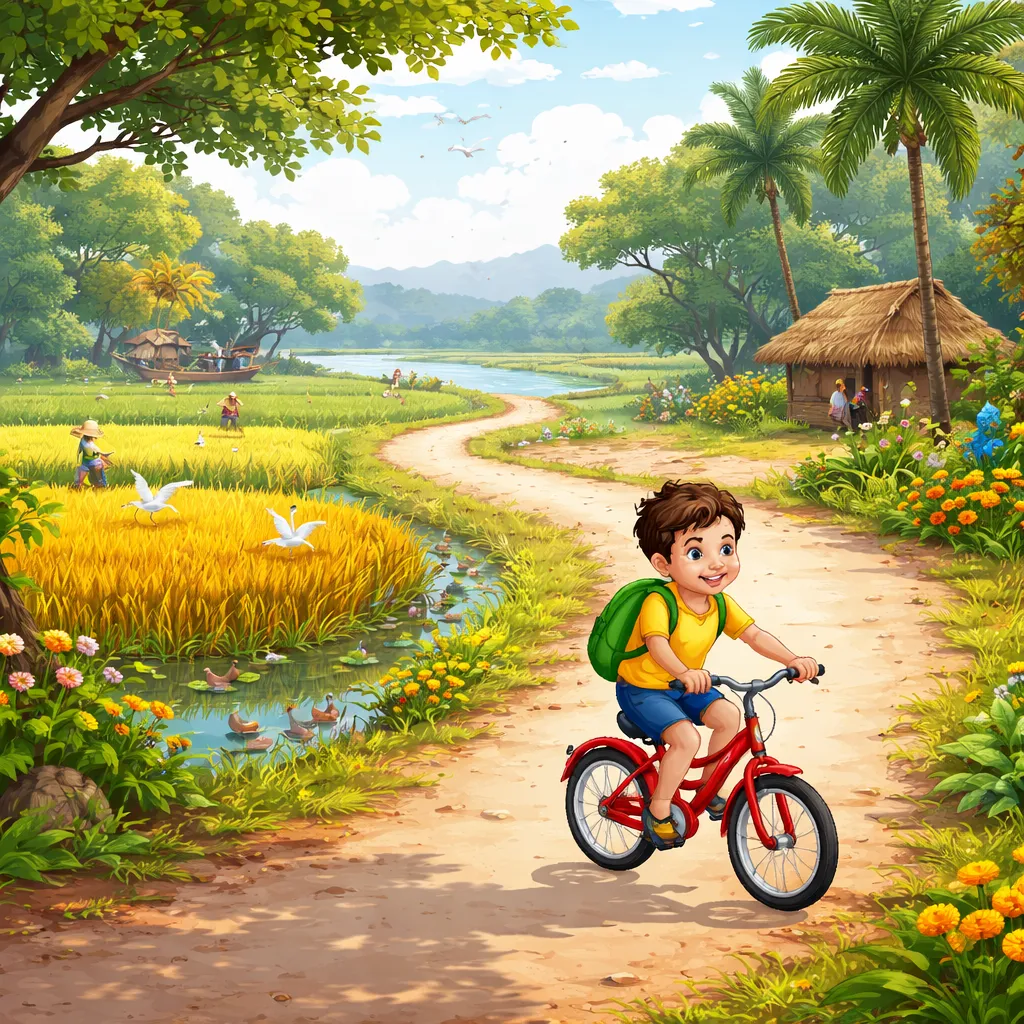

Have you ever felt the wind in your hair as you roll down a gentle hill? Have you learned to balance on two wheels, feeling proud and free? A bicycle is a wonderful invention—it’s powered by you! In Bangladesh and West Bengal, a region of busy streets and quiet village paths, there is a happy song that celebrates this simple, joyful ride. Let’s pedal along with the Bengali Song: The Little Bicycle (সাইকেল).
About the Song
Here is a cheerful verse from this popular children’s song in Bengali and English:
সাইকেল, সাইকেল, ছোট্ট সাইকেল
(Saikel, saikel, chhoto saikel)
Bicycle, bicycle, little bicycle
তোমার দুটো চাকা ঘোরে
(Tomar duto chaka ghore)
Your two wheels spin
আমি প্যাডেল চালাই, তুমি আগে যাও
(Ami pedal chalai, tumi age jao)
I pedal, you go forward
নিয়ে যাই বন্ধুদের
(Niye jai bondhuder)
I take my friends along
This song’s original name is “সাইকেল” (Saikel), the Bengali word for “Bicycle.” It is a beloved modern Bengali children’s song. The song is a cheerful conversation between a child and their bicycle. The music is often upbeat, rhythmic, and full of the energy of pedaling. The Bengali Song: The Little Bicycle (সাইকেল) is a musical celebration of teamwork between a rider and their bike, the fun of motion, and the joy of sharing adventures with friends.
What the Song is About
The song is a happy partnership story. First, we greet the bicycle with affection: “Bicycle, bicycle, little bicycle.” We notice the most important part: “Your two wheels spin.” The song then describes the teamwork. The child does their job: “I pedal.” The bicycle does its job: “you go forward.” It’s a perfect partnership of effort and motion. But the ride isn’t just for one. The best part is sharing: “I take my friends along.” The song pictures the child riding with a friend on the back or calling out to others to follow on their own bikes. The whole song is about the freedom and fun that comes from a simple machine and good company.
Who Made It & Its Story
This song is a popular part of modern Bengali children’s culture, often heard in schools and on children’s media. While the specific creators aren’t widely known, the song reflects the importance of bicycles in Bengali daily life. In both bustling cities and rural villages, the bicycle is a common, affordable, and eco-friendly way for people to get around. The Bengali Song: The Little Bicycle (সাইকেল) captures the universal childhood milestone of learning to ride. It is loved for three joyful reasons. First, it celebrates a child’s growing independence and physical skill in a positive, empowering way. Second, it highlights cooperation—between rider and bike, and between friends. Third, its tune is catchy and full of a forward-moving rhythm, perfect for singing while actually riding or playing.
When to Sing It
You can sing this song while riding your own bicycle or tricycle, chanting the words in time with your pedals. It’s perfect to hum with friends when you’re all on your bikes, getting ready for a ride around the park. You could also sing it during a game of pretend, using cushions to make a “bicycle” and pretending to pedal around the world.
The Bengali Song: The Little Bicycle (সাইকেল) gets us moving and thinking about teamwork. But every good cyclist must also be a learner! This song is our path to new knowledge. It teaches us words for motion and parts, how to talk about cooperation, and the role of simple vehicles in everyday life. Let’s hop on our learning bikes and go!
What Children Can Learn
Vocabulary
This song helps us learn words for transportation, motion, and cooperation.
Pedal: A flat part you push with your foot to make a bicycle move. You pedal to make the wheels spin.
Spokes: The thin rods that connect the center of a wheel to the rim. The spokes help the wheel stay strong.
Balance: The ability to stay steady and not fall. Riding a bike requires good balance.
Steer: To control the direction of a vehicle. You steer the bicycle with the handlebars.
Momentum: The force that makes a moving object continue to move. The bicycle gains momentum as you pedal.
Eco-friendly: Not harmful to the environment. Riding a bicycle is an eco-friendly way to travel.
Language Skills
This song is a clear example of using the First Conditional for Cause and Effect. We use this structure to talk about a likely future result of a present action. In the song, it’s about the direct result of pedaling.
What Is It?: Think of the First Conditional as your “If-Then” machine. It describes a real and possible situation. “If I do this, then that will happen.”
Finding the Secret: Look for two parts: the “if” clause (condition) in the simple present, and the main clause (result) with “will” or another present tense verb. Ask: “Is this sentence showing that one action directly causes another?”
Using It:
◦   Formula: If + [present simple], [will + base verb] or [Will + base verb] + if + [present simple].

◦   In the song’s logic: “If I pedal, (then) the bicycle will go forward.” The child’s action causes the bike’s movement.
Sounds & Rhythm Fun
Listen to the pedaling rhythm! The Bengali Song: The Little Bicycle (সাইকেল) has a steady, circular, and repetitive beat. It might sound like the consistent click-click of a chain or the turning of wheels. The melody often has a feeling of moving forward without stopping. This steady, circular rhythm mimics the motion of pedaling and makes the lyrics about spinning wheels and going forward easy and fun to remember. You can use this same circular, forward-moving rhythm to make up a song about any repetitive action, like skipping rope or swimming.
Culture & Big Ideas
This song connects to the practical and popular use of bicycles in Bengal. In cities like Dhaka and Kolkata, bicycles are used by students, office workers, and vendors. A common sight is the bicycle rickshaw, a three-wheeled passenger vehicle. The song reflects the simplicity and accessibility of this mode of transport. The Bengali Song: The Little Bicycle (সাইকেল) teaches three important ideas. First, Self-Powered Freedom: The bicycle shows that you don’t need an engine to go far; your own body’s energy is powerful. Second, Symbiosis: The rider and the bicycle work together perfectly—one cannot go without the other. This is a model of teamwork. Third, Shared Joy: The fun of an activity multiplies when you include others, turning a solo ride into a group adventure.
Values & Imagination
Imagine you are on the little bicycle. Where is your favorite path? A dirt road by a field? A city street? How does it feel to know you’re powering the whole journey yourself? This song teaches you the value of persistence (learning to balance takes practice!) and the joy of achieving a physical skill. It shows that simple, quiet activities can be just as fun as loud, fast ones. A simple idea: The next time you go for a walk, imagine you are riding your bicycle. Notice the path. Think about how you would steer around cracks or pedal up a small hill. You are planning your next adventure.
Your Core Takeaways
The Bengali Song: The Little Bicycle (সাইকেল) is a joyful pedal-powered lesson in independence, teamwork, and simple fun. You learned words like “pedal,” “spokes,” and “balance.” You discovered how to use the First Conditional to talk about cause and effect (“If I pedal, it will go”). You moved to the song’s steady, circular rhythm. You also connected the bicycle to everyday life in Bengal, from city streets to rickshaws. Most importantly, the song teaches that your own effort can take you places, that working together (even with a machine!) makes things happen, and that adventures are best when shared with friends along for the ride.
Your Practice Missions
- Be a “Cause and Effect” Reporter. With a grown-up, do a simple action and state its likely result using “if” and “will.” Example: “If I push this ball, it will roll.” “If I water this plant, it will grow.” Try the action and see if your prediction comes true!
- Design a “Friendship Bicycle.” Draw a big bicycle for two. In the front seat, draw yourself. In the back seat, draw a friend or family member. Around the bicycle, draw the path you would take together and the things you would see. Tell the story of your ride: “If we pedal together, we will see the park and the ice cream shop!” This shows the shared journey.