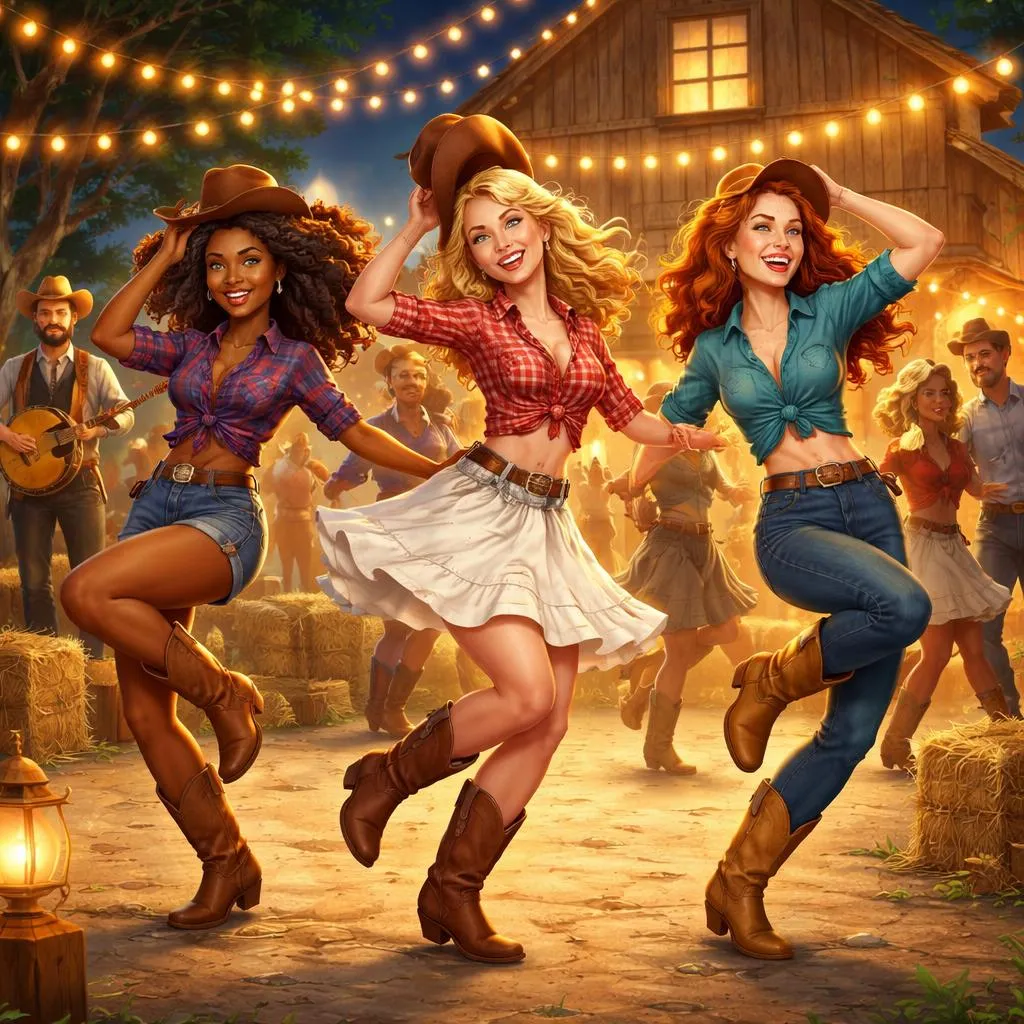

Have you ever been to a fair or a festival where there is music and everyone is dancing? Long ago, before radios or televisions, people made their own fun with songs that told stories and invited everyone to move. One of the most famous dance tunes from that time is all about seeing some girls and being amazed by their dancing. Let’s learn about the catchy, old-time song “Buffalo Gals.”
About the Song
Let’s read the playful, inviting words of this classic folk tune.
Buffalo gals, won’t you come out tonight,
Come out tonight, come out tonight?
Buffalo gals, won’t you come out tonight,
And dance by the light of the moon?
I asked her if I could be her beau,
She said she’d ask her Ma.
I asked her if she’d have a dance with me,
We danced on the sawdust floor.
As I was walking down the street,
Down the street, down the street,
A pretty gal I chanced to meet,
Oh, she was fair to see.
I’d like to make that gal my wife,
Happy all my life,
If she will only say “I do,”
I’d be happy, it is true.
This song is a traditional American folk song and popular dance tune from the 19th century. It is a lively, waltzing song about a young man who sees a girl (“gal”) in the city of Buffalo, New York, and asks her to dance. The song’s original version, from the 1840s, was called “Lubly Fan” and was performed by the blackface minstrel performer John Hodges, known as Cool White. The lyrics changed to “Buffalo Gals” as it traveled, becoming a generic song to invite girls from any town to dance. The song is famous for its bouncy, happy melody and its depiction of a simple, joyful social scene of courting and community dancing.
What the Song is About
The song paints a cheerful picture of a young man’s evening in a 19th-century town. He is walking down a gas-lit or moonlit street. He sees a group of girls, the “Buffalo gals,” and he calls out to them. He asks them to come out of their houses and join the fun, to dance under the moonlight.
He then focuses on one particular girl he meets. He thinks she is very pretty (“fair to see”). He gets up the courage to ask her two things. First, he asks if he can be her “beau,” an old word for boyfriend. She says she has to ask her mother for permission, which was the custom long ago. Then, he asks her to dance, and she says yes! They dance together happily on a rough “sawdust floor,” which was common in dance halls. The song ends with the young man dreaming about the future, hoping this girl might become his wife and make him happy for life.
Who Made It & Its Story
The earliest known version of the song was performed and published in the 1840s by the blackface minstrel entertainer John Hodges (Cool White). The minstrel show was a popular but controversial form of entertainment in the 1800s where white performers used burnt cork to darken their skin and performed songs and skits that mocked African Americans. The song “Lubly Fan” came from this tradition. As the song traveled across America, singers changed the words. When it reached Buffalo, New York, it became “Buffalo Gals.” It shed its specific minstrel origins and became a widely loved folk and dance tune, played at community gatherings, square dances, and socials for generations.
This song has remained popular for three main reasons. First, its melody is an incredibly catchy, simple waltz that is perfect for dancing and easy to remember. Second, it tells a sweet, relatable little story of seeing someone, asking them to dance, and having a happy time—a universal experience. Third, it captures a nostalgic feeling of old-fashioned community life, where fun was homemade and centered around music and dancing together.
When to Sing It
This song is perfect for playful, energetic moments. You can sing it while skipping or dancing around your living room, pretending to waltz under the “light of the moon.” You can sing it on a family walk at dusk, inviting the “gals” (or guys!) in your family to join in. You can also sing it as a silly, dramatic performance, acting out the parts of the young man and the girl who has to “ask her Ma.”
What Children Can Learn
This charming dance tune is a wonderful snapshot of history and language. Let’s step back in time and explore its lessons.
Vocabulary
The song teaches us old-fashioned, informal words. A “gal” is an informal, old way of saying “girl.” “Buffalo” is a city in New York, but here it just means the girls from that town. “Won’t” is the contraction for “will not.” A “beau” (pronounced “boh”) is an old-fashioned word for a boyfriend or sweetheart. “Ma” is an informal word for mother. “Sawdust” is the tiny pieces of wood that fall when wood is cut; it was often spread on floors to soak up spills. “Chanced to meet” means happened to meet by accident. “Fair to see” means pleasant or beautiful to look at.
Let’s use these words! You can say, “I chanced to meet my friend at the store.” Or, “The old floor was covered in sawdust.” New word: Courting. This is the old-fashioned process of dating with the hope of getting married. The young man is courting the Buffalo Gal.
Language Skills
This song is a great lesson in using informal contractions and the conditional mood to make polite requests. The title itself uses the contraction “won’t” in a question: “Buffalo gals, won’t you come out tonight?” This is a polite, if old-fashioned, way to make an invitation.
The song also uses the conditional mood to talk about wishes and possibilities: “I’d like to make that gal my wife…” (“I’d” is short for “I would”). “If she will only say ‘I do,’ I’d be happy…” This structure is used for imagining future hopes that depend on something else happening. It’s a key way to talk about dreams and plans.
Sounds & Rhythm Fun
Listen to the bouncy, waltzing rhythm of the melody. A waltz has a strong “ONE-two-three” feel. The lyrics use wonderful repetition and call-and-response. The line “come out tonight” is sung three times, like an eager plea. The song has a clear, simple rhyme scheme: “tonight” and “tonight,” “moon” and “soon” (in other versions), “beau” and “Ma,” “me” and “see.”
The rhythm is a classic 3/4 time waltz. It’s perfect for swaying or dancing in a circle. Try swaying: BUF-fa-lo GALS, won’t you COME out to-NIGHT? The melody is simple, based on a few notes, and is incredibly easy to whistle or hum. This strong, danceable waltz rhythm is what makes the song so memorable and fun. You can write your own invitation song! Use the same waltzing rhythm. Try: “Playground pals, won’t you come out and play, come out and play, come out and play? Playground pals, won’t you come out and play, and swing on the swings all day?”
Culture & Big Ideas
“Buffalo Gals” is a window into 19th-century American social life. It comes from the era of community dances, socials, and courting rituals. The song reflects the formalities of the time (asking a mother’s permission) and the simple joys of socializing. Its origins in minstrel shows are a important, though difficult, part of American cultural history, showing how entertainment and racism were intertwined. The song’s evolution into a harmless folk tune also shows how music can change and be claimed by communities for pure enjoyment.
The song conveys three core ideas. First, it’s about social joy and community. The fun happens when people “come out” and participate together. Second, it touches on old-fashioned manners and courtship. The young man is polite, asks permission, and has honorable intentions, reflecting the social rules of the past. Third, it’s about optimism and simple dreams. The singer’s happiness is found in a dance and the hope of a future with someone kind, celebrating life’s simple pleasures.
Values & Imagination
Imagine the street in Buffalo in the 1840s. What do the gas lamps look like? What are the “Buffalo gals” wearing? Long dresses, bonnets? The young man? A hat and boots? Imagine the dance hall with the sawdust floor. What does the music sound like? A fiddle? A banjo? Can you smell the sawdust? Now, imagine you are the girl who has to “ask her Ma.” What do you say? How does she respond? Draw a picture of the dance scene. Show the moon, the couple dancing, the musicians, and other people clapping. Include details from the song, like the sawdust on the floor.
The song inspires us to find joy in community and to be polite and hopeful. A simple idea is to have a “Family Social” evening. Clear some space, play some happy music (maybe even “Buffalo Gals”), and have a family dance. Practice asking someone to dance politely, just like in the song. You can even spread a towel on the floor to be your “sawdust.” This creates a fun, shared memory based on the song’s spirit.
So, as the last waltzing note fades, think about the community this song builds. It is a vocabulary lesson in charming old words. It is a grammar lesson in polite invitations and future hopes. It is a music lesson in a joyful, danceable waltz. From the first call to “come out tonight” to the final happy dream, it wraps up the simple, timeless joys of meeting someone, sharing a dance, and dreaming of happiness. “Buffalo Gals” teaches us that fun is meant to be shared, that good manners are timeless, and that a song can invite everyone to the dance, even 180 years later.
Your Core Takeaways
You are now an expert on the song “Buffalo Gals.” You know it is a 19th-century American folk song that started in minstrel shows but became a popular dance tune. You’ve learned old words like “gal,” “beau,” and “sawdust,” and you’ve practiced polite invitations with “won’t you” and future hopes with “I’d.” You’ve felt its bouncy waltz rhythm and created your own invitation verse. You’ve also discovered the song’s glimpse into historical social life, its themes of community joy, old-fashioned manners, and optimistic dreams.
Your Practice Missions
First, host a “Moonlight Dance.” As the song says, dance by the “light of the moon.” On an evening, turn off the main lights and use a lamp or flashlight to make soft light. Play “Buffalo Gals” and teach a simple waltz step (step-together-step) to a family member. Dance together! If you have a sibling or friend, you can act out the part where one asks the other to dance.
Second, write a “Modern Gal/Guy” verse. The song is about Buffalo gals. Write a new verse about kids in your own town or neighborhood. What would you invite them to do today? For example: “[Your Town] kids, won’t you come out and skate, come out and skate, come out and skate? [Your Town] kids, won’t you come out and skate, and roll by the light of the streetlamp?” Sing your new verse to the tune of the original song.