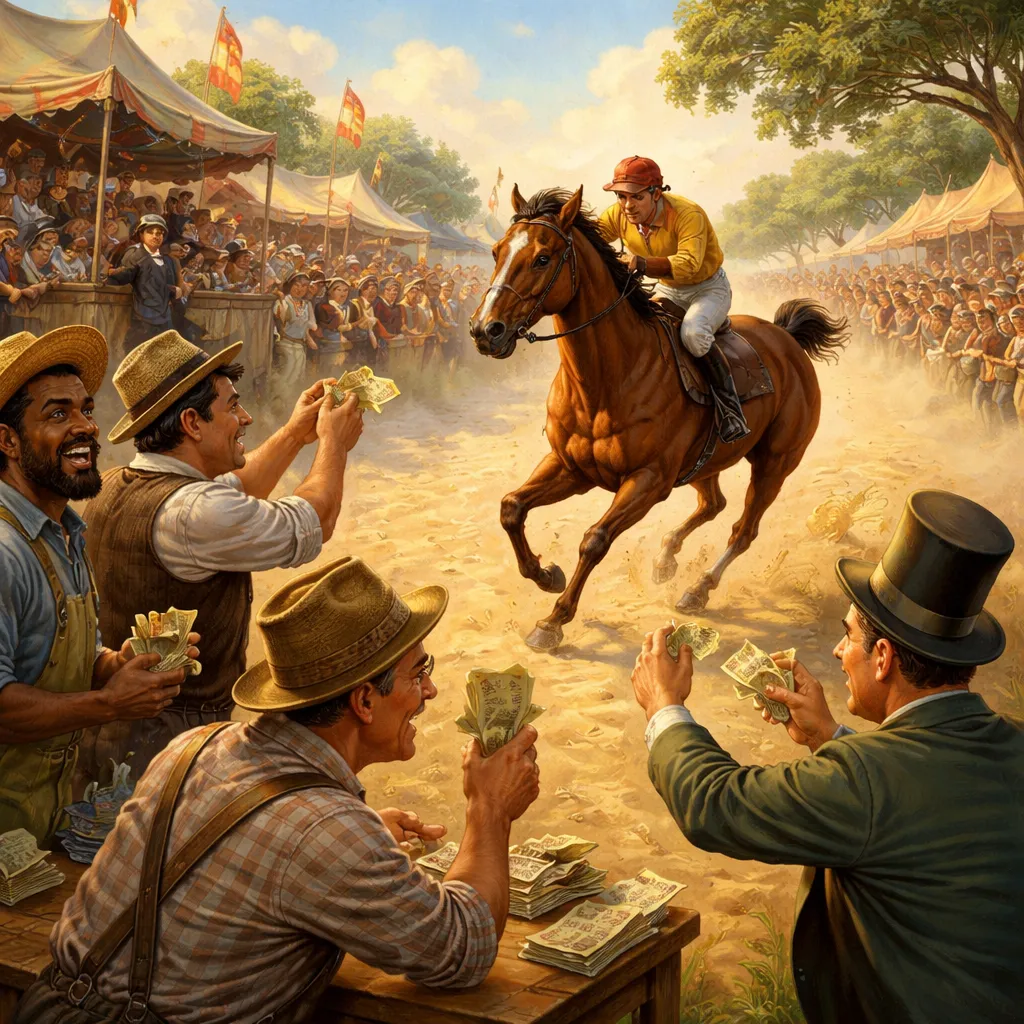

Can you imagine the excitement of a big race? The crowd cheering, the horses thundering by, and everyone hoping their favorite will win. Long ago, a famous songwriter captured that noisy, fun feeling in a song full of silly sounds. It’s a song about a racetrack, a bet, and a whole lot of “doo-da.” Let’s learn about the lively tune “Camptown Races.”
About the Song
Let’s read the fast-paced, funny words of this famous song.
The Camptown ladies sing this song, Doo-da, Doo-da
The Camptown racetrack’s five miles long, Oh, doo-da day
I come down there with my hat caved in, Doo-da, Doo-da
I go back home with a pocketful of tin, Oh, doo-da day
Gwine to run all night, gwine to run all day,
I’ll bet my money on the bobtail nag,
Somebody bet on the bay.
This song is a classic American folk song written by the famous songwriter Stephen Foster in 1850. Its official title is “Gwine to Run All Night,” but everyone knows it as “Camptown Races.” It is a lively, rhythmic minstrel song that describes the scene at a horse race in a place called Camptown. The song is famous for its cheerful nonsense chorus, “Doo-da, Doo-da,” and its depiction of a man going to the races, placing a bet, and hoping to win. Stephen Foster is known as the “father of American music,” and this is one of his most popular and enduring songs, blending folk energy with catchy melody.
What the Song is About
The song paints a noisy, bustling picture of race day. First, we hear that the “Camptown ladies” are singing this very song, so it’s a song within a song! We learn the racetrack is very long—five miles. The singer is a man who goes to the races. He arrives looking a bit ragged, with his hat “caved in” or dented.
But he is hopeful. He bets on a horse called the “bobtail nag”—a horse with a short, cut tail. He is so excited about the race that he sings, “Gwine to run all night, gwine to run all day!” (“Gwine” is an old, informal way of saying “going to.”) He’s putting his money on his chosen horse and notices that somebody else is betting on a different horse, the “bay” (a reddish-brown horse). The song captures the simple thrill of placing a bet, the suspense of the race, and the communal fun of the event.
Who Made It & Its Story
The creator of “Camptown Races” is the celebrated American composer Stephen Foster. He wrote the song in 1850 for the Christy’s Minstrels, a popular blackface minstrel group. While the minstrel tradition is a problematic part of American history, Foster’s songwriting talent helped create a uniquely American sound. The song was an instant hit. Its energetic rhythm and easy-to-remember chorus made it perfect for group singing. The “Camptown” in the song might refer to a generic camping ground used by railroad workers or canal diggers, where such rough-and-ready entertainments like horse races would happen. The song gave people a musical snapshot of a popular, if somewhat disreputable, pastime of the time.
This song has remained a favorite for three energetic reasons. First, its “doo-da” chorus is incredibly fun, nonsense, and easy for anyone to sing, making it a perfect group participation song. Second, its subject is exciting and universal—the thrill of a race and the hope of a lucky win. Third, it is a prime example of Stephen Foster’s genius for writing melodies that feel both fresh and familiar, capturing the energy of everyday American life in the 1800s.
When to Sing It
This song is perfect for high-energy, playful moments. You can sing it loudly while running around your backyard or at the park, pretending to be racehorses. You can sing it during a family game night when playing a competitive board game, replacing “bet my money” with “bet my points.” You can also chant the “doo-da” chorus as a silly cheer to pump yourself up before a big task, like cleaning your room.
What Children Can Learn
This energetic race-day song is a starting gate for lots of learning. Let’s run through the lessons.
Vocabulary
The song teaches us old-fashioned and specific words. A “racetrack” is a course for races. “Caved in” means crushed or dented inward. A “pocketful of tin” is an old phrase for a pocket full of money (tin was a cheap metal, so it might mean a small amount). “Gwine” is a dialect version of “going to.” A “bobtail nag” is a horse with a docked or short tail. A “bay” is a horse with a reddish-brown coat. “Bet” means to risk money on the outcome of a race or game.
Let’s use these words! You can say, “I saved a pocketful of coins.” Or, “The old can was caved in.” New word: Wager. This is another word for a bet. The singer places a wager on the bobtail nag.
Language Skills
This song is a wonderful lesson in using dialect and the future tense with “gwine” (going to). Dialect is a form of a language spoken in a particular area or by a particular group. The song uses the dialect form “gwine” for “going to,” which was common in some 19th-century American speech.
The future intention is clear: “Gwine to run all night, gwine to run all day.” Today, we would say, “It’s going to run all night.” The song also uses the simple present tense to describe habitual action: “I come down there… I go back home…” This gives the feeling that this is something the singer does often. The structure “I’ll bet my money…” is a future promise showing his decision.
Sounds & Rhythm Fun
Listen to the galloping, upbeat rhythm of the melody. The song is famous for its nonsense refrain: “Doo-da, Doo-da.” This doesn’t mean anything but adds a fantastic rhythmic and fun element that makes the song easy and joyful to sing. The verses have a clear rhyme: “song” and “long,” “in” and “tin.”
The rhythm is a quick, steady 2/4 time, which mimics the sound of horses trotting. Try clapping in a quick, even pattern: The CAMPtown LAdies SING this SONG, DOO-da, DOO-da. The melody is simple, repetitive, and feels like it’s always moving forward, just like a race. This driving, rhythmic, and silly musical pattern is what makes the song so unforgettable. You can write your own race song! Use the same galloping rhythm and nonsense sounds. Try: “The playground kids all play this game, zoom-zoom, zoom-zoom. The playground slide is such a fame, oh, zoom-zoom zoom! Gwine to slide all night, gwine to slide all day, I’ll bet my snack on the fastest kid, somebody bet on the way!”
Culture & Big Ideas
“Camptown Races” is a product of pre-Civil War America and the minstrel stage. It reflects the casual pastimes of working people, like gambling on horse races, which were common entertainments. The song’s use of dialect and its setting give a glimpse into the language and leisure activities of the time. While its origins are complex, the song today is mostly enjoyed for its sheer, nonsensical energy and as an example of early American popular music.
The song conveys three lively ideas. First, it’s about risk and reward. The singer takes a chance with his money, hoping for a big return, which is the basic thrill of any game or sport. Second, it captures communal excitement. The whole town is involved—the ladies sing, people are betting—showing how events bring people together. Third, it celebrates pure, silly fun. The “doo-da” chorus isn’t about deep meaning; it’s about the joy of making noise and being part of a crowd, teaching us that fun doesn’t always have to be serious.
Values & Imagination
Imagine you are at the Camptown racetrack. What do you see? Rough wooden stands? People in old-fashioned clothes? What do you hear? The crowd roaring, the horses snorting, the song being sung? What does the “bobtail nag” look like? Is it fast? Why is its tail bobbed? Imagine having a “pocketful of tin.” What would you buy with your winnings? Draw a picture of the racetrack. Show the long track, the horses (one with a bobtail!), the excited crowd, and the singer with his dented hat.
The song, while about gambling, can inspire discussions about healthy competition and enjoying games for fun. A great idea is to have a “Family Fun Race.” Organize silly, non-competitive races in your backyard—a sack race, a three-legged race, a hopping race. Instead of betting money, bet on which family member will win with silly “wagers” like “I bet Dad will win the sack race!” Celebrate everyone’s effort. This focuses on the excitement of the race without the element of money.
So, as the final “doo-da day” fades, think about the wild energy of this old song. It is a vocabulary lesson in 1850s slang and horse terms. It is a grammar lesson in dialect and future plans. It is a music lesson in a galloping, nonsense-filled rhythm. From the first line about the singing ladies to the final bet on the bay, it wraps the rough-and-tumble excitement of a bygone pastime in a tune that makes you want to move and shout. “Camptown Races” teaches us that songs can capture a moment of community fun, that a little nonsense is good for the soul, and that the thrill of a race, whether on a track or in your own backyard, is a feeling that never gets old.
Your Core Takeaways
You are now an expert on the song “Camptown Races.” You know it was written by Stephen Foster in 1850 and is about the excitement of a horse race. You’ve learned words like “bobtail nag,” “bay,” and “gwine,” and you’ve seen how dialect can be used in songs. You’ve felt its galloping rhythm and created your own version with a nonsense chorus. You’ve also discovered the song’s place in 19th-century American music, its themes of risk and reward, communal fun, and the pure joy of silly sounds.
Your Practice Missions
First, host a “Doo-Da Day” parade. Grab homemade instruments (pots, shakers). March around your home singing “Camptown Races.” Every time you sing “Doo-da,” jump or make a crazy dance move. See if you can get your whole family to join the noisy, joyful parade, just like the crowd at the races.
Second, design a “Racetrack of the Future.” The song describes a five-mile-long track. Using paper, blocks, or chalk, design your own fantasy racetrack. What would make it fun? Loops? Water jumps? Draw it and give it a name. Then, draw two horses to race on it: your own version of the “bobtail nag” and the “bay.” Give them names and colors. Present your racetrack design to your family.