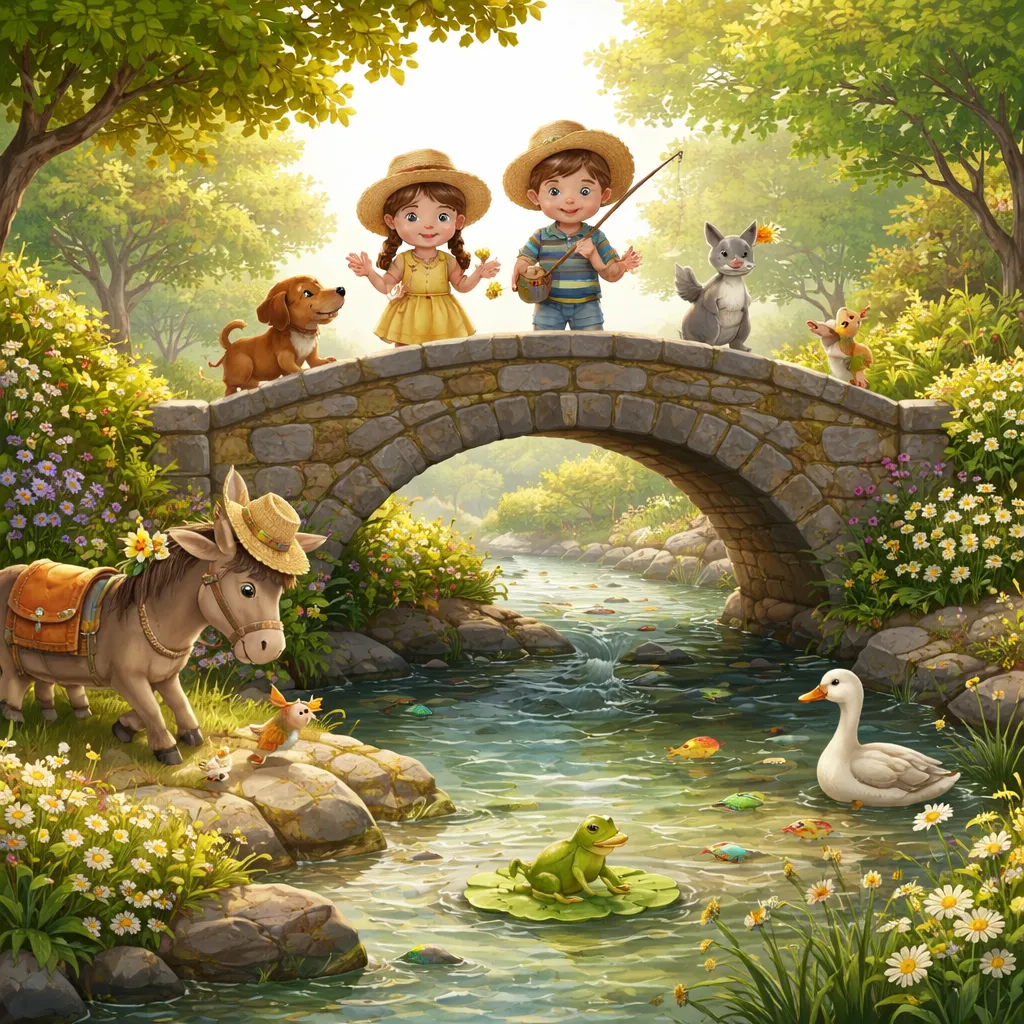

Have you ever walked across a little bridge in a park or over a stream? A bridge connects two sides, and people, animals, and stories can cross over it. In Spanish, there is a playful song about a very busy little bridge. It is a song about taking turns, making sounds, and everyone using the same path. Let’s see who is crossing and learn the orderly, fun song “The Little Bridge (El puentecito).”
About the Song
Here are the simple, repetitive words of a traditional Spanish folk and game song. This is a common and interactive version:
El puentecito, el puentecito,
el puentecito va a romperse.
Con tantas vaquitas, ¡ay, ay, ay!
que por él pasan, no puede sostenerse.
Pasa una vaca, ¡muuu!
Pasan dos vacas, ¡muuu, muuu!
Pasan tres vacas, ¡muuu, muuu, muuu!
Y el puentecito... ¡se rompió! ¡Uy, uy, uy!
English Translation:
The little bridge, the little bridge,
the little bridge is going to break.
With so many little cows, oh, oh, oh!
that cross over it, it cannot hold itself up.
One cow crosses, moo!
Two cows cross, moo, moo!
Three cows cross, moo, moo, moo!
And the little bridge... it broke! Oh, oh, oh!
This is a classic Spanish folk song, game, and cumulative chant. The song is about a little bridge (“el puentecito”) that is under a lot of stress! The affectionate “-cito” ending makes the bridge seem small and a bit fragile. The song builds suspense by telling us the bridge might break because so many cows are crossing it. Then, we watch and count as each cow crosses, making its sound. Finally, with a playful shout, the bridge gives way! The melody is simple, repetitive, and perfect for building anticipation, often sung with hand-clapping or acting out the breaking bridge.
What the Song is About
The song paints a funny, slightly silly picture of a bridge that has too many visitors. Imagine a small, wooden bridge over a little stream. The song starts with a warning: “The little bridge is going to break.” Why? Because “with so many little cows that cross over it, it cannot hold itself up!” You can picture the little bridge wobbling and creaking under the weight.
Then, the crossing begins, one by one. “One cow crosses, moo!” You see a single cow walk carefully across, calling out. Then, “Two cows cross, moo, moo!” Now two cows are on the bridge at the same time. It wobbles more. Then, “Three cows cross, moo, moo, moo!” Three cows! The bridge is now very full. The song builds excitement as we count and add more animal sounds. Everyone sings louder with each cow. Finally, the strain is too much! “And the little bridge... it broke! Oh, oh, oh!” The bridge collapses, and everyone shouts “¡Uy!” in playful surprise. The song is about counting, anticipation, and the funny consequence of too many friends trying to use the same thing at once.
Who Made It & Its Story
“The Little Bridge (El puentecito)” is a traditional Spanish cumulative song and playground game, part of a long tradition of songs that build with repetition. Like many folk songs, it was created by many people over time as children played and sang together. It reflects the simple, physical humor found in children’s games across cultures. The song acts as a simple, fun lesson in cause and effect, counting, and taking turns. It is often used in circles, with children acting as the bridge and the cows, making it a lively game about cooperation and playful consequences.
This interactive song is loved for three strong reasons. First, it builds suspense and playful tension in a very clear way, as children eagerly wait for the bridge to finally “break.” Second, it is a fantastic tool for learning to count in Spanish and for making animal sounds (onomatopoeia), which is always fun for young learners. Third, its simple, repetitive structure makes it incredibly easy to learn, remember, and turn into a physical game where everyone can join in, shout, and act.
When to Sing It
This song is perfect for playful, group moments. You can sing it while lining up or waiting for a turn, pretending each person is a “cow” crossing the bridge. You can chant it during a game of “London Bridge is Falling Down,” using the Spanish words and cow sounds. You can also sing it as a counting game, using fingers or toys to represent each cow that crosses.
What Children Can Learn
This counting, action-packed song is a wonderful teacher about numbers, Spanish language, and playful consequences.
Vocabulary
The song teaches us words for objects, actions, and numbers in Spanish. The “little bridge” (puentecito) is a small structure for crossing over something. “Is going to break” (va a romperse) means it will crack or fall apart soon. “With so many” (con tantas) means there are a lot of. “Little cows” (vaquitas) are the animals. “That cross over it” (que por él pasan) means the cows that go from one side to the other. “It cannot hold itself up” (no puede sostenerse) means it is not strong enough. “Passes” or “crosses” (pasa) is what the cow does. “One, two, three” (una, dos, tres) are the numbers. The sound “moo” (muuu) is what a cow says. “It broke” (se rompió) means it broke in the past. “Oh, oh, oh” (¡Uy, uy, uy!) is an expression of surprise.
Let’s use these words! You can say, “The cookie is going to break if you hold it there.” Or, “One dog, two dogs, three dogs are running.” New word: Structure. This is something that is built, like a bridge, a house, or a tower of blocks, and it needs to be strong to hold things up.
Language Skills
This song is a fantastic lesson in using verbs in the present tense to describe what is happening now and the handy phrase “va a” to talk about what is going to happen in the very near future.
Concept Definition: A verb is a word for an action or a state. In this song, verbs tell us what is happening. The special phrase “va a” (goes to/is going to) is like a crystal ball for verbs! It tells us what someone or something will do very soon. It is like saying, “Get ready, this action is about to happen!”
Features and Types: Look at the verbs and the future phrase in the song. First, we have a warning: “El puentecito va a romperse.” Here, “va a romperse” means “is going to break.” The verb “romperse” (to break) is about to happen. Then, we see the action: “Pasa una vaca.” Here, “pasa” (crosses) is in the simple present tense, telling us what the cow is doing right now. Later, we hear the result in the past: “se rompió” (it broke). This shows the sequence: warning (va a + verb), action (present tense verb), result (past tense verb).
How to Spot Them: Here is a simple “future finder” trick. Listen for the phrase “va a” right before another action word. When you hear “va a,” it almost always means “is going to” do the next thing. Ask: “Is the singer telling me about something that will happen next?” For present tense actions, ask: “What is the person or thing doing right now in the song?”
How to Use Them: A great way to warn or predict is the “about to happen recipe”. The pattern is: [Thing/Person] + [va a] + [Action Verb].
Example from the song: “El puentecito va a romperse.” (The little bridge is going to break.)
Example you can make: “La pelota va a caerse.” (The ball is going to fall.)
To say what is happening now, use: [Thing/Person] + [Present Tense Verb].
Example: “Una vaca pasa.” (One cow crosses.)
Sounds & Rhythm Fun
Listen to the building, chant-like rhythm of the melody. The song has a steady, walking beat that gets more excited as more cows are added. The repetition of the main line “El puentecito, el puentecito” sets the scene. The phrase “¡ay, ay, ay!” and the final “¡Uy, uy, uy!” are fun, exclamatory sounds that everyone can shout together. The animal sounds “¡muuu!” are perfect for joining in. The song builds musically, just like the number of cows: one “moo,” then two, then three, making it easy to remember the sequence.
The rhythm is steady and march-like, great for tapping your knees. The repetitive, cumulative structure (adding one more cow each time) makes the song’s story and counting very easy to remember and act out. This building, repetitive musical pattern is perfect for creating new verses. You can write your own “bridge song”! Use the same tune and structure. Try: “El puentecito… con tantos perritos… Pasa un perrito, ¡guau! Pasan dos perritos, ¡guau, guau!…” (The little bridge… with so many puppies… One puppy crosses, woof! Two puppies cross, woof, woof!…)
Culture & Big Ideas
“El puentecito” connects to the importance of bridges as connectors in communities and in Spanish geography. From ancient Roman bridges in Spain to simple footbridges in villages, bridges connect people, markets, and towns. This simple song turns a bridge into a playful, shared space where something funny happens. It reflects a common theme in children’s games worldwide: testing limits in a safe, pretend way (like seeing how many can fit on a bridge before it “breaks”). The song is less about a specific holiday and more about universal playground culture.
The song conveys three important ideas. First, it’s about sequence, order, and taking turns. The cows cross one by one, and we count them, teaching patience and sequence. Second, it explores cause and effect in a playful way. Too many cows (cause) leads to a broken bridge (effect). Third, it celebrates shared, playful storytelling and sound-making. The song is meant to be sung together, with everyone joining in on the “moos” and the final shout, building a sense of community and fun.
Values & Imagination
Imagine you are the little bridge. You are made of strong wood, stretched over a babbling brook. You feel the first cow step onto you. “Clip-clop, clip-clop.” You hold strong. Then a second cow steps on. You groan a little. “I cannot hold myself up!” you think. Then a third cow! Your wooden planks bend. “Creak, crack!” How do you feel? What sound do you make when you finally break? Now, imagine you are the first cow. Why are you crossing the bridge? Is there fresh, green grass on the other side? Do you look down at the water as you walk? Do you feel the bridge shake when your friends join you? Draw the busy scene. Draw your little bridge. On one side, draw three happy cows waiting. On the bridge, draw one, two, then three cows. Under the bridge, draw the stream. Can you draw the bridge starting to crack? This shows the story’s action.
The song encourages thinking about limits, sharing space, and playful consequences. A wonderful activity is the “Balancing Bridge Game.” Find a line on the floor (like a tile line or use a rope). This is your “puentecito.” You and your friends or toys are the “cows.” Sing the song. Each time a “cow” (a person steps on the line, or a toy is placed), make the “moo” sound. See how many can “cross” the line before it gets too crowded and everyone pretends the bridge breaks and falls down safely. This turns the song into a physical game about balance and fun.
So, from the first warning about the wobbly bridge to the final, cheerful crash, this song takes you on a counting, laughing adventure. It is a vocabulary lesson in objects, animals, and numbers. It is a language lesson in talking about what is happening now and what is about to happen. It is a music lesson in a building, chant-like rhythm. “The Little Bridge (El puentecito)” teaches us to count in order, to see how actions have funny results, and to share in the joy of a playful, group story where everyone gets to shout “¡Muuu!” and “¡Uy!”
Your Core Takeaways
You are now an expert on the song “The Little Bridge (El puentecito).” You know it is a traditional Spanish counting and game song about too many cows crossing a wobbly bridge. You’ve learned Spanish words like “puentecito,” “vaca,” “pasa,” and numbers, and you’ve practiced using “va a” to talk about what is going to happen soon. You’ve felt its building, repetitive rhythm and created your own animal verse. You’ve also discovered the song’s message about sequence, cause and effect, and shared, playful fun.
Your Practice Missions
First, play “Architect for a Moment.” The song’s bridge broke! Your mission is to build a stronger one. Use pillows, books, or blocks to make a bridge between two chairs. Test it by gently placing toys (your “vaquitas”) on it one by one. Count in Spanish as you add each toy: “una, dos, tres…” How many can your new bridge hold? This mission lets you experiment with the song’s problem.
Second, create a “New Crossing Song.” The bridge is fixed! But now, who will cross? Choose a different animal, like sheep (“ovejas” – oh-veh-has) or ducks (“patos” – pah-tos). Make their sound (“bee” for sheep, “cua” for ducks). Sing the song again, but with your new animal. “Pasa una oveja, ¡beeee!…” This helps you practice the song’s pattern with new Spanish words.