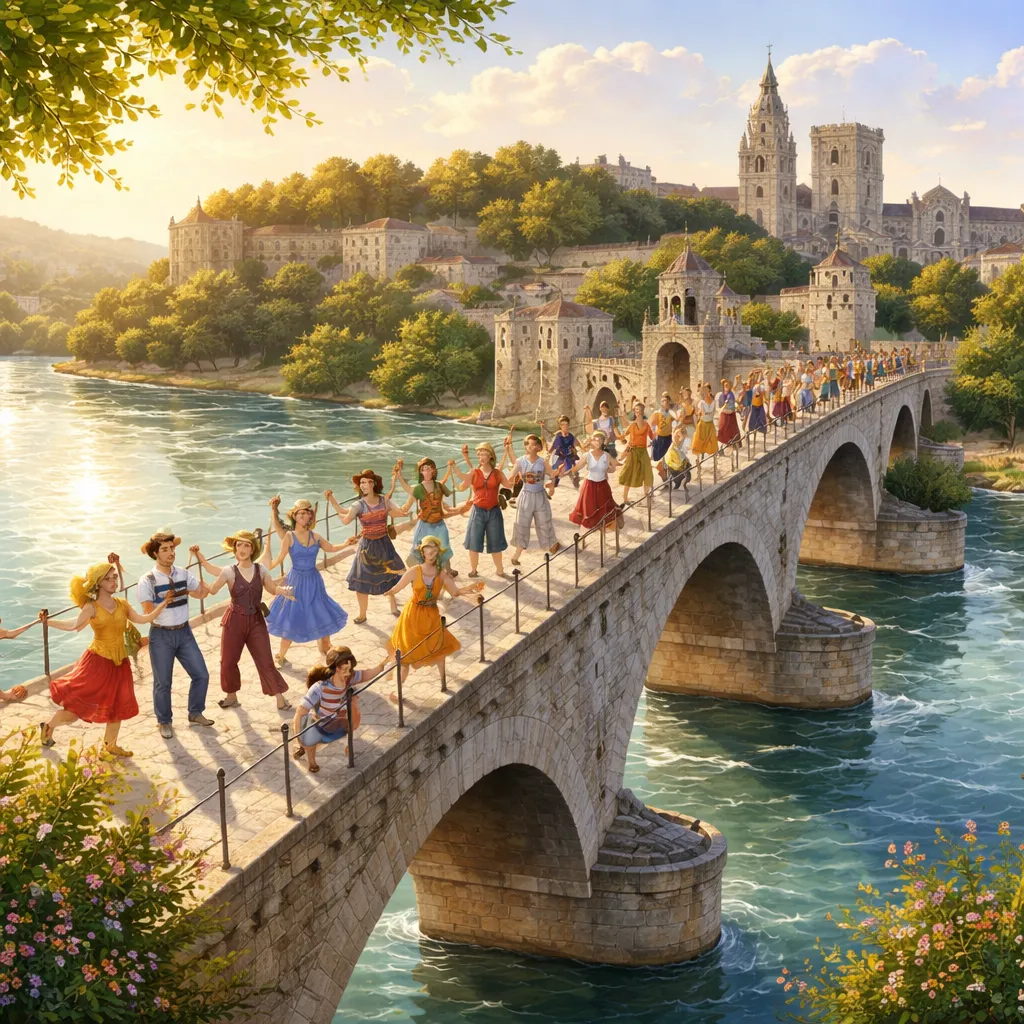

Do you have a special place where you love to play and dance? Maybe a playground or your own living room? In a sunny country called France, there is a famous old bridge that people sing about. The song imagines everyone from ladies to soldiers dancing there! Let’s visit this bridge through the song “Sur le Pont d’Avignon.”
About the Song
The song is almost always sung in its original French. Let’s read the first verse and its English meaning.
Sur le pont d’Avignon,
L’on y danse, l’on y danse,
Sur le pont d’Avignon,
L’on y danse tout en rond.
(On the bridge of Avignon,
We all dance there, we all dance there,
On the bridge of Avignon,
We all dance in a circle.)
The song then adds verses about different people dancing:
Les belles dames font comme ça,
Et puis encore comme ça.
(The lovely ladies do like this,
And then again like this.)
Les beaux messieurs font comme ça,
Et puis encore comme ça.
(The handsome gentlemen do like this,
And then again like this.)
This song is a traditional French folk song and dance. It is a lively, circular tune that invites everyone to imagine dancing on a famous bridge. The song describes a joyful scene where lovely ladies, handsome gentlemen, gardeners, soldiers, and more all come to the bridge to dance in their own special way. The bridge is the Pont Saint-Bénézet, a real historical bridge in the beautiful city of Avignon in the south of France. Built in the 12th century, it is now partly broken, but the song keeps it alive in our imagination as a place of celebration.
What the Song is About
The song paints a vivid, moving picture. First, we are taken to the bridge itself. It stretches over a wide, shiny river. The sun is warm. Then, we hear the music and see the people. A happy crowd has gathered right on the bridge. They are all holding hands and dancing together in a big, joyful circle.
Now, the song starts to point out different dancers. First, the beautiful ladies. They step forward and do a graceful dance move, perhaps a curtsy or a twirl. They do it once, and then they do it again. Next, the handsome gentlemen. They step forward and do a polite, strong dance move, maybe a bow or a stamp. They do it once, and then they do it again. The song can continue with gardeners, washerwomen, soldiers, and musicians, each group showing off their own special dance.
Who Made It & Its Story
“Sur le Pont d’Avignon” is a very old traditional song, so we don’t know who wrote it. It has been sung in France for hundreds of years, since at least the 15th century. The song refers to the real Pont d’Avignon, a bridge that was a major crossing point over the Rhône River. In the Middle Ages, the area under the arches of the bridge was a lively spot with taverns and shops, where people might have actually gathered to sing and dance. The song captures the festive spirit of that time and place.
This song is a worldwide favorite for three delightful reasons. First, its melody is incredibly happy, simple, and catchy. It makes you want to get up and move the moment you hear it. Second, it is a wonderful window into French culture, history, and language, making a faraway place feel friendly and fun. Third, it is a perfect action song. The “font comme ça” (do like this) parts invite you to invent your own dance moves, making it interactive and creative every time you sing it.
When to Sing It
This song is perfect for active, imaginative play. You can sing it during a family dance party in your living room, taking turns being the “belles dames” and “beaux messieurs” and making up your own “comme ça” moves. You can sing it on a walk, pretending a sidewalk crack is the bridge of Avignon and dancing as you cross it. You can also hum it while building a bridge with blocks or Legos, imagining tiny people dancing on your creation.
What Children Can Learn
This joyful dance song is full of wonderful lessons. Let’s join the circle and discover them all.
Vocabulary
The song teaches us simple but essential French words. “Sur” means “on.” “Le pont” means “the bridge.” “D’Avignon” means “of Avignon” (a city in France). “L’on y danse” means “one dances there” or “we dance there.” “Tout en rond” means “all in a circle” or “in a ring.”
“Les belles dames” means “the lovely ladies.” “Les beaux messieurs” means “the handsome gentlemen.” “Font” means “do” or “make.” “Comme ça” means “like this.” “Et puis encore” means “and then again.” New word: Landmark. This is a famous or important building or structure. The Pont d’Avignon is a famous French landmark.
Language Skills
This song is a fantastic lesson in using the preposition “on” (in French: “sur”). A preposition is a word that shows the relationship between a noun and another word, often telling us about place or time. The song’s entire setting is defined by the preposition “sur.”
Look at the title and repeated line: “Sur le pont d’Avignon.” This means “On the bridge of Avignon.” It tells us exactly where the dancing is happening. We use prepositions like this all the time in English: in the house, under the table, beside the tree. The song also uses the French present tense “l’on y danse” (we dance there) to describe a habitual action—something people usually do on that bridge in the song’s imaginary world. This is a great way to learn about describing routines.
Sounds & Rhythm Fun
Listen to the cheerful, bouncing pattern of the melody. The song uses wonderful repetition: “l’on y danse” is sung twice, and each verse ends with the playful “et puis encore comme ça.” The sounds are light and musical.
The rhythm is a clear, marching, danceable 4/4 beat. It has a “step-together-step” feel. Try clapping it: Sur le PONT d’A-vi-GNON. The melody is simple, repetitive, and moves up and down like little dance steps. This predictable, bouncy rhythm makes it incredibly easy to learn, remember, and move to. You can create your own location song! Use the same bouncy tune. Try: “In the park of our hometown, we all play there, we all play there. In the park of our hometown, we all play ball and run around. The little kids jump like this, and then again like this!”
Culture & Big Ideas
This song is a beautiful postcard from the Provence region of France. It connects us to French history, architecture, and the social tradition of the farandole, a chain dance that people do in circles and lines, often at festivals. The song reflects a culture that celebrates public joy, music, and community gathering in beautiful, historical settings.
The song shares three lovely ideas. First, it’s about community and inclusivity. The bridge welcomes everyone—ladies, gentlemen, workers, soldiers—to dance together, showing that joy is for all people. Second, it celebrates cultural heritage and place. The song keeps the memory of a specific, ancient bridge alive, teaching us to value and sing about important places from the past. Third, it’s about self-expression through movement. The “comme ça” invites everyone to contribute their own unique dance move, valuing individual creativity within a group activity.
Values & Imagination
Let your imagination dance on the Pont d’Avignon. What does the river look like flowing underneath? Is it blue? Are there boats? What are the dancers wearing? Fancy old-fashioned dresses? Hats? Can you hear the musicians? A fiddle? A drum? What time of day is it? A sunny afternoon? A warm evening with lanterns? Imagine you are there. What would your special “comme ça” dance move be? A spin? A funny walk? A jump? Draw a picture of the bridge crowded with all kinds of people dancing in their unique ways.
The song inspires us to appreciate shared spaces and traditions. A wonderful idea is to have a “Bridge of Friendship” moment. With your family or friends, hold hands in a circle. Sing the song, and as you get to “font comme ça,” go around the circle letting each person show one simple, happy dance move for everyone to copy. This builds community, just like the song describes.
So, as our dance on the imaginary bridge comes to an end, think about the journey this song has taken you on. It has taught you French words for “on” and “bridge.” It has given you a rhythmic pattern to clap to. It has shown you a piece of French history made of stone and song. “Sur le Pont d’Avignon” is more than a tune; it is an invitation. An invitation to move, to learn a new language, to celebrate community, and to use your imagination to visit a beautiful, faraway place where everyone is always dancing in the sunshine. From the first step “sur le pont” to the final “comme ça,” it proves that learning about the world can be a joyful, dancing adventure.
Your Core Takeaways
You are now a friend to the song “Sur le Pont d’Avignon.” You know it is a traditional French dance song about a real historical bridge. You’ve learned French words like “sur” (on) and “pont” (bridge), and you’ve seen how prepositions tell us where. You’ve felt its danceable rhythm and even composed your own location song. You’ve also discovered the song’s celebration of community, cultural heritage, and the simple, universal joy of dancing together.
Your Practice Missions
First, build and dance on your bridge. Use cushions, a blanket, or tape on the floor to make the shape of a bridge in your room. Walk onto your “bridge,” and start singing the song. Dance in a circle on it. When you sing about the ladies and gentlemen, stop and invent a special dance move for each. Perform the whole song on your homemade bridge.
Second, be a tour guide for a toy. Take a favorite toy or doll. Show them a picture of the real Pont d’Avignon (you can ask a grown-up to help you find one online). Then, tell your toy the story of the song in your own words: “This is the bridge in Avignon. In the song, everyone goes there to dance! The ladies do this… the gentlemen do this…” Act it out for them. This helps you explain the song’s story and culture.