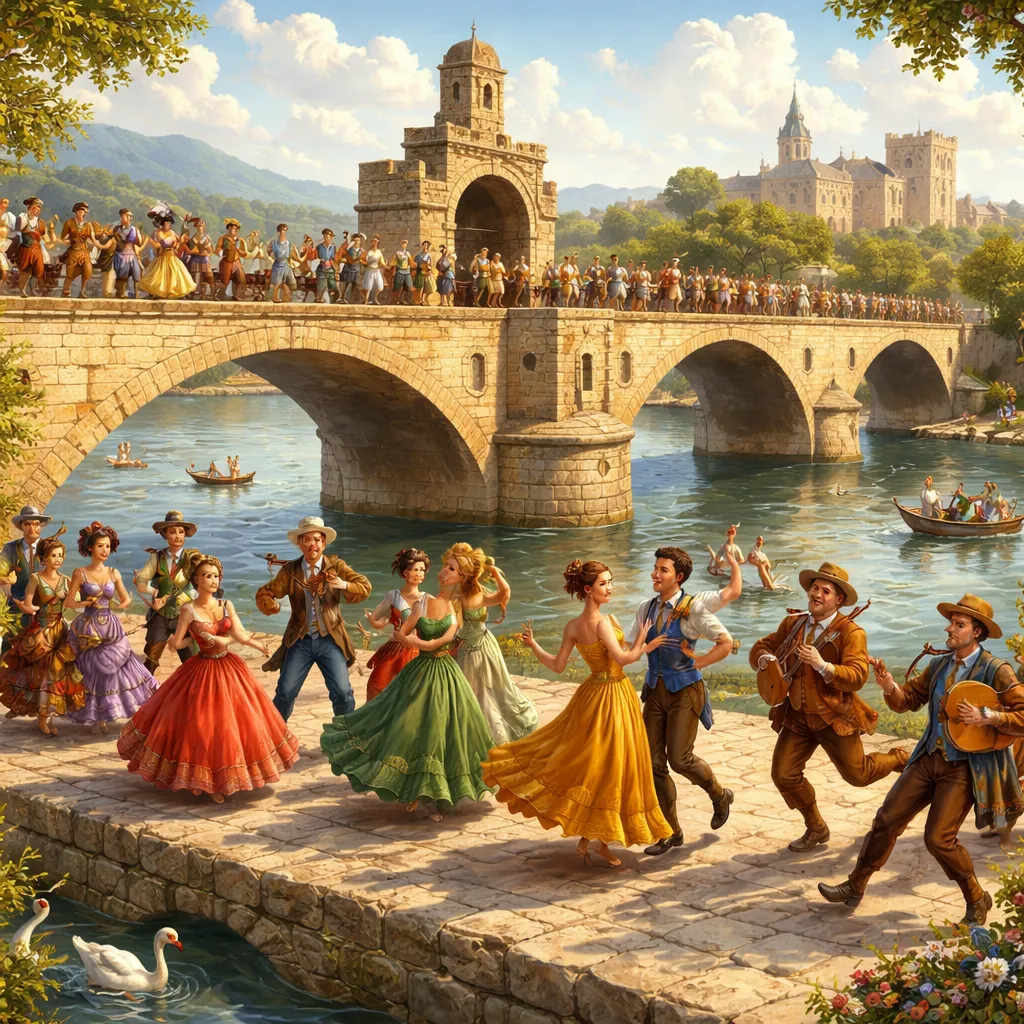

Have you ever walked on a bridge? Bridges are for crossing rivers, but what if a bridge was for dancing? In France, there is a famous, happy song all about a special bridge where everyone dances in their own special way. It is a song about movement, people, and joy. Let’s join the circle and learn the dancing song “The Bridge of Avignon (Sur le pont d'Avignon).”
About the Song
Here are the lively, dancing lyrics of a beloved traditional French song:
Sur le pont d'Avignon,
L'on y danse, l'on y danse,
Sur le pont d'Avignon,
L'on y danse tous en rond.
Les beaux messieurs font comme ça,
Et puis encore comme ça.
Sur le pont d'Avignon,
L'on y danse tous en rond.
Les belles dames font comme ça,
Et puis encore comme ça.
Sur le pont d'Avignon,
L'on y danse tous en rond.
English Translation:
On the bridge of Avignon,
We are dancing, we are dancing,
On the bridge of Avignon,
We are all dancing in a ring.
The handsome gentlemen go like this,
And then again like this.
On the bridge of Avignon,
We are all dancing in a ring.
The lovely ladies go like this,
And then again like this.
On the bridge of Avignon,
We are all dancing in a ring.
This is the original French-language song for children. The song invites us to a famous place for a community dance. “On the bridge of Avignon, we are dancing, we are dancing,” it starts, telling us exactly where the fun is happening. The dancing is together. “On the bridge of Avignon, we are all dancing in a ring,” everyone joins hands in a circle. Then, different people show their moves. “The handsome gentlemen go like this, and then again like this.” They do a special step. “The lovely ladies go like this, and then again like this.” They do their own step. Each verse ends by coming back to the whole group dancing together. The song is a joyful list of dancers and their movements on a historic bridge.
What the Song is About
The song paints a lively picture of a dance party on a famous old bridge in France. Imagine a sunny day on a long stone bridge over a wide river. Many people are there, holding hands. “On the bridge of Avignon, we are dancing, we are dancing,” they all sing as they move in a big, happy circle. “On the bridge of Avignon, we are all dancing in a ring,” they step side to side together.
Then, the gentlemen step into the center. “The handsome gentlemen go like this,” they might tip their hats or march proudly. “And then again like this,” they repeat their fancy step. Everyone cheers. Next, the ladies take a turn. “The lovely ladies go like this,” they might curtsy or spin gracefully. “And then again like this,” they do it once more. The song is a celebration of different people coming together to dance in the same place, each adding their own style to the fun.
Who Made It & Its Story
“Sur le pont d'Avignon” is a very old and popular French folk song and dance. Its specific creator is not known. The song refers to the real “Pont Saint-Bénézet,” a famous medieval bridge in the city of Avignon in southern France. Originally, the song was likely about dancing under the bridge (“sous le pont”), a popular spot for gatherings, but over time it changed to dancing on the bridge (“sur le pont”). The song and its simple, mimed dance have been taught to French children for generations. It is a joyful part of French cultural heritage, celebrating community, music, and a famous historical landmark.
This joyful, participatory song is loved for three wonderful reasons. First, it teaches simple, useful French vocabulary for places (“pont”), people (“messieurs,” “dames”), and actions (“danse,” “font”). Second, it has a catchy, circular melody that perfectly matches dancing in a ring, and the “comme ça” (like this) invites everyone to copy fun movements, making it a perfect action song. Third, it celebrates community, diversity, and shared joy, showing how different people (“messieurs,” “dames”) can all come together in the same dance.
When to Sing It
This song is perfect for any gathering where you can move. You can sing and dance to it at a family party, making a circle and showing your own “comme ça” moves. You can chant it on a walk when you cross a bridge, imagining the people dancing there long ago. You can also sing it in a group game, taking turns to be the “beaux messieurs” or “belles dames” and inventing a new dance step for everyone to copy.
What Children Can Learn
This lively, action-packed song is a wonderful teacher about places, people, and the important French preposition “sur” (on), which tells us where the fun happens.
Vocabulary
The song teaches us clear, useful French words for places, actions, and people. “On” (Sur). “The” (le). “Bridge” (pont). “Of Avignon” (d'Avignon). “We/One” (L'on). “There” (y). “Dance” (danse). “All” (tous). “In a ring” (en rond). “The” (Les). “Handsome/Beautiful” (beaux/belles). “Gentlemen/Men” (messieurs). “Do/Make” (font). “Like this” (comme ça). “And then” (Et puis). “Again” (encore). “Ladies” (dames).
Let’s use these words! You can say where you are: “Je suis sur le pont.” (I am on the bridge.) You can say what you do: “Nous dansons.” (We dance.) New word: La rivière. This means “the river,” which flows under the famous bridge.
Language Skills
This song is excellent for learning about telling where something happens, using the preposition “sur” (on). The very first words of the song are “Sur le pont” (On the bridge).
Concept Definition: The little word “sur” means “on” or “on top of.” We use it to tell the location of something, to say where an action is happening. The dance is not under the bridge or next to the bridge. The dance is on the bridge. “Sur” tells us the exact spot.
Features and Types: The word “sur” is a preposition. Other French prepositions you know are “dans” (in), “sous” (under), and “à côté de” (next to). “Sur” is for surfaces. You dance on the floor. You put a cup on the table. The picture hangs on the wall.
How to Spot Them: Here is a simple “where?” trick. When you hear about an action, ask: “Where is it happening?”. If the answer is a place you can put your hand on top of, you probably need “sur”. They dance. Where? On the bridge -> “sur le pont”. The cat sleeps. Where? On the bed -> “sur le lit”.
How to Use Them: A great way to say where you are or where something is is the “Location Spot Formula”. The pattern is: “Sur + [the place/article + noun].”
Example from the song: “Sur le pont d'Avignon” (On the bridge of Avignon).
Example you can make: “Le livre est sur la table.” (The book is on the table.) “Nous jouons sur le tapis.” (We are playing on the rug.) “L'oiseau est sur la branche.” (The bird is on the branch.)
Sounds & Rhythm Fun
Listen to the bouncy, marching rhythm of the melody. The song has a strong, steady beat that is perfect for walking or dancing in a circle. The melody for “Sur le pont d'Avignon” is memorable and repeats, acting like the chorus. The line “L'on y danse, l'on y danse” is fun to sing, with the “danse” sound repeating.
The rhythm feels like feet tapping on an old stone bridge. The verses for the gentlemen and ladies (“Les beaux messieurs…”, “Les belles dames…”) have the same tune, which makes it easy to add new verses. The “comme ça” part is where you can do any action! This musical pattern is perfect for creating your own dancing verse. You can write your own “Sur la plage” (On the beach) song! Try: “Sur la plage de Nice, L'on y court, l'on y court, Sur la plage de Nice, L'on y court tous en riant. Les enfants font comme ça, Et puis encore comme ça…” (On the beach of Nice, we are running… we are all running laughing. The children go like this…)
Culture & Big Ideas
“Sur le pont d'Avignon” connects us to French history, architecture, and the joy of social dancing. The real Pont d'Avignon (Saint Bénézet Bridge) is a famous UNESCO World Heritage site. While it is now a broken bridge that doesn’t cross the whole river, it remains a powerful symbol. The song celebrates the bridge as a place for community gathering and “la fête” (the party), a very important part of French life. It also reflects the traditional “ronde” (circle dance), a common folk dance style.
The song conveys three wonderful, joyful ideas. First, it celebrates community and togetherness (“tous en rond” – all in a ring), showing the fun of doing something together. Second, it acknowledges individuality within the group, as the gentlemen and ladies each have their own special “comme ça” moves within the same dance. Third, it connects joy and play to a specific, real-world location, teaching that history and places can be full of life and music.
Values & Imagination
Imagine you are on the wide, sunny Pont d'Avignon hundreds of years ago. The river Rhône flows below. You join hands with friends and strangers. “On the bridge of Avignon, we are dancing, we are dancing,” you all sing, moving in a big, happy circle. “On the bridge of Avignon, we are all dancing in a ring,” your feet step in time on the old stones.
Then, a man in a fine coat jumps into the center. “The handsome gentlemen go like this,” he does a proud, jumping step. “And then again like this,” he repeats it, and you all copy him. Next, a woman with a beautiful dress spins into the middle. “The lovely ladies go like this,” she twirls gracefully. “And then again like this,” she smiles, and everyone tries her step. How does the rough stone feel under your dancing shoes? Can you hear the river below and the music all around? Draw the dancing bridge. Draw a long stone bridge with arches. Draw a big circle of simple stick-figure people holding hands on the bridge. Draw a gentleman and a lady with special lines to show their “comme ça” dance moves inside the circle. This shows the song’s community and individual expression.
The song encourages us to find joy in shared activities, to appreciate public spaces where communities gather, and to celebrate how everyone can add their own special move to the group fun. A wonderful activity is the “Danse comme ça” (Dance like this) game. With friends or family, form a circle. Sing the song. When you get to “Les beaux messieurs font comme ça,” one person steps into the center, makes up a dance move, and says “comme ça!”. Everyone copies it. Then, for “Les belles dames,” someone else steps in with a new move. This connects you to the song’s playful, inclusive spirit.
So, from the historic bridge to the circling dance, this song is a celebration of shared joy. It is a vocabulary lesson in places, people, and actions. It is a language lesson in using the preposition “sur” (on) to tell where something happens. It is a music lesson in a steady, dancing rhythm that invites everyone to join in. “The Bridge of Avignon (Sur le pont d'Avignon)” teaches us about community, individual expression, and finding the music in everyday places.
Your Core Takeaways
You are now an expert on the song “The Bridge of Avignon (Sur le pont d'Avignon).” You know it is a joyful French song about people dancing in a circle on a famous bridge, where handsome gentlemen and lovely ladies each show their own dance move “comme ça.” You’ve learned French words like “pont,” “Avignon,” “danse,” “en rond,” “messieurs,” “dames,” and “comme ça,” and you’ve practiced using the preposition “sur” (on) to talk about location. You’ve felt its steady, dancing beat perfect for moving in a circle and created your own location-based verse. You’ve also discovered the song’s message about community, individual expression, and the history of a famous French place.
Your Practice Missions
First, play the “Où es-tu? Sur…” (Where are you? On…) game. Look around and name three things you can see that are on something else, using “sur.” For example, “Le chat est sur le canapé.” (The cat is on the sofa.) “Mon verre est sur la table.” (My glass is on the table.) “Le livre est sur l'étagère.” (The book is on the shelf.) This mission helps you practice the song’s key language skill of describing location.
Second, have a “Pont d'Avignon Dance Party.” Clear a space. With your family, hold hands and walk in a circle while singing the first part of the song. Then, take turns being the “beaux messieurs” or “belles dames” to step into the center, invent a funny or graceful dance move, and say “comme ça!” for everyone to copy. This mission lets you live the song’s core action of community dancing and individual fun.