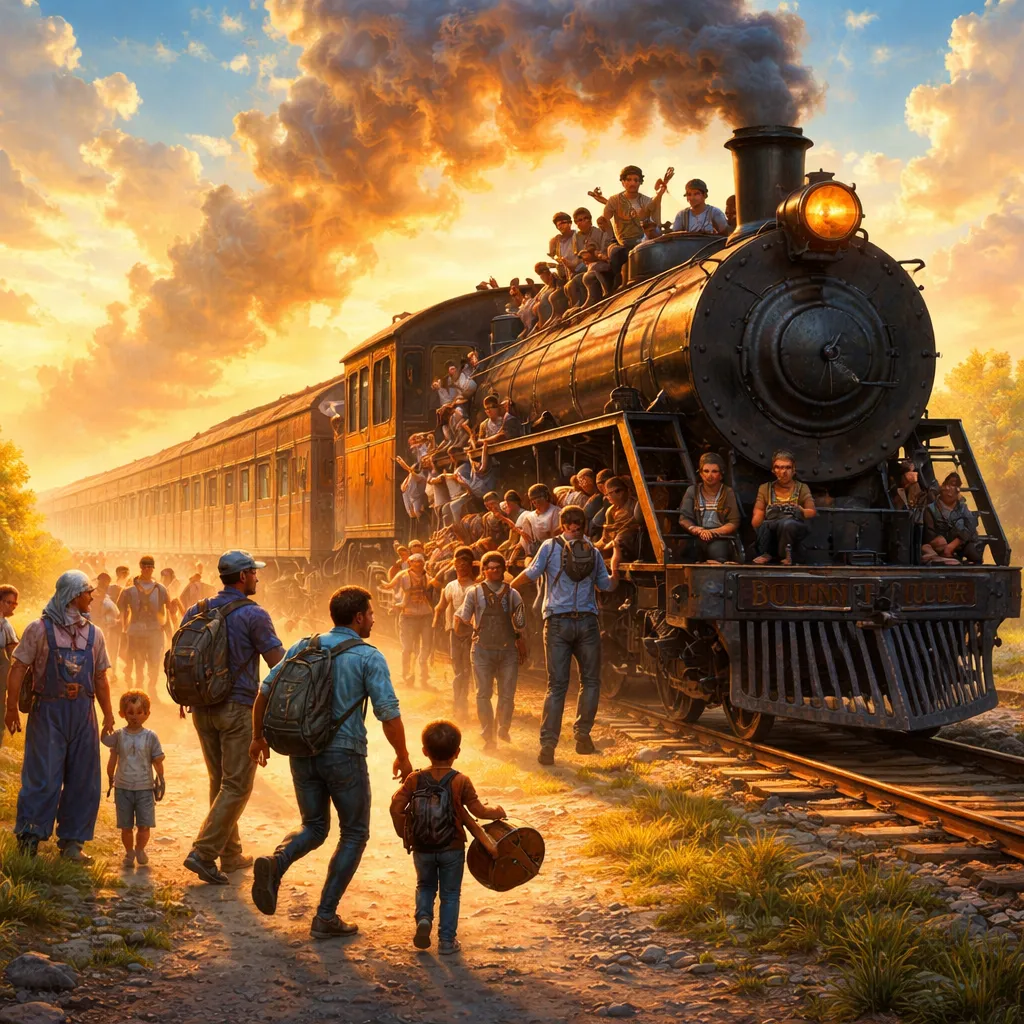

Have you ever stood by railroad tracks and felt the ground rumble as a huge train approaches? It’s powerful, exciting, and it’s going somewhere important. Long ago, people created a song about a very special train. This isn’t a train that carries coal or people to the next city. It’s a train that carries souls on a journey of hope, and it has very strict rules about who can get on board. Let’s learn about the spiritual “This Train.”
About the Song
Let’s read the rhythmic, rule-filled words of this famous spiritual.
This train is bound for glory, this train.
This train is bound for glory, this train.
This train is bound for glory,
Don’t carry nothing but the righteous and the holy.
This train is bound for glory, this train.
This train don’t carry no gamblers, this train.
This train don’t carry no gamblers, this train.
This train don’t carry no gamblers,
No cigar smokers, no midnight ramblers.
This train is bound for glory, this train.
This song is a traditional African American spiritual. It is a driving, rhythmic song that uses the powerful image of a train as a metaphor for a journey to heaven, salvation, or freedom. The song is structured as a proud, repeating announcement. The train is “bound for glory,” meaning its destination is a wonderful, heavenly place. The song then lists who is not allowed on this train: gamblers, cigar smokers, midnight ramblers (people who stay out late causing trouble). It emphasizes that it only carries the “righteous and the holy,” meaning people who live good and faithful lives. The song served as both a religious expression and, during the time of slavery and segregation, a coded message of hope for a better life and a critique of sinful behavior.
What the Song is About
The song paints a picture of a perfect, exclusive journey. A mighty train is getting ready to leave. Its destination is not a place on a map, but “glory,” which means heaven or a state of divine happiness. The singer announces this over and over, like a stationmaster calling out a departure.
Then, the singer explains the rules. This glorious train has high standards. It “don’t carry” certain types of people. The list includes those who gamble, smoke cigars, or are “midnight ramblers”—people who might be up late doing dishonest or unkind things. These are examples of behaviors that don’t fit on a journey to glory. In contrast, the train only carries the “righteous and the holy,” people who are good, fair, and live by their faith. The song is a musical way of talking about the choice between a good life and a troubled life, and the promise that a good life leads to a glorious destination.
Who Made It & Its Story
“This Train” is a traditional spiritual, so its original author is unknown. It was created by enslaved African Americans in the 19th century and later sung in Black churches. The train was a new, powerful symbol of movement and change, representing the Underground Railroad (the secret network to freedom) and, later, the Great Migration (when millions of African Americans moved north for a better life). The song’s list of forbidden passengers served as a moral guide for the community. It became widely known in the 20th century through folk singers like Sister Rosetta Tharpe (who gave it a rocking gospel sound) and Woody Guthrie (who adapted it into “This Land Is Your Land”). Their versions introduced the song to broad audiences as a symbol of justice and moral clarity.
This spiritual has remained powerful for three compelling reasons. First, its rhythm is incredibly strong, percussive, and mimics the sound of a moving train, making it exciting and easy to clap along to. Second, it uses a clear, modern metaphor (the train) to explain a spiritual idea, making a big concept easy to understand. Third, it presents a clear moral choice in a memorable way. The list of “don’ts” is simple and creates a vivid picture of the kind of community the singers aspired to be.
When to Sing It
This song is perfect for energetic, communal moments. You can sing it loudly while marching around the room, stomping your feet like a train. You can clap and chant it as a family while doing a big cleanup, making the work feel like a team effort toward a “glorious” goal. You can also sing it on a road trip, watching the world go by and imagining your car is the “train bound for glory.”
What Children Can Learn
This powerful, rhythmic song is a vehicle for many lessons. Let’s climb aboard and explore.
Vocabulary
The song teaches us strong moral and descriptive words. A “train” is a connected series of railroad cars. “Bound for” means headed to or destined for. “Glory” means magnificent beauty, praise, or heaven. “Righteous” means acting in a morally right way. “Holy” means dedicated to God or a religious purpose. A “gambler” is a person who bets money on games of chance. A “midnight rambler” is someone who wanders around late at night, often with a suspicious purpose.
Let’s use these words! You can say, “The ship was bound for a distant island.” Or, “She made a righteous decision to tell the truth.” New word: Metaphor. This is when you describe one thing as being another to show they are alike. The song uses a train as a metaphor for the journey to a good life.
Language Skills
This song is a great lesson in using the present simple tense for stating facts and the double negative for emphasis in informal speech. The song states a fact about the train: “This train is bound for glory.” The present simple is used for permanent truths.
The line “This train don’t carry no gamblers” uses a double negative (“don’t” and “no”), which is common in African American Vernacular English (AAVE) and informal speech for strong emphasis, though it is not standard in formal English. The song practices listing and exclusion, using “no” and “nothing but” to define what is not allowed and what is exclusively allowed.
Sounds & Rhythm Fun
Listen to the driving, chugging, clacking rhythm of the melody. The song perfectly mimics the sound and motion of a steam train. The repetition of “this train” acts like the pounding of wheels on the tracks. The lyrics have a strong, chant-like rhyme: “train” and “train,” “glory” and “glory,” “gamblers” and “ramblers.”
The rhythm is a steady, forceful 4/4 time. Try stomping your foot on each beat: THIS TRAIN is BOUND for GLO-ry, THIS TRAIN. The melody is simple, repetitive, and based on a few powerful notes. This strong, percussive, and repetitive musical pattern is what makes the song so easy to remember and so fun to perform. You can write your own “bound for glory” song! Use the same train rhythm. Try: “This bus is bound for learning, this bus. This bus is bound for learning, this bus. Don’t carry nothing but the curious and the yearning. This bus is bound for learning, this bus.”
Culture & Big Ideas
“This Train” is a cornerstone of African American spiritual and gospel music. It comes from a history of using coded language and powerful symbols to express dual hopes: for freedom in this life and salvation in the next. The train symbol connected the spiritual world to the very real historical experience of travel and migration in search of a better life. The song reflects the community’s values of righteousness, discipline, and collective aspiration. It is a profound piece of cultural history that uses music to teach morality and sustain hope.
The song conveys three important ideas. First, it’s about destiny and purpose. The train is “bound for” somewhere specific; it’s not wandering. This teaches that life should have a positive direction and goal. Second, it’s about community standards and boundaries. The song defines what behavior is not welcome (“no gamblers”) and what is required (“the righteous”) to be part of the community’s journey. Third, it expresses hope and exclusion as a form of safety. The glorious destination is only for those who follow the rules, creating a sense of a safe, sacred space for the community.
Values & Imagination
Imagine the “Train Bound for Glory.” What does it look like? Is it shining? What color is it? Who is the conductor? Now, imagine the station. Who is getting turned away? The gambler with cards? The rambler looking sleepy? Who is welcomed aboard? People helping each other? People singing? Draw a picture of the train station. On one side, draw the glorious train with happy, kind-looking passengers waving from the windows. On the other side, draw the people who are not allowed on board, looking confused. This shows the song’s central idea of choice.
The song encourages us to think about our own actions and the “journey” we are on. A lovely idea is to have a “Family Glory Train” discussion. As a family, talk about what your “family train” is bound for (happiness, kindness, learning). Then, decide on one or two things your “train doesn’t carry” (like yelling, not sharing). Make a simple poster with your family rules, inspired by the song. This turns the song’s metaphor into a positive family guide.
So, as the last powerful chant of “this train” fades, think about the journey this song invites you on. It is a vocabulary lesson in morality and destination. It is a grammar lesson in stating truths and using strong negatives. It is a music lesson in a driving, train-like rhythm. From the first announcement of its glorious destination to the final rule about who’s on board, it wraps lessons in purpose, community standards, and hopeful direction in a tune that moves your body and spirit. “This Train” teaches us that life is a journey with a destination, that our choices determine our path, and that the best trips are taken with good people heading toward glory.
Your Core Takeaways
You are now an expert on the spiritual “This Train.” You know it is an African American song that uses a train as a metaphor for the journey to heaven or a good life. You’ve learned words like “bound for,” “righteous,” and “midnight rambler,” and you’ve practiced the present simple tense and listing exclusions. You’ve felt its powerful, chugging rhythm and created your own journey verse. You’ve also discovered the song’s historical significance and its messages about living with purpose, upholding community values, and holding onto hope for a glorious destination.
Your Practice Missions
First, form a “Glory Train” march. With your family, line up like a train. Choose a conductor to lead. Chant the song while marching through your home, stomping your feet on the beat. The conductor can point at imaginary people to “let on” or “leave behind” based on the rules. This physical activity connects the rhythm to the song’s meaning.
Second, design a “Ticket to Glory.” The song talks about who is allowed on the train. Design a beautiful ticket for this special journey. What does it look like? What does it say? On the back, write the “passenger rules” in your own words. Who would you give a ticket to? This creative activity lets you think deeply about the song’s values.