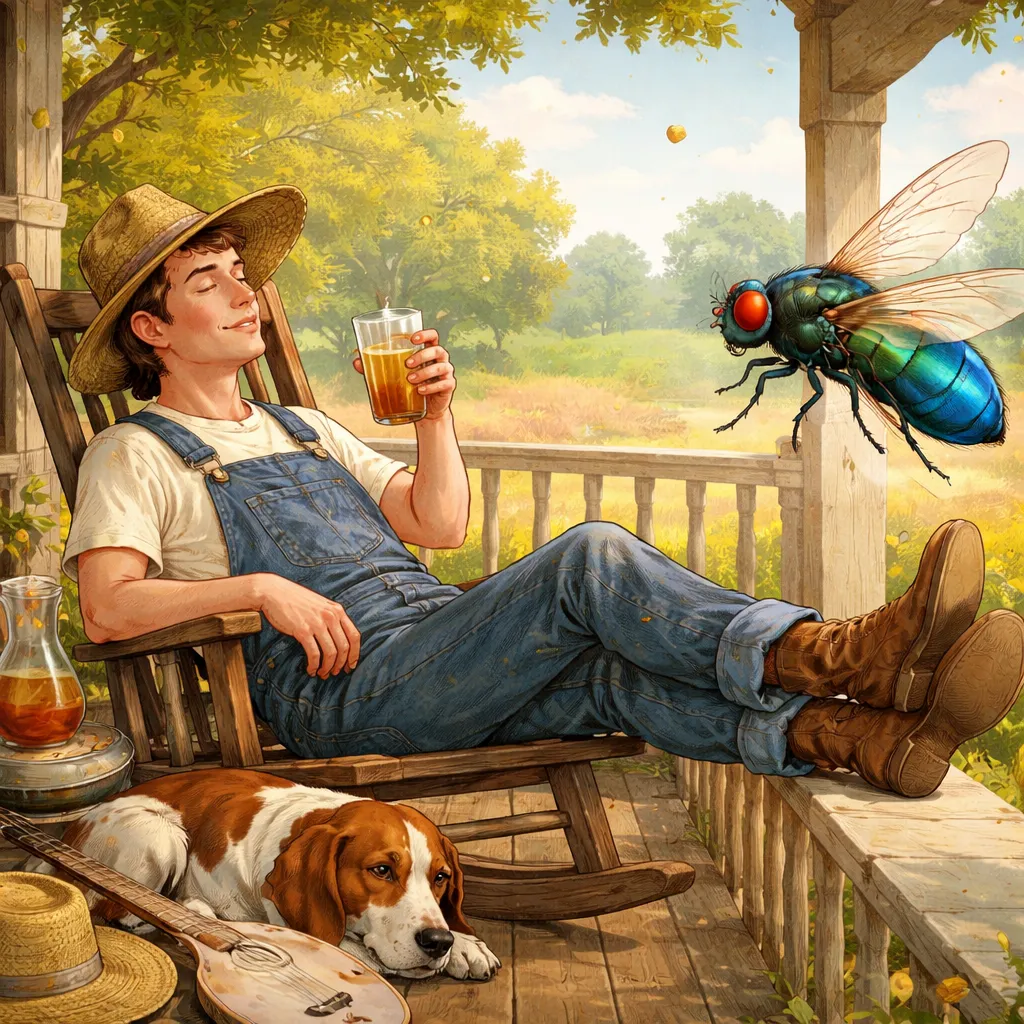

Have you ever been bothered by a buzzing insect that just wouldn’t go away? Maybe a fly that kept landing on your picnic. Now, imagine that tiny fly causing a very big, unexpected accident. There is a very old, catchy song that tells a funny, strange story about exactly that. It’s a song about a bug, a horse, and a man who ends up with a new chore. Let’s learn about the folk song “The Blue Tail Fly,” also called “Jimmy Crack Corn.”
About the Song
Let’s read the story-filled, rhythmic words of this classic tune.
When I was young I used to wait
On master and hand him his plate;
I’d pass the bottle when he got dry,
And brush away the blue-tail fly.
Chorus:
Jimmy crack corn and I don’t care,
Jimmy crack corn and I don’t care,
Jimmy crack corn and I don’t care,
My master’s gone away.
One day he rode around the farm,
The flies so numerous they did swarm;
One chanced to bite him on the thigh,
The devil take the blue-tail fly.
Chorus
The pony run, he jump, he pitch,
He threw my master in the ditch;
He died and the jury wondered why,
The verdict was the blue-tail fly.
Chorus
This song is a traditional American folk song that became popular in the 1840s in minstrel shows. The song tells a story from the perspective of an enslaved person or a servant, set in the pre-Civil War American South. The narrator describes his job of waiting on his “master.” The central event is the master’s death, caused indirectly by a blue-tail fly (a horsefly) that bites the master’s horse. The famous, repeating chorus, “Jimmy crack corn and I don’t care,” is a nonsense phrase that has sparked much debate. “Cracking corn” means crushing dried corn to feed animals, a common chore. The song mixes a simple story, a catchy tune, and a chorus that feels both lighthearted and mysterious.
What the Song is About
The song paints a picture of life on a farm long ago. The singer is telling a story from his youth. His job was to serve the master of the farm, bringing him food and drink and shooing away flies. He specifically mentions the “blue-tail fly,” a pesky horsefly.
One day, the master is riding his horse. The flies are swarming. One blue-tail fly bites the master’s thigh. The horse, bothered by the fly or the master’s reaction, bucks wildly. It throws the master into a ditch, and the master dies from the fall. A jury investigates and decides the cause of death was the blue-tail fly. After this accident, the singer is left with the chore of cracking corn. The chorus repeats that “Jimmy” (possibly the singer himself or another worker) is cracking corn and doesn’t care that the master is gone. The song is a simple, cause-and-effect story with a silly, exaggerated outcome and a memorable, shrugging refrain.
Who Made It & Its Story
“The Blue Tail Fly” is a traditional folk song, so its original author is unknown. It was first published in the 1840s and became a staple of blackface minstrel shows, a popular but problematic form of entertainment in the 19th century. The song’s composer is sometimes credited to Dan Emmett, the same man who wrote “Dixie.” The song’s origins are complex, as it comes from a time of slavery. Over the years, the song was separated from its minstrel show roots and entered the folk tradition as a children’s song, often sung without understanding its historical context. The chorus’s meaning is unclear—it could be a nonsense phrase, a secret expression of relief, or a simple description of a chore continuing after a change.
This song remained popular for three catchy reasons. First, its melody and chorus are incredibly simple, repetitive, and easy to sing, making it perfect for groups. Second, it tells a funny, exaggerated story where a tiny insect causes a huge accident, which appeals to children’s sense of humor. Third, the nonsense chorus “Jimmy crack corn and I don’t care” is fun to shout and easy to remember, even if you don’t know what it means.
When to Sing It
This song is perfect for active, rhythmic moments. You can sing it while doing a simple, repetitive chore like sweeping or setting the table, matching the action to the beat. You can chant it on a walk, clapping on the “Jimmy crack corn” part. You can also sing it as a silly, dramatic story with friends, acting out the horse bucking and the fly buzzing.
What Children Can Learn
This deceptively simple song is a bundle of lessons about language, history, and logic. Let’s explore.
Vocabulary
The song teaches us old-fashioned and specific words. A “blue-tail fly” is a type of large horsefly with a blue abdomen. To “crack corn” means to break dried corn kernels into smaller pieces, often to feed animals. The word “master” in this context means a man who had authority over servants or enslaved people. To “hand him his plate” means to serve him food. “Numerous” means many. A “jury” is a group of people who decide the cause of an event in a court. A “verdict” is the official decision made by a jury.
Let’s use these words! You can say, “The flies were so numerous at the picnic.” Or, “The jury listened to all the evidence.” New word: Indirect. This means not directly caused by something. The fly caused the master’s death indirectly, by startling the horse.
Language Skills
This song is a great lesson in using the simple past tense for storytelling and understanding cause and effect. The entire song is a story, so it uses the past tense: “I used to wait… He rode… The pony run… He died…”
The song shows a clear chain of cause and effect: The fly bit the master (cause 1) -> The horse bucked (cause 2) -> The master was thrown and died (effect). The chorus uses the simple present tense (“Jimmy crack corn”) to describe a habitual action that continues after the story’s main event.
Sounds & Rhythm Fun
Listen to the bouncy, galloping rhythm of the melody. The song has a clear verse-chorus structure. The verses tell the story, and the chorus is the famous, repetitive shout. The verses have a strong rhyme: “wait” and “plate,” “dry” and “fly,” “farm” and “swarm,” “thigh” and “fly,” “pitch” and “ditch,” “why” and “fly.”
The rhythm is a steady 4/4 time, with a feel that mimics a horse’s trot. Try clapping on the beat: When I was YOUNG I USED to WAIT. The chorus is even more rhythmic and is designed for group singing. This simple, narrative, and shout-along musical pattern is what makes the song so memorable. You can write your own chain-reaction song! Use the same bouncy rhythm. Try: “When I was small I had a cat, who liked to chase a little rat. The rat ran right behind the door, and that’s how we got a cat on the floor! Meow meow and I don’t care, the cat is sitting on the chair!”
Culture & Big Ideas
“The Blue Tail Fly” comes from the complex antebellum South and minstrel show tradition of the United States. It reflects a time of great injustice. While often sung as a silly children’s song today, it originally came from a culture where enslaved people had to hide their true feelings. The chorus’s apparent indifference (“I don’t care”) can be seen as a form of subtle resistance or a coded expression. The song is a historical artifact that, when understood in context, can teach about a difficult period in American history in an age-appropriate way.
The song conveys three core ideas. First, it’s a lesson in unexpected consequences and cause and effect. A tiny, everyday nuisance (a fly) sets off a chain of events leading to a major change. Second, it touches on the theme of continuing with routine after a change. Life goes on, and chores like cracking corn continue, even after a big event. Third, it introduces the concept of surface meaning versus deeper meaning. The chorus seems carefree, but the story is about a death, encouraging us to think about what words might really mean.
Values & Imagination
Imagine you are the servant in the song. What does the farm look like? The big house? The fields? How do you feel brushing away the flies? Now, imagine the scene with the horse. How big is the horse? How does it jump? What does the “blue-tail fly” look like? Shiny? Buzzing loudly? Draw a comic strip of the song. In three panels: 1. The servant brushing a fly near the master. 2. The fly biting the master on the horse. 3. The horse bucking. In a thought bubble from the servant, draw the chorus: a sack of corn cracking open. This shows the connection between the event and the chore.
The song encourages us to think about cause and effect in our own lives and to be observant of small things. A lovely idea is to play the “Butterfly Effect” game. With your family, start with a small, silly action (“I dropped a spoon”). Each person adds a consequence (“The dog grabbed it and ran!” “We chased the dog and knocked over a pillow!”). See how a small start can lead to a funny, big ending, just like in the song.
So, as the last “gone away” fades, think about the layers of this old tune. It is a vocabulary lesson in old farm life. It is a grammar lesson in past tense storytelling. It is a music lesson in a bouncy, trotting rhythm. From the first job of waiting on the master to the final verdict on the fly, it wraps lessons in cause and effect, the persistence of routine, and looking beneath the surface in a tune that is as catchy as it is curious. “The Blue Tail Fly” teaches us that small things can have big results, that life goes on, and that sometimes songs have more to say than it seems at first listen.
Your Core Takeaways
You are now an expert on the song “The Blue Tail Fly (Jimmy Crack Corn).” You know it is a 19th-century American folk song from the minstrel tradition that tells a story about a fly causing a fatal accident. You’ve learned words like “blue-tail fly,” “crack corn,” and “verdict,” and you’ve practiced the simple past tense and cause-and-effect chains. You’ve felt its galloping rhythm and created your own chain-reaction verse. You’ve also discovered the song’s complex history and its messages about unintended consequences, the continuation of daily life, and the idea that words can have more than one meaning.
Your Practice Missions
First, stage a “Chain Reaction Drama.” With your family, act out the song’s story. One person is the master, one the servant, one the horse (maybe on all fours!), and one can buzz around as the blue-tail fly. Act out the biting, the bucking, and the fall. Then, everyone sing the chorus together while pretending to crack corn. This helps you visualize the cause and effect.
Second, create a “Verdict Box.” The song ends with a jury giving a verdict. Create a “Verdict Box” for your home. Decorate a small box. When a small, funny “disaster” happens at home (like spilled milk), have a family “jury” decide the official, silly cause. Write it on a slip of paper and put it in the box. For example, “Verdict: The cat’s tail did it!” This turns the song’s theme into a playful family tradition.