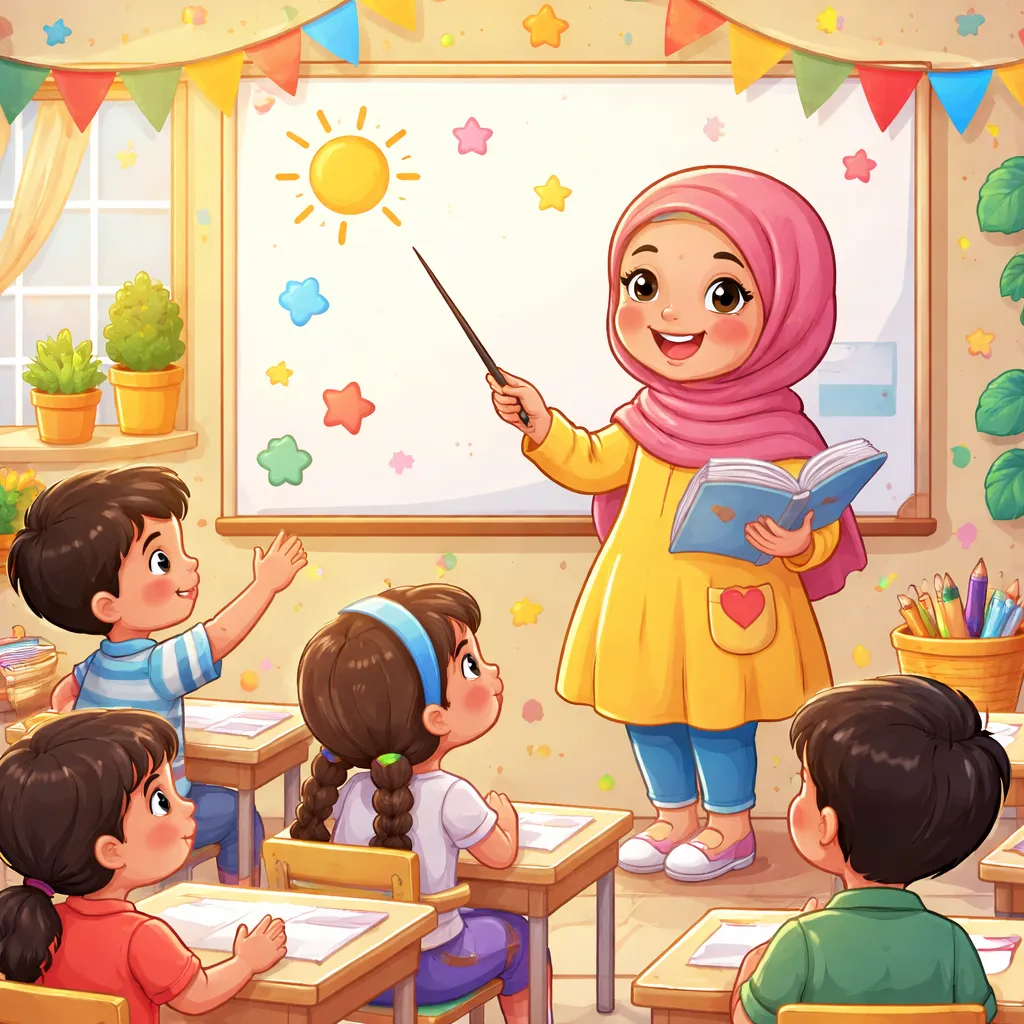

Have you ever played “school” with your friends, toys, or family? You get to be the teacher. You have a little board. You teach your “students” the letters or numbers you just learned. It feels powerful and fun! There is a special song that celebrates this exact game, where a child steps into the teacher’s shoes. Let’s stand at the front of the class and learn the Arabic song “The Little Teacher (المعلّمة الصغيرة).”
About the Song
Here is a common and charming version of this playful Arabic children’s song:
أنا المعلّمة الصغيرة، في بيتنا مدرسة
أعلّم أخي الصغير، الحروف والأرقام
أمسك الطباشير، وأكتب على السبورة
وأقول له أحسنت، يا تلميذي المجتهد
English Translation:
I am the little teacher, in our house is a school
I teach my little brother, the letters and the numbers
I hold the chalk, and I write on the blackboard
And I say to him “Well done,” oh my hardworking student
This is a delightful traditional Arabic children’s song that focuses on role-play and the respected figure of the teacher. Its exact origins are in the shared tradition of Arabic folk songs for kids. The song is sung from the proud perspective of a child, likely a big sister, who is pretending to be a teacher. It is a song about leadership, caring, and the joy of sharing knowledge with someone younger. It turns a simple game into an important job.
What the Song is About
The song is a proud announcement and a lesson. First, the child declares their new, important role: “I am the little teacher.” They have set up a school right in their own house. Their student is their little brother. Their job is to teach him the building blocks of learning: letters and numbers.
The child shows the actions of a teacher. They hold a piece of chalk. They write clearly on the blackboard for their brother to see. When their student does well, they give praise and encouragement: “Well done, my hardworking student!” The whole song is a sweet picture of a child taking responsibility and feeling the happiness of helping someone learn.
Who Made It & Its Story
As a folk song, it was created to make the respected role of the teacher (“المعلّمة” or “المعلم”) relatable and aspirational for children. In Arab culture, teachers are held in very high esteem. This song allows a child to imaginatively step into that role, fostering respect for education and the act of teaching itself. It is a beloved song for three key reasons. First, its tune is typically clear, upbeat, and slightly formal, with a rhythm that mimics the purposeful actions of a teacher writing on a board or giving instructions, making the role-play feel authentic. Second, it empowers the child singer, placing them in a position of knowledge, authority, and care, which builds confidence and leadership skills through imaginative play. Third, it beautifully models positive teaching methods—patience, clear demonstration (“I write on the blackboard”), and, most importantly, giving praise and encouragement (“Well done!”), which are vital for learning.
When to Sing It
This song is perfect for moments of teaching and role-play. You can sing it when you are playing school with younger siblings, cousins, or your toys, pretending to be the teacher. You can hum it while you are doing your homework, especially when you practice writing letters or numbers, imagining you are teaching them to someone. You can also sing it to celebrate when you help a friend understand something new, saying “Well done!” just like in the song.
What Children Can Learn
This empowering song is excellent for learning the first-person pronoun “I” (أنا) with present tense verbs, and vocabulary related to teaching and encouragement.
Vocabulary
The song teaches us important words about being a teacher. “I” (أنا / a-na). “The teacher (female)” (المعلّمة / al-mu-al-li-mah). “Small / Little” (الصغيرة / as-sa-ghee-rah). “In our house” (في بيتنا / fee bay-ti-na). “I teach” (أعلّم / u-al-li-mu). “My brother” (أخي / a-khee). “Small / Little” (الصغير / as-sa-gheer). “The letters” (الحروف / al-hu-roof). “And the numbers” (والأرقام / wal-ar-qaam). “I hold” (أمسك / a-mis-ku). “The chalk” (الطباشير / at-ta-ba-sheer). “I write” (أكتب / ak-tub). “On the blackboard” (على السبورة / a-la as-sa-boo-rah). “I say” (أقول / a-qool). “Well done” (أحسنت / ah-san-ta). “My student” (تلميذي / til-mee-thee). “Hardworking” (المجتهد / al-muj-ta-hid).
Let’s use these words! You can talk about helping: “أنا أعلّم أخي.” (I teach my brother.) Or “أكتب على الورق.” (I write on the paper.) New word: قلم (qa-lam). This means “pen.” You can say, “أمسك القلم.” (I hold the pen.)
Language Skills
This song clearly demonstrates the first-person singular present tense (“I” form of verbs) for declaring one’s actions and the possessive pronoun suffixes like “ـي” (my) and “ـنا” (our) to show belonging.
Concept Definition: We are learning about “I do” words (first-person singular present tense verbs) that tell people what I am doing right now or usually do. We are also learning about special little endings we add to words to show that something belongs to “me” (my) or “us” (our).
Features and Types: In Arabic, to say “I” do something, you often add the prefix “أـ” (a-) to the verb. “To teach” becomes “أعلّم” (u’allim). “To hold” becomes “أمسك” (amsik). To show possession, you add suffixes. “My” is often “ـي” (ee). “My brother” is “أخي” (akhee). “Our” is “ـنا” (na). “Our house” is “بيتنا” (baytuna).
Example from the song: “I” form: “أنا أعلّم، أمسك، أكتب، أقول.” Possessive: “أخي” (my brother), “بيتنا” (our house), “تلميذي” (my student).
How to Spot Them: Here is the “I-Do Detective” trick. Look for action words that start with the sound “أـ” (a). Ask: “Is the singer talking about what they themselves are doing?“ For “my” or “our,” look at the end of a word. If it ends with a “ـي” (ee) or “ـنا” (na) sound, ask: “Does this word show that something belongs to someone, like ‘my book’ or ‘our car’?“
How to Use Them: A great way to talk about your actions is: “أنا + [Action word starting with أ].“ To show something is yours, add “ـي” to the end. For “our,” add “ـنا”.
Example from the song: “أنا أعلّم أخي.” (I teach my brother.) “في بيتنا.” (In our house.)
Example you can make: “أنا أقرأ كتابي.” (I read my book.) “هذا سريرنا.” (This is our bed.)
Sounds & Rhythm Fun
The melody of “المعلّمة الصغيرة” is often cheerful, clear, and has a steady, instructive rhythm. It sounds confident and purposeful, like a teacher giving clear steps. The tune is usually simple and repetitive, easy for a child to sing proudly.
The sounds are full of the strong “أ” (a) sound that starts the “I” verbs: “أنا، أعلّم، أمسك، أكتب، أقول.” This makes the song sound active and decisive. The “ـة” (ah) sound at the end of feminine words like “معلّمة” and “صغيرة” gives a soft, graceful ending. The rhythm is like gentle, firm steps. This clear, strong rhythm is perfect for creating your own teacher instructions. Try singing: “أنا المعلم الصغير، أشرح الدرس بسرور، وأسأل صفّي الجميل، من يعرف الجواب الكبير؟“ (I am the little teacher, I explain the lesson with pleasure, and I ask my beautiful class, who knows the big answer?)
Culture & Big Ideas
In Arab and many other cultures, the teacher is a deeply respected figure, often addressed with honorifics. Playing “teacher” is a common and encouraged game, reflecting this societal value. The song connects to the importance of family learning, where older siblings often help younger ones with their first lessons at home.
The song conveys three wonderful, empowering ideas. First, it shows that learning is not just about receiving knowledge but also about giving it, empowering children to see themselves as capable teachers and leaders, not just students. Second, it highlights the importance of encouragement and positive feedback in the learning process, modeling how a simple “well done” (“أحسنت”) can make a student feel proud and motivated. Third, it celebrates the care and responsibility within a family, showing an older sibling taking a gentle, patient, and active role in a younger sibling’s growth, strengthening family bonds.
Values & Imagination
Imagine you are the “little teacher.” Your bedroom is your classroom. Your little brother, your stuffed animals, or even your parent sitting on the floor is your student. You stand up tall. You write the letter “أ” (Alif) big and clear on a pretend board. You point to it and say the sound. Your “student” repeats it. When they get it right, you give them a big smile and say “أحسنت!” just like in the song. You feel proud and helpful. Draw this scene: yourself standing next to a big blackboard. On the board, draw the letters “أ، ب، ت.” Draw a happy student sitting and listening. Draw a speech bubble from your mouth saying “أحسنت!” This shows the song’s spirit of guiding and encouraging others.
The song encourages us to be confident, to help others learn, and to always use kind and encouraging words when teaching. It teaches that sharing what you know is a powerful and happy thing to do. It also shows respect for the important job of teachers. A wonderful activity is to have a “يوم المعلمة الصغيرة” (Little Teacher Day). Choose something you are good at—tying shoelaces, drawing a cat, saying colors in another language. “Teach” it to a family member. Use the words from the song: “أنا أعلّمك…” (I will teach you…). Remember to say “أحسنت!” when they try. This turns the song into real-life practice of mentorship and kindness.
So, from the chalk to the “well done,” the Arabic song “The Little Teacher (المعلّمة الصغيرة)” is a celebration of leadership and kindness. It is a vocabulary lesson in words for teaching, learning, and praise. It is a language lesson in saying what “I” do and using “my” and “our.” It is a music lesson in a clear, confident, and purposeful melody. It teaches us to be confident helpers, to share our knowledge patiently, and to cheer for others when they learn.
Your Core Takeaways
You are now an expert on the Arabic song “The Little Teacher (المعلّمة الصغيرة).” You know it is a playful, traditional song about a child who pretends to be a teacher for their younger sibling, teaching letters and numbers and giving praise. You’ve learned Arabic words like “معلّمة,” “أعلّم,” “أخي,” “أحسنت,” and “تلميذي,” and you’ve practiced the “I” form of verbs (أفعل) and possessive endings like “ـي” (my) and “ـنا” (our). You’ve felt its clear, confident, and steady rhythm that sounds like a good teacher. You’ve also discovered the song’s message about the joy of teaching, the power of encouragement, and the caring bond between siblings.
Your Practice Missions
First, play “أنا المعلّم” (I am the Teacher). Choose a simple thing to teach, like a shape, a color, or how to say “hello” in another language. Stand up and tell your “student” (a toy or person) what you will do, using the “أنا + [أفعل]” pattern. Say: “أنا أعلّمك الألوان. هذا أحمر.” (I will teach you colors. This is red.) This mission helps you practice the song’s grammar of leading and announcing your actions.
Second, give a “جائزة أحسنت” (Well Done Award). Find a moment when someone you know does something well—finishes a puzzle, helps set the table, reads a word. Go to them, smile, and say exactly the phrase from the song: “أحسنت!” (Well done!). You can add “يا تلميذي المجتهد” (oh my hardworking student) if you’ve been playing teacher. This mission lets you use the song’s most important word to spread encouragement and praise in real life.