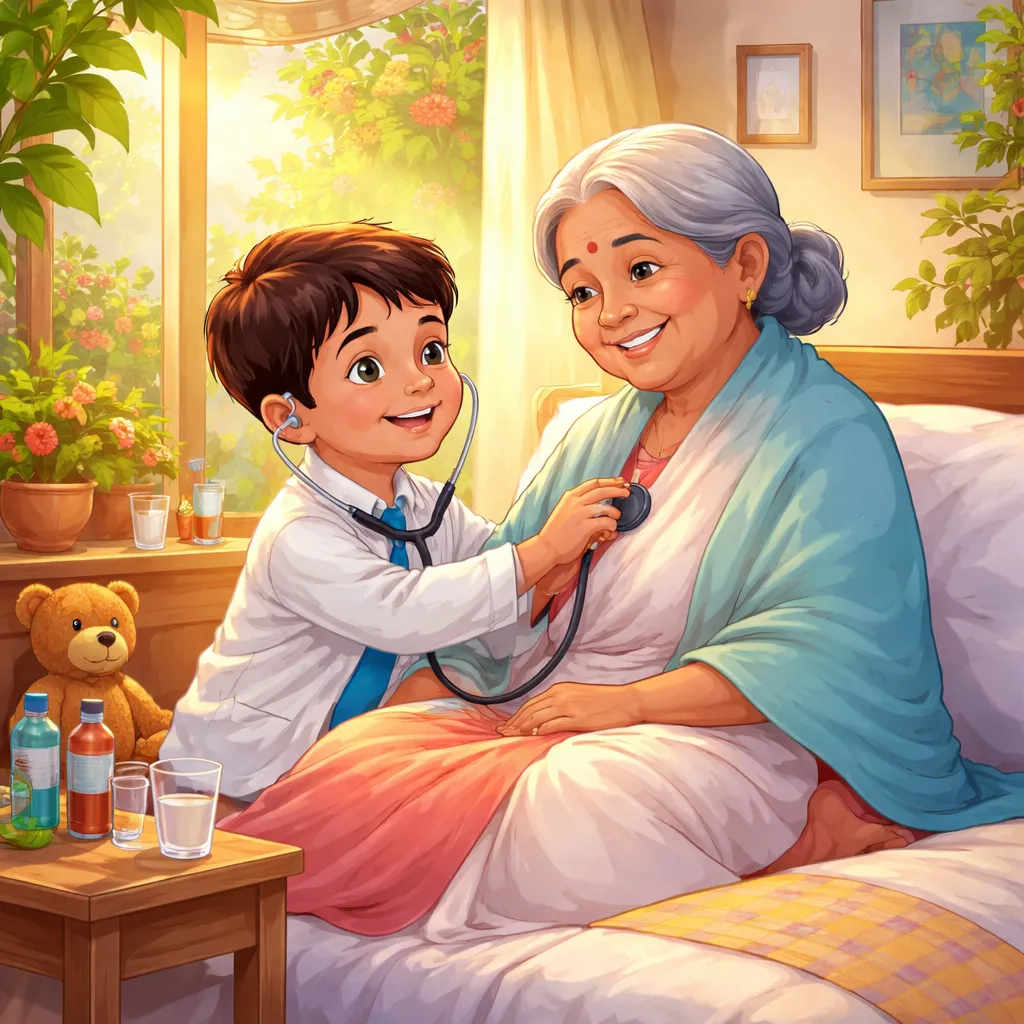

Have you ever had a scraped knee that needed a bandage? Or a sore throat that felt better after some medicine? When we don’t feel well, there is a special person who knows just how to help. In Bangladesh and West Bengal, a region that values care and community, there is a gentle song about this helpful person. Let’s learn about caring with the Bengali Song: The Little Doctor (ডাক্তার).
About the Song
Here is a kind verse from this popular children’s song in Bengali and English:
ডাক্তার, ডাক্তার, ছোট্ট ডাক্তার
(Daktar, daktar, chhoto daktar)
Doctor, doctor, little doctor
তোমার স্টেথোস্কোপে শুনি
(Tomar stethoscope-e shuni)
With your stethoscope, I listen
তুমি দেখাও সব ঠিক আছে
(Tumi dekhao shob thik ache)
You show that everything is okay
তোমার চিকিৎসায় সুস্থ হই
(Tomar chikitshay sustho hoi)
With your treatment, I become healthy
This song’s original name uses the word “ডাক্তার” (Daktar), borrowed from English into Bengali. It is a beloved modern Bengali children’s song. The song is sung from the perspective of a child who is visiting a kind doctor. The music is often calm, reassuring, and friendly. The Bengali Song: The Little Doctor (ডাক্তার) is a musical check-up, celebrating the doctor’s role in making us feel safe and helping our bodies heal.
What the Song is About
The song is about a visit that makes you feel better. First, the child greets the doctor warmly: “Doctor, doctor, little doctor.” The child notices the doctor’s important tool: “With your stethoscope, I listen.” We can picture the doctor placing the cool metal disc on the child’s back, letting them hear the magical lub-dub of their own strong heart. The doctor then gives good news: “You show that everything is okay.” This simple sentence takes away worry. Finally, the child explains the result: “With your treatment, I become healthy.” The song shows that a doctor’s job is to check, reassure, and heal, turning a scary visit into a positive step toward feeling good again.
Who Made It & Its Story
This song is a part of modern Bengali children’s music that introduces respected professions. While specific creators aren’t widely listed, the song reflects the high regard for doctors in society. A key figure in Bengal’s medical history is Dr. Bidhan Chandra Roy, a famous physician and former Chief Minister of West Bengal, whose birthday is celebrated as National Doctors' Day in India. The Bengali Song: The Little Doctor (ডাক্তার) makes this vital role friendly for children. It is popular for three comforting reasons. First, it helps reduce fear of doctors and medical visits by framing the experience positively. Second, it teaches children about basic medical tools and the process of getting better. Third, its melody is typically gentle and soothing, perfect for singing to calm a child who isn’t feeling well.
When to Sing It
You can sing this song softly while playing with a toy doctor’s kit, giving a check-up to a stuffed animal. It’s perfect to hum after a real visit to the doctor, to remember the good care you received. You could also sing it with a sibling or friend who is feeling a little unwell, as a musical promise that they will get better.
The Bengali Song: The Little Doctor (ডাক্তার) shows us how doctors help. But staying healthy is something we can all learn about. This song is like a friendly health class. It teaches us words for wellness, shows us how to talk about getting better, and shares the importance of caring for others. Let’s explore what else we can learn.
What Children Can Learn
Vocabulary
This song helps us learn words for health, medicine, and care.
Treatment: Medical care given to a patient for an illness or injury. The doctor’s treatment helps you heal.
Stethoscope: A tool doctors use to listen to sounds inside the body, like the heart and lungs.
Recovery: The process of getting better after an illness or injury. Good rest helps with recovery.
Prevention: The act of stopping something bad, like sickness, from happening. Washing your hands is a form of prevention.
Pediatrician: A doctor who specializes in treating babies and children.
Wellness: The state of being in good health. Doctors help us maintain our wellness.
Language Skills
This song is a good example of using “With” to Indicate Means or Instrument. We use “with” to talk about the tool or method used to do something.
What Is It?: Think of “with” as your “using tool” word. It connects an action to the thing that helps you do it. The doctor listens with a stethoscope. You get better with treatment.
Finding the Secret: Look for the word “with” followed by a noun (person, place, or thing). It often tells you how something is done. Ask: “What is being used to do this action?”
Using It:
◦   Formula: [Action] + with + [tool/method].

◦   Examples: “I write with a pencil.” “She cuts the paper with scissors.” “We get better with care.”

◦   In the song: “With your stethoscope, I listen.” “With your treatment, I become healthy.”
Sounds & Rhythm Fun
Listen to the steady, calm rhythm. The Bengali Song: The Little Doctor (ডাক্তার) often has a predictable, gentle beat. It sounds like a calm heartbeat or a soothing pulse. The melody is usually simple and repetitive, easy to remember, which helps create a feeling of safety and routine. This steady, reassuring rhythm makes the positive message of healing easy to internalize. You can use this same calm, steady rhythm to make up a song about any caring routine, like brushing your teeth or washing your hands.
Culture & Big Ideas
This song connects to the respect for healthcare workers in Bengal. A significant day is National Doctors' Day in India (July 1st), which honors doctors’ service, remembering Dr. Bidhan Chandra Roy. The song reflects the trust placed in medical professionals. The Bengali Song: The Little Doctor (ডাক্তar) teaches three important ideas. First, Healing is a Process: Getting better often happens with help, time, and the right care, not magically. Second, Trust in Expertise: We trust doctors because they have studied and trained to understand how our bodies work. Third, Preventive Care: The song implies that checking on health (“showing everything is okay”) is just as important as fixing a problem, teaching us to be proactive about our well-being.
Values & Imagination
Imagine you are the little doctor. Your patient is nervous. How do you use your voice to make them feel calm? How do you explain what the stethoscope does? This song teaches you the value of empathy and clear communication. It shows that helping others feel safe is a big part of making them better. A simple idea: Make a “Get Well Soon” card for someone. On the inside, draw or write one thing that helps people get better, like rest, medicine, or a hug. Give them your card. You are practicing the doctor’s care.
Your Core Takeaways
The Bengali Song: The Little Doctor (ডাক্তার) is a gentle lesson in health, trust, and compassionate care. You learned health words like “treatment,” “recovery,” and “prevention.” You discovered how to use “with” to talk about the tools and methods we use to do things. You felt the song’s calm, steady rhythm. You also connected the doctor’s role to cultural respect for physicians and National Doctors' Day. Most importantly, the song teaches that doctors are helpers we can trust, that healing takes teamwork, and that showing care and kindness is powerful medicine all by itself.
Your Practice Missions
- Be a “With” Detective. Look around a room. Find three actions you can do and say what tool you use “with.” Example: “I see with my eyes. I draw with a crayon. I drink with a cup.” This helps you understand how we use tools.
- Host a “Wellness Check” for Toys. Gather a few stuffed animals or dolls. Be the little doctor. Use a safe household item as a pretend stethoscope (like headphones or a paper tube). Gently check each “patient.” Say one kind thing to each one, like “With rest, you will feel better,” or “With a hug, you will smile.” This playful activity practices care and comforting words.














