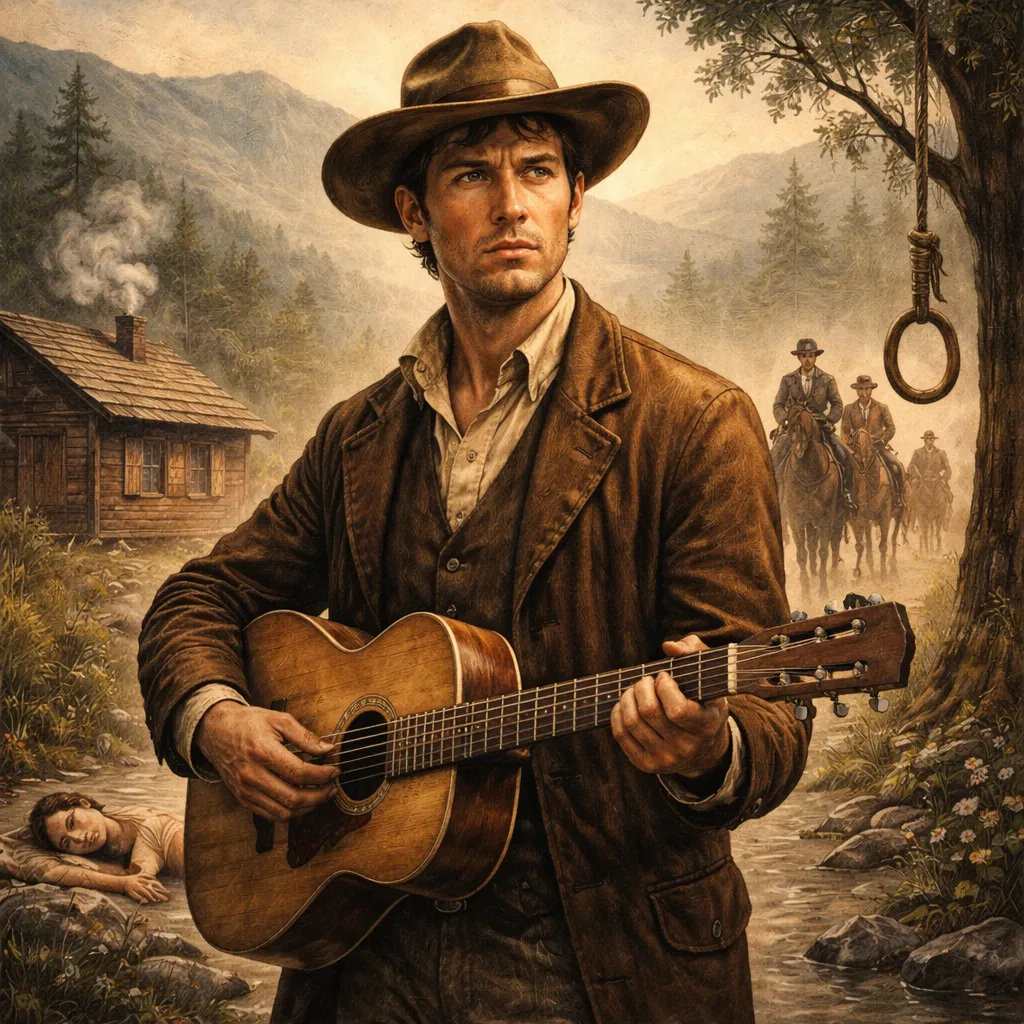

Have you ever heard a story about someone who made a very, very bad choice? Stories can teach us important lessons about what happens when people are unkind or dishonest. A long time ago, in the mountains of America, a real event happened that was so sad and dramatic, people turned it into a song to remember and to teach a lesson. Let’s learn the story behind the folk ballad “Tom Dooley.”
About the Song
Let’s read the somber, story-filled words of this famous ballad.
Hang down your head, Tom Dooley,
Hang down your head and cry.
Hang down your head, Tom Dooley,
Poor boy, you're bound to die.
I met her on the mountain, there I took her life.
Met her on the mountain, stabbed her with my knife.
This time tomorrow, reckon where I'll be.
If it hadn't been for Grayson, I'd a been in Tennessee.
This time tomorrow, reckon where I'll be.
Down in some lonesome valley, hangin' from a white oak tree.
Hang down your head, Tom Dooley,
Hang down your head and cry.
Hang down your head, Tom Dooley,
Poor boy, you're bound to die.
This song is a traditional American folk murder ballad from the Appalachian region. It is a slow, haunting song that tells a story based on true events. The song is sung from different perspectives: sometimes a narrator, and sometimes from Tom Dooley himself. It recounts the crime, the capture, and the punishment. Tom Dula (pronounced Dooley) was a real man who was convicted of murdering a woman named Laura Foster in North Carolina in 1866. The song became a national hit in the 1950s when the folk group The Kingston Trio recorded it, introducing the old story to a new generation.
What the Song is About
The song paints a dark picture of regret and punishment. The singer, or a narrator, speaks directly to Tom Dooley. They tell him to hang his head in shame and cry, because he is destined (“bound”) to die. This sets a very sad and serious mood.
Then, the perspective seems to switch. We hear what might be Tom’s own confession. He says he met a woman on the mountain and took her life with a knife. He thinks about the next day, knowing he will be executed by hanging from a white oak tree. He blames a man named Grayson for his capture, saying if not for him, he’d be free in Tennessee. The song doesn’t tell a happy story. It is a circular tale that starts and ends with Tom facing the ultimate consequence for a terrible action. It’s a song about crime, capture, and the inescapable result of doing a grave wrong.
Who Made It & Its Story
“Tom Dooley” is a traditional folk ballad, so its original author is unknown. It is based on the true story of Tom Dula, a Confederate war veteran who was tried and hanged in 1868 for the murder of Laura Foster in Wilkes County, North Carolina. The case was famous and the story was turned into a local ballad soon after. The song was passed down orally in the Appalachian Mountains for decades. Its modern fame is due to The Kingston Trio, whose 1958 recording became a number one hit, sparking the American folk music revival. Their version softened some of the darker details, making the story more palatable for a wide audience, but kept the core of the tragic tale.
This ballad has remained famous for three compelling reasons. First, its melody is simple, catchy, and easy to remember, which helped the story spread. Second, it taps into the universal fascination with true stories and moral lessons about crime and punishment. Third, it is a direct link to a specific time and place in American history, giving us a glimpse into post-Civil War Appalachian life and the tradition of turning news into song.
When to Sing It
This song is best for older children and in thoughtful contexts. You might hear it in a history lesson about American folk music or the Appalachian region. You can discuss it with a grown-up to understand the story and its lesson about choices. It is not a playful song for singing loudly, but one for listening to and thinking about the narrative and the history it represents.
What Children Can Learn
This historical, story-driven song opens doors to lessons about language, history, and ethics.
Vocabulary
The song teaches us strong, emotional words. To “hang down your head” is to look at the ground in shame or sadness. “Bound to die” means certain to die. To “reckon” is to think or believe. A “lonesome valley” is a remote, lonely place. “Hangin’” refers to execution by hanging, a historical form of punishment. A “white oak tree” is a type of large, strong tree common in America.
Let’s use these words! You can say, “He was bound to be late if he didn’t hurry.” Or, “I reckon it will rain this afternoon.” New word: Consequence. This is the result of an action. Tom faced the ultimate consequence for his crime.
Language Skills
This song is a strong lesson in using the imperative mood for commands and the second conditional for imagining a different past. The song starts with commands: “Hang down your head, Tom Dooley.” These are orders given to Tom, showing he is being told what to do.
Tom uses the second conditional to imagine a different outcome: “If it hadn’t been for Grayson, I’d a been in Tennessee.” This means, “If Grayson had not captured me, I would be in Tennessee now.” This structure is used to talk about an unreal past situation. The song also uses the simple future (“reckon where I’ll be”) to express a certain, grim prediction.
Sounds & Rhythm Fun
Listen to the steady, plodding, serious rhythm of the melody. The song is in a slow 4/4 time. The repetition of lines like “Hang down your head” makes the song memorable and emphasizes its sad message. The lyrics use a clear, mournful rhyme scheme: “cry” and “die,” “life” and “knife,” “be” and “tree.”
The rhythm is deliberate and heavy. Try a slow, even clap: HANG DOWN your HEAD, TOM DOO-lee. The melody uses a small range of notes and tells its story plainly. This simple, repetitive, and somber musical pattern is what makes the story so haunting and easy to remember. You can write a story song about a lesson learned! Use a similar serious rhythm. Try: “Sit down and think, oh, what you did, sit down and think, oh, you’re just a kid. Think about the rule you broke, and the trust you nearly shook.”
Culture & Big Ideas
“Tom Dooley” is a prime example of an Appalachian murder ballad, a genre that turned real-life tragedies into songs. This tradition served as a form of news, a moral warning, and community storytelling. The song comes from a specific historical moment in the rural American South after the Civil War. It connects to the broader folk tradition where songs were used to process difficult events and teach lessons about justice and morality. The song reminds us that history isn’t just in books; it’s in the stories and songs people pass down.
The song conveys three serious ideas. First, it is about the inescapable consequences of serious actions. The song’s circular structure—ending where it began, with Tom doomed—shows that some choices lead to a fixed and tragic end. Second, it explores shame and facing one’s deeds. Tom is told to “hang down his head,” a physical symbol of shame for his actions. Third, it touches on the historical concept of frontier justice. The song reflects a time and place where justice, though formalized in a trial, was swift and severe, a concept very different from today.
Values & Imagination
Imagine the mountain where this event took place. What did it look like? Thick trees? A dusty path? Now, imagine Tom Dooley. Does he look sorry? Scared? Imagine the “lonesome valley.” Why is it lonesome? Draw a picture that shows a cause and its effect, inspired by the song. On one side, draw a bad choice (like taking something that isn’t yours). On the other side, draw the consequence (having to return it and apologize). This focuses on the song’s core lesson about actions and results, rather than the specific violence.
The song provides an opportunity to discuss making good choices and the importance of honesty and kindness. A valuable activity is to have a “Choice and Consequence” discussion. With a grown-up, talk about a time a small bad choice (like lying about a broken toy) led to a bigger problem. Then talk about what a good choice would have been. This connects the song’s heavy theme to everyday life in an age-appropriate way.
So, as the last “bound to die” fades, think about the history and lesson in this old ballad. It is a vocabulary lesson in emotion and justice. It is a grammar lesson in commands and imagining different outcomes. It is a music lesson in a simple, mournful melody. From the first command to hang his head to the final image of the lonesome valley, it is a solemn reminder about actions and their consequences, wrapped in a tune that ensures the story is not forgotten.
Your Core Takeaways
You have learned about the ballad “Tom Dooley.” You know it is an American folk song based on the true story of Tom Dula, who was hanged for murder in 1868. You’ve learned words like “reckon” and “bound to,” and you’ve seen the imperative mood and second conditional in use. You’ve felt its slow, serious rhythm. You’ve also discovered the song as an example of an Appalachian murder ballad and its messages about inescapable consequences, facing shame, and how history can be preserved in song.
Your Practice Missions
First, be a “History Detective.” With a grown-up’s help, look at a map of the United States. Find North Carolina and Tennessee. Talk about how people traveled in the 1860s. Why might Tom have wanted to go to Tennessee? This connects the song to real geography and history.
Second, create a “Ballad of a Good Choice.” The song tells of a bad choice. Write a short, four-line ballad about someone making a good choice (like telling the truth, sharing, or helping). Use a simple, rhyming pattern. Share your “good choice” ballad with your family. This flips the song’s theme to focus on positive behavior.