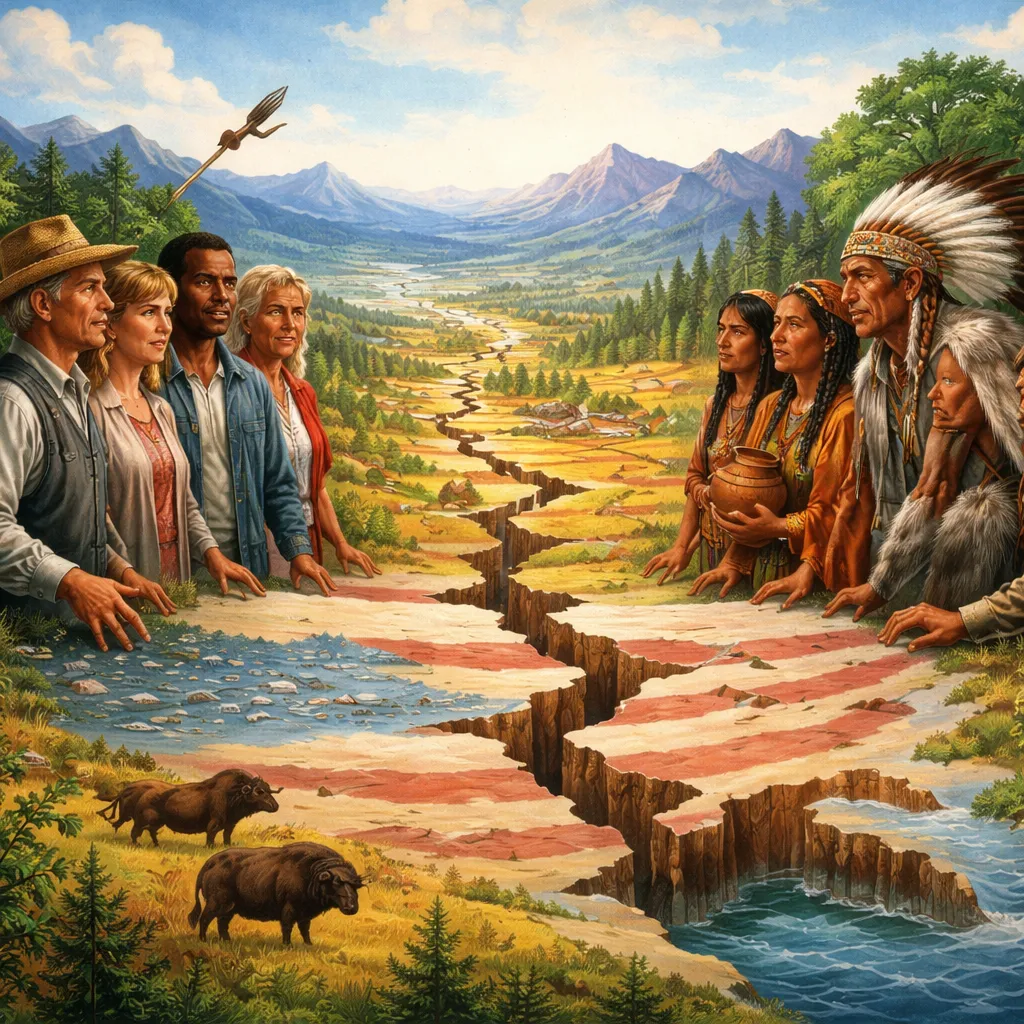

Have you ever looked out the window on a long car trip and seen huge mountains, wide rivers, or endless fields? Did you ever wonder who that beautiful land belongs to? There is a famous song that gives a very big, generous answer to that question. It’s a musical postcard about the whole country, and it says the land belongs to you, me, and everyone. Let’s learn about the song “This Land Is Your Land.”
About the Song
Let’s read the hopeful and beautiful words of this famous folk song.
This land is your land, this land is my land
From California to the New York island;
From the redwood forest to the Gulf Stream waters
This land was made for you and me.
As I was walking that ribbon of highway,
I saw above me that endless skyway;
I saw below me that golden valley,
This land was made for you and me.
I’ve roamed and rambled and I followed my footsteps
To the sparkling sands of her diamond deserts;
And all around me a voice was sounding:
This land was made for you and me.
This song is a classic American folk song. It is a traveling tune that celebrates the vast, beautiful geography of the United States of America. The song was written in 1940 by the famous folk singer and songwriter Woody Guthrie. He wrote it as a response to a song he heard too much on the radio, “God Bless America.” Woody wanted a song that celebrated the country’s beauty but also reminded people that it belonged to all its people, especially the poor and struggling workers he met during the Great Depression. The song is a gentle but powerful statement about sharing, equality, and belonging.
What the Song is About
The song paints a giant, moving picture of America. The singer is a traveler, walking down a long, straight highway that looks like a ribbon. He looks up and sees the huge, open sky. He looks down and sees a beautiful, sunny valley.
As he walks, he thinks about how far the land stretches. He names places from one coast to the other: from California in the west to the New York islands in the east. He mentions specific, beautiful natural features: the tall redwood forests, the warm Gulf Stream ocean water, and shiny deserts with sand that looks like diamonds. In every verse, no matter what he sees, he comes to the same conclusion. He hears a voice, or has a thought, that repeats: “This land was made for you and me.” The song says the amazing country is not just for rich people or powerful people. It is a home made for everyone to share.
Who Made It & Its Story
The writer of “This Land Is Your Land” is the legendary American folk musician Woody Guthrie. He wrote it in 1940, a time when many Americans were very poor after the Great Depression. Woody was angry that songs like “God Bless America” ignored the struggles of common people. He originally called his song “God Blessed America for Me,” but he changed it. The song had verses that talked about hunger and private property, which were often left out when it was sung in schools. But the main message was always one of shared beauty and common ownership. The song became a famous anthem during the civil rights movement and is still sung today as a song of hope and unity.
This song became a national favorite for three powerful reasons. First, its melody is simple, easy to remember, and perfect for group singing. Second, its lyrics are like a beautiful geography lesson, painting pictures of the country’s most iconic landscapes. Third, its message is deeply democratic and inclusive. It doesn’t say the land belongs to the government or the rich; it says it belongs to “you and me,” making every listener feel like a valued owner of their country.
When to Sing It
This song is perfect for moments of national pride and community. You can sing it on a family road trip when you see amazing scenery, connecting the song to the real view. You can sing it in a group at a school assembly or a community event, especially on holidays like the Fourth of July. You can also hum it while looking at a map of the United States, tracing the journey from the “redwood forest” to the “New York island.”
What Children Can Learn
This grand, traveling song is a classroom in itself. Let’s journey through all the lessons it holds.
Vocabulary
The song teaches us wonderful words about geography and travel. “Land” means the solid part of the earth’s surface; a country. An “island” is a piece of land surrounded by water. A “forest” is a large area covered with trees. A “Gulf Stream” is a warm ocean current. A “ribbon” is a long, narrow strip; here it describes a highway. A “highway” is a main road. A “skyway” means the sky, seen as a path. A “valley” is low land between hills or mountains. To “roam” and “ramble” means to travel or wander with no fixed plan. “Sparkling” means shining with flashes of light. A “desert” is a dry, often sandy area with little rain.
Let’s use these words! You can say, “We drove on a long highway through the valley.” Or, “The glitter was sparkling on the paper.” New word: Anthem. An anthem is a rousing or uplifting song that represents a group. This song is like a people’s anthem.
Language Skills
This song is a masterful lesson in using the simple present tense to state facts and the simple past tense to tell a story. The chorus uses the present tense to state a timeless fact: “This land is your land… This land was made for you and me.” The verb “was made” is in the past tense, talking about the act of creation.
The verses use the past tense to describe the singer’s journey: “As I was walking… I saw… I’ve roamed…” This mix of tenses is common in storytelling: setting a present-time truth and then giving past examples. The song also uses the powerful repetitive structure: “This land is [your/my] land” and the refrain “This land was made for you and me,” which reinforces the main idea.
Sounds & Rhythm Fun
Listen to the steady, walking rhythm of the melody. The song has a gentle, rolling feel, like putting one foot in front of the other on a long journey. The lyrics use clear, descriptive rhymes: “island” and “highland” (in some versions), “waters” and “daughters,” “highway” and “skyway,” “sounding” and “sounding” (repeated).
The rhythm is a relaxed, folk-style 4/4 time. It’s easy to tap your foot to. Try a slow tap: This LAND is YOUR land, this LAND is MY land. The melody is simple, uses a small range of notes, and is very easy to learn. This uncomplicated, solid rhythm and melody are what make the song so easy for crowds to sing together, turning it into a shared experience. You can write your own land song! Use the same rolling rhythm. Try: “This park is our park, this park is your park, from the swings and slides to the old oak tree. From the soccer field to the little creek bed, this park is a place for you and me.”
Culture & Big Ideas
“This Land Is Your Land” is a cornerstone of 20th-century American folk music and protest culture. It comes from the tradition of folk singers who traveled and sang about the lives of everyday people. The song reflects the American ideals of freedom, equality, and shared destiny, but from a grassroots perspective. It connects to historical moments like the labor movement and the fight for civil rights, where people sang it to claim their place in society.
The song communicates three profound ideas. First, it’s about collective ownership and belonging. The land and the country are framed as a shared inheritance for all citizens, not private property. Second, it celebrates the sheer physical beauty and diversity of the natural world, encouraging appreciation and perhaps conservation. Third, it’s a song of quiet protest and inclusion. By insisting the land is for “you and me,” it challenges any idea that some people are more entitled to it than others, promoting a vision of equality.
Values & Imagination
Imagine you are the walker in the song. What does the “ribbon of highway” feel like under your feet? What does the air smell like in the redwood forest? Pine and dirt? What does the “golden valley” look like at harvest time? Imagine standing in the “diamond desert” at night. What do the stars look like? Who is the “voice” that sounds all around? Is it the wind? Your own conscience? The voice of the people? Draw a map of the singer’s journey. Draw the United States and mark the places he names: California, New York, the redwood forest, the Gulf Stream. Draw a little stick figure walking across it.
The song inspires us to appreciate our shared spaces and to think about what it means to belong. A wonderful idea is to create a “Our Land” collage. With your family, cut out pictures from magazines or print photos that show what your “land” includes. It could be your neighborhood park, your street, a national landmark, or even your own backyard. Glue them onto a poster. Write “This Land is Made for You and Me” at the top. This activity helps you define what you value in your shared community.
So, as we end our journey with this song, think about the wide view it gives us. It is a vocabulary lesson in the poetry of place. It is a grammar lesson in stating truths and telling travel stories. It is a music lesson in steady, unifying rhythm. From the first claim of “your land” and “my land” to the final, inclusive “you and me,” it wraps a vision of shared beauty and common cause in a tune that feels as open and enduring as the skyway itself. “This Land Is Your Land” teaches us that countries are best loved through the eyes of their people, that nature is a common treasure, and that the most powerful songs are the ones that invite everyone to join in.
Your Core Takeaways
You are now an expert on the song “This Land Is Your Land.” You know it was written by Woody Guthrie in 1940 as a folk anthem celebrating America’s beauty and the idea of shared ownership. You’ve learned geography words like “redwood forest” and “Gulf Stream,” and you’ve practiced using the present and past tenses for facts and stories. You’ve felt its steady, walking rhythm and created your own version. You’ve also discovered the song’s message about collective belonging, appreciation for nature, and its history as a gentle protest song for equality and inclusion.
Your Practice Missions
First, be a “Land Song” reporter. Take the song’s idea to your own neighborhood. Go for a short walk with a grown-up. Observe. What do you see that is for “you and me”? A library? A bus stop? A tree? Write down or draw three things. Then, create one new line for the song about your neighborhood. For example: “From the local library to the big playground, this town is a place for you and me.” Share your line with your family.
Second, host a “Singing Geography” lesson. Find a map of the United States. As you sing the song, point to or trace your finger from California to New York. Try to find pictures of a redwood forest, the Gulf Stream, and a desert. Talk about what makes each one special. This connects the song’s words to real places on the map, turning the song into a geography adventure.