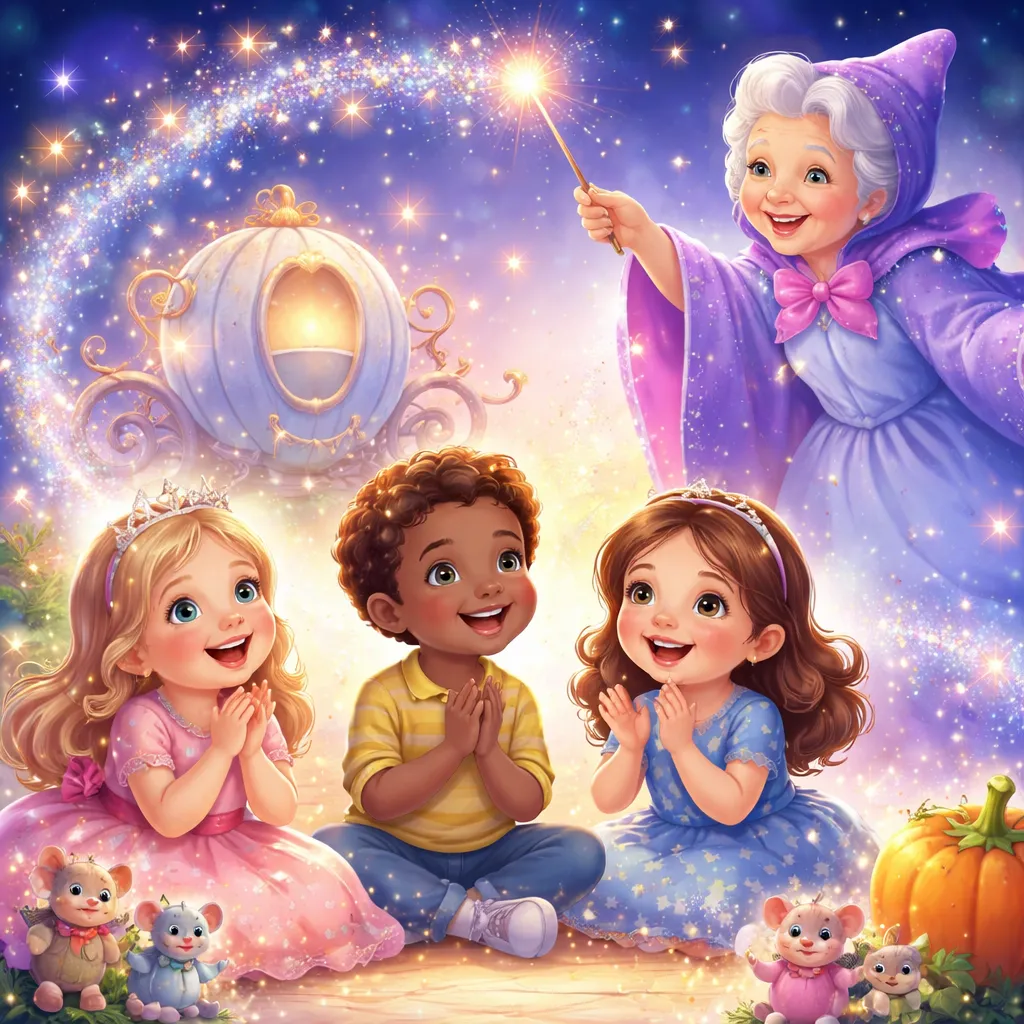

Some songs capture the feeling of magic perfectly. The English song: Bibbidi-Bobbidi-Boo (from Cinderella) does exactly that. The Fairy Godmother sings this playful tune as she transforms a pumpkin into a carriage and rags into a beautiful gown. The words sound like magic spells. They have no real meaning, but they carry all the wonder of fairy tales. For families learning English together, this song offers a joyful way to explore sounds, rhythm, and the pure fun of language. Let us discover the magic hidden in this delightful song.
What Is the Story Behind This Famous Song?
The English song: Bibbidi-Bobbidi-Boo (from Cinderella) appears in Disney's 1950 animated classic, Cinderella. The story follows a kind young girl forced to work as a servant for her cruel stepmother and stepsisters. She dreams of attending the royal ball. Her animal friends help her make a dress from old materials. But her stepsisters tear it apart.
Just when all hope seems lost, her Fairy Godmother appears. She cannot create something from nothing, but she can transform what already exists. She finds a pumpkin, some mice, a horse, and a dog. With a wave of her wand and this magical song, she turns them into a carriage, horses, a coachman, and footmen. She transforms Cinderella's rags into a stunning ball gown and creates glass slippers.
The song became one of Disney's most memorable tunes. The Sherman Brothers did not write this one. Instead, Mack David, Al Hoffman, and Jerry Livingston created it for the film. The nonsense words "bibbidi-bobbidi-boo" sound like a real magic spell. Children love saying them because they feel powerful and mysterious.
The Complete Lyrics of the Song
Reading the words helps us appreciate the song's playful spirit. Here are the lyrics to the English song: Bibbidi-Bobbidi-Boo (from Cinderella). Let us look at them in sections.
Salagadoola mechicka boola bibbidi-bobbidi-boo
Put them together and what have you got
Bibbidi-bobbidi-boo
Salagadoola mechicka boola bibbidi-bobbidi-boo
It'll do magic, believe it or not
Bibbidi-bobbidi-boo
Salagadoola means mechicka boolaroo
But the thingamabob that does the job is bibbidi-bobbidi-boo
Salagadoola mechicka boola bibbidi-bobbidi-boo
Put them together and what have you got
Bibbidi-bobbidi-boo
Learning New Words from the Song
The English song: Bibbidi-Bobbidi-Boo (from Cinderella) introduces mostly nonsense words. But it also includes some real English words worth exploring.
First, the song uses "magic". Magic means using special powers to make impossible things happen. The Fairy Godmother has magic. She uses it to help Cinderella. Children love this word because it connects to wonder and possibility.
The lyrics ask "what have you got?" This is a common English question. We use it when we want to know what someone has or what the result is. For example, "What have you got in your lunchbox?" or "What have you got for me?"
The song also uses the phrase "believe it or not". We say this when something seems hard to believe but is true. For example, "Believe it or not, I finished all my homework" or "Believe it or not, cats can swim."
Another interesting word is "thingamabob". This is a fun word for something whose name we do not know or cannot remember. We use it like "whatchamacallit" or "thingy". For example, "Can you pass me that thingamabob on the table?" This word teaches children that English has playful placeholders when we forget specific names.
Exploring Pronunciation and Rhythm
The English song: Bibbidi-Bobbidi-Boo (from Cinderella) offers wonderful practice with English rhythm and sounds. The nonsense words follow clear patterns that help children feel the beat of the language.
Listen to "Salagadoola mechicka boola". Say it slowly. Sa-la-ga-doo-la me-chi-cka boo-la. Each syllable has a clear sound. The rhythm bounces along happily. Clapping along helps children feel this pattern.
The magic words use many consonant sounds. B, D, L, M, and K appear throughout. Practicing these sounds helps children develop clear pronunciation. The repetition makes practice feel like play, not work.
The song also shows how English uses stress. The strongest beat falls on "boo" at the end. "Bibbidi-bobbidi-BOO." This pattern appears throughout English. Words and phrases have strong and weak syllables. Songs train our ears to hear these patterns naturally.
Finding Grammar Patterns in the Lyrics
The English song: Bibbidi-Bobbidi-Boo (from Cinderella) offers some grammar points despite its nonsense words. One pattern appears in the line "Put them together". This uses the imperative form. We give commands or instructions with this form. The Fairy Godmother tells us what to do. We use imperatives all the time. For example, "Put your shoes on" or "Listen to the music".
The song also asks a question. "What have you got?" uses the present perfect tense. "Have got" means the same as "have". It shows possession. In American English, we often use "have" instead. But "have got" appears commonly in songs and stories. For example, "I have got a new book" or "She has got a pretty dress".
Another pattern appears with "it'll do magic". "It'll" is a contraction of "it will". We use contractions all the time in spoken English. They make speech flow more smoothly. "Will" shows the future. The magic will happen later. For example, "It'll rain tomorrow" or "She'll be here soon".
Fun Learning Activities for the Whole Family
Listening to the English song: Bibbidi-Bobbidi-Boo (from Cinderella) can inspire many playful activities. Here are some ideas to try together.
First, create your own magic words. Sit in a circle and take turns inventing new nonsense words. They can be long or short. Say them with dramatic flair. Pretend they do magic. Wave your hands like a wand. This builds confidence with sounds and pronunciation in a safe, playful way.
Second, try a transformation game. Pick ordinary objects around the house. A pillow becomes a cloud. A towel becomes a magic carpet. Use the song as background music. Describe each transformation in English. "This pillow is now a fluffy cloud" or "This towel can fly". This builds vocabulary and imagination together.
Third, have a magic show. Let children dress up as fairy godmothers or wizards. Use the song as entrance music. Perform simple tricks like making a toy disappear under a cup. Describe the tricks in English. "Watch closely. Bibbidi-bobbidi-boo. The toy is gone!" This builds confidence with speaking in front of others.
Creating Printable Materials at Home
Families can make simple learning tools based on the English song: Bibbidi-Bobbidi-Boo (from Cinderella). These activities help reinforce new ideas.
Create magic word flashcards. Write each nonsense phrase on its own card. "Salagadoola" on one. "Mechicka boola" on another. "Bibbidi-bobbidi-boo" on a third. Practice saying them in order. Mix them up and put them back in sequence. This builds memory and sequencing skills.
Make a transformation drawing book. Fold papers together to make a small book. On each page, draw something before and after magic. A pumpkin becomes a carriage. Rags become a gown. Mice become horses. Write simple sentences under each drawing. "The pumpkin became a carriage" or "The mice became horses". This builds storytelling skills.
Create a fill-in-the-blank page using the song. Remove key words like "magic", "together", and "believe". Leave blanks where those words belong. Listen to the song together and fill in the missing words. This builds listening and spelling skills.
Connecting the Song to Daily Life
The English song: Bibbidi-Bobbidi-Boo (from Cinderella) teaches us about transformation. Things can change into something better. In daily life, we experience small transformations too. A messy room becomes tidy. A sad day becomes happy. A difficult problem becomes easy with help.
Talk about transformations in your family's life. Use English to describe them. "This morning you were sleepy. Now you are wide awake." "Yesterday we had no cookies. Today we baked some." These small changes mirror the magic in the song.
Parents can model using the song's playful spirit. When something improves, sing "bibbidi-bobbidi-boo". Use it as a family cheer for good changes. This connects language learning with positive family moments.
The song also teaches that magic exists in attitude. The Fairy Godmother could not create something from nothing. She worked with what she had. In daily life, we can do the same. We can transform ordinary moments into special ones with imagination and joy.
Educational Games to Play Together
Games make learning with the English song: Bibbidi-Bobbidi-Boo (from Cinderella) exciting. Here are some simple games to try.
Play the magic word memory game. One person says a nonsense word like "salagadoola". The next person repeats it and adds a new word. Continue building a chain. See how long the chain can grow. This builds memory and pronunciation skills.
Try the transformation charades game. One person acts out an object transforming into something else. First they act like a pumpkin. Then slowly change into acting like a carriage. Others guess what is happening. This builds vocabulary and creative thinking.
Play the magic spell game. One person names a problem. "My room is messy." Others invent a magic spell using nonsense words. They wave imaginary wands and describe the result. "Bibbidi-bobbidi-boo. Now your room is clean!" This builds problem-solving and sentence skills.
Why This Song Helps English Learning
The English song: Bibbidi-Bobbidi-Boo (from Cinderella) helps learners in special ways. The nonsense words remove the fear of making mistakes. Children cannot pronounce them wrong because they have no correct form. This freedom builds confidence for trying other English sounds.
The song also teaches the rhythm of English. The bouncy beat mirrors natural speech patterns. When children internalize this rhythm, their spoken English flows more naturally.
The magical theme engages imagination. Children want to learn words connected to wonder and possibility. This motivation makes practice feel effortless.
Making Music Part of Your Routine
Families can make magical songs a regular part of English learning. Choose one song each week to explore together. Listen during quiet moments or while playing.
The English song: Bibbidi-Bobbidi-Boo (from Cinderella) can become your family's magic anthem. Use it to signal transitions. Play it when it is time to tidy up or get ready for bed. Let the music transform ordinary moments into something special.
Remember that language learning thrives on joy and imagination. When children associate English with fairy godmothers and magic spells, they want more. Keep singing, keep transforming ordinary moments, and keep believing in the magic of words. Bibbidi-bobbidi-boo can mean whatever your family wants it to mean. That is the real magic of language.