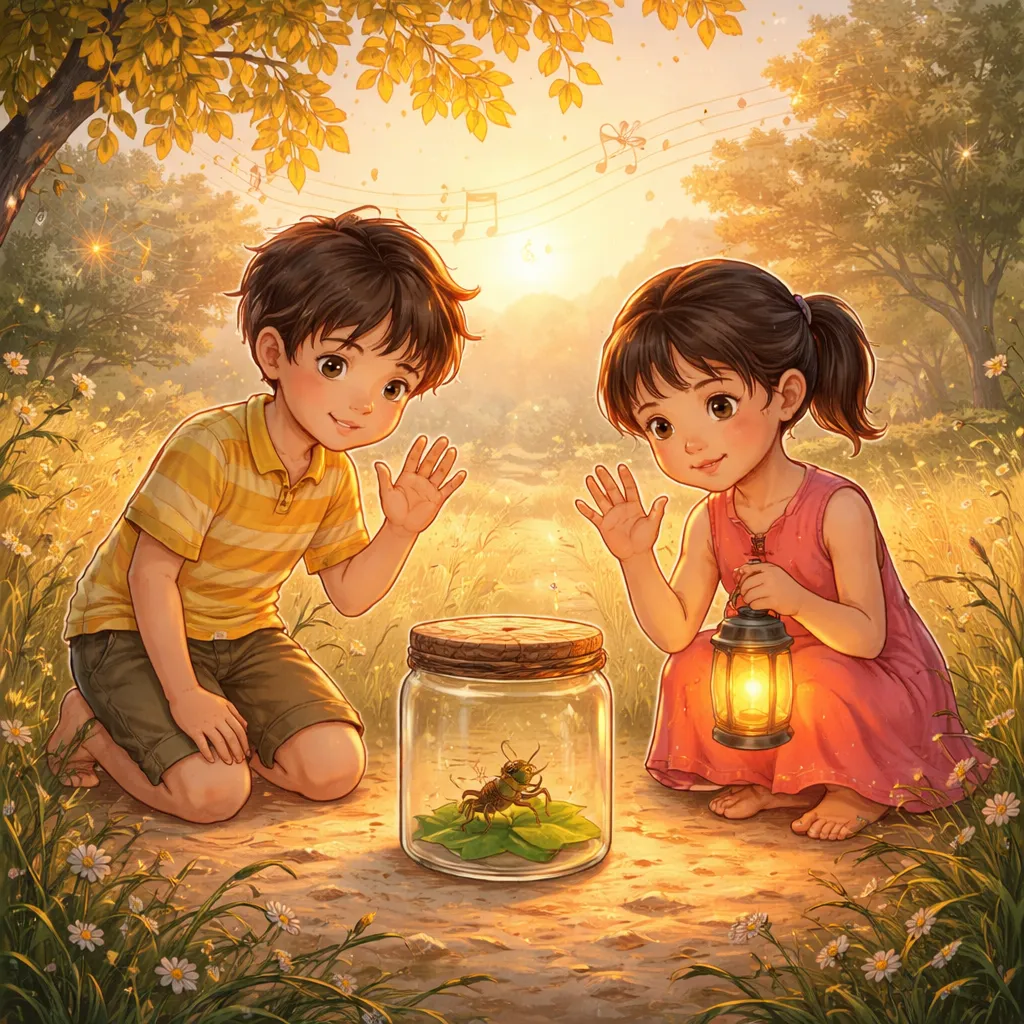

Have you ever made a friend in the summer, like a butterfly you watched or a ladybug on your hand? What happens when summer ends? In China, there is a gentle, thoughtful song about saying a kind farewell to a tiny, musical friend of the night. Let’s listen to the story and sweet melody of “Goodbye, Little Cricket” (小蟋蟀, Xiǎo xīshuài).
About the Song
Let’s read the gentle, conversational words of this seasonal song.
小蟋蟀,在窗下,
我在窗下听你歌唱。
你的歌声多么嘹亮,
叫我怎能进入梦乡。
小蟋蟀,不要唱,
秋风起,天气凉。
请你回到你的家乡,
明年你再放声歌唱。
再见吧,再见吧,
我的朋友小蟋蟀。
再见吧,再见吧,
明年夏天你再歌唱。
English Translation:
Little cricket, under the window,
Under the window, I listen to you sing.
Your song is so bright and clear,
How can I fall asleep with that sound?
Little cricket, please don’t sing,
The autumn wind rises, the weather turns cool.
Please go back to your own home,
Next year you can sing out loud again.
Goodbye, goodbye,
My little cricket friend.
Goodbye, goodbye,
Next summer you can sing again.
This song is a popular modern Chinese children’s song. It describes a tender scene between a child and a cricket. The child listens to the cricket singing its nightly song beneath the window. At first, the cricket’s loud, clear song even keeps the child awake. But as the season changes to autumn, the wind grows cool. The child speaks kindly to the cricket, asking it to stop singing and return to its home, promising that it can come back and sing again next summer. The song ends with a soft, repeated farewell. It is a peaceful song about the cycles of nature, gentle friendship, and learning to say goodbye to things we enjoy for a little while.
What the Song is About
The song paints a quiet, nightly picture. A child is in bed, near a window. Outside, under the window, a little cricket is singing its evening song. The child is listening carefully. The cricket’s song is very loud and beautiful. In fact, the song is so bright and clear that the child finds it hard to fall asleep.
Then, the child notices a change. The autumn wind begins to blow. The air feels cooler. The child understands that the seasons are changing. The child talks directly to the cricket. The child says, “Little cricket, please don’t sing now. It is getting cold. You should go back to your own home where it’s warm.” The child makes a kind promise. The child tells the cricket that it should return next summer. Then, it can sing its loud, happy song again. The song finishes with the child waving a gentle goodbye to the cricket friend, looking forward to meeting again in the future.
Who Made It & Its Story
“Goodbye, Little Cricket” is a modern Chinese children’s song from the latter half of the 20th century. While specific composer credits are not widely attributed like some older folk songs, it is a standard piece in Chinese children’s music repertoire. The song captures a very common experience in many parts of China, where the chirping of crickets is a classic sound of late summer nights. The song turns this natural phenomenon into a gentle story about change and temporary farewells. It is used in schools and homes to softly introduce children to the concept of seasons changing and the bittersweet feeling of something nice coming to an end, with the hope of its return. It frames this change not as sad, but as a natural and expectant cycle.
This song remains a gentle favorite for three comforting reasons. First, its melody is soft, lyrical, and slightly wistful, perfectly matching the feeling of a cool autumn night and a gentle farewell. Second, it personifies a small insect as a friend, fostering empathy for nature and making the concept of seasonal change personal and understandable. Third, it teaches a healthy perspective on goodbyes. The goodbye is not forever; it is a “see you later,” filled with hope for a future reunion, which is a comforting lesson for children.
When to Sing It
This song is perfect for quiet, reflective moments. You can sing it softly on a late summer evening when you actually hear crickets chirping outside your own window. You can hum it in the early autumn, feeling the cooler air, and talk about how nature is getting ready for a rest. You can also sing it as a gentle lullaby, imagining the friendly cricket outside finally stopping its song so everyone can sleep.
What Children Can Learn
This empathetic, seasonal song is a wonderful teacher about nature, language, and emotions.
Vocabulary
The song teaches us words about insects, seasons, and sounds. A “cricket” (蟋蟀, xīshuài) is a small, jumping insect that makes a chirping sound at night. A “song” (歌声, gēshēng) is the musical sound an animal or person makes. “Loud and clear” (嘹亮, liáoliàng) describes a sound that is strong and easy to hear. “Autumn wind” (秋风, qiūfēng) is the wind that blows in the fall season. “Cool/Cold” (凉, liáng) means a low temperature that is not warm. “Hometown/Home” (家乡, jiāxiāng) is the place where someone or something is from. “Next year” (明年, míngnián) means the year that comes after this one.
Let’s use these words! You can say, “I heard the cricket’s song all night.” Or, “The autumn wind is blowing the leaves.” New word: Farewell. This is another word for goodbye, often used when you will not see someone or something for a while. The song is a farewell to the cricket.
Language Skills
This song is a gentle lesson in making polite requests and talking about the future. The child speaks directly to the cricket, making a request: “不要唱” (please don’t sing). This is a direct but soft command. The child also gives advice for the future: “请你回到你的家乡” (please return to your home).
The song uses a common structure to explain a reason: “秋风起,天气凉” (The autumn wind rises, the weather turns cool). This is a cause-and-effect pattern. The song also beautifully uses the future time marker “明年” (next year) to express hope: “明年你再放声歌唱” (Next year you can sing out loud again). This teaches how to talk about plans and hopes for a future time.
Sounds & Rhythm Fun
Listen to the flowing, gentle, wave-like rhythm of the melody. The song is in a smooth 4/4 time. The melody rises and falls softly, like the chirping of a cricket or a gentle sigh. The repetition of the word “再见吧” (goodbye) makes the farewell feel heartfelt and memorable. The lyrics have a soft, poetic rhyme, like “唱” (chàng) and “亮” (liàng), “凉” (liáng) and “乡” (xiāng), and “蟀” (shuài) and “再” (zài).
The rhythm is slow and peaceful. Try swaying gently with the beat: 小 蟋 蟀, 在 窗 下 (xiǎo xī shuài, zài chuāng xià). The tune is not bouncy but smooth, which helps create a feeling of calm and a little sadness, but also hope. This flowing, repetitive, and gentle musical pattern is what makes the song so soothing and easy to remember. You can write your own seasonal goodbye song! Use the same gentle, flowing rhythm. Try: “Little firefly, in the night, your little lamp is shining bright. But now the mornings are so cold, find a place your light to hold. Goodbye, goodbye, my glowing friend, on you I can always depend.”
Culture & Big Ideas
“Goodbye, Little Cricket” connects to the deep Chinese cultural appreciation for nature and its cycles. The cricket is not just an insect; in tradition, it is often seen as a lucky creature and its song is appreciated. The song reflects the philosophical idea of accepting the natural flow of time, similar to themes found during the Mid-Autumn Festival, when families gather to appreciate the moon and the full harvest, knowing summer is over. The act of bidding a thoughtful farewell shows respect for even the smallest parts of nature. It also teaches the value of observation and quiet listening—the child is quietly listening to the cricket’s song, showing attentiveness to the natural world.
The song conveys three gentle, important ideas. First, it’s about observing and appreciating the small wonders in nature, like the song of a tiny insect on a summer night. Second, it expresses understanding and accepting change. Seasons change, and some things must end for a while, and that is a natural part of life. Third, it highlights the hope of return and the comfort of memory. Goodbye does not have to mean forever; it can mean “see you again,” and the memory of the happy summer nights can be kept until then.
Values & Imagination
Imagine you are the child in the song. It’s a warm, dark night. You hear the cricket’s song—chirp, chirp, chirp. What does it sound like? A tiny violin? A little bell? Now, imagine you feel a cool breeze through the window. What does that breeze tell you? How do you feel talking to the cricket? A little sad, but also caring? Draw a two-part picture. On the left, draw a summer night: a child at a window, a cricket singing, a big yellow moon. On the right, draw an autumn day: the same window, leaves falling, the cricket is gone, and the child is waving. Draw a dotted line connecting the summer cricket to a spot in the spring grass. This shows the cycle of “goodbye” and “see you later.”
The song encourages empathy for living things, appreciation for nature’s rhythms, and a positive way to handle goodbyes. A lovely idea is to create a “Seasonal Sound Diary.” For one week, sit quietly for two minutes each evening by a window. Draw or write one sound you hear (e.g., “cricket,” “car,” “wind”). At the end of the week, talk about which sounds are for summer and which might stay for autumn. This builds observation skills just like the child in the song.
So, as the final “goodbye” fades, think about the gentle lesson in this soft tune. It is a vocabulary lesson in seasons and insects. It is a grammar lesson in making polite requests and talking about the future. It is a music lesson in a flowing, lyrical melody. From the first listen to the cricket’s song to the final hopeful farewell, it wraps lessons in nature observation, accepting change, and hopeful goodbyes in a melody that feels like a kind, understanding friend. “Goodbye, Little Cricket” teaches us to listen to small wonders, to say goodbye with kindness, and to always hold hope for a happy return.
Your Core Takeaways
You are now an expert on the song “Goodbye, Little Cricket” (小蟋蟀). You know it is a modern Chinese song about a child saying a seasonal farewell to a cricket friend. You’ve learned words like “cricket,” “autumn wind,” and “next year,” and you’ve practiced making polite requests and using future time words. You’ve felt its gentle, flowing rhythm and created your own farewell verse. You’ve also discovered the song’s connection to appreciating nature’s cycles and its messages about observing small wonders, accepting change, and hoping for return.
Your Practice Missions
First, have a “Quiet Listening” moment. Tonight or on a quiet evening, sit by an open window for three minutes with a family member. Just listen. Can you hear a cricket, a bird, or the wind? Afterwards, hum the tune of “Goodbye, Little Cricket” and talk about one sound you heard that might change or go away when the season changes. This connects you directly to the song’s moment.
Second, make a “Hope to See You Again” card. Think of something you enjoy that is seasonal, like swimming, a type of fruit, or a flower. Draw a picture of it on a card. On the inside, write or tell your family: “Goodbye for now, [swimming/the strawberry/etc.]! Thank you for the fun. I hope to see you again next year!” This turns the song’s theme of hopeful farewell into a creative, personal activity.