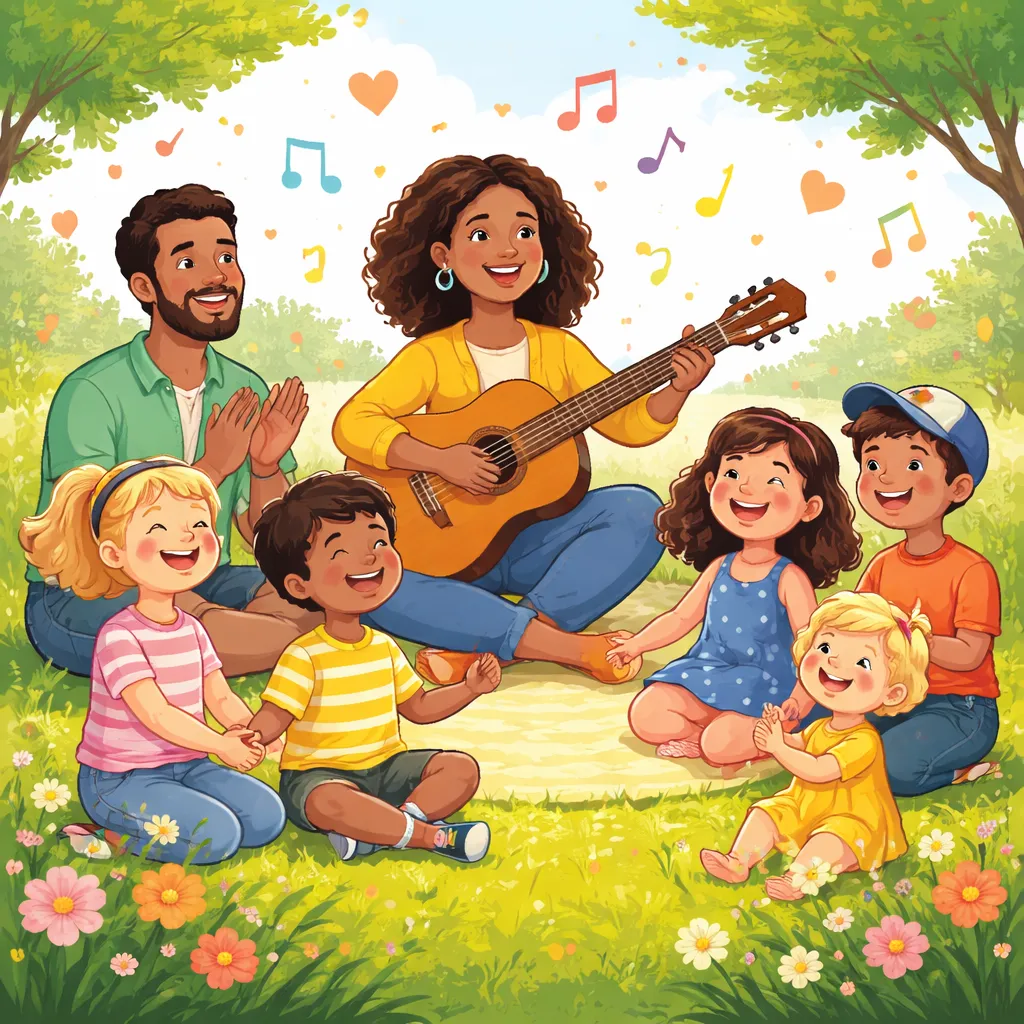

Think about the best part of your day. Is it when you are playing alone, or is it when you are laughing and sharing with friends and family? There is a happy, simple song that believes the answer is clear: being together is the best! It’s a musical rule about how friendship works. Let’s learn about the song “The More We Get Together.”
About the Song
Let’s read the cheerful, repetitive words of this classic tune.
The more we get together, together, together,
The more we get together, the happier we’ll be.
For your friends are my friends,
And my friends are your friends.
The more we get together, the happier we’ll be.
This song is a traditional children’s song and round from the United States. It is a joyful, simple statement about friendship and community. The song uses easy words and a catchy melody to teach a very important idea: that sharing our friendships and spending time with each other creates more happiness for everyone. The song is often sung in preschools, playgrounds, and camps as a way to build a sense of group belonging and joy. It is a perfect example of a folk song created to teach social values in a fun, memorable way.
What the Song is About
The song paints a picture of a growing circle of friends. Imagine a group of children in a sunny park or a cozy classroom. One child reaches out a hand to another. They start to sing. As they sing “together, together, together,” more and more children join the circle, holding hands or linking arms.
The song states a clear rule: every time someone new joins the group, the happiness of the whole group grows. It’s like adding more logs to a fire to make it brighter. Then, the song explains why. In this big circle, there are no separate groups. The friends of one person become the friends of another. “Your friends are my friends, and my friends are your friends.” All the friendships are shared and mixed together. The song ends by repeating the happy rule, making sure everyone remembers that togetherness is the key to joy.
Who Made It & Its Story
“The More We Get Together” is a traditional American folk song, so its original author is unknown. It comes from the rich tradition of community-singing and camp songs that were used to bring groups of children together in the 19th and 20th centuries. The song’s message perfectly fit the goals of schools and youth organizations that wanted to teach cooperation and social harmony. Its simple structure also makes it easy to sing as a “round,” where different groups start at different times, creating a beautiful, overlapping harmony that itself is a symbol of people working together in harmony.
This song has remained a classroom and campfire staple for three wonderful reasons. First, its melody is incredibly simple, repetitive, and easy for even the youngest child to sing. Second, its message is positive, inclusive, and emotionally intelligent, teaching a core social truth in a way children can grasp. Third, it is interactive and adaptable. It can be sung in a round, with gestures (like hugging oneself on “together”), and the word “happy” can be replaced with other feelings like “sillier” or “merrier,” encouraging creativity.
When to Sing It
This song is perfect for building group spirit. You can sing it at the start of a playdate with friends, to set a happy and sharing mood. You can sing it in the car with your family on the way to a fun outing, reminding everyone that the trip is part of the adventure. You can also sing it as a calming, unifying activity after a small disagreement between siblings or friends, to help everyone remember your bond.
What Children Can Learn
This joyful circle of a song is full of important lessons. Let’s join the circle and see what we can learn.
Vocabulary
The song teaches us foundational social and emotional words. “Together” means with each other, in a group. “More” is a word that shows a greater amount. “Happier” is the comparative form of happy, meaning “more happy.” “Friends” are people you know, like, and trust. The word “for” in the song is used to mean “because,” giving a reason.
Let’s use these words! You can say, “Let’s work together to build this tower.” Or, “The more I practice, the better I get.” New word: Community. This is a group of people living in the same place or sharing a common characteristic. Our classroom is a learning community.
Language Skills
This song is a brilliant lesson in the comparative structure and the future tense. The comparative structure is used to show how one thing changes when another thing changes. The pattern is: “The more… the happier…” This shows a direct relationship: if we increase “getting together,” we increase “happiness.”
Look at the core sentence: “The more we get together, the happier we’ll be.” It’s a cause-and-effect sentence. The song also uses the future tense with “will” to state a sure result: “the happier we ’ll be.” This teaches us to talk about future outcomes based on present actions. We can use this for many things: “The more you read, the more you’ll know.”
Sounds & Rhythm Fun
Listen to the bouncy, friendly rhythm of the song. The song uses delightful repetition. The word “together” is sung three times in a row, which is fun and emphasizes the main idea. The lines “your friends are my friends” and “my friends are your friends” mirror each other perfectly.
The rhythm is a steady, walking 4/4 beat. It’s easy to clap or sway to. Try clapping: The MORE we GET to-GE-ther. The melody is simple, uses only a few notes, and goes up and down in a predictable, cheerful way. This clear, repetitive musical pattern makes the song incredibly easy to remember and perfect for a group to sing without practice. You can write your own comparative song! Use the same structure. Try: “The more we share our toys today, the more we share our toys today, the more we share our toys today, the more fun we will have. For your toys are my toys, and my toys are your toys, the more we share our toys today, the more fun we will have!”
Culture & Big Ideas
“The More We Get Together” is a classic piece of American children’s music culture, often used in educational settings. It reflects the cultural value placed on social cohesion, teamwork, and the idea that individual happiness is tied to the well-being of the group. The song is a musical tool for teaching pro-social behavior, a common goal in early childhood education in the United States and many other countries.
The song communicates three foundational ideas. First, it’s about the mathematics of kindness. Happiness isn’t limited; it multiplies when shared. More togetherness equals more joy for everyone. Second, it teaches inclusivity and shared identity. By swapping friends (“your friends are my friends”), the song breaks down barriers and creates one big, shared group. Third, it emphasizes active choice. Happiness is something we can create by choosing to “get together,” highlighting the power of our own actions to improve our feelings.
Values & Imagination
Imagine the “together” the song describes. What does it look like? A giant, weaving line of children holding hands, winding through a playground? A family piled on a sofa for a movie? A video call with relatives spread across the world? Imagine the happiness as a visible thing. Does it look like a golden light that gets brighter with every person who joins? What happens when “your friends” and “my friends” all become “our friends”? Draw a picture of this. Draw one small, smiling stick figure. Then draw a circle of friends around them. Then draw an even bigger circle around that one. Label the circles: “The more we get together, the happier we’ll be.”
The song inspires us to be community builders. A wonderful idea is to start a “Friendship Chain.” Each day, try to do one small thing to “get together” with someone, even if it’s just for a minute. It could be playing a game with a sibling, calling a grandparent, or smiling at a classmate. Draw a paper link for each act and add it to a chain in your room. Watch how the chain (your “togetherness”) grows, and see if it makes your home feel happier.
So, as we reach the end of our time together with this song, think about its simple, powerful logic. It is a vocabulary lesson in social words. It is a grammar lesson in cause and effect. It is a music lesson in repetitive, group-affirming melody. From the first “The more” to the final “we’ll be,” it wraps a profound truth about human connection in a tune so simple that it can be carried in the heart of a child. “The More We Get Together” teaches us that joy is a collective project, that friendship is a shared treasure, and that the very best thing we can do is to gather, share, and sing about it.
Your Core Takeaways
You are now an expert on the song “The More We Get Together.” You know it is a traditional American children’s song about friendship and shared joy. You’ve learned words like “together” and “happier,” and you’ve mastered the comparative “The more… the happier…” structure. You’ve felt its bouncy, clapping rhythm and even created your own version. You’ve also discovered the song’s message about the multiplying power of kindness, inclusivity, and the active choice to build community.
Your Practice Missions
First, conduct a “Happiness Experiment.” The song is a theory. Test it! Choose two activities: one to do alone (like drawing) and one to do “together” with a family member (like building a block tower). After each, rate your happiness on a scale of 1 to 5. Which activity scored higher? Talk about your results. This turns the song into a fun, personal science project.
Second, create a “Togetherness Mural.” On a large piece of paper, draw a scene that shows “the more we get together.” It could be a park, a party, or a fantasy land. Invite every member of your family to add one thing to the drawing—a person, a tree, a sun, a smile. While you draw, sing the song. Your mural will be a visual proof of the song’s idea, created by your very own community.