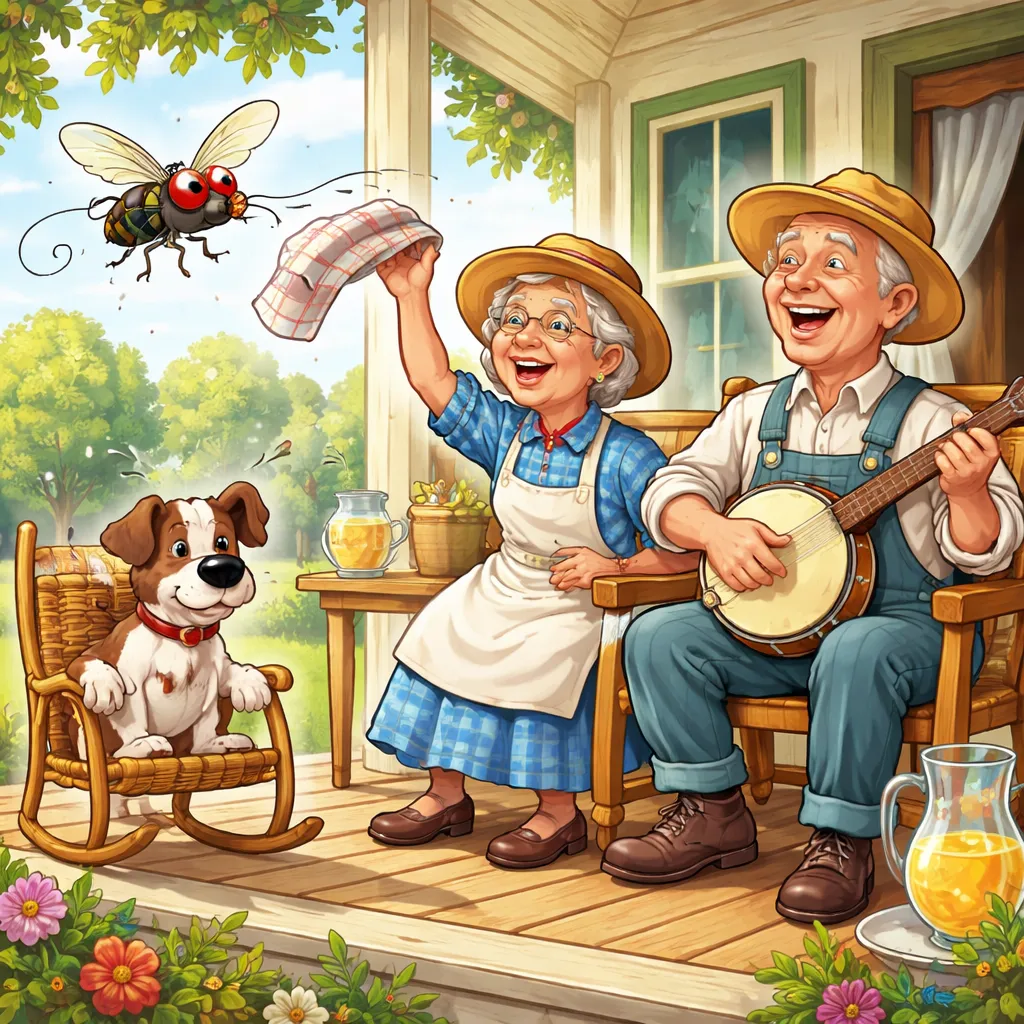

Have you ever been trying to enjoy a nice snack or a quiet moment, and a pesky fly just won’t leave you alone? It buzzes around your head, lands on your food, and is generally a big nuisance. What do you do? You wave your hand and say, “Shoo!” A long, long time ago, someone made a very silly, bouncy song about exactly that feeling. Let’s learn about the comical song “Shoo Fly, Don’t Bother Me.”
About the Song
Let’s read the funny, repetitive words of this classic tune.
Shoo fly, don’t bother me,
Shoo fly, don’t bother me,
Shoo fly, don’t bother me,
For I belong to somebody.
I do, I do, I do, I do,
I do belong to somebody.
I feel, I feel, I feel, I feel,
I feel like a morning star.
I do, I do, I do, I do,
I do belong to somebody.
This song is a traditional American song, first published in 1869. The music was written by Billy Reeves, and the lyrics were written by T. Brigham Bishop. It became extremely popular in the late 19th century as a minstrel show song. The song is a simple, repetitive complaint addressed directly to a fly. The singer tells the fly to go away (“shoo”) and not to bother them. The reason given is funny and mysterious: “For I belong to somebody.” The verses that follow are playful and nonsensical, with the singer repeating “I do” and saying they feel “like a morning star.” The song is lighthearted, silly, and perfect for singing with big, dramatic gestures.
What the Song is About
The song paints a picture of someone who is very annoyed by a fly. The singer is talking right to the insect. They say, “Shoo fly, don’t bother me,” not once, but three times in a row! This shows how persistent the fly is and how frustrated the singer feels.
Then, the singer gives a reason for wanting to be left alone: “For I belong to somebody.” This is a playful way of saying, “I’m important! I’m not for you to bother!” The next verses are just for fun, with the singer happily declaring “I do, I do” and comparing themselves to a bright, shining “morning star.” The song doesn’t tell a real story. Instead, it captures a single, everyday moment of annoyance and turns it into a funny, boastful, and catchy tune that makes you want to wave your hands and sing along.
Who Made It & Its Story
The song “Shoo Fly, Don’t Bother Me” was written by T. Brigham Bishop (lyrics) and Billy Reeves (music) in 1869. It was originally performed in minstrel shows, a popular form of entertainment in the 19th century that we now understand was based on racist stereotypes. Over time, the song was separated from that context and became a standard children’s song because of its incredibly catchy and silly nature. It was a hit during the Spanish-American War as a marching tune and has been used in countless cartoons, movies, and school music classes. Its simple, repetitive structure made it easy to remember and fun for generations of children.
This song has remained a favorite for three silly reasons. First, its melody is incredibly catchy, bouncy, and easy to sing, making it impossible not to join in. Second, it is about a universal, relatable experience that every child understands—being bothered by a pesky insect. Third, it is a perfect action song. The word “shoo” just makes you want to wave your hands, which adds a fun physical element to the singing.
When to Sing It
This song is perfect for playful, active moments. You can sing it loudly while waving your hands in the air, pretending to shoo away an imaginary fly. You can chant it during a picnic if a real fly shows up, turning an annoyance into a game. You can also sing it as a silly, marching song with your family, stomping your feet and shouting “I do! I do!”
What Children Can Learn
This simple, playful song is a fun teacher about language and music. Let’s see what we can learn.
Vocabulary
The song teaches us action and descriptive words. “Shoo” is an exclamation used to scare away animals or pests. A “fly” is a small, flying insect. To “bother” someone means to annoy or disturb them. “Somebody” means a person, but not a specific named person. A “morning star” is the planet Venus, which looks like a bright star in the early morning sky.
Let’s use these words! You can say, “I had to shoo the bird away from the bread.” Or, “Please do not bother the cat while it is sleeping.” New word: Pesky. This means annoying or troublesome. The fly in the song is very pesky.
Language Skills
This song is a great lesson in using the imperative mood for commands and the simple present tense for facts. The song is built on a command: “Shoo fly, don’t bother me.” This is a direct order given to the fly. “Don’t” is the contraction for “do not,” used to make a negative command.
The singer then states a fact in the present tense: “I belong to somebody.” This is saying something that is true. The verses use repetition for emphasis: “I do, I do” and “I feel, I feel.” This makes the statements stronger and more memorable.
Sounds & Rhythm Fun
Listen to the bouncy, marching, cheerful rhythm of the melody. The song is in a lively 2/4 or 4/4 time, which gives it a peppy, marching feel. The repetition of the main line three times makes it easy to remember. The lyrics have a clear, simple rhyme: “me” and “me,” “somebody” and “somebody,” “star” and “somebody.”
The rhythm is steady and upbeat. Try clapping on the beat: SHOO FLY, DON’T BOTH-er ME. The melody is based on a very simple, repeating pattern that is easy to learn. This simple, repetitive, and energetic musical pattern is what makes the song so infectious. You can write your own “don’t bother me” song! Use the same bouncy rhythm. Try: “Shoo mosquito, don’t bite me, shoo mosquito, don’t bite me, for I am trying to watch TV. I am, I am, I am, I am, I am trying to watch TV!”
Culture & Big Ideas
“Shoo Fly, Don’t Bother Me” is a classic piece of 19th-century American popular music. It comes from the minstrel show tradition, which is a complex and problematic part of American entertainment history. While we can enjoy the catchy tune today, it’s important to know where it came from. The song’s journey shows how music can change over time, moving from a specific type of show to a general children’s song. It connects to the universal human habit of making up silly songs about everyday irritations. The song is a reminder that even small, annoying things can inspire art and fun.
The song conveys three simple ideas. First, it’s about expressing annoyance in a playful way. Instead of just getting mad, the singer makes a song out of it, which can make the feeling easier to handle. Second, it expresses a sense of self-importance. Saying “I belong to somebody” is a funny way of standing up for yourself, even to a fly. Third, it highlights the joy of nonsense and repetition. The “I do, I do” verses don’t have to make deep sense; they are just fun to sing, showing that music can be playful and silly for its own sake.
Values & Imagination
Imagine the pesky fly. How does it buzz? In circles? How does it feel to have it near your ear? Now, imagine you are the singer. How do you say “shoo”? Do you stamp your foot? Do you wave a napkin? Draw a picture of the scene. Draw a very annoyed, funny-looking person with a big speech bubble that says, “SHOO FLY!” Draw a silly, smiling fly buzzing around their head. In the corner, draw a shining morning star to show how the singer feels inside—bright and important.
The song encourages us to handle small annoyances with humor, to be playful, and to stick up for ourselves in a funny way. A lovely idea is to have a “Shoo Silly” game. With your family, take turns pretending to be bothered by a silly imaginary pest (a buzzing bee, a chattering squirrel). The “bothered” person sings a made-up “shoo” song, and everyone else acts out the pest. This turns complaints into creative play.
So, as the last “I do” fades, think about the fun in this old tune. It is a vocabulary lesson in dealing with pests. It is a grammar lesson in giving commands. It is a music lesson in a bouncy, repetitive rhythm. From the first “shoo” to the final boast of being a morning star, it wraps lessons in playful expression, self-importance, and joyful nonsense in a tune that makes you want to march, shoo, and laugh. “Shoo Fly, Don’t Bother Me” teaches us that you can sing about your annoyances, that it’s okay to be silly, and that even a fly can inspire a song that lasts for over 150 years.
Your Core Takeaways
You are now an expert on the song “Shoo Fly, Don’t Bother Me.” You know it is a 19th-century American song about playfully telling a fly to go away. You’ve learned words like “shoo” and “bother,” and you’ve practiced the imperative mood for commands. You’ve felt its bouncy, marching rhythm and created your own silly verse. You’ve also discovered the song’s history and its messages about handling annoyances with humor, feeling self-important, and enjoying musical nonsense.
Your Practice Missions
First, stage a “Shoo Fly” drama. With your family, act out the song. One person is the singer, and another is the fly (buzzing and flying around). The singer must try to “shoo” the fly away with hand motions while singing. Swap roles! This makes the song a physical game.
Second, design a “Wanted Poster” for a silly pest. The fly in the song is a pest. Create a funny “Wanted” poster for an imaginary pest, like the “Giggle Gnat” or the “Ticklish Termite.” Draw a picture of it, describe its annoying crime, and offer a silly reward for its capture. Present your poster. This activity encourages creative thinking and storytelling based on the song’s theme.