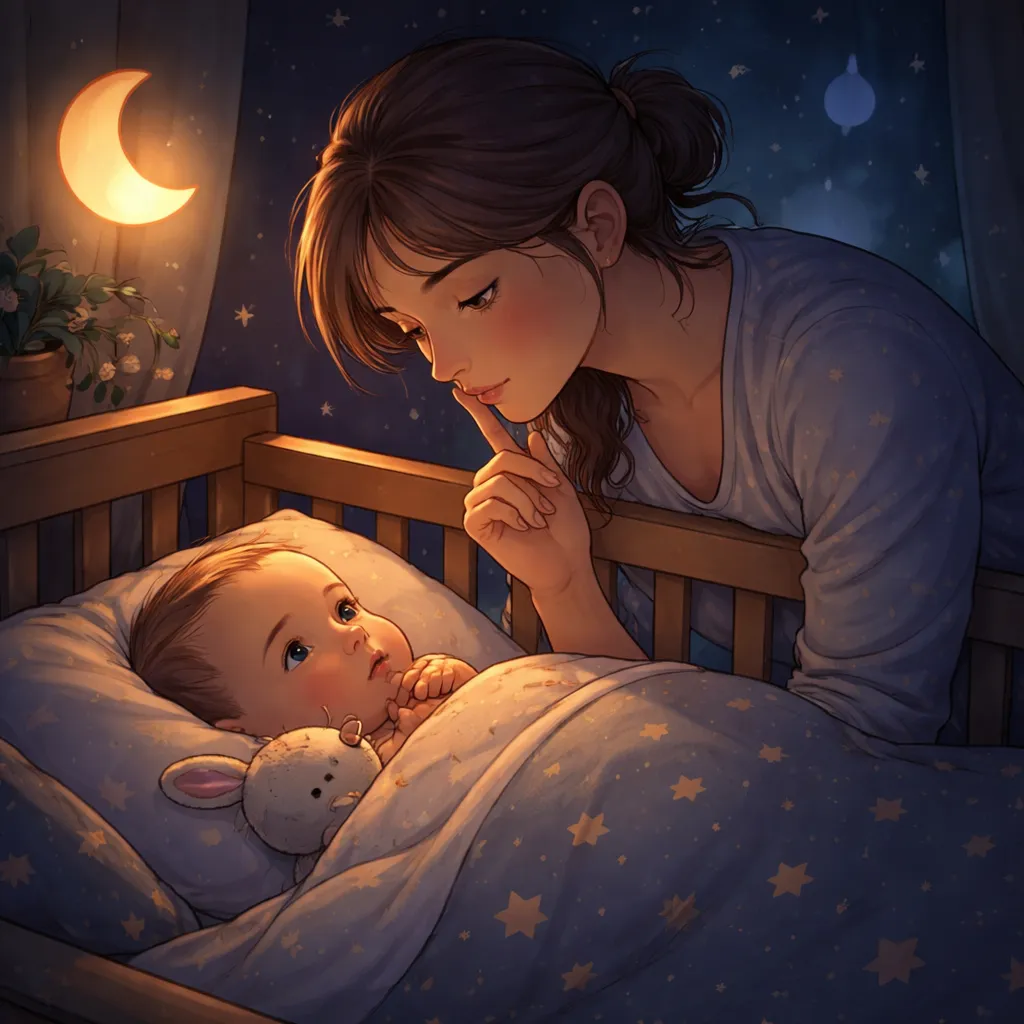

When the lights go out and shadows fill the room, sometimes a tear might escape. It’s a scary, lonely feeling. But then, a soft voice begins to sing, and the darkness feels a little safer. The oldest, simplest comfort is a song. Let’s learn about the gentle command of the lullaby “Hush-a-bye, Don’t You Cry.”
About the Song
Let’s read the soft, promising words of this classic bedtime song.
Hush-a-bye, don’t you cry,
Go to sleep, my little baby.
When you wake, you shall have
All the pretty little horses.
Blacks and bays, dapples and grays,
Coach and six white horses.
Hush-a-bye, don’t you cry,
Go to sleep, my little baby.
This song is a traditional American lullaby, often called “All the Pretty Little Horses.” It is a slow, rhythmic promise sung to soothe a fussy or crying child. The song’s origins are in the Southern United States of the 19th century, with roots in African American communities. It is believed to have been sung by caregivers, often enslaved women, to the children in their care. The song directly addresses a child’s fear and sadness, first with a gentle command to be quiet and sleep, and then with the magical reward of a beautiful dream about horses. It is a perfect example of a lullaby using both authority and imagination to create calm.
What the Song is About
The song paints a picture of a caregiver’s loving strategy. A child is upset, crying in the dark. The caregiver leans close and sings the first, most important instruction: “Hush-a-bye, don’t you cry.” This is a soft, firm request for quiet. The next instruction is the goal: “Go to sleep, my little baby.”
But the song knows that just being told to be quiet isn’t always enough. So, it offers a wonderful trade. If you go to sleep now, then when you wake up, you will receive a gift. The gift is a vision: “All the pretty little horses.” The singer describes this gift in beautiful detail—horses of every color, and even a grand coach pulled by six white horses. The song ends by repeating the initial gentle command, wrapping the child in the same comforting words, now filled with the hope of the promised dream.
Who Made It & Its Story
“Hush-a-bye, Don’t You Cry” is a traditional folk lullaby, so its original author is unknown. It was passed down orally for generations before being first published in 1927 by folklorist Dorothy Scarborough. The song comes from the complex cultural landscape of the pre-Civil War American South. Its simple, powerful structure—a command followed by a lavish promise—made it effective and memorable. The song traveled from family to family, becoming a standard lullaby, recorded by countless artists. It stands as a testament to the universal need to comfort a child, transcending its specific historical origins.
This lullaby has endured for three powerful reasons. First, its melody is incredibly slow, repetitive, and soothing, naturally slowing a child’s breathing and heart rate. Second, its lyrics masterfully combine a gentle command (“hush”) with a positive distraction (the “pretty little horses”), addressing both the behavior and the emotion behind it. Third, it carries a deep emotional resonance of care and protection, a feeling that connects every caregiver and child through time.
When to Sing It
This song is perfect for any moment that needs calm and comfort. You can sing it very softly at a younger sibling’s bedside, gently rocking them. You can hum it quietly to yourself when you feel worried or sad, as a way to self-soothe. You can also sing it slowly while cuddling a favorite stuffed animal, pretending to be the caregiver helping your toy find peace.
What Children Can Learn
This gentle, poetic song is a quiet classroom of lessons. Let’s explore what it teaches.
Vocabulary
The song teaches us tender, descriptive words. “Hush-a-bye” is an old, gentle way to say “be quiet” or “hush.” “Pretty” means beautiful and pleasant to look at. “Blacks and bays” refers to black horses and bay (reddish-brown) horses. “Dapples” are horses with coats marked with round spots. “Grays” are horses with gray coats. A “coach” is a large, enclosed horse-drawn carriage. “Six white horses” describes a team of six white horses, a sign of grandeur.
Let’s use these words! You can say, “The pretty flowers bloomed in the garden.” Or, “The dapple-gray pony trotted in the field.” New word: Soothe. This means to gently calm someone. The lullaby is meant to soothe.
Language Skills
This song is a wonderful lesson in using the imperative mood for gentle commands and the future tense to make a promise. The song starts with imperative verbs that give soft, direct instructions: “Hush-a-bye, don’t you cry, Go to sleep.”
It then uses the future tense, with the formal “shall,” to state a guaranteed promise: “you shall have all the pretty little horses.” This “if-then” structure (if you sleep, then you get this) is a simple, powerful way to make a deal. The song also uses adjectives to create vivid images: “pretty little horses,” “white horses.”
Sounds & Rhythm Fun
Listen to the slow, swaying, rocking rhythm of the melody. The song uses repetition to create a hypnotic, calming effect. The first two lines are repeated at the end, like a peaceful circle closing. The lyrics have a gentle, comforting rhyme: “cry” and “baby,” “have” and “horses,” “bays” and “grays,” “horses” and “horses.”
The rhythm is a slow, steady 6/8 time, which feels like the rocking of a cradle or a chair. Try a slow, gentle sway: HUSH-a-BYE, DON’T you CRY. The melody uses a small range of notes and moves up and down smoothly, like a gentle wave. This slow, repetitive, and predictable musical pattern is what makes the song so effective for lulling someone to sleep—it gives the mind a simple, beautiful focus. You can write your own soothing song! Use the same swaying rhythm. Try: “Hush now, dry your eyes so bright, go to sleep, my dear tonight. When you wake, you’ll see a sight, all the twinkling stars so light. Reds and golds, and silver moons, dancing to the night’s sweet tunes.”
Culture & Big Ideas
“Hush-a-bye, Don’t You Cry” is a classic piece of American folk culture, specifically from the lullaby tradition. It reflects the universal human practice of using song, rhythm, and promise to guide children from distress to rest. Its suspected origins in the complex relationships of the pre-Civil War South add a layer of historical depth, showing how the fundamental act of care persists even in difficult circumstances. The song is a testament to the nurturing power of the human voice.
The song conveys three profound ideas. First, it’s about emotional regulation through structure. The song provides a clear sequence: stop crying, go to sleep, receive a reward. This structure helps a child manage big feelings. Second, it celebrates the power of imagination as a tool for comfort. The singer doesn’t just say “stop”; they redirect the child’s mind to a beautiful, peaceful dream. Third, it’s about the loving authority of a caregiver. The singer is gently in charge, using their voice to create a safe container for the child’s emotions, building essential trust.
Values & Imagination
Imagine you are the child hearing this song. What does the caregiver’s voice sound like? Warm and low? What does the room look like? Is it lit by a small lamp? Now, imagine the promised dream. Picture the field where the pretty little horses are. What do their coats feel like? Silky? How do they move? Gracefully? Imagine the “coach and six white horses.” Is it made of glass? Gold? Who is inside? Draw a picture of the moment before the dream. Show the child in bed, tears drying, and the caregiver singing. From the child’s mind, draw a thought bubble that shows the beginning of the horse dream. This shows the song’s power to change thoughts.
The song inspires us to be comforting and to use creative promises for good. A lovely idea is to create a “Comfort Box.” With your family, decorate a small box. Inside, place small items that promise comfort: a smooth stone, a drawing of a happy place, a favorite joke. When someone is sad, they can open the box. It’s a physical version of the song’s promise, offering a “pretty” thought to replace a sad one.
So, as the last “my little baby” whispers into silence, think about the quiet power of this old song. It is a vocabulary lesson in beauty and calm. It is a grammar lesson in gentle commands and future promises. It is a music lesson in a slow, swaying rhythm. From the first “hush” to the final image of white horses, it wraps a lesson in emotional care, imaginative redirection, and protective love in a melody that feels like a soft blanket for the soul. “Hush-a-bye, Don’t You Cry” teaches us that words can be a gentle guide, that dreams are tools we can use, and that the simplest songs often hold the deepest wisdom for healing a heart.
Your Core Takeaways
You are now an expert on the lullaby “Hush-a-bye, Don’t You Cry.” You know it is a traditional American song, also known as “All the Pretty Little Horses,” used to soothe children with a promise of beautiful dreams. You’ve learned descriptive words like “bay” and “dapple,” and you’ve practiced using gentle commands and future promises. You’ve felt its slow, rocking rhythm and created your own soothing verse. You’ve also discovered the song’s role in caregiving and its messages about managing emotions, using imagination for comfort, and the loving authority of a protector.
Your Practice Missions
First, be a “Soothing Sound Scientist.” The next time you or someone in your family feels upset, try the song’s method. First, offer a gentle, calm command like “Let’s take a deep breath.” Then, promise a pleasant distraction: “After we breathe, let’s read one page of your favorite book.” See if the structure helps change the mood. Talk about how it felt.
Second, design a “Dream Coupon Book.” The song promises a dream of horses. Make a small book of “Dream Coupons” for a family member. Each coupon can promise a different good dream or happy thought, like “This coupon is good for one dream about flying” or “This coupon promises a dream of a cookie castle.” Draw a picture on each coupon. Give the book to someone as a gift of comfort, just like the song.